Imagine a busy city where garbage trucks collect large piles of waste while water supply vehicles distribute clean water to homes. Although both vehicles enter and leave the city, they carry very different materials for different purposes.
A similar process happens inside living cells. The difference between phagocytosis and pinocytosis lies in what the cell takes in and how it performs the task. Understanding the difference between phagocytosis and pinocytosis helps students, researchers, and healthcare professionals understand how cells survive, defend the body, and absorb nutrients.
If you are studying biology or preparing for competitive exams, learning the difference between phagocytosis and pinocytosis makes complex cellular processes much easier. This guide explains the difference between phagocytosis and pinocytosis in simple language with clear examples and comparisons.
Key Difference Between Phagocytosis and Pinocytosis
The primary difference between phagocytosis and pinocytosis is the type of material a cell absorbs.
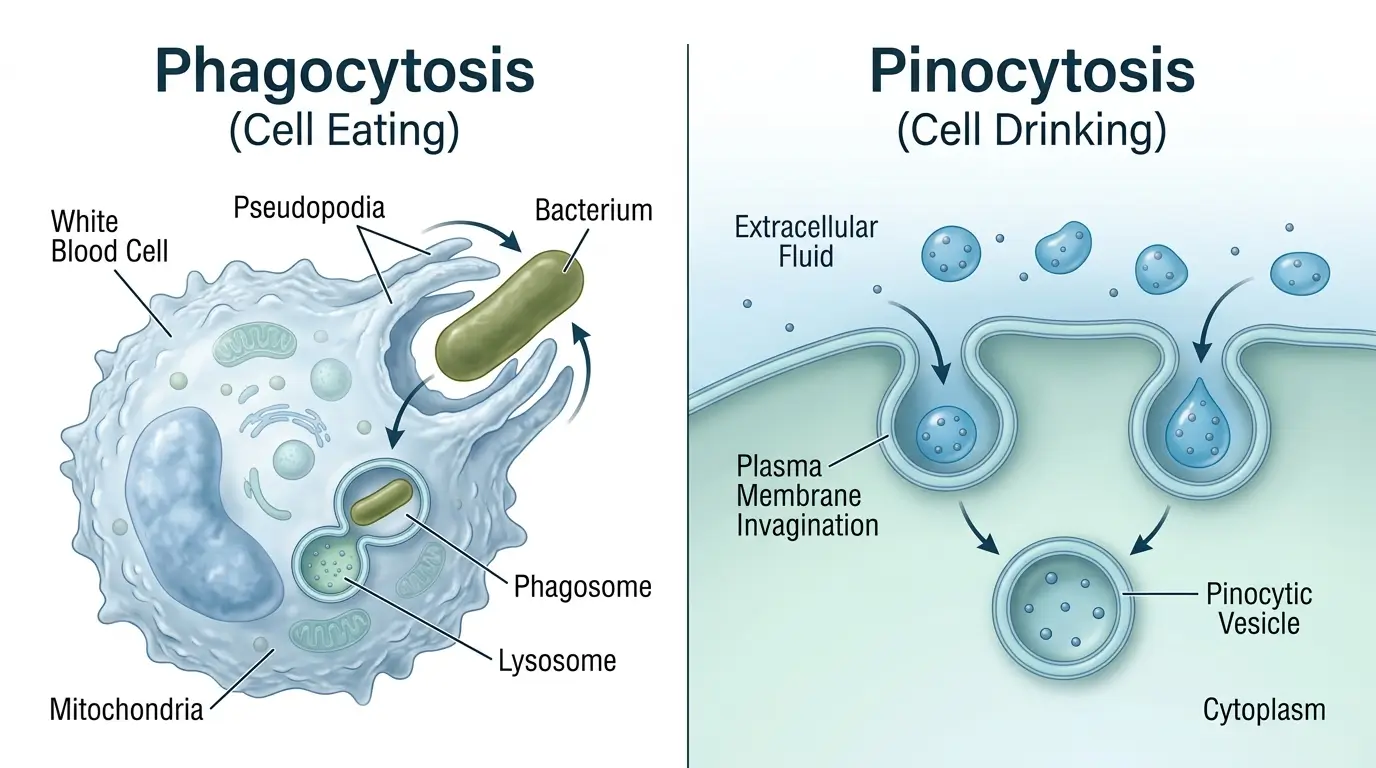
- Phagocytosis is the process by which a cell engulfs large solid particles, such as bacteria, dead cells, or food particles.
- Pinocytosis is the process by which a cell takes in liquids and dissolved substances, including nutrients, ions, and proteins.
In simple words:
- Phagocytosis = “Cell Eating”
- Pinocytosis = “Cell Drinking”
Why Is Their Difference Important for Learners and Experts?
Knowing the difference between these two cellular processes is important because they explain how living organisms survive, fight diseases, and absorb nutrients.
For students, understanding these concepts builds a strong foundation in biology, microbiology, physiology, and medicine. These topics frequently appear in school examinations, university courses, and competitive tests.
For researchers and healthcare professionals, phagocytosis explains how immune cells destroy harmful microorganisms, while pinocytosis helps explain how cells absorb nutrients, hormones, and medicines. This knowledge contributes to vaccine development, cancer research, drug delivery systems, tissue engineering, and disease treatment.
In society, these mechanisms play an indirect but vital role in improving public health, developing new medicines, and advancing modern biotechnology.
Pronunciation
| Term | US Pronunciation | UK Pronunciation |
| Phagocytosis | fag-oh-sy-TOH-sis (/ˌfæɡoʊsaɪˈtoʊsɪs/) | fag-oh-sy-TOH-sis (/ˌfæɡəʊsaɪˈtəʊsɪs/) |
| Pinocytosis | pie-noh-sy-TOH-sis (/ˌpaɪnoʊsaɪˈtoʊsɪs/) | pie-noh-sy-TOH-sis (/ˌpaɪnəʊsaɪˈtəʊsɪs/) |
From Basic Definitions to Real Cellular Functions
Now that you understand the basic meaning of both terms, let’s explore the detailed difference between phagocytosis and pinocytosis. The following sections compare their functions, mechanisms, examples, and biological importance through ten easy-to-understand points.
Difference Between Phagocytosis and Pinocytosis
1. Material Taken Into the Cell
Phagocytosis
Phagocytosis engulfs large solid particles such as bacteria, fungi, dead cells, and food particles.
Example 1: A white blood cell engulfs harmful bacteria.
Example 2: An amoeba captures food particles from pond water.
Pinocytosis
Pinocytosis absorbs liquids and dissolved substances from the surrounding environment.
Example 1: Intestinal cells absorb dissolved nutrients.
Example 2: Kidney cells take in dissolved proteins from body fluids.
2. Meaning of the Process
Phagocytosis
The word means “cell eating.” Cells consume large objects by surrounding them with the cell membrane.
Example 1: A macrophage eats a dead cell.
Example 2: A neutrophil engulfs invading bacteria.
Pinocytosis
The word means “cell drinking.” Cells continuously take in extracellular fluid.
Example 1: Cells absorb water containing minerals.
Example 2: Endothelial cells absorb dissolved molecules from blood plasma.
3. Size of the Vesicles Formed
Phagocytosis
Produces large vesicles, called phagosomes, because the particles are large.
Example 1: A phagosome enclosing a bacterium.
Example 2: A vesicle containing a fungal spore.
Pinocytosis
Forms small vesicles because only tiny droplets of fluid enter.
Example 1: Small vesicles carrying amino acids.
Example 2: Vesicles transporting dissolved glucose.
4. Type of Cellular Activity
Phagocytosis
It is a specialized cellular activity performed mainly by immune cells.
Example 1: Macrophages removing pathogens.
Example 2: Dendritic cells capturing foreign particles.
Pinocytosis
It is a continuous process occurring in almost all animal cells.
Example 1: Liver cells constantly absorbing nutrients.
Example 2: Blood vessel cells taking in surrounding fluid.
5. Purpose of the Process
Phagocytosis
Its primary purpose is protection and waste removal.
Example 1: Destroying bacteria during infection.
Example 2: Removing damaged tissue cells after injury.
Pinocytosis
Its main purpose is nutrient absorption and fluid regulation.
Example 1: Absorbing dissolved vitamins.
Example 2: Taking in hormones from extracellular fluid.
6. Energy Requirement
Phagocytosis
Requires a large amount of ATP because moving the membrane around large particles consumes significant energy.
Example 1: Macrophages attacking bacteria.
Example 2: Amoeba engulfing algae.
Pinocytosis
Also requires ATP but generally uses less energy because only small droplets are internalized.
Example 1: Nutrient uptake by epithelial cells.
Example 2: Continuous fluid absorption by endothelial cells.
7. Cell Types Performing the Process
Phagocytosis
Mostly occurs in specialized cells.
Example 1: Macrophages.
Example 2: Neutrophils.
Pinocytosis
Occurs in nearly all living animal cells.
Example 1: Liver cells.
Example 2: Kidney tubule cells.
8. Mechanism of Membrane Movement
Phagocytosis
The membrane extends pseudopodia, which surround and trap large particles.
Example 1: A macrophage surrounding bacteria.
Example 2: Amoeba extending pseudopods toward food.
Pinocytosis
The membrane folds inward, forming tiny pockets that pinch off into vesicles.
Example 1: Uptake of extracellular fluid.
Example 2: Internalization of dissolved nutrients.
9. Biological Importance
Phagocytosis
Essential for immune defense and tissue cleanup.
Example 1: Destroying disease-causing microbes.
Example 2: Clearing dead cells during healing.
Pinocytosis
Essential for cell nutrition and communication.
Example 1: Absorbing dissolved proteins.
Example 2: Internalizing signaling molecules.
10. Common Occurrence
Phagocytosis
Occurs only when needed, especially during infection or when debris must be removed.
Example 1: Fighting bacterial infections.
Example 2: Removing damaged tissue after injury.
Pinocytosis
Occurs continuously throughout a cell’s life.
Example 1: Regular nutrient absorption.
Example 2: Maintaining cellular fluid balance.
Nature and Behaviour of Both
Nature and Behaviour of Phagocytosis
Phagocytosis is a defensive and highly selective process. Cells actively recognize harmful microorganisms, damaged cells, or foreign particles before engulfing them. It mainly supports immunity by protecting the body from infections and maintaining tissue health. Because it targets large particles, the process requires extensive membrane movement and considerable energy.
Nature and Behaviour of Pinocytosis
Pinocytosis is a routine and non-selective process in which cells continuously sample the surrounding fluid. Instead of targeting large objects, it helps maintain nutrition, hydration, and chemical balance by absorbing water and dissolved substances. Since it occurs almost constantly in most cells, pinocytosis plays a vital role in normal cellular metabolism and overall physiological function.
Why Are People Confused About Their Use?
Many learners confuse phagocytosis and pinocytosis because both are types of endocytosis, a process in which cells bring substances inside through the cell membrane. Since both involve vesicle formation and require energy (ATP), they appear similar at first.
Another reason for the confusion is that their scientific names end with “-cytosis.” However, the prefixes explain their true meanings:
- Phago comes from a Greek word meaning “to eat.”
- Pino comes from a Greek word meaning “to drink.”
Textbooks often introduce these processes together, causing students to focus on their similarities rather than their differences. Remembering the phrases “cell eating” and “cell drinking” makes them much easier to distinguish.
Difference and Similarity Between Phagocytosis and Pinocytosis
| Feature | Phagocytosis | Pinocytosis |
| Meaning | Cell eating | Cell drinking |
| Material Taken In | Large solid particles | Liquids and dissolved substances |
| Vesicle Size | Large phagosomes | Small vesicles |
| Main Purpose | Defense and waste removal | Nutrient and fluid absorption |
| Occurs In | Specialized immune cells | Nearly all animal cells |
| Membrane Action | Uses pseudopodia | Membrane folds inward |
| Frequency | When needed | Continuously |
| Energy Requirement | High | Moderate |
| Selectivity | Usually selective | Mostly non-selective |
| Examples | Macrophages, neutrophils | Intestinal, kidney, endothelial cells |
Similarities
| Feature | Both Processes Share |
| Type | Both are forms of endocytosis. |
| Cell Membrane | Both involve the plasma membrane. |
| Energy | Both require ATP. |
| Vesicles | Both form membrane-bound vesicles. |
| Function | Both transport substances into cells. |
| Importance | Both are essential for cell survival and normal body functions. |
Which Is Better in What Situation?
Phagocytosis
Phagocytosis is better when the body needs protection against harmful microorganisms or must remove large unwanted particles. During infections, immune cells such as macrophages and neutrophils engulf bacteria, viruses (indirectly by infected cells or particles), fungi, and dead cells. This process prevents disease from spreading and supports tissue repair. Without phagocytosis, the immune system would struggle to eliminate many pathogens and cellular debris.
Pinocytosis
Pinocytosis is better when cells need a constant supply of water, nutrients, proteins, hormones, and dissolved minerals. It allows cells to absorb extracellular fluid continuously, helping maintain normal metabolism and communication. Pinocytosis also contributes to the uptake of certain medicines and biological molecules, making it valuable in both normal physiology and modern medical treatments.
How the Keywords Are Used in Metaphors and Similes
Although phagocytosis and pinocytosis are scientific terms, writers and teachers sometimes use them metaphorically to simplify biological concepts.
Phagocytosis as a Metaphor
Meaning: Completely consuming, removing, or absorbing something.
Examples
- “The new corporation performed phagocytosis on smaller companies by acquiring them.”
- “Her curiosity showed phagocytosis, swallowing every new idea she encountered.”
Similes
- “The security team removed troublemakers like phagocytosis removing bacteria.”
- “The cleaning crew worked like macrophages performing phagocytosis.”
Pinocytosis as a Metaphor
Meaning: Slowly absorbing knowledge, emotions, or experiences.
Examples
- “Children learn through pinocytosis, taking in tiny pieces of information every day.”
- “She absorbed the atmosphere of the city through pinocytosis, one experience at a time.”
Similes
- “The sponge absorbed water like pinocytosis in a living cell.”
- “He gathered knowledge like cells performing pinocytosis.”
Connotative Meaning of Both Keywords
| Keyword | Connotation | Explanation | Example |
| Phagocytosis | Mostly Positive | Protection, defense, cleanup | “White blood cells use phagocytosis to destroy bacteria.” |
| Phagocytosis | Occasionally Negative (figurative) | Total domination or consumption | “The large company phagocytosed its competitors.” |
| Pinocytosis | Neutral to Positive | Gradual absorption and nourishment | “Cells use pinocytosis to absorb nutrients.” |
| Pinocytosis | Positive (figurative) | Continuous learning | “She absorbed new skills through intellectual pinocytosis.” |
Idioms or Proverbs Related to the Words
There are no standard English idioms or proverbs containing the scientific terms phagocytosis or pinocytosis.
However, these common expressions convey similar ideas.
Related to Phagocytosis
- Swallow something whole
- He swallowed the false story whole without questioning it.
- Clean house
- The manager cleaned house after discovering fraud.
- Eat away at
- Stress can eat away at your confidence.
Related to Pinocytosis
- Soak up knowledge
- Young students soak up knowledge very quickly.
- Drink in the scenery
- The tourists drank in the beautiful mountain views.
- Absorb like a sponge
- She absorbs new languages like a sponge.
Works in Literature Featuring the Keywords
Because phagocytosis and pinocytosis are scientific concepts rather than literary themes, they mainly appear in educational and scientific publications.
Phagocytosis
- “The Wonderful Adventures of Mrs. Seacole in Many Lands” (Historical references to immunity are indirect, not the term itself.)
- “The Cell” – Molecular Biology textbook, Geoffrey M. Cooper, Biology, 1997
- “Molecular Biology of the Cell” – Bruce Alberts et al., Cell Biology, 1983 (multiple later editions)
- “Essential Cell Biology” – Bruce Alberts et al., Educational Biology, 1998
Pinocytosis
- “Molecular Biology of the Cell” – Bruce Alberts et al., Cell Biology, 1983
- “Essential Cell Biology” – Bruce Alberts et al., Educational Biology, 1998
- “Cell and Molecular Biology” – E. D. P. De Robertis, Biology Textbook, 1980
Movies and Documentaries Related to the Keywords
There are no major feature films specifically titled “Phagocytosis” or “Pinocytosis.” However, these documentaries explain the concepts.
Related to Phagocytosis
- The Inner Life of the Cell (2006, United States)
- Journey to the Microcosmos (educational documentary series, United States, ongoing)
Related to Pinocytosis
- The Inner Life of the Cell (2006, United States)
- Secret Universe: The Hidden Life of the Cell (2012, United Kingdom)
Frequently Asked Questions (FAQs)
1. What is the main difference between phagocytosis and pinocytosis?
Phagocytosis engulfs large solid particles, while pinocytosis absorbs liquids and dissolved substances.
2. Are both forms of endocytosis?
Yes. Both processes are types of endocytosis because they move substances into the cell using membrane-bound vesicles.
3. Which process is called cell eating?
Phagocytosis is known as cell eating because it engulfs large particles.
4. Which process is called cell drinking?
Pinocytosis is called cell drinking because it takes in extracellular fluid and dissolved molecules.
5. Do both processes require energy?
Yes. Both require ATP because vesicle formation and membrane movement are active cellular processes.
How Both Are Useful for Our Surroundings
Phagocytosis and pinocytosis contribute significantly to the health of living organisms and ecosystems.
Phagocytosis helps maintain healthy tissues by removing dead cells, harmful microorganisms, and foreign particles. This supports strong immune systems in humans and animals and reduces the spread of infections.
Pinocytosis enables cells to absorb nutrients, maintain fluid balance, and respond to chemical signals. It supports growth, tissue repair, and normal body functions. Researchers also use knowledge of pinocytosis to design targeted drug delivery systems and improve treatments for diseases.
Together, these processes sustain life, advance medical research, and improve public health.
Final Words
Although phagocytosis and pinocytosis are both forms of endocytosis, they serve different purposes. Phagocytosis protects the body by engulfing large harmful particles, whereas pinocytosis continuously absorbs fluids and dissolved nutrients. Understanding their differences provides a clearer picture of how cells survive, communicate, and defend living organisms.
Conclusion
The difference between phagocytosis and pinocytosis is a fundamental concept in cell biology. While both processes allow cells to take in substances from their surroundings, they differ in the type of material absorbed, the mechanism involved, and their biological roles.
Phagocytosis specializes in engulfing large solid particles for defense and cleanup, whereas pinocytosis continuously absorbs fluids and dissolved molecules to support nutrition and cellular balance.
Learning these concepts benefits students, educators, researchers, and healthcare professionals alike. By understanding how these two processes work together, we gain a deeper appreciation of the remarkable efficiency of living cells and the complex systems that sustain life.

Dr. Marcus Reed is a lead editorial author at WordCompares.com and a specialist in communication studies and written clarity. With more than 12 years of university-level teaching experience, he focuses on explaining word distinctions in a clear and structured manner. His work ensures that WordCompares.com maintains accuracy, depth, and reader trust.