Imagine a young entrepreneur who takes a loan of $20,000 to start a small business. A year later, she notices that the amount she owes is more than the original loan.
The extra amount is called interest, while the original borrowed amount is known as the principal. This simple example highlights the difference between principal and interest, a concept that affects millions of people every day.
Understanding the difference between principal and interest is essential whether you are taking a mortgage, paying off student debt, or investing money. Many people hear these financial terms regularly but do not fully understand how they work together.
The difference between principal and interest determines how loans are repaid and how investments grow. Learning the difference between principal and interest can help individuals make smarter financial decisions and manage money more effectively.
Pronunciation of Principal and Interest
| Word | US Pronunciation | UK Pronunciation |
| Principal | /ˈprɪn.sə.pəl/ | /ˈprɪn.sɪ.pəl/ |
| Interest | /ˈɪn.trəst/ or /ˈɪn.trest/ | /ˈɪn.trəst/ |
Key Difference Between Principal and Interest
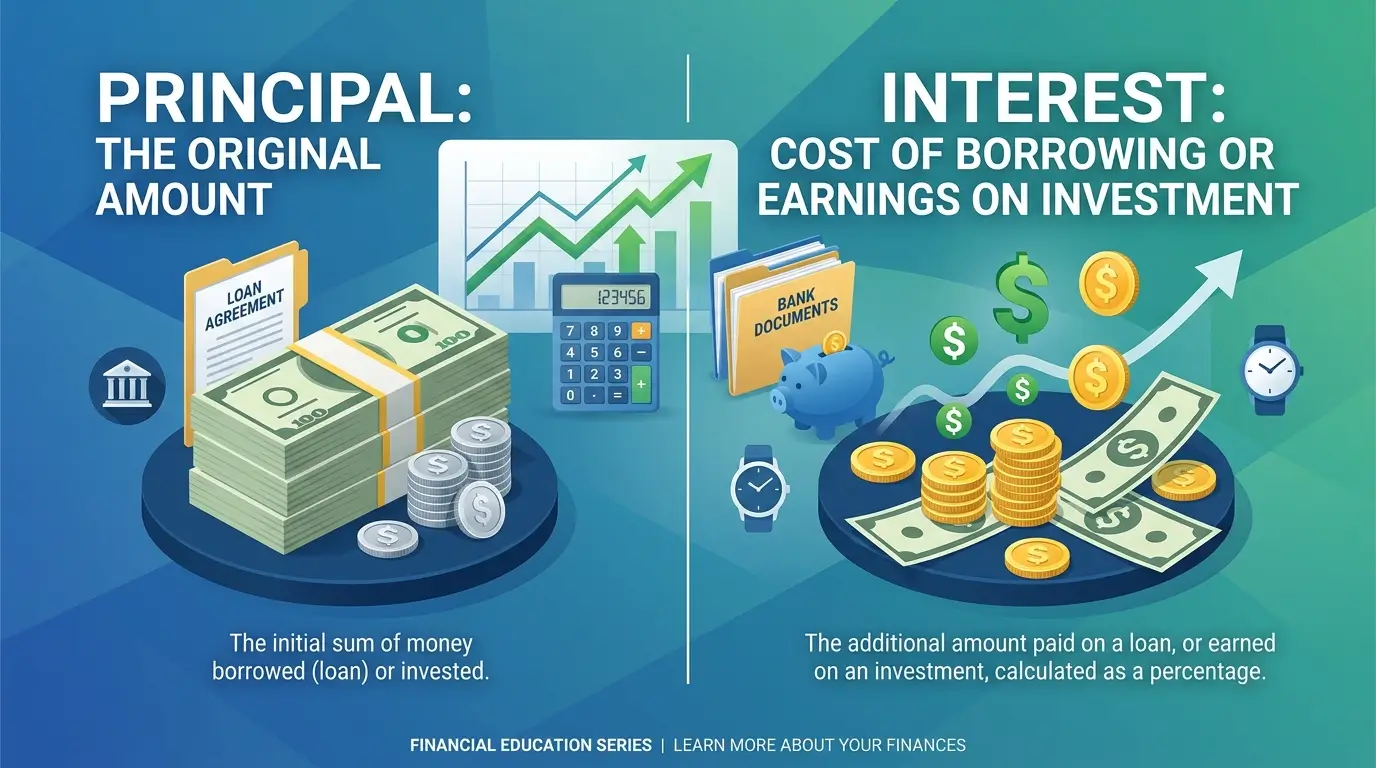
The principal is the original amount of money borrowed, lent, or invested. Interest is the additional amount charged or earned based on the principal over time.
For example, if you borrow $10,000 from a bank, the $10,000 is the principal. If the bank charges $500 for using that money, the $500 is the interest.
Why Is Their Difference Necessary to Know for Learners and Experts?
Understanding principal and interest is important because these concepts influence personal finance, business operations, banking systems, and investment decisions.
Students need this knowledge to understand loans and savings accounts. Homebuyers must know how mortgage payments are divided. Investors use principal and interest calculations to estimate profits. Financial experts rely on these concepts to assess risk and create investment strategies.
In modern society, understanding these terms helps people avoid debt problems, compare loan offers, and build wealth more effectively.
Linking Hook
Now that we understand the basic meaning of these financial terms, let’s explore the difference between principal and interest in greater detail and see how they affect everyday financial activities.
Difference Between Principal and Interest
1. Definition
Principal
Principal is the original amount borrowed or invested.
Examples:
- A student borrows $15,000 for education.
- An investor deposits $5,000 into a savings account.
Interest
Interest is the cost of borrowing or the reward for lending money.
Examples:
- A bank charges $1,000 interest on a loan.
- A savings account earns $200 interest annually.
2. Purpose
Principal
Represents the base financial amount.
Examples:
- Mortgage loan amount.
- Initial business investment.
Interest
Compensates lenders or rewards investors.
Examples:
- Credit card charges.
- Savings account earnings.
3. Time Dependency
Principal
Exists regardless of time.
Examples:
- $10,000 borrowed today.
- $10,000 invested today.
Interest
Depends on the passage of time.
Examples:
- One year of loan charges.
- Five years of investment returns.
4. Financial Role
Principal
Forms the foundation of a loan or investment.
Examples:
- Home mortgage amount.
- Startup capital.
Interest
Represents financial growth or borrowing cost.
Examples:
- Loan fees.
- Investment earnings.
5. Calculation
Principal
Usually predetermined.
Examples:
- Fixed loan amount.
- Initial deposit amount.
Interest
Calculated as a percentage of principal.
Examples:
- 5% mortgage rate.
- 3% savings account return.
6. Impact on Borrowers
Principal
Must be repaid eventually.
Examples:
- Student loan balance.
- Car loan balance.
Interest
Increases total repayment amount.
Examples:
- Additional mortgage cost.
- Credit card fees.
7. Impact on Investors
Principal
The original investment.
Examples:
- Purchasing bonds.
- Opening a fixed deposit.
Interest
The profit earned.
Examples:
- Bond coupon payments.
- Savings account returns.
8. Accounting Treatment
Principal
Recorded as the main liability or asset.
Examples:
- Loan balance.
- Investment capital.
Interest
Recorded as expense or income.
Examples:
- Interest expense.
- Interest revenue.
9. Risk Exposure
Principal
May be at risk in some investments.
Examples:
- Stock market losses.
- Business investments.
Interest
Depends on principal remaining intact.
Examples:
- Bond yields.
- Bank interest earnings.
10. Long-Term Effect
Principal
Determines future earning potential.
Examples:
- Larger investment amount.
- Higher down payment.
Interest
Determines growth or borrowing cost.
Examples:
- Compound interest gains.
- Long-term mortgage expenses.
Nature and Behaviour of Principal and Interest
Nature of Principal
Principal is stable and serves as the foundation of financial transactions. It represents ownership, debt, or investment capital.
Nature of Interest
Interest is dynamic and changes based on rates, time periods, and financial agreements. It can grow through compounding or accumulate as borrowing costs.
Why Are People Confused About Their Use?
People often confuse principal and interest because both are connected in financial transactions. Loan statements usually combine them into one payment. Additionally, interest is calculated using principal, making the terms appear closely related. The confusion increases when discussing mortgages, bonds, and savings accounts where both amounts interact continuously.
Difference and Similarity Between Principal and Interest
| Feature | Principal | Interest | Similarity |
| Meaning | Original amount | Additional amount | Both involve money |
| Purpose | Base amount | Cost or reward | Used in finance |
| Time Factor | Independent | Time-based | Related to transactions |
| Calculation | Fixed initially | Percentage-based | Financial values |
| Loan Role | Amount borrowed | Cost of borrowing | Part of repayment |
| Investment Role | Amount invested | Return earned | Affect wealth growth |
Which Is Better in What Situation?
When Principal Is Better
Principal is more important when building a financial foundation. Investors benefit from increasing principal because a larger base can generate greater future returns. Borrowers also benefit from reducing principal quickly because it lowers future interest costs.
In wealth-building strategies, growing principal is often the first priority because it creates opportunities for long-term financial growth.
When Interest Is Better
Interest becomes valuable when earning passive income from investments. Savers and investors appreciate interest because it increases wealth without additional effort. For lenders, interest is a primary source of income.
Compound interest is particularly powerful because it allows money to grow exponentially over time, making interest highly beneficial in long-term investment situations.
How the Keywords Are Used in Metaphors and Similes
Principal
Metaphors
- The principal is the seed of financial growth.
- Principal is the foundation of a money-building house.
Similes
- The principal is like the roots of a tree.
- The principal is like the engine of a car.
Interest
Metaphors
- Interest is the fruit of financial patience.
- Interest is the reward for letting money work.
Similes
- Interest grows like a snowball rolling downhill.
- Interest spreads like branches from a tree.
Connotative Meaning of Both Keywords
Principal
Positive
- Stability
- Foundation
- Ownership
Example: Building a strong principal creates future wealth.
Negative
- Large debt burden
Example: A huge principal loan can feel overwhelming.
Neutral
- Original amount
Example: The principal balance remains unchanged.
Interest
Positive
- Growth
- Reward
- Profit
Example: Compound interest helped her retirement fund grow.
Negative
- Debt expense
Example: High interest rates increased loan costs.
Neutral
- Financial charge or return
Example: Interest was calculated annually.
Idioms or Proverbs Related to the Words
Related to Interest
“Money makes money.”
Example: By investing wisely, she proved that money makes money through interest earnings.
“A penny saved is a penny earned.”
Example: Keeping money in a savings account showed that a penny saved is a penny earned.
Related to Principal
No widely recognized English idioms use “principal” directly, but related expressions include:
“Don’t eat your seed corn.”
Example: Investors should not spend their principal because it is their seed corn.
Works in Literature Containing the Keywords
Principal
- The Principal’s Office – Children’s Fiction – Gordon Korman – 2007
- The Principal Navigations – Travel Literature – Richard Hakluyt – 1589
Interest
- Interest of the State – Political Literature – Henry St. John – 1714
- Self-Interest Before All – Political Satire – Nikolai Leskov – 1877
Movies Containing the Keywords
Principal
- The Principal (1987, USA)
Interest
- Love and Other Interests (Various regional releases using the term “interest” in titles)
- Interest is less commonly used as a standalone movie title.
Frequently Asked Questions
1. What is the main difference between principal and interest?
Principal is the original amount borrowed or invested, while interest is the cost or reward associated with that amount.
2. Can interest exist without principal?
No. Interest is always calculated based on a principal amount.
3. Which should be paid first in a loan?
Many loan payments cover interest first and then reduce principal.
4. Why does principal reduction matter?
Reducing principal lowers future interest charges and shortens debt repayment.
5. How does compound interest affect principal?
Compound interest increases the total balance, allowing future interest to be earned on both principal and previous interest.
How Both Are Useful for Surroundings
Principal and interest support economic activity by enabling borrowing, lending, investing, and saving. Businesses use principal to expand operations, while banks earn interest for providing financial services. Individuals use loans to buy homes and vehicles, and investors use interest to build financial security. Together, they fuel economic growth and financial stability.
Final Words for Both
Principal represents the starting point of financial activity. It is the foundation upon which borrowing and investing are built.
Interest represents the movement and growth of money over time. It rewards savers and compensates lenders for risk and opportunity costs.
Conclusion
The difference between principal and interest is one of the most important concepts in personal finance and investing.
Principal refers to the original amount of money involved in a financial transaction, while interest represents the additional amount paid or earned over time. Although closely connected, they serve different purposes and affect financial outcomes in unique ways.
Understanding the difference between principal and interest helps borrowers reduce debt efficiently, allows investors to maximize returns, and enables individuals to make informed financial decisions.
Whether managing a mortgage, saving for retirement, or evaluating investment opportunities, knowing how principal and interest work together can lead to better financial success and long-term stability.

Dr. Marcus Reed is a lead editorial author at WordCompares.com and a specialist in communication studies and written clarity. With more than 12 years of university-level teaching experience, he focuses on explaining word distinctions in a clear and structured manner. His work ensures that WordCompares.com maintains accuracy, depth, and reader trust.