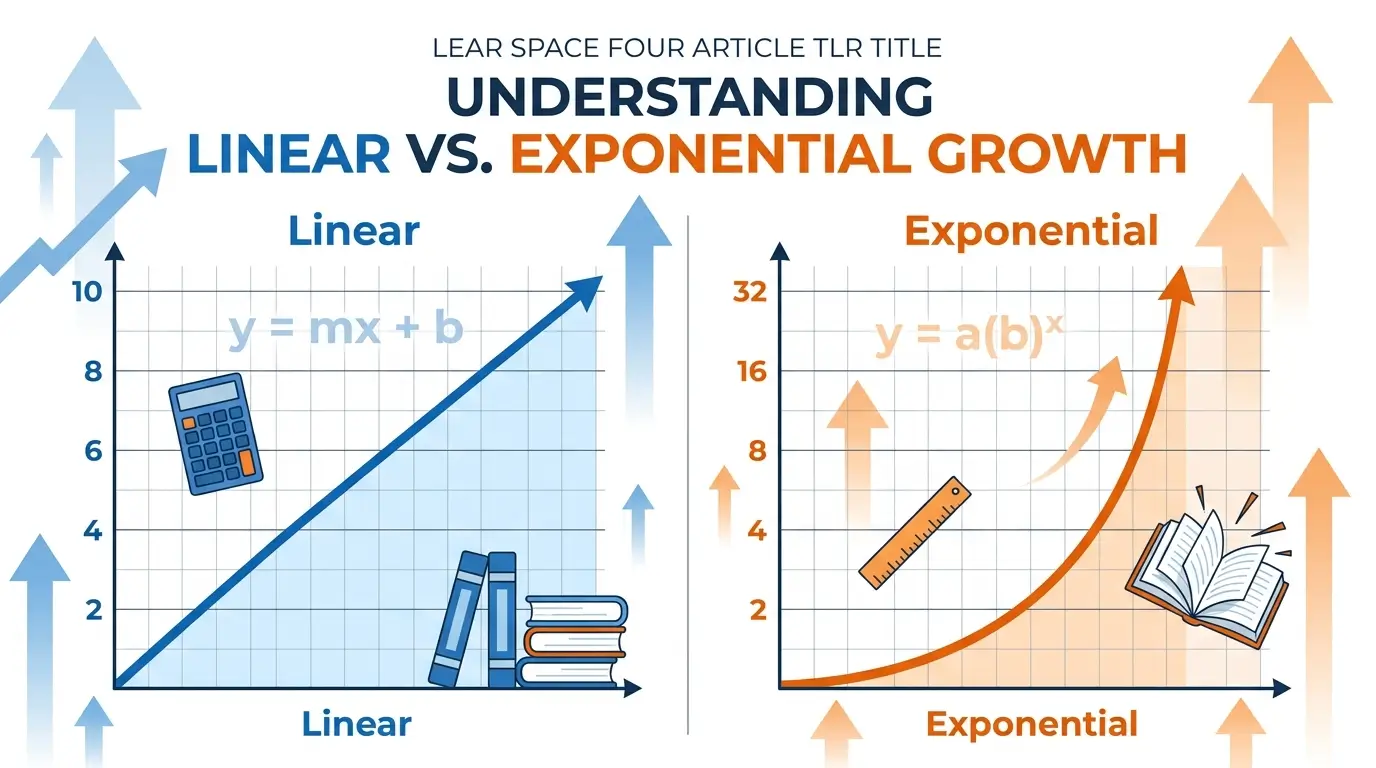
Imagine two friends deciding to save money. One saves $10 every week, while the other starts with $1 but doubles the amount every week. During the first few weeks, the first friend seems to save much more. However, after some time, the second friend’s savings increase dramatically. This simple story explains the difference between linear and exponential growth.
The difference between linear and exponential lies in how values change over time. A linear pattern grows or decreases by adding the same amount repeatedly. An exponential pattern grows or decreases by multiplying by the same factor repeatedly.
Understanding the difference between linear and exponential helps students solve mathematical problems, enables scientists to analyze data, and assists businesses in making smart financial decisions. If you are learning mathematics or studying economics, knowing the difference between linear and exponential is an essential skill.
Key Difference Between Linear and Exponential
The primary difference between linear and exponential is the pattern of change.
- Linear means the value changes by adding or subtracting a fixed amount over equal intervals.
- Exponential means the value changes by multiplying by a fixed percentage or factor over equal intervals.
Simply put, linear growth is steady, while exponential growth becomes faster and faster as time passes.
Why Is Their Difference Important for Learners and Experts?
Understanding the difference between linear and exponential is important because these concepts appear in almost every field of life.
Students use them to solve algebra and graphing problems. Scientists rely on exponential models to study population growth, radioactive decay, and disease spread. Economists use them to predict inflation and compound interest. Engineers analyze system performance, while environmental researchers use them to study climate changes.
Without understanding these concepts, it becomes difficult to interpret graphs, make predictions, or understand how real world systems behave. Knowing the correct model allows professionals to make accurate decisions that affect society, technology, healthcare, and business.
Pronunciation
| Word | US Pronunciation | UK Pronunciation |
| Linear | LIN ee er (/ˈlɪniər/) | LIN ee uh (/ˈlɪniə/) |
| Exponential | ek spoh NEN shəl (/ˌekspəˈnenʃəl/) | ek spuh NEN shəl (/ˌekspəˈnenʃəl/) |
Before comparing them in detail, let’s explore exactly how linear and exponential differ in mathematics, science, economics, and everyday life.
Difference Between Linear and Exponential
1. Rate of Change
Linear
Linear change adds or subtracts the same amount every time.
Example 1: A salary increases by $500 every year.
Example 2: A car travels 60 miles every hour.
Exponential
Exponential change multiplies by the same factor.
Example 1: Money in a savings account grows by 8% annually.
Example 2: A bacterial population doubles every hour.
2. Growth Pattern
Linear
Growth remains constant throughout the process.
Example 1: Walking 5 kilometers every day.
Example 2: Filling a container with one liter every minute.
Exponential
Growth becomes increasingly faster.
Example 1: Viral videos gaining millions of views.
Example 2: Computer processing power improving over decades.
3. Graph Shape
Linear
The graph forms a straight line.
Example 1: Distance traveled at constant speed.
Example 2: Weekly allowance increasing equally.
Exponential
The graph forms a curved line that becomes steeper.
Example 1: Population growth.
Example 2: Compound investment returns.
4. Mathematical Formula
Linear
General formula:
y = mx + b
Example 1: y = 3x + 2
Example 2: y = 7x − 4
Exponential
General formula:
y = a(b)^x
Example 1: y = 2(3)^x
Example 2: y = 100(1.05)^x
5. Speed of Growth
Linear
Growth speed stays the same.
Example 1: Saving $100 every month.
Example 2: Reading 20 pages daily.
Exponential
Growth accelerates over time.
Example 1: Compound interest.
Example 2: Chain reactions in chemistry.
6. Real Life Applications
Linear
Common where change is predictable.
Example 1: Hourly wages.
Example 2: Fixed monthly rent.
Exponential
Used where change compounds.
Example 1: Population increase.
Example 2: Virus transmission.
7. Prediction
Linear
Future values are easier to estimate.
Example 1: Utility bills with fixed increases.
Example 2: Monthly subscription costs.
Exponential
Long term predictions become more dramatic.
Example 1: Inflation over decades.
Example 2: Investment portfolios.
8. Initial Stage
Linear
Starts steadily and remains steady.
Example 1: Building a brick wall.
Example 2: Walking one mile every day.
Exponential
Begins slowly but later rises rapidly.
Example 1: Social media followers.
Example 2: Forest fire spread.
9. Long Term Outcome
Linear
Produces moderate increases.
Example 1: Regular salary increments.
Example 2: Daily exercise improvements.
Exponential
Can produce extremely large values.
Example 1: Cryptocurrency growth during booms.
Example 2: Pandemic infections.
10. Common Fields of Use
Linear
Frequently used in engineering, budgeting, and construction.
Example 1: Road construction measurements.
Example 2: Manufacturing schedules.
Exponential
Common in biology, finance, physics, and computer science.
Example 1: Radioactive decay.
Example 2: Artificial intelligence computing growth.
Nature and Behaviour of Linear and Exponential
Nature of Linear
Linear relationships are predictable, constant, and uniform. The amount of change remains the same over equal intervals. This makes linear models easy to understand and calculate.
Behaviour of Linear
- Changes at a constant rate.
- Produces a straight line graph.
- Easy to estimate future values.
- Suitable for situations where growth is stable.
- Rarely produces sudden or dramatic increases.
Nature of Exponential
Exponential relationships are dynamic, compounding, and accelerating. Instead of adding a fixed amount, they multiply by a constant factor.
Behaviour of Exponential
- Changes by a constant percentage or ratio.
- Produces a curved graph.
- Starts slowly but grows rapidly.
- Can increase or decrease dramatically.
- Becomes much larger than linear growth over time.
Why Are People Confused About Their Use?
Many learners confuse linear and exponential because both describe growth or decline over time. At first, exponential growth often looks similar to linear growth since the numbers increase slowly. However, after several intervals, exponential values rise much faster.
Another reason for confusion is that both concepts use graphs, equations, and tables. Students sometimes focus only on increasing numbers without checking If the increase is by a fixed amount (linear) or by a fixed percentage or factor (exponential).
A simple rule to remember is:
- Same amount added = Linear
- Same factor multiplied = Exponential
Difference and Similarity Between Linear and Exponential
| Feature | Linear | Exponential | Similarity |
| Rate of change | Constant amount | Constant factor | Both describe change over time |
| Graph | Straight line | Curved line | Both can be shown on graphs |
| Formula | y = mx + b | y = a(b)^x | Both use mathematical equations |
| Growth | Steady | Accelerating | Both may increase or decrease |
| Prediction | Easy | More complex | Both help predict future values |
| Real life use | Salary, distance, budgeting | Population, investments, bacteria | Both solve practical problems |
| Early growth | Uniform | Usually slow | Both begin from initial values |
| Long term result | Moderate | Often very large | Both model long term trends |
| Data analysis | Simple | More advanced | Both are used in statistics |
| Mathematics | Algebra | Algebra and calculus | Both are fundamental mathematical concepts |
Which Is Better in What Situation?
When Is Linear Better?
Linear models are better when change happens at a constant rate. They are ideal for calculating wages, budgeting monthly expenses, measuring distance traveled at constant speed, planning production schedules, and estimating regular savings. Because the rate never changes, linear models are simple, reliable, and easy to explain. Teachers often introduce linear relationships before exponential ones because they help learners understand the basics of mathematical modeling.
When Is Exponential Better?
Exponential models are better when growth or decay depends on multiplication rather than addition. They accurately describe compound interest, investment returns, population growth, radioactive decay, disease spread, and technological advancement. Although exponential models are more complex, they provide much more accurate predictions in situations where values grow or shrink by percentages instead of fixed amounts.
How Are the Keywords Used in Metaphors and Similes?
Linear in Metaphors
The word linear often symbolizes something straightforward, organized, or predictable.
Examples
- “Her career followed a linear path, with one promotion after another.”
- “His thinking was linear, focusing only on one solution.”
Linear in Similes
- “The road was as linear as a ruler.”
- “His explanation was as linear as a straight line.”
Exponential in Metaphors
The word exponential symbolizes rapid expansion or dramatic change.
Examples
- “Her confidence experienced exponential growth.”
- “The company’s success grew exponentially.”
Exponential in Similes
- “The excitement spread like an exponential curve.”
- “The audience grew like multiplying stars.”
Connotative Meaning
Linear
Positive
- Organized
- Predictable
- Stable
- Logical
Example:
“The project followed a linear plan that everyone understood.”
Negative
- Rigid
- Limited
- Uncreative
Example:
“His linear thinking prevented him from finding new ideas.”
Neutral
- Sequential
- Step by step
Example:
“The instructions were presented in a linear order.”
Exponential
Positive
- Powerful
- Fast growing
- Innovative
Example:
“The startup experienced exponential success.”
Negative
- Uncontrolled
- Overwhelming
- Explosive
Example:
“Exponential debt quickly became impossible to manage.”
Neutral
- Multiplicative
- Compounding
Example:
“The data followed an exponential pattern.”
Idioms or Proverbs Related to the Words
There are no common English idioms containing the exact words linear or exponential, but these expressions closely relate to their meanings.
1. Slow and steady wins the race.
(Relates to linear growth.)
Example:
“Saving a little every month proves that slow and steady wins the race.”
2. Rome wasn’t built in a day.
(Relates to gradual linear progress.)
Example:
“Learning mathematics takes time because Rome wasn’t built in a day.”
3. Snowball effect.
(Relates to exponential growth.)
Example:
“The rumor created a snowball effect across social media.”
4. Growing by leaps and bounds.
(Relates to exponential growth.)
Example:
“The company’s profits are growing by leaps and bounds.”
Works in Literature Related to the Keywords
Although few literary works use the exact words in their titles, several books focus on these mathematical concepts.
Linear
- Linear Algebra Done Right — Sheldon Axler (Mathematics, 1995)
- Elementary Linear Algebra — Howard Anton (Textbook, 1973)
- Introduction to Linear Algebra — Gilbert Strang (Educational, 1993)
Exponential
- Exponential Organizations — Salim Ismail, Michael S. Malone & Yuri van Geest (Business, 2014)
- The Exponential Age — Azeem Azhar (Technology, 2021)
- Exponential Living — Sheri Riley (Self help, 2017)
Movies Related to the Keywords
There are no major films titled exactly “Linear” or “Exponential.” However, these movies explore ideas closely connected to linear or exponential concepts.
Related to Linear Thinking
- Pi (1998, USA)
- A Beautiful Mind (2001, USA)
- The Man Who Knew Infinity (2015, UK/USA)
Related to Exponential Growth
- Contagion (2011, USA)
- The Social Network (2010, USA)
- Moneyball (2011, USA)
Frequently Asked Questions
1. What is the biggest difference between linear and exponential?
Linear changes by adding a constant amount, while exponential changes by multiplying by a constant factor.
2. Which grows faster?
Exponential growth eventually becomes much faster than linear growth.
3. Which graph is a straight line?
Linear relationships produce straight line graphs.
4. Where is exponential growth seen in everyday life?
It appears in compound interest, population growth, viral videos, technology, and disease spread.
5. Why should students learn both?
They help solve mathematical problems, analyze data, understand science, and make accurate predictions.
How Are Both Useful for Our Surroundings?
Linear and exponential models help people understand the world more accurately. Engineers use linear calculations when designing roads, bridges, and buildings. Businesses use linear models for budgeting and pricing. Scientists rely on exponential models to study climate change, population growth, and epidemics.
Financial institutions use exponential calculations for loans, savings, and investments. Together, these concepts improve planning, scientific research, environmental protection, and technological innovation.
Final Words
Linear and exponential relationships are among the most important mathematical concepts. Linear models represent steady and predictable change, while exponential models explain rapid and compounding change. Learning when to use each one allows students, professionals, and researchers to interpret information correctly and make informed decisions.
Conclusion
Understanding the difference between linear and exponential is essential for anyone who wants to study mathematics, science, business, or economics. Although both describe how quantities change over time, they do so in very different ways. Linear relationships grow by equal amounts, making them predictable and easy to understand.
Exponential relationships grow by equal factors, leading to rapid increases or decreases over time. Recognizing these patterns helps students solve problems accurately and enables professionals to make better predictions in finance, engineering, healthcare, and technology.
Once you understand the difference between linear and exponential, you will find it much easier to interpret graphs, analyze data, and understand many real world situations.

Dr. Marcus Reed is a lead editorial author at WordCompares.com and a specialist in communication studies and written clarity. With more than 12 years of university-level teaching experience, he focuses on explaining word distinctions in a clear and structured manner. His work ensures that WordCompares.com maintains accuracy, depth, and reader trust.