Imagine two employees starting new jobs at the same company. During orientation, both hear about health benefits, including an HRA and an FSA. One employee assumes they are the same because both help pay medical expenses. Months later, she discovers they work very differently, affecting how much money she can save and spend.
This simple situation shows why understanding the difference between HRA and FSA is so important. The difference between HRA and FSA lies in who owns the account, who contributes the money, and how the funds can be used.
Learning the difference between HRA and FSA helps employees choose the right healthcare benefits and avoid costly mistakes. Whether you are a new employee, an HR professional, or a business owner, knowing the difference between HRA and FSA can help you make informed financial and healthcare decisions.
Key Difference Between HRA and FSA
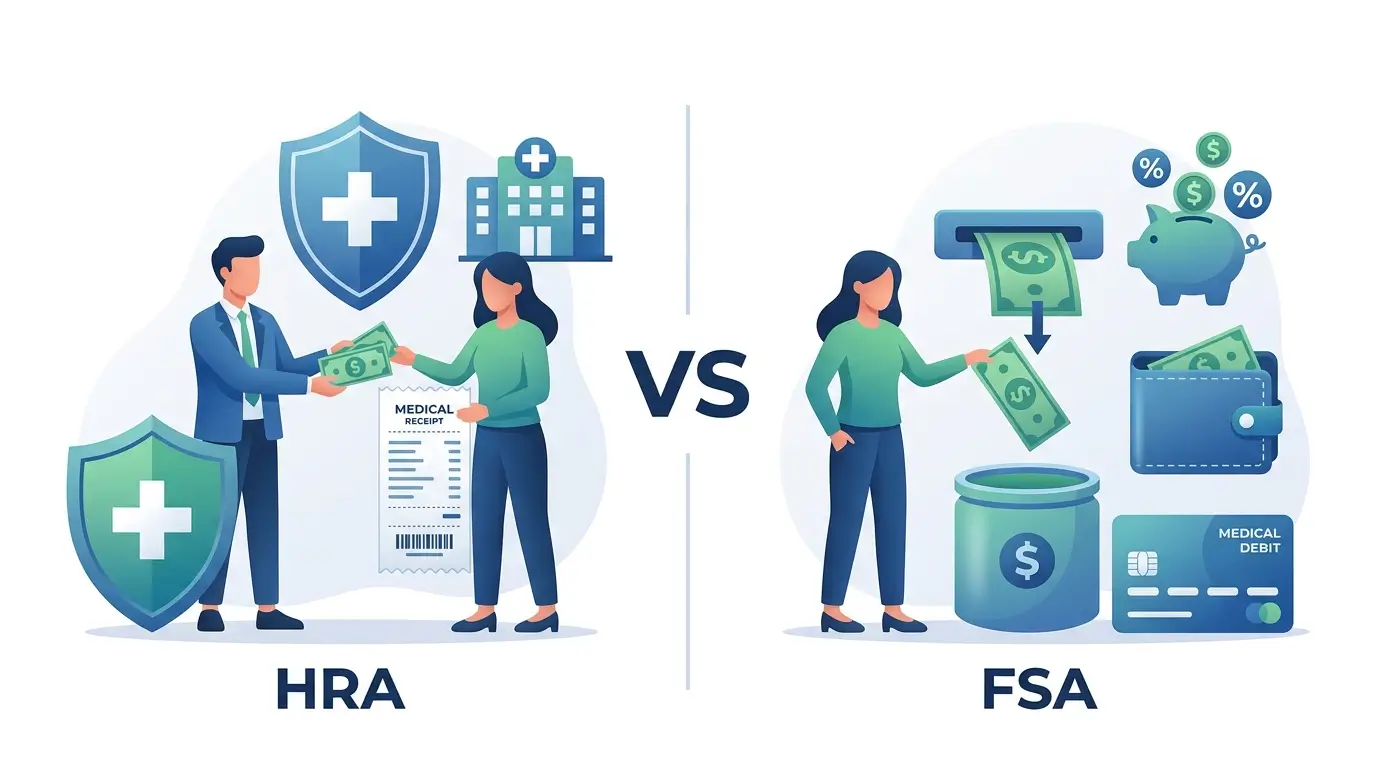
The primary difference between HRA and FSA is ownership and funding.
- HRA (Health Reimbursement Arrangement) is funded entirely by an employer. Employees are reimbursed for qualified medical expenses but do not own the account.
- FSA (Flexible Spending Account) is usually funded by employees through pre-tax payroll deductions, although employers may also contribute. Employees decide how much money to contribute within IRS limits.
In simple words:
- HRA = Employer’s money reimbursing employee expenses.
- FSA = Employee’s pre-tax money set aside for healthcare expenses.
Why Is Their Difference Necessary to Know for Learners and Experts?
Understanding the difference between HRA and FSA is valuable because healthcare costs continue to rise worldwide. Employees who understand these benefit plans can reduce out-of-pocket medical expenses and maximize tax savings.
For learners, this knowledge builds financial literacy and prepares them for future employment. Many graduates receive benefit packages without fully understanding them. Learning the differences early helps them make better workplace decisions.
For HR professionals, accountants, financial advisors, and business owners, knowing these plans ensures proper benefit administration, legal compliance, and employee satisfaction. Companies that educate employees about HRAs and FSAs often experience better benefit utilization and higher workplace morale.
Ultimately, understanding these accounts benefits individuals, employers, and society by encouraging responsible healthcare spending and better financial planning.
Pronunciation
HRA (Health Reimbursement Arrangement)
US Pronunciation:
/eɪtʃ ɑːr eɪ/
(H-A-R-A)
UK Pronunciation:
/eɪtʃ ɑː r eɪ/
FSA (Flexible Spending Account)
US Pronunciation:
/ef es eɪ/
(F-S-A)
UK Pronunciation:
/ef es eɪ/
Before We Compare Them in Detail
Now that you understand the basic meaning of these healthcare benefit plans, let’s explore the difference between HRA and FSA in greater detail. Although both help employees manage medical expenses and offer tax advantages, they differ in ownership, funding, flexibility, portability, and reimbursement rules. The following comparison explains each difference with simple language and practical examples.
Difference Between HRA and FSA
1. Source of Funding
HRA
An HRA is funded entirely by the employer. Employees cannot deposit their own money into the account. The employer determines the annual reimbursement amount.
Example 1:
ABC Company provides every employee with an HRA worth $2,500 for qualified medical expenses.
Example 2:
Sarah visits a doctor and pays $300. Her employer reimburses the expense through the HRA.
FSA
An FSA is primarily funded by the employee through pre-tax payroll deductions. Some employers also contribute additional funds.
Example 1:
John elects to contribute $2,000 from his salary into his FSA during open enrollment.
Example 2:
Maria contributes $100 from every paycheck to build her healthcare FSA.
2. Ownership of the Account
HRA
The employer owns the HRA. Employees receive reimbursements but never own the actual funds.
Example 1:
When Lisa leaves her company, her HRA remains with the employer.
Example 2:
David cannot transfer his HRA to his new employer.
FSA
The employee controls the money contributed through payroll deductions while employed under the plan.
Example 1:
Emily chooses how much money to contribute before the plan year begins.
Example 2:
Michael uses his FSA debit card to purchase eligible medical supplies.
3. Who Decides the Contribution Amount?
HRA
The employer decides how much money is available for employee reimbursements.
Example 1:
Company A offers each employee an annual HRA allowance of $1,800.
Example 2:
Another employer increases the reimbursement limit to $3,000 for families.
FSA
Employees choose their annual contribution amount during open enrollment, subject to legal contribution limits.
Example 1:
Rachel selects an annual FSA contribution of $1,500.
Example 2:
Kevin decides to contribute the maximum allowed amount for the upcoming year.
4. Tax Treatment
HRA
Employer reimbursements are generally tax-free to employees when used for qualified medical expenses.
Example 1:
Nancy receives a $500 reimbursement without paying income tax.
Example 2:
A reimbursement for prescription medication is excluded from taxable income.
FSA
Employee contributions reduce taxable income because they are deducted before taxes.
Example 1:
Chris contributes $2,000 before taxes, lowering his taxable salary.
Example 2:
Olivia saves money on federal income taxes through payroll deductions.
5. Availability of Funds
HRA
Employees can only receive reimbursement after paying eligible medical expenses and submitting proper documentation, depending on the employer’s plan rules.
Example 1:
Emma pays her hospital bill first and later receives reimbursement.
Example 2:
After buying prescription glasses, Daniel submits the receipt for reimbursement.
FSA
Most healthcare FSAs make the employee’s full annual elected contribution available at the beginning of the plan year, even though payroll deductions continue throughout the year.
Example 1:
Sophia elects to contribute $2,400 annually. She can use the full amount for surgery in January.
Example 2:
James uses his FSA card for a dental procedure early in the year while contributions continue from future paychecks.
6. Portability
HRA
An HRA usually stays with the employer. If an employee leaves the company, they generally lose access to the remaining balance unless the employer’s plan provides otherwise.
Example 1:
Emma resigns from her job and cannot take her HRA funds to her new employer.
Example 2:
After retirement, David loses access to his HRA because his employer’s plan does not continue coverage.
FSA
An FSA is also generally tied to employment. Employees typically lose unused funds when leaving a job, unless they continue coverage through applicable rules (such as certain continuation options).
Example 1:
John changes jobs in July and forfeits his unused FSA balance.
Example 2:
Sophia carefully spends her FSA funds before leaving her employer.
7. Eligible Expenses
HRA
Employers determine which qualified medical expenses are reimbursable, following applicable tax rules.
Example 1:
Rachel receives reimbursement for prescription medications.
Example 2:
Her employer also reimburses eligible vision care expenses.
FSA
An FSA can generally be used for a wide variety of qualified healthcare expenses defined under applicable tax regulations.
Example 1:
Michael purchases contact lenses using his FSA card.
Example 2:
Linda pays for dental fillings through her FSA.
8. Unused Funds
HRA
Whether unused HRA funds roll over depends on the employer’s plan design.
Example 1:
An employer allows unused HRA money to roll into the next year.
Example 2:
Another company resets HRA balances at the end of each plan year.
FSA
Healthcare FSAs are generally subject to a “use-it-or-lose-it” rule, although many plans may offer a limited grace period or allow a limited carryover if permitted by law.
Example 1:
Kevin forgets to spend his remaining FSA balance before the deadline.
Example 2:
Anna uses her remaining FSA money to purchase eligible medical supplies before year-end.
9. Flexibility
HRA
Employers decide the reimbursement rules, eligible expenses, and annual limits.
Example 1:
One company reimburses only medical insurance deductibles.
Example 2:
Another employer covers prescriptions, doctor visits, and vision care.
FSA
Employees choose how and when to spend their available balance on eligible expenses during the plan year.
Example 1:
Jennifer uses her FSA for orthodontic treatment.
Example 2:
Mark spends his FSA funds on approved over-the-counter medical products.
10. Best Suited For
HRA
An HRA is best for employees whose employers offer generous reimbursement benefits.
Example 1:
A small business fully reimburses employees for annual health expenses.
Example 2:
A nonprofit organization provides an HRA instead of increasing salaries.
FSA
An FSA is ideal for employees who expect regular healthcare expenses and want to reduce taxable income.
Example 1:
Parents budget for children’s medical expenses through an FSA.
Example 2:
An employee with regular prescription costs contributes to an FSA every year.
Nature and Behaviour
Nature of HRA
- Employer-owned benefit.
- Reimbursement-based.
- Employer-funded.
- Flexible according to company policy.
- Encourages employers to help employees with healthcare costs.
Behaviour of HRA
- Reimburses approved medical expenses.
- Cannot accept employee contributions.
- May allow unused balances to roll over depending on the employer’s plan.
- Ends when employment ends in many cases.
Nature of FSA
- Employee-funded benefit.
- Tax-saving account.
- Budgeting tool for healthcare expenses.
- Available through employer-sponsored benefit plans.
Behaviour of FSA
- Receives contributions through payroll deductions.
- Reduces taxable income.
- Encourages planned healthcare spending.
- May require unused funds to be forfeited unless the plan includes an allowed grace period or carryover.
Why Are People Confused About Their Use?
People often confuse HRAs and FSAs because both help pay qualified medical expenses and are commonly offered as employee benefits. Both provide tax advantages and are used for healthcare-related costs, making them appear similar at first glance.
The confusion increases because both involve employers, healthcare reimbursements, and IRS rules. However, the major distinctions involve ownership, funding, reimbursement methods, and plan flexibility. Once employees understand who contributes the money and who controls the account, the differences become much easier to remember.
Difference and Similarity Between HRA and FSA
| Feature | HRA | FSA |
| Full Name | Health Reimbursement Arrangement | Flexible Spending Account |
| Owner | Employer | Employee contributions under employer-sponsored plan |
| Primary Funding | Employer | Employee (pre-tax), sometimes employer |
| Tax Benefit | Tax-free reimbursements | Pre-tax salary deductions |
| Eligible Expenses | Qualified medical expenses | Qualified medical expenses |
| Contribution Decision | Employer | Employee |
| Portability | Usually not portable | Generally tied to employment |
| Rollover | Depends on employer plan | Limited by plan rules |
| Payroll Deduction | No | Yes |
| Main Purpose | Reimburse healthcare costs | Save taxes while paying healthcare costs |
Similarities
| Similarity | Explanation |
| Healthcare Benefits | Both help pay eligible medical expenses. |
| Tax Advantages | Both can provide valuable tax savings. |
| Employer Sponsored | Both are available through employers. |
| Medical Focus | Both support healthcare spending. |
| Financial Planning | Both reduce the burden of medical costs. |
Which Is Better in What Situation?
When HRA Is Better
An HRA is often the better option for employees whose employers provide generous reimbursements. Since employees do not contribute their own money, they receive financial assistance without reducing their paychecks. It is especially useful for people who have unpredictable medical expenses or want employer-funded support. Employers also have flexibility to design HRA benefits that meet the needs of their workforce.
When FSA Is Better
An FSA is generally the better choice for employees who expect regular healthcare expenses during the year. It allows them to set aside pre-tax income for qualified medical costs, reducing taxable income. Families with ongoing prescription costs, routine doctor visits, dental work, or vision care often benefit from careful FSA planning. Employees should estimate their annual expenses wisely to avoid leaving unused money in the account.
How the Keywords Are Used in Metaphors and Similes
Although HRA and FSA are financial terms rather than literary words, they can be used figuratively.
HRA
Metaphor:
- “An HRA is a financial safety net.”
Simile:
- “An HRA works like a helpful backup plan for medical expenses.”
FSA
Metaphor:
- “An FSA is a healthcare savings toolbox.”
Simile:
- “An FSA is like a monthly piggy bank for future medical costs.”
Connotative Meaning
| Word | Connotation | Example |
| HRA | Positive | “The HRA reduced my medical expenses significantly.” |
| FSA | Positive | “My FSA helped me save money on healthcare taxes.” |
Both terms generally carry positive connotations because they relate to financial assistance and healthcare savings.
Idioms or Proverbs Related to the Topic
There are no widely recognized English idioms specifically about HRA or FSA. However, these financial idioms fit the context.
1. Save for a rainy day
Meaning: Save money for future needs.
Example:
An FSA helps employees save for a rainy day when medical bills arise.
2. An ounce of prevention is worth a pound of cure
Meaning: Preparing early prevents larger problems later.
Example:
Choosing the right healthcare benefit follows the idea that an ounce of prevention is worth a pound of cure.
3. Don’t put all your eggs in one basket
Meaning: Avoid relying on one option.
Example:
Many employees combine health insurance with an HRA or FSA instead of relying on only one financial resource.
Works in Literature
There are no novels, poems, or classic literary works whose titles are HRA or FSA because these are healthcare benefit acronyms rather than literary subjects.
However, these books discuss employee benefits and healthcare:
- Employee Benefits Design and Planning — Business/HR — Various Authors
- Health Insurance Today — Healthcare Education — Janet I. Beik (multiple editions)
- Fundamentals of Employee Benefit Programs — Human Resources — International Foundation of Employee Benefit Plans
Movies
There are no well-known movies titled HRA or FSA because these terms are healthcare benefit programs rather than entertainment subjects.
Frequently Asked Questions
1. What is the biggest difference between HRA and FSA?
The biggest difference is that an HRA is funded by the employer, while an FSA is mainly funded through an employee’s pre-tax salary contributions.
2. Can I have both an HRA and an FSA?
Yes. Depending on your employer’s benefit plan and the type of accounts offered, some employees may be eligible to participate in both.
3. Which one saves more taxes?
An FSA directly reduces taxable income through pre-tax payroll deductions. An HRA provides tax-free reimbursements for qualified medical expenses.
4. Can unused money be carried over?
HRA rollover depends on the employer’s plan. FSA rollover depends on the specific plan and applicable legal limits.
5. Which is easier to manage?
An HRA often requires less employee financial planning because the employer funds it. An FSA requires employees to estimate healthcare expenses and choose contribution amounts carefully.
How Both Are Useful for Society
Both HRAs and FSAs contribute to healthier communities by making medical care more affordable. They encourage preventive care, reduce financial stress caused by healthcare expenses, and help employees receive timely treatment.
Employers benefit from healthier and more productive workforces, while employees gain greater financial security. These benefit plans also promote responsible healthcare spending and improve overall workplace well-being.
Final Words
HRAs and FSAs are valuable healthcare benefit programs, but they serve employees in different ways. An HRA emphasizes employer-funded reimbursements, while an FSA focuses on employee-funded pre-tax savings. Understanding their differences enables employees to maximize benefits, reduce medical costs, and make informed financial decisions.
Conclusion
Understanding the difference between HRA and FSA is essential for anyone navigating employer-sponsored healthcare benefits. Although both accounts help cover qualified medical expenses, they differ in funding, ownership, flexibility, and reimbursement rules.
An HRA is entirely employer-funded and reimburses eligible expenses, whereas an FSA allows employees to contribute pre-tax income for planned healthcare costs. Choosing the right option depends on your employer’s offerings, expected medical expenses, and financial goals.
By learning how each account works, employees can reduce healthcare costs, improve tax efficiency, and make smarter decisions about their overall benefits package.

Jordan L. Carter is a contributing language analyst at WordCompares.com, focusing on modern English usage, evolving vocabulary trends, and digital communication language. With over a decade of writing experience, Jordan provides insightful word comparisons that make complex language differences simple for everyday readers.