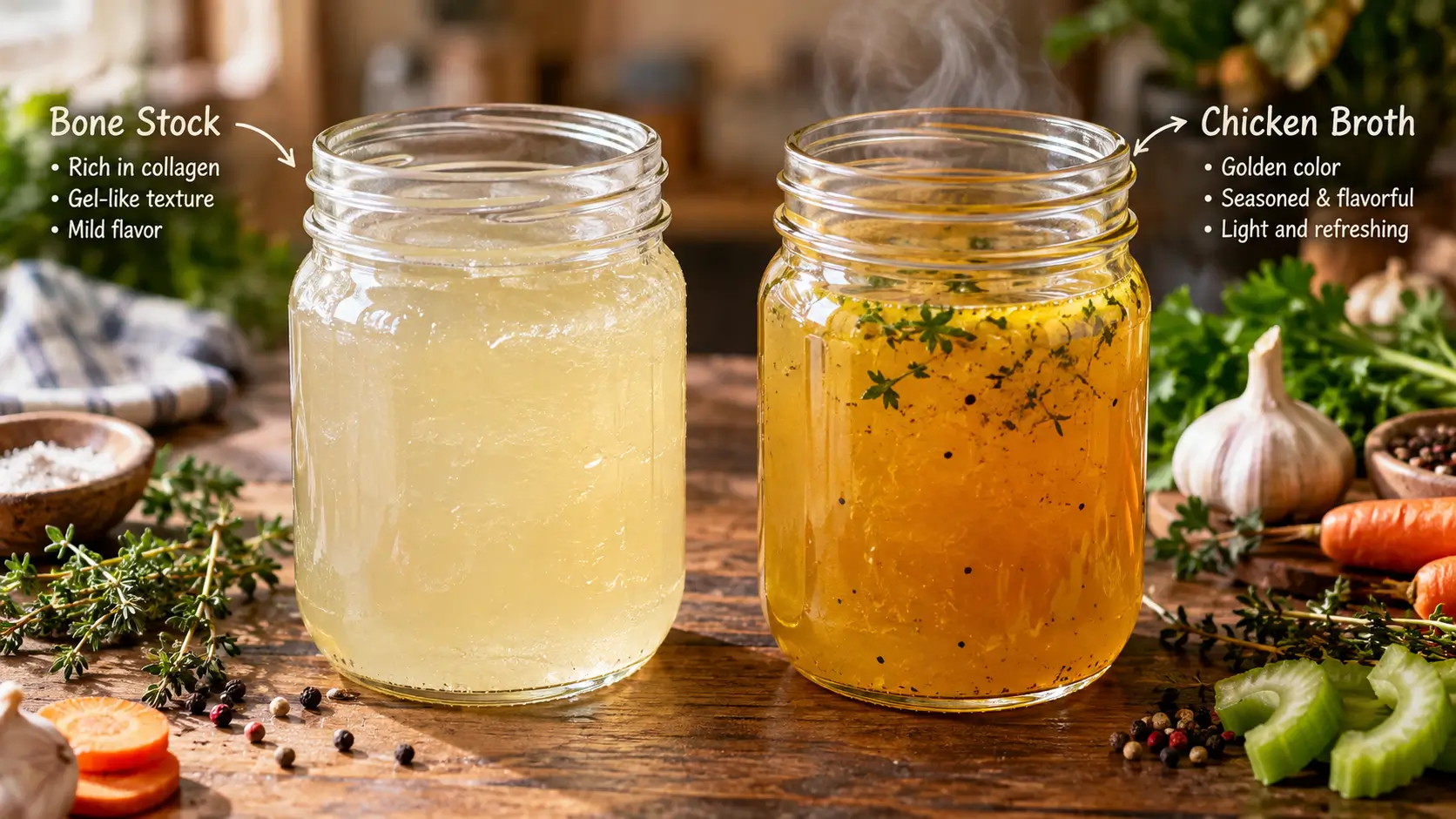
My grandmother once handed me two pots simmering side by side on her old stove and asked me to guess which was which. One held bones, vegetable scraps, and water that had been quietly bubbling for six hours. The other held meat, fresh vegetables, and herbs cooked gently for barely forty minutes, then seasoned with salt.
I couldn’t tell the difference by smell alone, and that’s when she explained the real story behind stock and broth. The stock, she said, was the silent backbone of her kitchen, never eaten alone, only used to build flavor.
The broth, on the other hand, was a finished dish, ready to sip straight from the bowl. That single afternoon taught me more about the difference between stock and broth than any recipe book ever could, and it’s a lesson every cook eventually learns the hard way.
Key Difference Between Stock and Broth
At its core, the difference between stock and broth comes down to two things: what goes into the pot and how long it cooks. Stock is made mainly from bones simmered for hours to pull out collagen, which gives it a thick, gelatinous texture once cooled. Broth is made mainly from meat and vegetables, cooked for a shorter time, and it’s seasoned and light enough to drink on its own. Stock builds a foundation; broth stands as a finished product.
Why Is This Difference Necessary to Know
Understanding the difference between stock and broth isn’t just kitchen trivia; it matters for cooks, chefs, and health-conscious people alike. In professional kitchens, using stock where a recipe calls for broth (or the reverse) changes the texture, richness, and salt balance of an entire dish.
In households, people managing sodium intake, following bone-broth diets, or simply trying to cook a proper soup need to know which one they’re actually using. Society’s growing interest in home cooking, meal-prep culture, and nutrition-focused eating has made the stock and broth distinction genuinely useful knowledge, not just a chef’s technicality.
Pronunciation of Stock and Broth
| Word | US Pronunciation | UK Pronunciation |
| Stock | /stɒk/ → “stahk” | /stɒk/ → “stok” |
| Broth | /brɔːθ/ → “brawth” | /brɒθ/ → “broth” (shorter “o” sound) |
Both words are pronounced almost identically across US and UK English, with only a subtle vowel shift. Americans tend to open the “o” sound slightly wider in both words, while British speakers keep it shorter and crisper.
Now that you know how to say them correctly, let’s get into exactly what separates stock from broth because once you understand these ten core differences, you’ll never confuse a recipe again.
Difference Between Stock and Broth
1. Main Ingredient
Stock is built primarily from bones: chicken carcasses, beef bones, or fish frames. Broth is built primarily from meat, often with bones left in but not the main focus.
Example 1: A chef roasting beef marrow bones for eight hours to make a rich brown stock is using bones as the star ingredient. Example 2: A home cook simmering a whole chicken with carrots and celery for forty-five minutes to make chicken broth is using meat as the star ingredient.
2. Cooking Time
Stock simmers for a long time, often 4 to 24 hours, to extract collagen from bones. Broth cooks much faster, usually 45 minutes to 2 hours.
Example 1: A restaurant kitchen may keep beef stock simmering overnight to develop deep flavor. Example 2: A quick vegetable broth for a weeknight soup can be ready in under an hour.
3. Texture When Cooled
Because of collagen extraction, stock turns thick and jelly-like when refrigerated. Broth stays thin and liquid even when cold.
Example 1: Leftover bone stock in the fridge will jiggle like soft gelatin the next morning. Example 2: Leftover chicken broth in the fridge will still pour smoothly, with no gel formation.
4. Seasoning
Stock is traditionally left unseasoned or very lightly seasoned, since it’s meant to be a base for other dishes. Broth is seasoned with salt and often pepper, since it’s meant to be eaten as-is.
Example 1: A pastry chef will keep veal stock salt-free so it doesn’t over-season a finished sauce. Example 2: A home cook adding salt and black pepper to chicken broth before serving it as a soup.
5. Purpose in Cooking
Stock functions as a building block; it’s used to make sauces, gravies, risottos, and soups. Broth functions as a finished product, served directly in a bowl or as a light meal.
Example 1: A French sauce like demi-glace begins with a carefully reduced veal stock. Example 2: A bowl of chicken broth with noodles served to someone recovering from a cold.
6. Nutrient Profile
Stock is rich in collagen and minerals drawn from long-simmered bones, giving it joint-supporting compounds. Broth is comparatively lighter, offering protein and flavor from the meat itself rather than deep bone extraction.
Example 1: Bone broth (a hybrid, long-simmered stock) is marketed for its collagen and gut-health benefits. Example 2: A light turkey broth after Thanksgiving is valued more for its protein and warmth than for collagen content.
7. Clarity and Color
Stock, especially when simmered gently and skimmed, tends to be clear and pale unless roasted first (brown stock). Broth is often slightly cloudier because fat and small meat particles remain in the liquid.
Example 1: A classical French fish stock, or fumet, is strained multiple times to stay crystal clear. Example 2: A homestyle chicken broth from a whole bird often looks slightly cloudy with visible fat droplets on top.
8. Vegetables and Aromatics
Stock uses vegetables sparingly, mainly for background flavor (mirepoix: onion, carrot, celery). Broth often includes a fuller vegetable presence since it’s a stand-alone dish.
Example 1: A basic stock recipe may call for just one onion, one carrot, and one celery stalk per large pot of bones. Example 2: A vegetable broth recipe may include leeks, mushrooms, garlic, and herbs in generous amounts to build direct flavor.
9. Shelf Life and Storage Behavior
Because stock is thicker and more concentrated, it freezes into dense blocks and stores exceptionally well for months. Broth, being thinner and already seasoned, is often consumed sooner and doesn’t store quite as densely.
Example 1: Restaurants freeze stock in ice-cube trays for portioned, long-term use in sauces. Example 2: Leftover broth is usually refrigerated for a few days and finished within the week as soup.
10. Culinary Skill Level Required
Making a proper stock is considered a foundational culinary technique taught in professional kitchens, requiring careful skimming, timing, and straining. Making broth is a more approachable, beginner-friendly process most home cooks pick up naturally.
Example 1: Culinary schools dedicate entire early lessons to mastering a clean, well-skimmed stock. Example 2: A first-time cook can successfully make a decent chicken broth on their very first attempt.
Nature and Behaviour of Stock and Broth
Stock behaves like a quiet, patient worker in the kitchen. It doesn’t demand attention on its own; it exists to strengthen everything it touches. Its nature is transformative: raw bones become a silky, flavor-dense liquid only through time, heat, and patience. It’s humble in taste when tasted alone, but powerful once folded into a sauce or risotto.
Broth, by contrast, behaves like a confident, ready-to-serve character. Its nature is immediate and complete; it doesn’t need another dish to shine. Broth is sociable in behavior; it welcomes noodles, vegetables, rice, or dumplings and still tastes balanced. Where stock hides in the background, broth stands at the front of the table.
Why Are People Confused About Their Use?
The confusion around stock and broth exists for a simple reason: commercial labeling is inconsistent. Grocery store cartons often use “stock” and “broth” interchangeably, even when the contents don’t match the traditional definition of either. Add to this the fact that both liquids look similar, are made with overlapping ingredients, and are often substituted for one another in home recipes without any real problem, and it’s easy to see why most people use the words as synonyms. Regional cooking traditions and translated recipes from other languages (where a single word may cover both concepts) add another layer of mix-up.
Stock vs Broth: Difference and Similarity Table
| Feature | Stock | Broth |
| Main ingredient | Bones | Meat |
| Cooking time | Long (4–24 hrs) | Shorter (45 min–2 hrs) |
| Texture when cold | Gelatinous | Liquid |
| Seasoning | Usually unseasoned | Seasoned, ready to eat |
| Main use | Base for sauces/soups | Stand-alone dish |
| Color/clarity | Often clearer | Often slightly cloudy |
| Nutrient focus | Collagen, minerals | Protein, light flavor |
| Similarity | Both made by simmering ingredients in water | Both made by simmering ingredients in water |
| Similarity | Both used as a soup base | Both used as a soup base |
| Similarity | Both can be made from chicken, beef, fish, or vegetables | Both can be made from chicken, beef, fish, or vegetables |
Which Is Better In What Situation?
When making a sauce, gravy, or risotto: Stock is the better choice. Its concentrated, unseasoned nature gives the cook full control over salt levels later, and its collagen content helps sauces gain body and shine naturally, something broth simply can’t replicate as effectively.
When serving a quick, comforting soup: Broth wins here. It’s already seasoned, ready to drink, and doesn’t require additional reduction or adjustment. For someone who’s sick, tired, or short on time, broth delivers comfort and flavor in a fraction of the effort stock demands.
When meal-prepping for the week, stock is more practical, since it freezes well in concentrated form and can be diluted or transformed into different broths, soups, or sauces as needed, offering more versatility per batch than pre-seasoned broth.
Stock and Broth in Metaphors and Similes
Beyond the kitchen, both words have slipped into everyday language as figures of speech.
- “To take stock” is a common metaphor meaning to pause and assess a situation carefully, as in, “After the layoffs, the whole team took stock of where the company stood.”
- “Stock-still” is used as a simile-like expression meaning completely motionless, as in, “He stood stock-still when he heard the news.”
- “Laughing-stock” metaphorically describes someone who has become an object of ridicule, as in, “His failed prediction made him the laughing-stock of the office.”
- “Broth” is used less metaphorically in modern English, but the phrase “too many cooks spoil the broth” functions as a full metaphor for how too many people working on one task ruin the outcome. Its imagery, of many cooks each tossing something into the same pot until the final dish is ruined, has made it one of the most enduring culinary metaphors in the English language.
Connotative Meaning of Stock and Broth
Stock carries a mostly positive to neutral connotation. It suggests reliability, supply, and foundation; think “well-stocked,” meaning prepared and dependable, as in “The store was well-stocked before the holiday rush.” It can occasionally carry a mild negative shade in phrases like “stock answer,” implying something generic or insincere: “His apology felt like a stock answer, not a real one.”
Broth carries a positive, comforting connotation almost universally. It’s associated with warmth, healing, and nourishment, especially in phrases tied to sickness or care, such as “Her mother made her warm broth when she had the flu.” It rarely, if ever, carries a negative meaning in everyday English.
Idioms and Proverbs Related to Stock and Broth
- “Too many cooks spoil the broth” Meaning too many people working on the same task will ruin the result. Example: “The marketing plan fell apart because five managers tried to run it; too many cooks spoil the broth.”
- “To take stock (of something)” Meaning to pause and evaluate a situation. Example: “Before signing the contract, she decided to take stock of every clause first.”
- “Stock-still” Meaning to stand completely without movement. Example: “The deer stood stock-still the moment it noticed us.”
- “To put stock in something” Meaning to place trust or belief in it. Example: “I don’t put much stock in rumors until I see proof.”
Stock and Broth in Literature
Dedicated literary works built entirely around the culinary meanings of “stock” or “broth” are rare, since both are everyday kitchen terms rather than dramatic subjects. However, the words appear meaningfully in a few notable works, mostly through their broader or idiomatic meanings:
- The Big Birthday Play, written by Hugh Leonard, 1956 (later adapted into the film discussed below; the phrase “broth of a boy,” an old Irish expression for a fine young man, gives the story its flavor)
- Traditional English proverb collections dating back to the 1500s document “too many cooks spoil the broth” as one of the earliest recorded English proverbs, first noted around 1575
- Classic French culinary literature, including Auguste Escoffier’s foundational cookbook Le Guide Culinaire (Culinary reference text, 1903), formally defined and codified the modern technique of stock-making (fond in French) that professional kitchens still follow today
Movies Featuring Stock and Broth
- Broth of a Boy Comedy, Ireland/UK, 1959 (title drawn from the old Irish idiom for a fine young man, not the culinary liquid, but a charming cultural use of the word)
- Lock, Stock and Two Smoking Barrels Crime Comedy, United Kingdom, 1998 (uses “stock” in its older sense referring to a gun’s stock, showcasing how far the word has traveled from the kitchen)
- The Wolf of Wall Street, Biographical Drama, United States, 2013 (built entirely around “stock” in its financial market sense, showing the word’s dominant modern usage outside cooking)
Frequently Asked Questions
1. Can I substitute stock for broth in a recipe?
Yes, in most home recipes you can substitute one for the other. The main difference you’ll notice is that stock adds more body and richness, while broth adds more direct, seasoned flavor, so you may need to adjust salt levels.
2. Is bone broth the same as stock?
Bone broth sits in between the two. It’s made from bones like a traditional stock but simmered even longer, and it’s often seasoned and consumed on its own like a broth, which is why the naming causes so much confusion.
3. Why does stock gel in the fridge but broth doesn’t?
Stock gels because long simmering extracts collagen from bones, which turns into gelatin once cooled. Broth is cooked for a shorter time and uses less bone, so it doesn’t extract enough collagen to gel.
4. Which one is healthier, stock or broth?
Both offer nutritional value, but stock is generally richer in collagen and minerals due to longer cooking, while broth tends to be lighter and lower in fat, especially when made mostly from lean meat.
5. Can vegetarians make a version of both stock and broth?
Yes. Vegetable stock is made by simmering vegetable scraps for a long time to build a neutral base, while vegetable broth is made more quickly with fresh vegetables and herbs, seasoned to be enjoyed as a finished soup.
How Both Are Useful for Their Surroundings
In the kitchen ecosystem, stock and broth each play a role that reduces waste and builds efficiency. Stock allows cooks to repurpose bones and vegetable scraps that would otherwise be thrown away, turning kitchen waste into a valuable cooking ingredient a practice increasingly valued in sustainable and zero-waste cooking communities.
Broth, meanwhile, supports households and communities directly by offering an affordable, nourishing meal that requires minimal ingredients, making it a staple in home care during illness, in budget cooking, and in cultures where warm soups are central to daily meals.
Final Words for Both
Stock deserves recognition as the quiet foundation of great cooking: patient, humble, and essential, even when it never appears on the plate by itself.
Broth deserves recognition as the comforting, complete dish that asks for nothing more than a spoon and a hungry person. Neither is “better” in an absolute sense; they simply serve different purposes, and a good cook learns to reach for the right one at the right moment.
Conclusion
The difference between stock and broth ultimately comes down to ingredients, cooking time, and purpose: stock is a long-simmered, bone-based foundation, while broth is a quicker, meat-based dish ready to eat on its own.
Knowing this distinction changes how confidently you cook, whether you’re building a restaurant-quality sauce or simply warming up a bowl of soup on a cold evening. My grandmother’s two simmering pots taught me that stock and broth aren’t rivals; they’re teammates, each doing a different job in the kitchen.
The next time a recipe calls for one or the other, you’ll know exactly why it matters, and your cooking will be better for it.

Alexandra “Alex” Monroe is a senior linguistics contributor at WordCompares.com, where she specializes in comparative word analysis, semantics, and language clarity. With over 15 years of academic and editorial experience, Alex helps readers understand subtle differences between commonly confused words and phrases. Her research-driven yet practical writing style strengthens the educational authority of WordCompares.com.