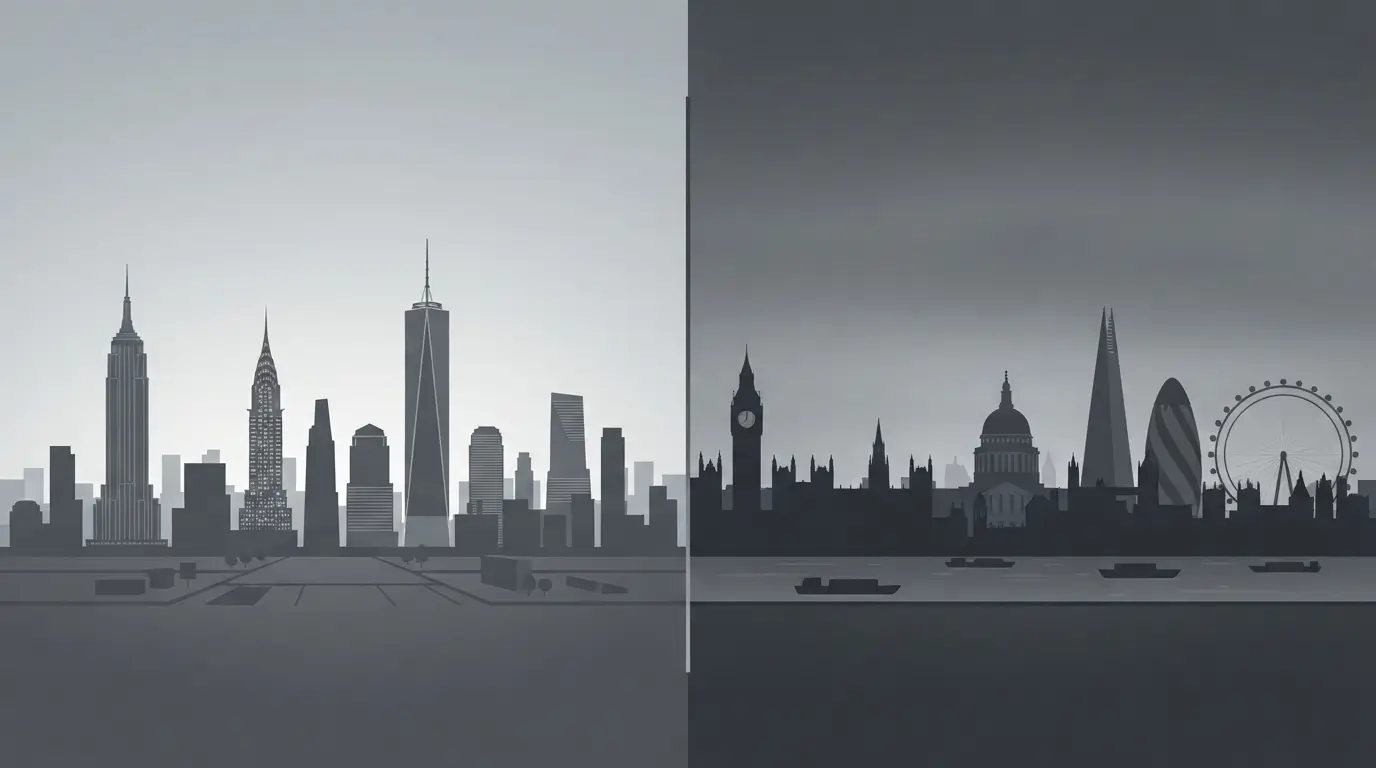
A few years ago, an American editor and a British author were finalizing a children’s book together over a video call. The American kept typing “gray sky” in the manuscript, while the British writer kept changing it to “grey sky.” Neither was wrong; they were simply speaking two flavors of the same language.
This small tug-of-war over gray and grey happens every day in offices, classrooms, and publishing houses around the world. The truth is, gray and grey mean the same shade between black and white; the only real difference is geography. Understanding when to use gray and when to use grey isn’t just a spelling quirk — it’s a small signal of which English tradition you’re writing in.
Key Difference Between the Both
The core difference between gray and grey is regional spelling preference, not meaning. “Gray” is the standard spelling in American English, while “grey” is the standard spelling in British English, and this pattern extends to most Commonwealth countries like Canada, Australia, and India (though usage there can be mixed).
Why Their Difference Is Necessary to Know for Learners and Experts
For students, writers, editors, and businesses, knowing the gray vs grey distinction matters because consistency signals professionalism. A resume, novel, or website that mixes gray and grey randomly looks careless.
For global brands, choosing the right spelling builds trust with a specific audience an American company writing “grey” to a US audience can feel oddly foreign, while a British publication using “gray” can feel Americanized. In short, gray and grey are small words with a big cultural footprint.
Pronunciation of Gray and Grey (US & UK)
Here’s the good news: pronunciation doesn’t change with spelling.
- US English: Both “gray” and “grey” are pronounced /ɡreɪ/ (rhymes with “day” or “say”).
- UK English: Both “gray” and “grey” are pronounced /ɡreɪ/ as well, with the same rhyming sound.
So whether you write gray or grey, you’ll say it the same way. The difference lives entirely on the page, not on the tongue — which brings us to the heart of this article: a full breakdown of how gray and grey diverge in usage, history, and cultural meaning.
Difference Between Gray and Grey
1. Regional Origin
Gray is the American English spelling, while grey is the British English spelling. This split grew out of natural language drift after the American and British dialects separated over centuries.
- Example 1: An American writer types, “The gray clouds rolled in before the storm.”
- Example 2: A British writer types, “The grey clouds rolled in before the storm.”
2. Historical Roots
Both spellings existed side by side in Old and Middle English (“grǣg”), but grey became more dominant in Britain while gray became standardized in the US by the 19th century thanks to dictionaries like Webster’s.
- Example 1: Noah Webster’s American Dictionary (1828) favored “gray.”
- Example 2: Samuel Johnson’s Dictionary of the English Language (1755) favored “grey.”
3. Dictionary Preference
Merriam-Webster (American) lists “gray” as the primary spelling, while the Oxford English Dictionary (British) lists “grey” as the primary spelling.
- Example 1: Merriam-Webster entry: “gray (also grey).”
- Example 2: Oxford Dictionary entry: “grey (also gray, especially US).”
4. Proper Nouns and Names
Some proper nouns lock in one spelling regardless of the country, such as “Earl Grey tea” or “Gray’s Anatomy,” and these do not change based on regional preference.
- Example 1: “Earl Grey tea” is always spelled with an “e,” even in American cafes.
- Example 2: “Gray’s Anatomy” (the medical textbook and the TV show) always uses “a.”
5. Business and Branding Use
Companies often choose one spelling to match their target market’s expectations, and switching it can feel jarring to local customers.
- Example 1: A US car brand advertises a “gray interior.”
- Example 2: A UK car brand advertises a “grey interior.”
6. Software and Style Guides
Global tech companies often standardize on American English, so most software, coding documentation, and international style guides default to “gray.”
- Example 1: CSS color codes use “gray” (e.g., color: gray;).
- Example 2: A UK-based tech blog following AP style may still switch to “grey” for local readers.
7. Literature and Publishing
Publishers usually follow the spelling convention of the country where the book is released, even if the author’s home country differs.
- Example 1: An American edition of a novel prints “gray skies.”
- Example 2: The same novel’s British edition prints “grey skies.”
8. Emotional and Descriptive Writing
Writers in both traditions use the words interchangeably for mood-setting, but grey often appears slightly more often in poetic or literary British prose.
- Example 1: “Her grey eyes held a quiet sadness.” (British-style prose)
- Example 2: “His gray hair told stories of years at sea.” (American-style prose)
9. Regional Variants Beyond US and UK
Canada often mixes both spellings, while Australia and New Zealand lean toward “grey,” following British tradition.
- Example 1: A Canadian newspaper might print “gray” in one article and “grey” in another.
- Example 2: An Australian weather report almost always uses “grey skies.”
10. Frequency of Use
Corpus studies show “gray” is used more globally due to the size and influence of American publishing and media, but “grey” remains dominant within the UK and Commonwealth nations.
- Example 1: A Google Ngram search shows “gray” spikes higher in American texts after 1800.
- Example 2: British newspapers like The Guardian consistently favor “grey” in headlines.
Nature and Behaviour of Gray and Grey
Gray, as a word, behaves as the confident, streamlined American variant — shorter to type in casual contexts, dominant in US-based digital platforms, and closely tied to technical fields like design and coding.
Grey, on the other hand, carries a more traditional, literary feel — favored in classic British literature, poetry, and everyday British speech, often perceived as slightly more elegant or old-fashioned by American readers.
Why Are People Confused About Their Use?
Confusion happens because gray and grey sound identical, mean the same thing, and are both technically “correct” there’s no grammar rule to memorize, only a regional convention. Add to this global media consumption (British shows watched by American audiences, and vice versa), spell-checkers set to different regional dictionaries, and inconsistent editing in international content, and it’s easy to see why writers second-guess themselves.
Difference and Similarity Between Gray and Grey
| Aspect | Gray | Grey | Similarity |
| Region | American English | British English | Same color meaning |
| Pronunciation | /ɡreɪ/ | /ɡreɪ/ | Identical sound |
| Dictionary Default | Merriam-Webster | Oxford Dictionary | Both are dictionary-recognized |
| Common Use | Tech, US media | Literature, UK media | Both used in formal writing |
| Proper Nouns | Rarely fixed | “Earl Grey,” “Gray’s Anatomy” fixed | Both appear in brand names |
| Popularity | Higher word frequency globally | Higher within UK/Commonwealth | Both grammatically correct |
Which Is Better in What Situation?
When to use Gray: If you’re writing for an American audience, working in US-based tech or business documentation, or following AP style, “gray” is the better choice. It fits naturally into American publishing, marketing copy, and everyday communication, keeping your writing consistent with reader expectations and search engine conventions common in the US.
When to use Grey: If your audience is British, Australian, or from another Commonwealth nation, or if you’re writing literary or poetic content with a classic British tone, “grey” is the stronger choice. It aligns with local dictionaries, style guides, and cultural familiarity, making your writing feel authentic and properly localized rather than translated.
How Gray and Grey Are Used in Metaphors and Similes
Both words step far beyond describing color and are frequently used to represent uncertainty, dullness, or moral ambiguity.
- “His future looked gray and uncertain.” (metaphor for uncertainty)
- “The negotiations fell into a grey area.” (metaphor for ambiguity)
- “The old man’s beard was as grey as morning fog.” (simile for softness/age)
- “Her mood turned as gray as the winter sky.” (simile for sadness)
Connotative Meaning of Gray and Grey
Gray:
- Neutral connotation: “The report used a gray color scheme for balance.”
- Negative connotation: “His outlook on life had turned gray and hopeless.”
Grey:
- Positive connotation: “The grey-haired mentor was respected for his wisdom.”
- Negative connotation: “The city felt grey and lifeless after the factories closed.”
Overall, both words lean slightly negative or neutral when describing mood or atmosphere, but positive when describing wisdom, elegance, or maturity (like “grey hair” symbolizing experience).
Idioms and Proverbs Related to Gray/Grey
- “Grey area” — something unclear or not clearly defined. Example: “Whether the rule applies here is a bit of a grey area.”
- “Gray matter” — a person’s brain or intelligence. Example: “Use your gray matter and solve the puzzle yourself.”
- “Grow grey/gray in service” — to spend a long time, often loyally, in a role. Example: “He grew grey in service to the company over three decades.”
Works in Literature Featuring Gray or Grey
- The Picture of Dorian Gray — Novel, by Oscar Wilde (1890)
- Fifty Shades of Grey — Novel, by E. L. James (2011)
- The Gray Man — Thriller novel, by Mark Greaney (2009)
- Old Possum’s Book of Practical Cats (features “Grey” imagery in feline description) — Poetry, by T. S. Eliot (1939)
Movies Made on Gray or Grey Themes
- The Picture of Dorian Gray — 2009, United Kingdom
- Fifty Shades of Grey — 2015, United States
- The Gray Man — 2022, United States
- Fifty Shades Darker (sequel featuring “Grey” surname) — 2017, United States
Five Frequently Asked Questions About Gray vs Grey
1. Is gray or grey more correct?
Neither is more “correct” — gray is standard in American English, and grey is standard in British English. Both are grammatically valid.
2. Does gray or grey change pronunciation?
No. Both spellings are pronounced the same way: /ɡreɪ/, rhyming with “day.”
3. Which spelling should I use in professional writing?
Match your audience: use gray for American readers and grey for British or Commonwealth readers to maintain consistency and credibility.
4. Why is “Earl Grey” tea always spelled with an “e”?
Because it’s a proper noun named after a historical figure (Charles Grey), so its spelling is fixed and doesn’t follow regional rules.
5. Can I mix gray and grey in the same document?
It’s best to avoid mixing them, as consistency in spelling reflects careful editing and professionalism, especially in formal or published work.
How Both Are Useful for Surroundings
Beyond language, the color gray/grey itself plays a practical role in our environment — it’s used in architecture and interior design for its calming neutrality, in fashion for its versatility, and in nature (overcast skies, stone, fog) as a signal of transition or change. Linguistically, having both gray and grey enriches English by preserving regional identity, helping readers instantly recognize the cultural origin of a piece of writing.
Final Words for Gray and Grey
Gray and grey are not rivals they are reflections of English’s rich, branching history. Choosing one over the other isn’t about right or wrong; it’s about knowing your audience, respecting regional tradition, and writing with intention.
Conclusion
At the end of the day, the gray vs grey debate boils down to geography, not grammar. Gray belongs to American English, grey belongs to British English, and both describe the exact same shade sitting quietly between black and white.
What separates them is culture, history, and audience expectation not correctness. Whether you’re a student polishing an essay, a novelist setting a scene, or a brand crafting global content, understanding when to use gray and when to use grey helps you communicate with precision and authenticity.
So next time you write about cloudy skies or graying hair, pause for a second and ask: who am I writing for? That answer will tell you which spelling gray or grey belongs on the page.

Alexandra “Alex” Monroe is a senior linguistics contributor at WordCompares.com, where she specializes in comparative word analysis, semantics, and language clarity. With over 15 years of academic and editorial experience, Alex helps readers understand subtle differences between commonly confused words and phrases. Her research-driven yet practical writing style strengthens the educational authority of WordCompares.com.