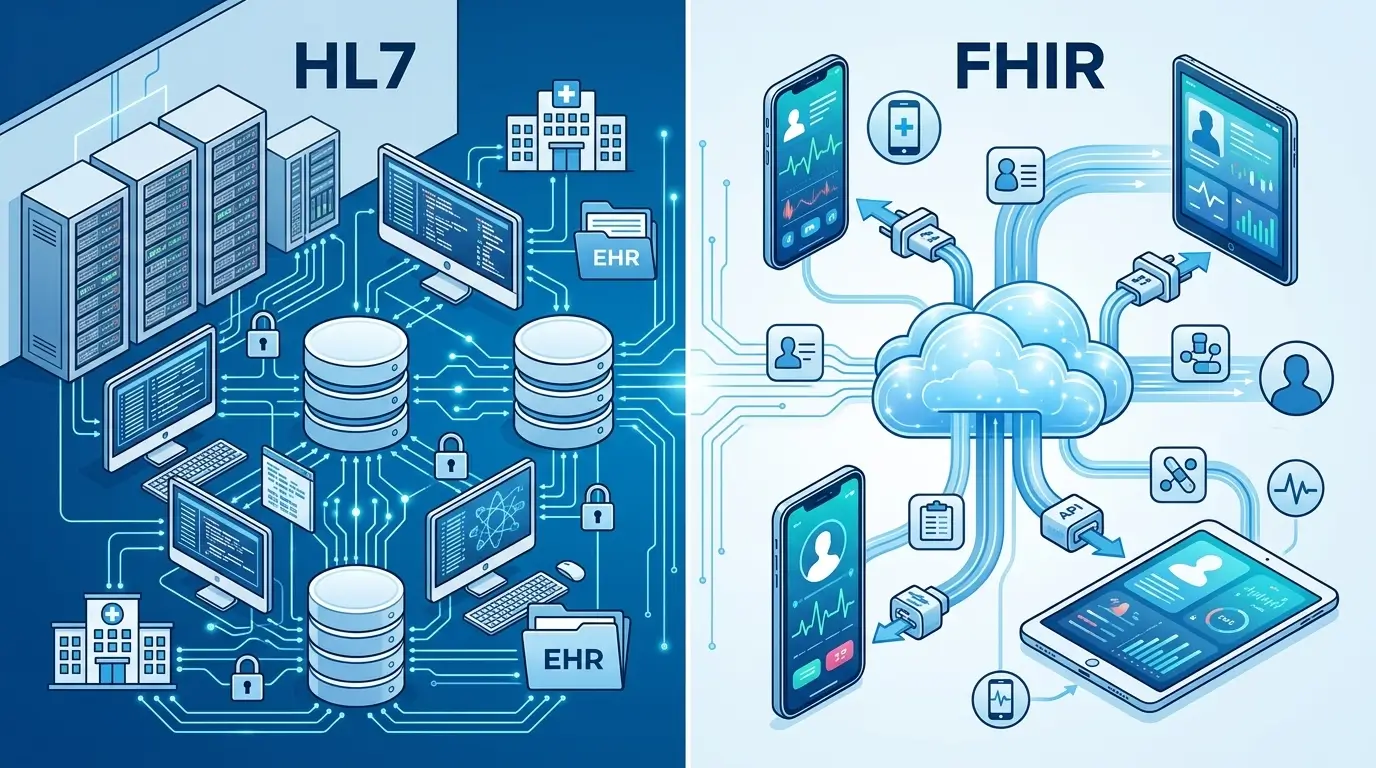
Imagine a patient visiting a hospital in one city and then receiving treatment in another. Doctors need quick access to medical records, prescriptions, and test results to provide proper care. This is where healthcare data standards become important. Two of the most discussed standards are HL7 and FHIR. Understanding the difference between HL7 and FHIR helps healthcare professionals, software developers, and students understand how medical information moves between systems.
The difference between HL7 and FHIR is a major topic in healthcare technology because both standards aim to improve communication between healthcare applications. While HL7 has been used for decades, FHIR introduces modern web technologies that simplify data sharing. Learning the difference between HL7 and FHIR helps organizations choose the right interoperability solution. As healthcare becomes increasingly digital, understanding the difference between HL7 and FHIR is more valuable than ever.
Key Difference Between HL7 and FHIR
The primary difference is that HL7 is a broader family of healthcare communication standards developed over several decades, whereas FHIR (Fast Healthcare Interoperability Resources) is a modern standard created by HL7 that uses web-based technologies such as RESTful APIs, JSON, and XML to exchange healthcare data more efficiently.
Why Is Their Difference Necessary to Know for Learners and Experts?
Understanding HL7 and FHIR is essential because healthcare systems depend on accurate and secure data exchange. Students learning health informatics need to understand how patient information travels between systems. Healthcare IT professionals use these standards to build interoperable software. Hospitals rely on them to improve patient care, reduce errors, and increase efficiency.
As healthcare organizations continue adopting electronic health records (EHRs), knowledge of HL7 and FHIR becomes increasingly valuable. Understanding their differences helps organizations select suitable technologies, improve integration projects, and support better patient outcomes.
Pronunciation of HL7 and FHIR
HL7
| Region | Pronunciation |
| US | Aitch-El-Seven |
| UK | Haitch-El-Seven |
FHIR
| Region | Pronunciation |
| US | “Fire” |
| UK | “Fire” |
From Traditional Messaging to Modern APIs
Now that we understand their meanings and importance, let’s explore the detailed differences between HL7 and FHIR and see how each standard serves the healthcare industry in unique ways.
Difference Between HL7 and FHIR
1. Definition
HL7
HL7 (Health Level Seven) is a set of international standards for transferring healthcare information.
Example 1: A hospital sends laboratory results to another hospital using HL7 messages.
Example 2: A pharmacy receives prescription data through HL7 integration.
FHIR
FHIR stands for Fast Healthcare Interoperability Resources and is a newer HL7 standard.
Example 1: A mobile health app retrieves patient records through a FHIR API.
Example 2: A telemedicine platform accesses medication data using FHIR resources.
2. Technology Foundation
HL7
Uses traditional messaging structures and protocols.
Example 1: HL7 v2 message segments.
Example 2: Batch data transmission between systems.
FHIR
Uses web technologies such as REST APIs, JSON, and XML.
Example 1: API-based patient lookup.
Example 2: Cloud-based healthcare applications.
3. Ease of Implementation
HL7
Can be complex due to custom implementations.
Example 1: Interface engine configuration.
Example 2: Custom message mapping.
FHIR
Designed to be easier for modern developers.
Example 1: Standard REST endpoints.
Example 2: JSON-based data structures.
4. Data Structure
HL7
Uses messages and segments.
Example 1: ADT messages.
Example 2: ORU messages.
FHIR
Uses modular resources.
Example 1: Patient resource.
Example 2: Observation resource.
5. Flexibility
HL7
Less flexible and often customized.
Example 1: Vendor-specific message fields.
Example 2: Proprietary extensions.
FHIR
Highly flexible and extensible.
Example 1: Custom resource profiles.
Example 2: API extensions.
6. Real-Time Access
HL7
Typically message-based communication.
Example 1: Sending updates after an event.
Example 2: Scheduled transfers.
FHIR
Supports real-time querying.
Example 1: Instant patient search.
Example 2: Live medication lookup.
7. Mobile Application Support
HL7
Not originally designed for mobile environments.
Example 1: Legacy hospital systems.
Example 2: Internal healthcare networks.
FHIR
Designed with mobile and web applications in mind.
Example 1: Patient portals.
Example 2: Healthcare mobile apps.
8. Learning Curve
HL7
Requires understanding message structures and segments.
Example 1: Parsing ADT messages.
Example 2: Managing interface engines.
FHIR
More familiar to web developers.
Example 1: REST API development.
Example 2: JSON parsing.
9. Industry Adoption
HL7
Widely adopted for decades.
Example 1: Hospital information systems.
Example 2: Laboratory systems.
FHIR
Rapidly growing adoption worldwide.
Example 1: Health information exchanges.
Example 2: Patient engagement platforms.
10. Future Readiness
HL7
Supports many existing systems but is considered legacy in some environments.
Example 1: Older EHR integrations.
Example 2: Established healthcare networks.
FHIR
Designed for modern and future healthcare ecosystems.
Example 1: Cloud healthcare platforms.
Example 2: AI-driven healthcare applications.
Nature and Behaviour of HL7 and FHIR
Nature of HL7
HL7 is structured, message-oriented, and highly established. It focuses on reliable communication between healthcare systems and often requires specialized implementation.
Nature of FHIR
FHIR is flexible, resource-oriented, and developer-friendly. It emphasizes accessibility, interoperability, and modern web integration.
Why Are People Confused About Their Use?
People often confuse HL7 and FHIR because FHIR is actually developed by HL7 International. Many assume they are competing technologies rather than related standards. Additionally, healthcare organizations often use both simultaneously, creating confusion about where one ends and the other begins.
Difference and Similarity Table
| Feature | HL7 | FHIR | Similarity |
| Purpose | Healthcare data exchange | Healthcare data exchange | Both support interoperability |
| Age | Older standard | Newer standard | Both are healthcare standards |
| Technology | Messaging-based | API-based | Both transfer health data |
| Data Format | Segments and messages | Resources | Both organize healthcare information |
| Mobile Support | Limited | Strong | Both can be integrated into apps |
| Implementation | More complex | Simpler | Both require technical expertise |
| Flexibility | Moderate | High | Both allow customization |
| Industry Use | Established | Growing | Both are widely recognized |
| Real-Time Access | Limited | Excellent | Both support communication |
| Developer Experience | Traditional | Modern | Both serve healthcare systems |
Which Is Better in What Situation?
When HL7 Is Better
HL7 is better when working with established healthcare infrastructures that already depend on traditional messaging systems. Large hospitals with legacy software often find HL7 practical because existing systems are built around it. Organizations that need stable and proven communication methods may prefer HL7 for maintaining compatibility with older technologies.
When FHIR Is Better
FHIR is better when developing modern healthcare applications, patient portals, mobile apps, and cloud-based services. Organizations seeking real-time access, API integration, and faster development often choose FHIR. It is especially useful when connecting healthcare systems with modern digital platforms and consumer-facing applications.
How the Keywords Are Used in Metaphors and Similes
HL7
Metaphor: HL7 is the postal service of healthcare data.
Meaning: It reliably delivers information between systems.
Simile: HL7 works like a well-organized mail carrier delivering medical records.
FHIR
Metaphor: FHIR is the internet highway of healthcare information.
Meaning: It allows fast and efficient movement of data.
Simile: FHIR works like a smartphone app connecting users instantly.
Connotative Meaning of HL7 and FHIR
HL7
Positive: Reliable, established, trusted.
Example: “HL7 remains the backbone of many healthcare networks.”
Negative: Complex, outdated in some contexts.
Example: “The organization struggled with HL7 customization.”
Neutral: Industry communication standard.
Example: “The hospital uses HL7 for data exchange.”
FHIR
Positive: Modern, innovative, efficient.
Example: “FHIR accelerated application development.”
Negative: Newer systems may require transition costs.
Example: “FHIR implementation demanded additional training.”
Neutral: Interoperability framework.
Example: “FHIR supports healthcare APIs.”
Idioms or Proverbs Related to the Concepts
There are no direct idioms specifically using HL7 or FHIR. However, related communication idioms include:
“On the same page”
Meaning: Having shared understanding.
Example: HL7 helps healthcare systems stay on the same page.
“Bridge the gap”
Meaning: Connect separate groups.
Example: FHIR helps bridge the gap between healthcare applications.
“Speak the same language”
Meaning: Communicate effectively.
Example: Data standards allow systems to speak the same language.
Works in Literature Featuring the Keywords
Because HL7 and FHIR are technical standards rather than literary subjects, they do not commonly appear as titles of literary works. However, they are frequently discussed in professional publications.
HL7
- HL7 for Busy Professionals – Technical Guide – Caristix – Various Editions
- HL7 Essentials – Healthcare Informatics – Various Authors
FHIR
- FHIR Overview and Implementation Guide – Technical Reference – Various Contributors
- FHIR in Action – Technology Guide – Various Authors
Movies Featuring the Keywords
There are currently no mainstream movies specifically titled HL7 or FHIR. These terms primarily appear in healthcare technology documentaries, webinars, training videos, and educational content.
Frequently Asked Questions
1. Is FHIR replacing HL7?
FHIR is not completely replacing HL7. Many healthcare organizations use both standards together.
2. What does FHIR stand for?
FHIR stands for Fast Healthcare Interoperability Resources.
3. Which is easier to learn?
FHIR is generally easier for modern software developers because it uses common web technologies.
4. Is HL7 still relevant?
Yes. HL7 remains widely used across hospitals, laboratories, and healthcare organizations worldwide.
5. Can HL7 and FHIR work together?
Yes. Many healthcare systems integrate HL7 messaging with FHIR APIs to achieve interoperability.
How Both Are Useful for Surroundings
HL7 and FHIR improve healthcare environments by enabling secure information sharing among hospitals, clinics, laboratories, pharmacies, and patients. They reduce duplication of records, support better medical decisions, and contribute to faster treatment. Their use ultimately benefits communities by improving healthcare quality and operational efficiency.
Final Words for Both
HL7 represents decades of healthcare communication experience and remains essential in many healthcare systems. FHIR represents the future of interoperability, offering faster and more flexible data sharing. Together, they form the foundation of modern healthcare information exchange.
Conclusion
The difference between HL7 and FHIR lies mainly in their approach to healthcare interoperability. HL7 relies on traditional message-based communication, while FHIR embraces modern web technologies and API-driven integration. Both standards play vital roles in healthcare data exchange and contribute to better patient care.
HL7 continues to support countless existing systems, whereas FHIR is driving innovation in mobile health, cloud computing, and patient-centered applications. For students, healthcare professionals, and developers, understanding these standards is essential for navigating the evolving healthcare technology landscape.
Rather than viewing them as competitors, it is more accurate to see HL7 and FHIR as complementary tools working toward the shared goal of seamless healthcare communication.

Dr. Marcus Reed is a lead editorial author at WordCompares.com and a specialist in communication studies and written clarity. With more than 12 years of university-level teaching experience, he focuses on explaining word distinctions in a clear and structured manner. His work ensures that WordCompares.com maintains accuracy, depth, and reader trust.