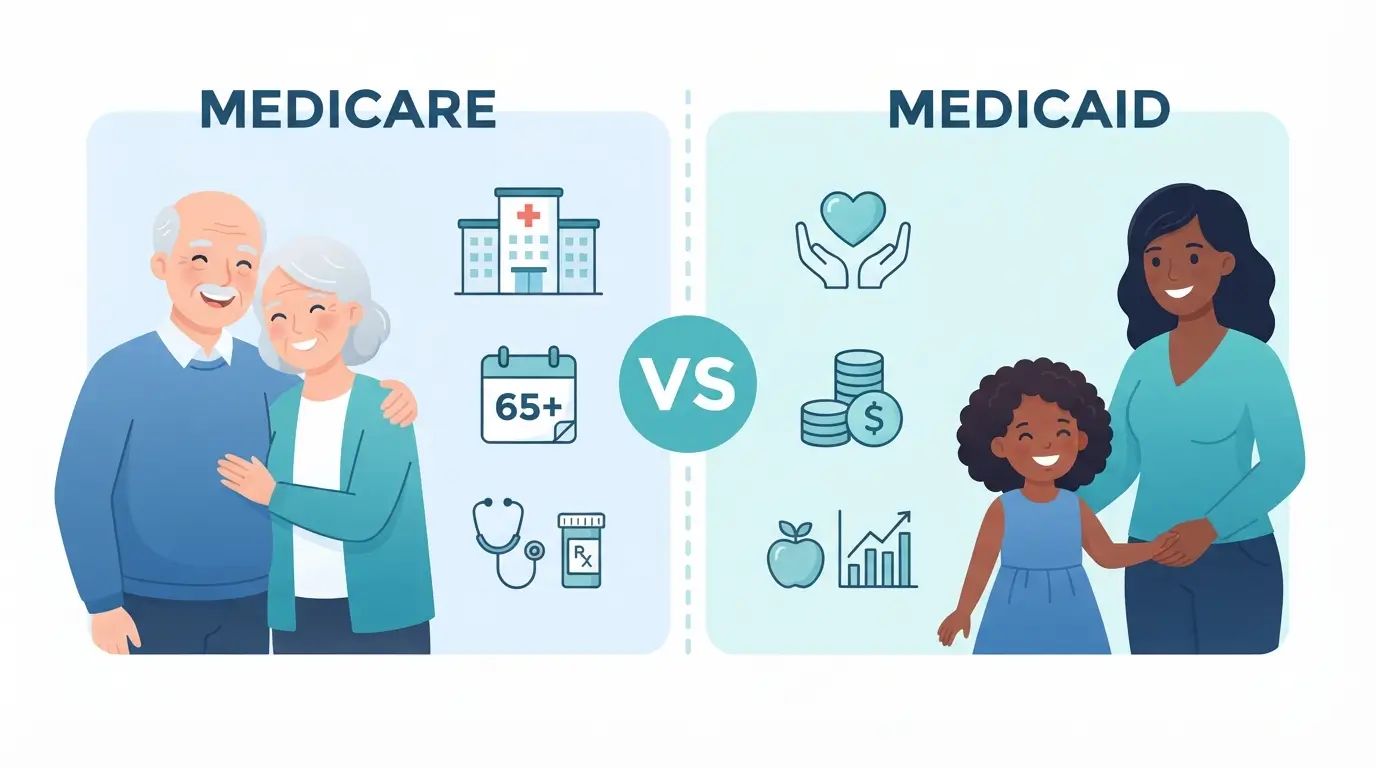
Picture Grandma Rosa, 68, who just retired after 40 years of factory work, and her neighbor Daniel, 34, a single father who lost his job and his health insurance in the same month. Both walked into the same government office asking for help paying medical bills, and both walked out with cards that looked almost identical.
Rosa got Medicare. Daniel got Medicaid. Neither of them, at first, understood the difference between Medicare and Medicaid and that confusion cost Daniel three months of delayed treatment because he assumed he’d been rejected. This true-to-life mix-up happens every single day across the United States, which is exactly why understanding the difference between Medicare and Medicaid matters so much.
Key Difference Between the Two
At the simplest level, the difference between Medicare and Medicaid comes down to one word each: age and income. Medicare is primarily for adults 65 and older or those with specific disabilities, while Medicaid is mainly for children, adolescents, and adults with limited income.
Medicare is a federal program with the same rules nationwide, while Medicaid is run jointly by federal and state governments, so it changes shape depending on where you live.
Why Is Their Difference Necessary to Know for Learners and Experts
For students of public policy, healthcare professionals, insurance agents, and everyday families, knowing the difference between Medicare and Medicaid isn’t just academic trivia it decides whether a patient gets timely surgery, whether a senior citizen pays a crushing premium, or whether a low-income family qualifies for free care. Society runs smoother when people understand which safety net catches them, and when experts advising the public grasp the difference between Medicare and Medicaid clearly enough to explain it in plain language.
Pronunciation
- Medicare
- US English: /ˈmɛd.ɪ.kɛr/ (MED-ih-kair)
- UK English: /ˈmɛd.ɪ.keə(r)/ (MED-ih-kair, with a softer “r”)
- Medicaid
- US English: /ˈmɛd.ɪ.keɪd/ (MED-ih-kayd)
- UK English: /ˈmɛd.ɪ.keɪd/ (MED-ih-kayd — nearly identical to US, since Medicaid is a distinctly American term rarely used in the UK)
Now that we can say both words correctly, let’s walk through exactly what sets them apart, point by point.
Difference Between Medicare and Medicaid
1. Governing Authority
Medicare is run entirely by the federal government, with identical core rules in all 50 states. Medicaid is a joint federal-state partnership, so each state designs its own version.
- Example 1: A Medicare Part B claim in Texas follows the same national rulebook as one filed in New York.
- Example 2: Medicaid in California may cover certain dental procedures that Medicaid in Mississippi does not, because each state sets its own optional benefits.
2. Eligibility Basis
Medicare eligibility depends on age or disability status, not income. Medicaid eligibility depends primarily on income and financial need.
- Example 1: A wealthy retired executive automatically qualifies for Medicare at 65, regardless of net worth.
- Example 2: A 25-year-old with no disability but very low income can qualify for Medicaid, while the same person would not qualify for Medicare.
3. Who It Serves
Medicare mainly serves older adults and people with qualifying disabilities. Medicaid serves low-income individuals of any age, including children, pregnant women, and people with disabilities.
- Example 1: A 70-year-old with dialysis needs relies on Medicare.
- Example 2: A pregnant teenager with no income may receive prenatal care through Medicaid.
4. Funding Source
Medicare is funded through payroll taxes collected in dedicated federal trust funds. Medicaid is funded by a mix of federal and state tax dollars, shared through the Federal Medical Assistance Percentage (FMAP).
- Example 1: A worker’s paycheck deduction labeled “FICA Medicare Tax” feeds directly into the Medicare trust fund.
- Example 2: A state legislature must budget its own share of Medicaid spending every fiscal year alongside federal matching funds.
5. Cost to the Beneficiary
Medicare generally requires premiums, deductibles, and coinsurance. Medicaid is often free or very low-cost for enrollees.
- Example 1: A Medicare Part B enrollee pays a standard monthly premium regardless of income level.
- Example 2: A Medicaid recipient in a qualifying income bracket may pay nothing beyond a small copay for a prescription.
6. Coverage Scope
Medicare covers hospital care, doctor visits, and prescription drugs through its four parts. Medicaid often covers a broader range of services, including long-term nursing home care, personal care assistance, and transportation to appointments.
- Example 1: Medicare pays for a short hospital stay after surgery but stops covering nursing care after 100 days.
- Example 2: Medicaid can continue funding a nursing home stay indefinitely for an eligible low-income senior.
7. Enrollment Process
Medicare has defined enrollment periods tied to your 65th birthday or disability approval. Medicaid can be applied for at any time of year.
- Example 1: Missing the Medicare Initial Enrollment Period can lead to a late penalty added to future premiums.
- Example 2: A family that loses income in October can apply for Medicaid immediately, without waiting for an annual window.
8. Long-Term Care
Medicare offers very limited long-term custodial care coverage. Medicaid is the nation’s primary payer for long-term nursing home care.
- Example 1: A senior recovering from a hip fracture gets short-term rehab paid by Medicare.
- Example 2: The same senior, if they later need permanent nursing home care and have limited assets, shifts to Medicaid to cover it.
9. Administration and Consistency
Medicare offers a consistent, uniform experience nationwide. Medicaid can look and feel very different from state to state, with different names (like “Medi-Cal” in California or “MassHealth” in Massachusetts).
- Example 1: A Medicare card works the same way in Ohio as it does in Florida.
- Example 2: Someone moving from New York Medicaid to Georgia Medicaid must reapply, since the programs aren’t automatically transferable.
10. Dual Eligibility
Medicare is a standalone program for those who qualify. Medicaid can work alongside Medicare for people who qualify for both.
- Example 1: A low-income 67-year-old can be “dual eligible,” with Medicare paying first and Medicaid covering the rest.
- Example 2: A dual-eligible individual may get help from Medicaid to pay their Medicare Part B premium through a Medicare Savings Program.
Nature and Behaviour of Medicare and Medicaid
Medicare behaves like a predictable, insurance-style system: you pay in over your working life through payroll taxes, and it pays out consistently once you reach eligibility, almost like a retirement benefit you’ve earned. Its “personality” is stable, rule-bound, and uniform.
Medicaid behaves more like a flexible, need-based safety net: it responds to your current financial circumstances rather than your work history, expanding or tightening its rules depending on state policy and economic conditions. Its “personality” is adaptive, localized, and responsive to hardship.
Why Are People Confused About Their Use?
The confusion is understandable and common. The words “Medicare” and “Medicaid” are so much alike that it’s easy to get confused, and both are government programs that help people pay for health care. Both were created in the same year, both start with the same six letters, both issue insurance-style cards, and both can apply to the same senior citizen at the same time through dual eligibility. Add in state-specific Medicaid names and constantly shifting income thresholds, and it’s no wonder the two terms get swapped in everyday conversation.
Difference and Similarity Table
| Feature | Medicare | Medicaid |
| Administered by | Federal government | Federal + state governments |
| Main eligibility factor | Age (65+) or disability | Income and financial need |
| Cost to beneficiary | Premiums, deductibles, coinsurance | Free or low-cost |
| Long-term care coverage | Very limited | Extensive |
| Consistency across states | Same everywhere | Varies by state |
| Year established | 1965 | 1965 |
| Funded by | Payroll taxes | Federal + state tax revenue |
| Purpose | Health coverage in later life/disability | Health coverage for low-income people |
| Similarity | Government-run health insurance program | Government-run health insurance program |
| Similarity | Can be combined (dual eligibility) | Can be combined (dual eligibility) |
Which Is Better in What Situation?
Medicare is better for someone who has just turned 65, has a steady income or savings, and wants predictable, nationwide coverage without worrying about state-by-state rule changes. It suits people who value consistency and already paid into the system through years of payroll taxes, even though they’ll share some costs through premiums and deductibles.
Medicaid is better for someone with limited income, especially families with children, pregnant women, or people needing long-term nursing home care that Medicare won’t fully cover. It suits people who need low-cost or free access to a broad range of services, including long-term custodial care, and who meet their state’s specific income and asset limits.
Medicare and Medicaid in Metaphors and Similes
These two terms are technical and program-specific, so they rarely appear in poetic metaphor or simile the way words like “heart” or “storm” do. When writers do reach for figurative language, Medicare is often described as a lifeline for the golden years, evoking stability and earned reward after a lifetime of work. Medicaid is more often described as a safety net, evoking the image of something that catches people before they fall through the cracks of the healthcare system.
Connotative Meaning
- Medicare — generally carries a neutral-to-positive connotation. It’s associated with dignity, having “earned” a benefit, and a rite of passage into retirement. Example: “She finally qualifies for Medicare” often sounds like a milestone, similar to saying someone reached retirement.
- Medicaid — carries a mixed connotation, ranging from positive (a vital lifeline) to occasionally negative or stigmatized in casual speech, where it’s sometimes wrongly associated with poverty or dependency. Example: “He’s on Medicaid” can be said with warmth and relief, or, unfortunately, with judgment, depending on the speaker.
Idioms or Proverbs Related to the Words
Neither “Medicare” nor “Medicaid” has a genuine, long-standing idiom or proverb attached to it — these are 20th-century government program names, not folk language. However, English speakers often borrow the general idiom “fall through the cracks” when discussing gaps between the two programs, and “safety net” when describing what Medicaid provides.
- Example using “fall through the cracks”: Without Medicaid, many low-income families would fall through the cracks of the healthcare system.
- Example using “safety net”: Medicaid acts as a safety net for people who can’t yet qualify for Medicare.
Works in Literature Mentioning Medicare or Medicaid
- Escape Fire: The Fight to Rescue American Healthcare — nonfiction/policy analysis, by Maggie Mahar and colleagues, 2009 (discusses Medicare and Medicaid systemically)
- The Social Transformation of American Medicine — nonfiction history, by Paul Starr, 1982 (covers the creation and impact of Medicare and Medicaid)
- Sick: The Untold Story of America’s Health Care Crisis — nonfiction, by Jonathan Cohn, 2007 (references both programs extensively)
Movies Made on or Referencing Medicare/Medicaid
- Sicko — documentary, 2007, United States (directed by Michael Moore; discusses Medicare and Medicaid alongside the broader US healthcare system)
- Rx: The Quiet Revolution documentary, 2020, United States (touches on Medicaid-funded community health models)
Note: neither program has inspired dedicated feature films the way broader healthcare topics have — most references appear within documentaries about the US healthcare system as a whole.
Frequently Asked Questions
1. Can I have both Medicare and Medicaid at the same time?
Yes. This is called dual eligibility. People who have both Medicare and full-benefit Medicaid coverage are “dually eligible,” and Medicare pays first when you get Medicare-covered services, with Medicaid paying last, after Medicare and any other health insurance you have.
2. Is Medicaid only for unemployed people?
No. Many working people with low wages, part-time jobs, or large families still qualify for Medicaid based on income limits, even while employed.
3. Does Medicare cover nursing home care?
Only short-term. Medicare covers only short, skilled nursing stays, up to 100 days after a qualifying hospital stay, and does not pay for ongoing custodial long-term care. Medicaid is the main payer for long-term nursing home stays.
4. Do Medicare and Medicaid cost the same everywhere?
No. While the federal government sets core requirements and provides significant federal funding for Medicaid, each state establishes and administers its own program, allowing states to tailor their programs to residents’ needs, so Medicaid costs and benefits vary by state, while Medicare stays consistent nationwide.
5. What’s the easiest way to remember the difference between Medicare and Medicaid?
Think: Medicare = career/age-based (65+ or disability); Medicaid = aid/income-based (financial need at any age).
How Both Programs Are Useful for Society
Medicare keeps older citizens and people with disabilities from facing bankruptcy over routine medical bills, allowing them to age with dignity instead of depending entirely on family or savings.
Medicaid protects the most financially vulnerable members of society: children, pregnant women, low-income families, and people with disabilities ensuring that a lack of income never becomes a barrier to basic medical care.
Together, they form the backbone of the American public healthcare safety net, reducing emergency room overcrowding, improving public health outcomes, and easing the financial strain that unpaid medical bills place on hospitals and communities.
Final Words
Medicare stands as a symbol of earned benefit after decades of work, offering older Americans and people with disabilities a stable, federally consistent form of health coverage. Medicaid stands as a symbol of compassion built into policy, meeting people exactly where they are financially, regardless of age.
Neither program is “better” in an absolute sense; each was designed to solve a different problem for a different population, and together they cover tens of millions of Americans who would otherwise struggle to access care.
Conclusion
The difference between Medicare and Medicaid isn’t just a matter of two similar-sounding names it shapes real outcomes for real families like Rosa’s and Daniel’s. Medicare rewards age and work history with dependable, nationwide coverage, while Medicaid responds to financial need with flexible, state-tailored support.
Understanding the difference between Medicare and Medicaid helps patients avoid costly mistakes, helps professionals guide their clients accurately, and helps society appreciate why both programs remain essential six decades after they began. Whether you’re 25 or 75, knowing which door to walk through Medicare’s or Medicaid’s can make all the difference in getting the care you need, when you need it.

Dr. Marcus Reed is a lead editorial author at WordCompares.com and a specialist in communication studies and written clarity. With more than 12 years of university-level teaching experience, he focuses on explaining word distinctions in a clear and structured manner. His work ensures that WordCompares.com maintains accuracy, depth, and reader trust.