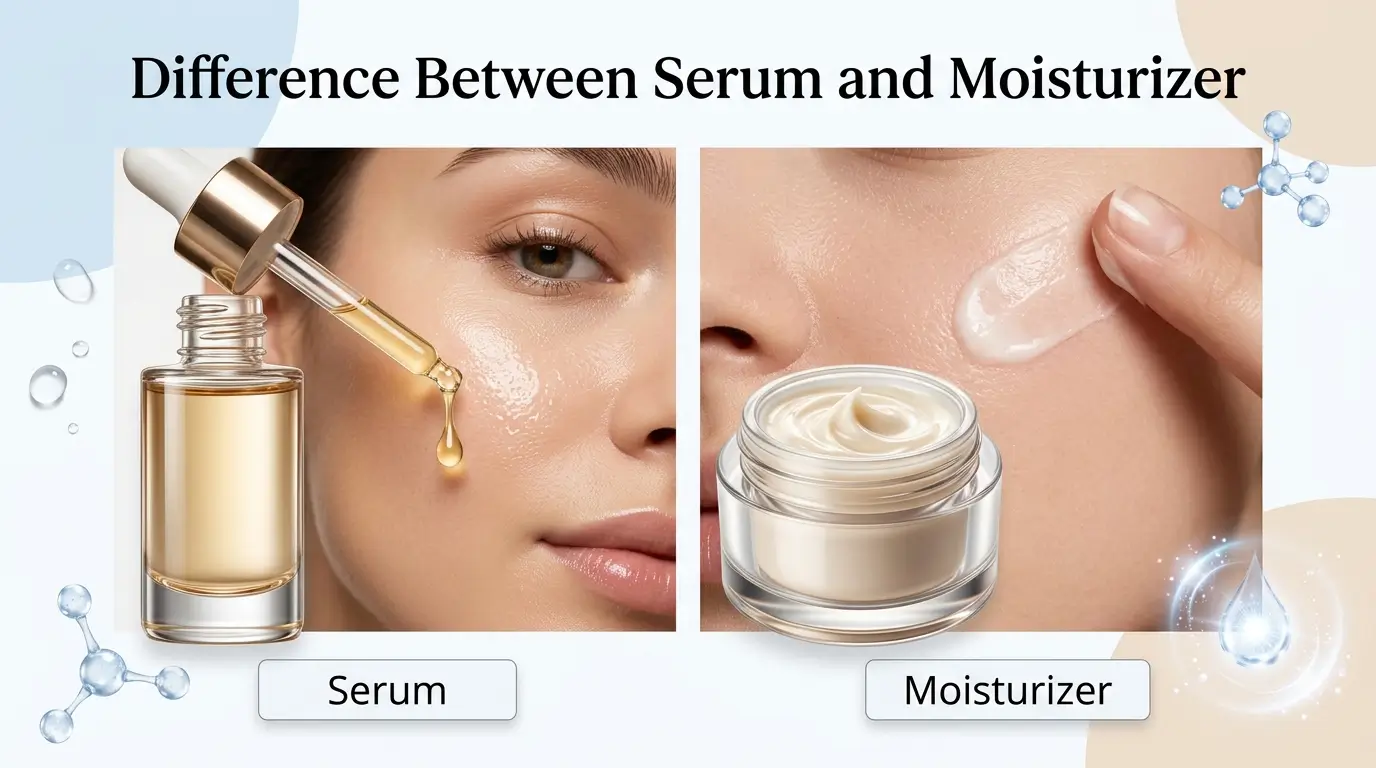
Imagine standing in a skincare aisle looking at dozens of products promising healthy, glowing skin. You pick up a serum and a moisturizer, but both seem to offer hydration and skin benefits. This is where many people become confused. Understanding the difference between serum and moisturizer is essential for creating an effective skincare routine.
A serum is a lightweight skincare product designed to deliver concentrated active ingredients deep into the skin. A moisturizer, on the other hand, is formulated to hydrate the skin and create a protective barrier that prevents moisture loss.
Knowing the difference between serum and moisturizer helps people choose the right product for their skin needs. If you are a beginner or a skincare expert, understanding the difference between serum and moisturizer can improve skin health and prevent unnecessary spending on unsuitable products. As skincare awareness continues to grow worldwide, learning the difference between serum and moisturizer has become increasingly important.
Pronunciation
Serum
US: /ˈsɪr.əm/ (SEER-um)
UK: /ˈsɪə.rəm/ (SEE-uh-rum)
Moisturizer
US: /ˈmɔɪs.tʃə.raɪ.zər/
UK: /ˈmɔɪs.tʃər.aɪ.zə/
Before choosing between these two skincare essentials, let’s explore their features, functions, and benefits in detail.
Key Difference Between Serum and Moisturizer
The primary difference is that a serum delivers concentrated active ingredients to address specific skin concerns, while a moisturizer hydrates the skin and locks in moisture. Serums target problems such as wrinkles, dark spots, or acne, whereas moisturizers focus on maintaining skin hydration and protection.
Why Is Their Difference Necessary to Know for Learners and Experts?
Understanding skincare products is important because healthy skin contributes to confidence, comfort, and overall well-being. Learners need this knowledge to avoid using products incorrectly, while skincare professionals rely on it to recommend effective treatments.
As skincare products become more advanced, knowing the correct purpose of each product helps consumers save money, achieve better results, and avoid skin irritation. This knowledge also supports the growing beauty and wellness industry worldwide.
Difference Between Serum and Moisturizer
1. Purpose
Serum
Serums target specific skin concerns such as aging, acne, or pigmentation.
Examples:
- Vitamin C serum for dark spots.
- Retinol serum for wrinkles.
Moisturizer
Moisturizers mainly hydrate and protect the skin.
Examples:
- Daily facial moisturizer.
- Night cream moisturizer.
2. Texture
Serum
Usually lightweight and thin.
Examples:
- Water-based serum.
- Gel serum.
Moisturizer
Generally thicker and creamier.
Examples:
- Cream moisturizer.
- Lotion moisturizer.
3. Active Ingredients
Serum
Contains highly concentrated active ingredients.
Examples:
- Hyaluronic acid serum.
- Niacinamide serum.
Moisturizer
Contains fewer active ingredients and more hydrating compounds.
Examples:
- Ceramide moisturizer.
- Glycerin moisturizer.
4. Absorption
Serum
Penetrates deeper into the skin.
Examples:
- Anti-aging serum.
- Brightening serum.
Moisturizer
Mostly works on the skin surface.
Examples:
- Barrier-repair moisturizer.
- Sensitive skin moisturizer.
5. Consistency
Serum
Light and fast-absorbing.
Examples:
- Liquid serum.
- Essence-like serum.
Moisturizer
Dense and protective.
Examples:
- Rich cream.
- Thick moisturizing balm.
6. Function
Serum
Treats skin problems.
Examples:
- Acne-control serum.
- Firming serum.
Moisturizer
Maintains hydration levels.
Examples:
- Dry skin moisturizer.
- Everyday moisturizer.
7. Usage Order
Serum
Applied before moisturizer.
Examples:
- Morning vitamin C serum.
- Night retinol serum.
Moisturizer
Applied after serum.
Examples:
- Day moisturizer.
- Sleeping moisturizer.
8. Skin Penetration
Serum
Designed to reach deeper skin layers.
Examples:
- Peptide serum.
- Antioxidant serum.
Moisturizer
Remains mostly on the outer layer.
Examples:
- Protective moisturizer.
- Occlusive moisturizer.
9. Cost
Serum
Often more expensive due to concentrated ingredients.
Examples:
- Luxury vitamin C serum.
- Premium peptide serum.
Moisturizer
Generally less expensive.
Examples:
- Drugstore moisturizer.
- Basic hydrating cream.
10. Primary Benefit
Serum
Targets skin improvement.
Examples:
- Reducing fine lines.
- Brightening complexion.
Moisturizer
Prevents dryness.
Examples:
- Restoring hydration.
- Softening rough skin.
Nature and Behaviour of Both
Nature and Behaviour of Serum
Serums are treatment-focused products. They are lightweight, absorb quickly, and deliver active ingredients deep into the skin. Their behavior is corrective rather than protective.
Nature and Behaviour of Moisturizer
Moisturizers are protective products. They form a barrier that reduces water loss and keeps the skin comfortable and hydrated. Their behavior is preventive and supportive.
Why Are People Confused About Their Use?
People often confuse serums and moisturizers because both are applied to the face and may claim to hydrate the skin. Marketing terms can also overlap, making it difficult to understand their distinct roles. Additionally, some products combine serum-like ingredients with moisturizing properties.
Difference and Similarity Table
| Feature | Serum | Moisturizer | Similarity |
| Main Purpose | Treatment | Hydration | Improve skin health |
| Texture | Thin | Thick | Applied to skin |
| Active Ingredients | High concentration | Moderate concentration | May contain beneficial ingredients |
| Absorption | Deep | Surface level | Support skincare routine |
| Usage Order | First | Second | Often used together |
| Cost | Usually higher | Usually lower | Available in many brands |
| Target | Specific concerns | General hydration | Promote healthier skin |
| Protection | Minimal | Strong | Help skin appearance |
Which Is Better in What Situation?
When Serum Is Better
A serum is better when you have a specific skin concern that needs treatment. If you want to reduce wrinkles, brighten dark spots, control acne, or improve skin texture, a serum can provide concentrated ingredients that directly address those issues.
Because serums penetrate deeper into the skin, they are highly effective for targeted skincare goals. People seeking visible improvements often benefit most from adding a serum to their routine.
When Moisturizer Is Better
A moisturizer is better when your main goal is maintaining hydration and protecting the skin barrier. People with dry, sensitive, or dehydrated skin often depend on moisturizers to keep their skin comfortable and healthy.
Moisturizers help prevent water loss and shield the skin from environmental stress. Even if someone uses a serum, a moisturizer remains essential because it locks in moisture and supports overall skin health.
How the Keywords Are Used in Metaphors and Similes
Serum
Metaphor:
- “Her advice was a serum for my confidence.”
Simile:
- “The solution worked like a serum for the struggling company.”
Moisturizer
Metaphor:
- “His kindness was a moisturizer for wounded emotions.”
Simile:
- “The speech soothed the audience like a moisturizer on dry skin.”
Connotative Meaning
Serum
Positive
- Healing
- Improvement
- Renewal
Example:
“The new training program was a serum for workplace productivity.”
Moisturizer
Positive
- Comfort
- Protection
- Care
Example:
“Her encouragement acted as a moisturizer during difficult times.”
Negative
Neither word commonly carries negative connotations.
Neutral
Both words are generally neutral in technical skincare discussions.
Idioms or Proverbs Related to the Words
There are no widely recognized English idioms directly based on “serum” or “moisturizer.”
However, related skincare expressions include:
“Beauty is only skin deep.”
Example:
“Remember, beauty is only skin deep; character matters more.”
“Prevention is better than cure.”
Example:
“Using moisturizer daily proves that prevention is better than cure.”
Works in Literature
Serum
- The Serum – Crime Fiction, Douglas Preston, 2012
- The Truth Serum – Children’s Fiction, various editions
Moisturizer
There are currently no major literary works titled “Moisturizer.”
Movies Related to the Keywords
Serum
- Truth Serum (2007, USA)
- The Serum (Independent Film, USA)
Moisturizer
No major internationally recognized films are titled “Moisturizer.”
Frequently Asked Questions
1. Can I use serum without moisturizer?
Yes, but using both provides better skincare benefits.
2. Should serum be applied before moisturizer?
Yes. Serum should always be applied first.
3. Can moisturizer replace serum?
No. They perform different functions.
4. Is serum necessary for all skin types?
Not always, but it helps address specific concerns.
5. Can oily skin use moisturizer?
Yes. Oily skin still needs hydration.
How Both Are Useful for Surroundings
Serums and moisturizers contribute to personal hygiene, confidence, and overall well-being. Healthy skin can reduce discomfort and improve social interactions. The skincare industry also creates jobs, supports scientific research, and promotes awareness about skin health and protection.
Final Words for Both
Serums and moisturizers are not competitors; they are partners in skincare. While serums focus on treatment and improvement, moisturizers focus on hydration and protection. Using them together often produces the best results.
Conclusion
Understanding the difference between serum and moisturizer is essential for building an effective skincare routine. Although both products contribute to healthier skin, they serve different purposes. Serums provide concentrated active ingredients that target specific concerns such as wrinkles, pigmentation, and acne.
Moisturizers hydrate the skin and create a protective barrier that prevents moisture loss. Knowing when and how to use each product allows people to maximize skincare benefits and achieve better results. If you are a skincare beginner or an experienced professional, recognizing the strengths of both products can help you make informed decisions and maintain healthy, radiant skin for years to come.

Dr. Marcus Reed is a lead editorial author at WordCompares.com and a specialist in communication studies and written clarity. With more than 12 years of university-level teaching experience, he focuses on explaining word distinctions in a clear and structured manner. His work ensures that WordCompares.com maintains accuracy, depth, and reader trust.