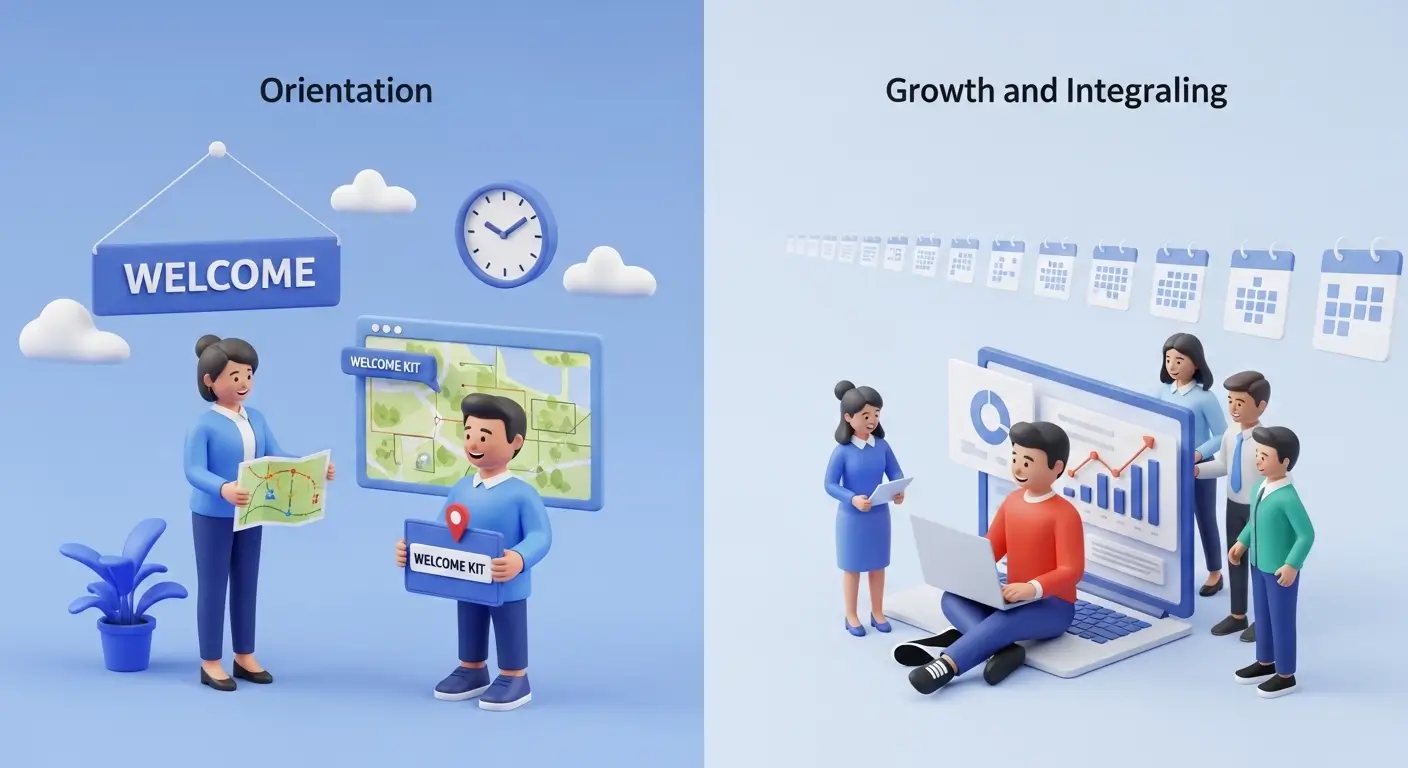
On his first day at a new job, Ahmed walked into the office feeling both excited and nervous. The HR team welcomed him, introduced him to colleagues, and explained the company’s rules. This was his orientation. But over the next few weeks, he attended training sessions, learned company systems, and slowly became part of the team—that was onboarding.
The difference between orientation and onboarding often confuses people because both processes happen at the start of a new job or program. However, understanding the difference between orientation and onboarding helps employees adapt faster and helps organizations improve productivity. Whether you are a student, a teacher, or a corporate professional, knowing the difference between orientation and onboarding can help you prepare for new environments more confidently. This guide explains the difference between orientation and onboarding in a clear and practical way.
Key Difference Between the Both
Orientation is a short-term introduction, usually conducted on the first day or first few days, where new members learn basic information such as rules, policies, and structure. Onboarding, on the other hand, is a long-term process that focuses on training, integration, and skill development over weeks or months.
Why Is Their Difference Necessary to Know?
Understanding the difference is important for both learners and experts. Students entering universities, employees joining companies, and even volunteers in organizations go through these processes. If institutions only focus on orientation and ignore onboarding, individuals may feel lost after the first week.
Experts in management and education emphasize onboarding because it improves retention, performance, and satisfaction. Knowing the difference between orientation and onboarding helps organizations design better programs and helps individuals know what to expect during transitions in life.
Pronunciation of Both Words
- Orientation
- US: or-ee-en-TAY-shun
- UK: aw-ree-en-TAY-shun
- Onboarding
- US: on-bor-ding
- UK: on-baw-ding
Linking Hook to the Main Discussion
Now that you understand the basic meaning and importance of these terms, let us explore the detailed difference between orientation and onboarding through clear examples and comparisons.
Difference Between Orientation and Onboarding
1. Duration
Orientation is short, often lasting one day or one week.
Onboarding continues for weeks or months.
Examples:
- Orientation: A university holds a one-day welcome session for new students.
- Orientation: A company gives a two-hour presentation about company rules.
- Onboarding: A new employee receives training for three months.
- Onboarding: A student participates in mentoring programs throughout the semester.
2. Purpose
Orientation provides basic information, while onboarding focuses on skill development and integration.
Examples:
- Orientation: HR explains company policies.
- Orientation: School staff explain campus rules.
- Onboarding: Employee learns how to use company software.
- Onboarding: New teacher receives classroom management training.
3. Depth of Information
Orientation gives general information. Onboarding gives detailed and practical knowledge.
Examples:
- Orientation: Overview of company departments.
- Orientation: Introduction to school facilities.
- Onboarding: Detailed training on department tasks.
- Onboarding: Workshops on academic writing skills.
4. Time of Occurrence
Orientation happens at the beginning. Onboarding continues after orientation.
Examples:
- Orientation: Conducted on the first day of joining.
- Orientation: Held before classes start.
- Onboarding: Weekly check-ins after joining.
- Onboarding: Continued mentoring during the first semester.
5. Focus
Orientation focuses on information, while onboarding focuses on adaptation and performance.
Examples:
- Orientation: Rules about attendance are explained.
- Orientation: Company history is shared.
- Onboarding: Employee learns how to handle real projects.
- Onboarding: Student learns how to manage assignments effectively.
6. Interaction Level
Orientation is often lecture-based. Onboarding is interactive and hands-on.
Examples:
- Orientation: Watching presentations in a hall.
- Orientation: Listening to speeches from administrators.
- Onboarding: Participating in team projects.
- Onboarding: Hands-on software training.
7. Emotional Impact
Orientation reduces initial anxiety, while onboarding builds confidence and belonging.
Examples:
- Orientation: Meeting colleagues reduces fear.
- Orientation: Seeing the campus reduces confusion.
- Onboarding: Team lunches create friendships.
- Onboarding: Mentoring improves confidence in work.
8. Responsibility
Orientation is usually handled by HR or administration. Onboarding involves managers, mentors, and team members.
Examples:
- Orientation: HR presents company policies.
- Orientation: School administration introduces departments.
- Onboarding: Manager trains employee on daily tasks.
- Onboarding: Senior student guides junior students.
9. Content Type
Orientation content is mostly general. Onboarding content is role-specific.
Examples:
- Orientation: General safety rules for all employees.
- Orientation: Overview of all academic programs.
- Onboarding: Training specific to marketing department.
- Onboarding: Guidance specific to engineering students.
10. Goal
Orientation aims to inform. Onboarding aims to integrate and retain.
Examples:
- Orientation: Making sure new hires know company rules.
- Orientation: Ensuring students know where classes are held.
- Onboarding: Helping employees stay long-term.
- Onboarding: Helping students succeed academically.
Nature and Behaviour of Both
Orientation is formal, structured, and informational. It behaves like an introduction that opens the door to a new environment.
Onboarding is continuous, supportive, and developmental. It behaves like a guiding process that helps individuals grow and feel part of the system.
Why People Are Confused About Their Use
People confuse these terms because both occur at the start of a new experience. Many organizations also use them interchangeably, even though they have different purposes. Additionally, orientation is often included as the first step of onboarding, which makes the boundary between the two less clear.
Table Showing Difference and Similarity
| Feature | Orientation | Onboarding | Similarity |
| Duration | Short | Long-term | Both occur at the beginning |
| Purpose | Introduction | Integration | Both help newcomers |
| Depth | Basic | Detailed | Both provide information |
| Interaction | Mostly passive | Highly interactive | Both involve communication |
| Responsibility | HR/Admin | Whole organization | Both organized by institution |
Which Is Better in What Situation?
Orientation is better when someone needs quick and essential information to avoid confusion. For example, on the first day of school or job, people need directions, schedules, and rules. Orientation serves this purpose effectively because it saves time and gives a structured overview of the environment.
Onboarding is better when the goal is long-term success and performance. Complex workplaces, universities, and technical roles require training, mentoring, and gradual adaptation. In such situations, onboarding ensures that individuals not only understand the environment but also perform well and remain engaged.
Use in Metaphors and Similes
- Orientation is often compared to “a map before a journey.”
- Onboarding is compared to “learning to sail after boarding a ship.”
Examples:
- “The orientation session was like a map that helped me navigate my first week.”
- “Good onboarding is like a coach guiding a player through the entire season.”
Connotative Meaning
Orientation
- Usually neutral or positive
- Example: “The orientation was helpful and welcoming.”
Onboarding
- Mostly positive because it suggests support and development
- Example: “The company’s onboarding process made me feel valued and prepared.”
Idioms or Proverbs Related to the Words
While there are no direct idioms for these terms, related expressions are used:
- “First impressions matter” – related to orientation
- Example: “A well-organized orientation shows that first impressions matter.”
- “Learning the ropes” – related to onboarding
- Example: “During onboarding, new employees learn the ropes of the company.”
Works in Literature
Although these exact words are modern, related themes appear in literature:
- “Great Expectations” – Novel, Charles Dickens, 1861
- Shows a character adjusting to a new social environment.
- “Jane Eyre” – Novel, Charlotte Brontë, 1847
- Depicts adaptation and integration into new institutions.
Movies Related to the Themes
- “The Internship” – 2013, USA
- Shows onboarding and training of new employees at a tech company.
- “Legally Blonde” – 2001, USA
- Shows orientation and adaptation to a new academic environment.
Frequently Asked Questions
1. Is orientation part of onboarding?
Yes, orientation is usually the first step in the onboarding process.
2. How long does onboarding usually last?
Onboarding can last from a few weeks to several months depending on the organization.
3. Can a company succeed without onboarding?
Yes, but employees may take longer to adjust and may leave earlier due to lack of support.
4. Do schools also use onboarding?
Yes, many universities now provide mentoring and training programs that function as onboarding.
5. Which one is more important?
Both are important because orientation provides the foundation and onboarding builds long-term success.
How Both Are Useful for Surroundings
Orientation ensures that people understand rules, safety procedures, and expectations, which helps maintain order in schools, workplaces, and communities. Onboarding builds strong relationships, improves performance, and creates supportive environments, making institutions more productive and harmonious.
Final Words for Both Terms
Orientation opens the door to a new world, while onboarding guides individuals as they walk through that door and settle in. Both are essential stages of any new beginning.
Conclusion
In summary, the difference between orientation and onboarding lies in their duration, purpose, and depth. Orientation is a short introduction that provides basic information, while onboarding is a long-term process that supports learning, integration, and development. Understanding this distinction helps organizations design better programs and helps individuals adapt more confidently to new environments.
When both processes are properly implemented, they create a smooth transition, reduce stress, and increase success for everyone involved. Whether in education or employment, orientation and onboarding together form the foundation of a positive and productive start.

Dr. Marcus Reed is a lead editorial author at WordCompares.com and a specialist in communication studies and written clarity. With more than 12 years of university-level teaching experience, he focuses on explaining word distinctions in a clear and structured manner. His work ensures that WordCompares.com maintains accuracy, depth, and reader trust.