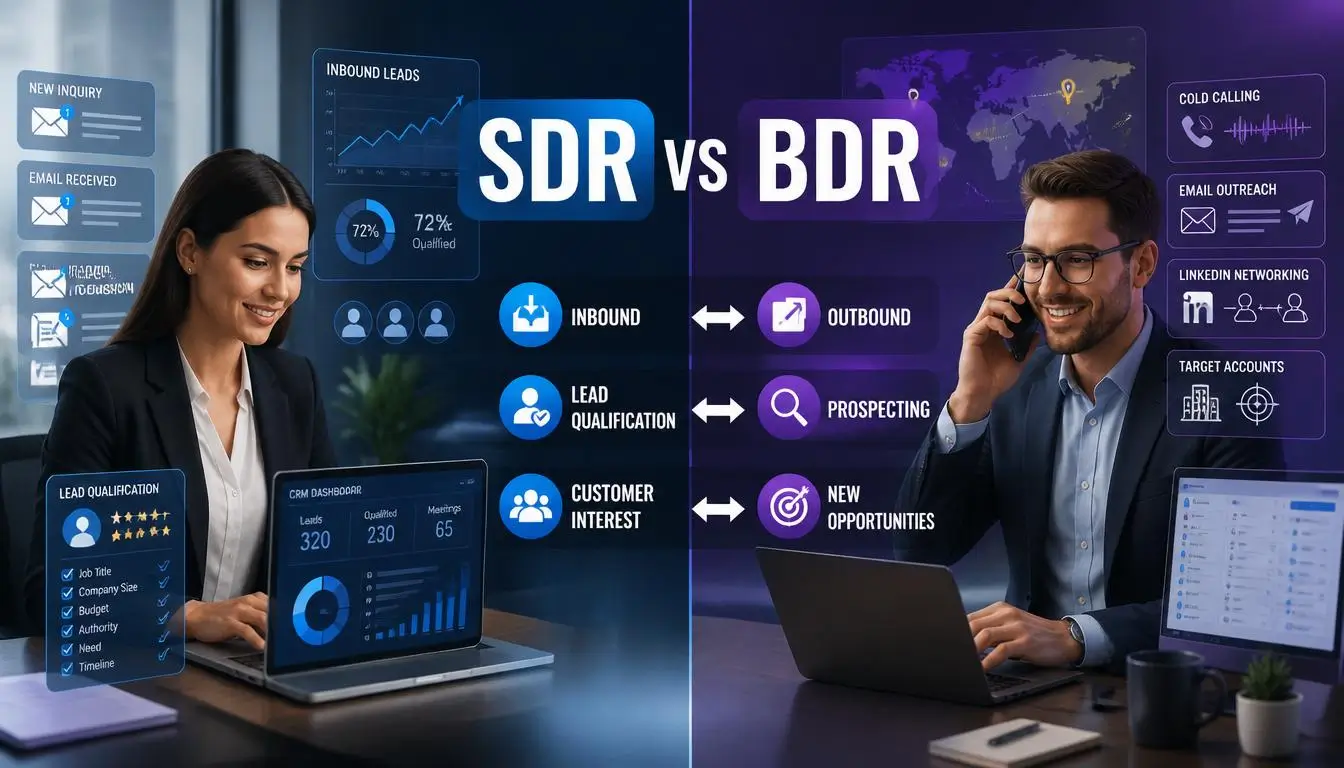
Imagine a growing software company that receives hundreds of potential customer inquiries every week. To manage these opportunities effectively, the company creates two specialized sales roles: SDR and BDR.
While both professionals help generate business opportunities, their responsibilities differ significantly. Understanding the difference between SDR and BDR is essential for businesses, sales teams, learners, and professionals who want to succeed in modern sales environments.
The difference between SDR and BDR often confuses newcomers because both roles focus on lead generation and customer acquisition. However, their methods, target audiences, and objectives vary.
Learning the difference between SDR and BDR helps organizations build efficient sales pipelines and improve revenue generation. Whether you are a student, entrepreneur, or sales expert, knowing the difference between SDR and BDR can improve your understanding of business development and sales operations.
Key Difference Between SDR and BDR
The primary difference is that an SDR (Sales Development Representative) focuses on qualifying inbound leads and identifying sales opportunities, while a BDR (Business Development Representative) focuses on generating new business opportunities through outbound prospecting and relationship building.
Why is the difference necessary to Know for Learners and Experts?
Understanding SDR and BDR roles is important because modern businesses rely heavily on specialized sales teams. Learners gain clarity about career opportunities in sales, while experts can improve organizational efficiency by assigning the right tasks to the right professionals.
Knowing these differences helps companies:
- Improve sales productivity.
- Increase lead conversion rates.
- Reduce wasted resources.
- Create clear career paths.
- Enhance customer engagement.
In today’s competitive business environment, SDRs and BDRs play critical roles in driving growth and revenue generation.
Pronunciation
SDR
US Pronunciation: /ˌes.diːˈɑːr/
UK Pronunciation: /ˌes.diːˈɑː/
Pronounced as: Ess-Dee-Are
BDR
US Pronunciation: /ˌbiː.diːˈɑːr/
UK Pronunciation: /ˌbiː.diːˈɑː/
Pronounced as: Bee-Dee-Are
Linking Hook
Now that we understand what SDRs and BDRs are and why they matter, let’s explore the detailed difference between SDR and BDR through ten key comparison points.
Difference Between SDR and BDR
1. Primary Focus
SDR
SDRs focus on qualifying incoming leads generated through marketing efforts.
Examples:
- Responding to a website inquiry.
- Following up on webinar registrations.
BDR
BDRs focus on finding new business opportunities through proactive outreach.
Examples:
- Contacting companies not yet familiar with the brand.
- Cold emailing potential customers.
2. Lead Source
SDR
Works mainly with inbound leads.
Examples:
- Leads from online forms.
- Leads from digital advertising campaigns.
BDR
Works mainly with outbound leads.
Examples:
- Prospect lists.
- Industry directories.
3. Outreach Method
SDR
Responds to prospects who have already shown interest.
Examples:
- Returning customer calls.
- Scheduling discovery meetings.
BDR
Initiates first contact with prospects.
Examples:
- Cold calls.
- LinkedIn prospecting.
4. Sales Funnel Position
SDR
Operates in the middle of lead generation processes.
Examples:
- Evaluating lead quality.
- Determining purchasing readiness.
BDR
Works at the top of the sales funnel.
Examples:
- Identifying target companies.
- Creating prospect databases.
5. Goal
SDR
Goal is lead qualification.
Examples:
- Assessing budget.
- Confirming decision-makers.
BDR
Goal is opportunity creation.
Examples:
- Opening conversations.
- Creating market awareness.
6. Customer Relationship Stage
SDR
Engages interested prospects.
Examples:
- Product demonstrations.
- Follow-up discussions.
BDR
Engages unfamiliar prospects.
Examples:
- Introduction emails.
- Networking outreach.
7. Performance Metrics
SDR
Measured by qualified leads generated.
Examples:
- Number of appointments booked.
- Conversion rates.
BDR
Measured by opportunities created.
Examples:
- Meetings arranged.
- New accounts identified.
8. Communication Style
SDR
More consultative and informative.
Examples:
- Answering product questions.
- Providing solutions.
BDR
More persuasive and exploratory.
Examples:
- Creating curiosity.
- Introducing business value.
9. Collaboration
SDR
Works closely with marketing teams.
Examples:
- Managing campaign-generated leads.
- Providing lead quality feedback.
BDR
Works closely with sales leadership.
Examples:
- Developing target account strategies.
- Identifying market opportunities.
10. Skill Requirements
SDR
Requires strong qualification and communication skills.
Examples:
- Active listening.
- Product knowledge.
BDR
Requires prospecting and networking abilities.
Examples:
- Cold outreach.
- Relationship building.
Nature and Behaviour of SDR and BDR
SDR Nature and Behaviour
SDRs are analytical, patient, and customer-focused. They spend time understanding prospects’ needs and determining whether they are ready for sales conversations.
BDR Nature and Behaviour
BDRs are proactive, energetic, and opportunity-driven. They actively search for potential customers and create new business relationships.
Why Are People Confused About Their Use?
People often confuse SDRs and BDRs because both roles involve lead generation and sales development. Their daily activities may appear similar, especially in smaller organizations where one person performs both functions. Additionally, different companies sometimes define these roles differently, increasing confusion.
Difference and Similarity Table
| Feature | SDR | BDR | Similarity |
| Full Form | Sales Development Representative | Business Development Representative | Both are sales roles |
| Lead Type | Inbound | Outbound | Generate opportunities |
| Main Goal | Qualify leads | Create leads | Support revenue growth |
| Outreach | Reactive | Proactive | Customer engagement |
| Funnel Stage | Middle | Top | Part of sales pipeline |
| Metrics | Qualified leads | New opportunities | Performance-based |
| Focus | Lead nurturing | Prospecting | Business growth |
| Team Collaboration | Marketing | Sales leadership | Team-oriented |
| Communication | Consultative | Persuasive | Relationship building |
| Career Path | Account Executive | Sales Leadership | Sales advancement |
Which Is Better in What Situation?
SDR
An SDR role is better when a company receives large volumes of inbound leads. Organizations that invest heavily in digital marketing need SDRs to evaluate prospects efficiently and ensure only qualified opportunities reach sales representatives. SDRs help maximize conversion rates and improve customer experiences.
BDR
A BDR role is better when a company wants to expand into new markets or acquire new customers. Businesses launching new products or entering competitive industries benefit from BDRs because they actively identify opportunities that marketing efforts may not generate naturally.
How the Keywords Are Used in Metaphors and Similes
SDR
Metaphor: “The SDR is the gatekeeper of the sales kingdom.”
Simile: “An SDR is like a skilled detective, uncovering qualified opportunities.”
BDR
Metaphor: “The BDR is the explorer of new business territories.”
Simile: “A BDR is like a hunter searching for valuable opportunities.”
Connotative Meaning
| Word | Connotation | Example |
| SDR | Positive/Neutral | “The SDR carefully qualified the lead before passing it on.” |
| BDR | Positive/Neutral | “The BDR opened doors to several new business opportunities.” |
Neither term usually carries negative connotations.
Idioms or Proverbs Related to SDR and BDR
Since SDR and BDR are modern business terms, there are no direct idioms. However, related business idioms include:
“Get your foot in the door”
Meaning: Gain an initial opportunity.
Example: The BDR helped the company get its foot in the door with major clients.
“Strike while the iron is hot”
Meaning: Act quickly when an opportunity appears.
Example: The SDR contacted the lead immediately and struck while the iron was hot.
“Cast a wide net”
Meaning: Reach many prospects.
Example: The BDR cast a wide net during the outreach campaign.
Works in Literature Related to Sales and Business Development
While SDR and BDR themselves rarely appear as literary titles, related business works include:
- The Challenger Sale — Business, Matthew Dixon & Brent Adamson (2011)
- SPIN Selling — Sales, Neil Rackham (1988)
- Fanatical Prospecting — Sales, Jeb Blount (2015)
- Predictable Revenue — Business, Aaron Ross & Marylou Tyler (2011)
- New Sales. Simplified. — Business, Mike Weinberg (2012)
Movies Related to Sales and Business Development
- Glengarry Glen Ross (1992, USA)
- Boiler Room (2000, USA)
- The Pursuit of Happyness (2006, USA)
- Jerry Maguire (1996, USA)
- The Founder (2016, USA)
Frequently Asked Questions
1. What does SDR stand for?
SDR stands for Sales Development Representative.
2. What does BDR stand for?
BDR stands for Business Development Representative.
3. Is SDR higher than BDR?
Not necessarily. They are different roles with different responsibilities.
4. Do SDRs and BDRs both generate leads?
Yes, but SDRs usually handle inbound leads while BDRs focus on outbound prospecting.
5. Which role is better for beginners?
Both are excellent entry-level sales careers. The best choice depends on whether someone prefers lead qualification or prospecting.
How Both Are Useful for Surroundings
SDRs and BDRs contribute to economic growth by helping businesses connect with customers, create employment opportunities, and drive innovation. Their work supports healthy competition and improves access to products and services for consumers.
Final Words for Both
SDRs ensure that interested prospects receive proper attention and qualification, while BDRs create new opportunities that fuel business expansion. Together, they form a strong foundation for modern sales success.
Conclusion
Understanding the difference between SDR and BDR is essential for anyone involved in business, sales, or marketing. Although both roles aim to generate revenue and business growth, their approaches differ significantly. SDRs specialize in qualifying inbound leads and nurturing interested prospects, whereas BDRs focus on outbound prospecting and opening new opportunities.
Each role contributes unique value to the sales process, helping organizations build efficient pipelines and achieve sustainable growth. By learning the strengths, responsibilities, and purposes of each position, learners and professionals can make informed career decisions and improve organizational performance.
Ultimately, SDRs and BDRs work together to transform prospects into long-term business relationships.

Jordan L. Carter is a contributing language analyst at WordCompares.com, focusing on modern English usage, evolving vocabulary trends, and digital communication language. With over a decade of writing experience, Jordan provides insightful word comparisons that make complex language differences simple for everyday readers.