Imagine a primary school where several children suddenly become sick within the same week. Some develop itchy blisters all over their bodies, while others experience a high fever followed by a widespread red rash. Parents become worried and ask an important question: Is it chickenpox or measles? Although both diseases can cause rashes and fever, they are very different illnesses with distinct causes, symptoms, and complications.
Understanding the difference between chickenpox and measles is essential for parents, teachers, healthcare workers, and students. The difference between chickenpox and measles helps people recognize symptoms early and seek proper medical care.
Learning the difference between chickenpox and measles can also prevent unnecessary panic and reduce the spread of infection. Throughout this article, we will explore the difference between chickenpox and measles in a simple and practical way.
Key Difference Between Chickenpox and Measles
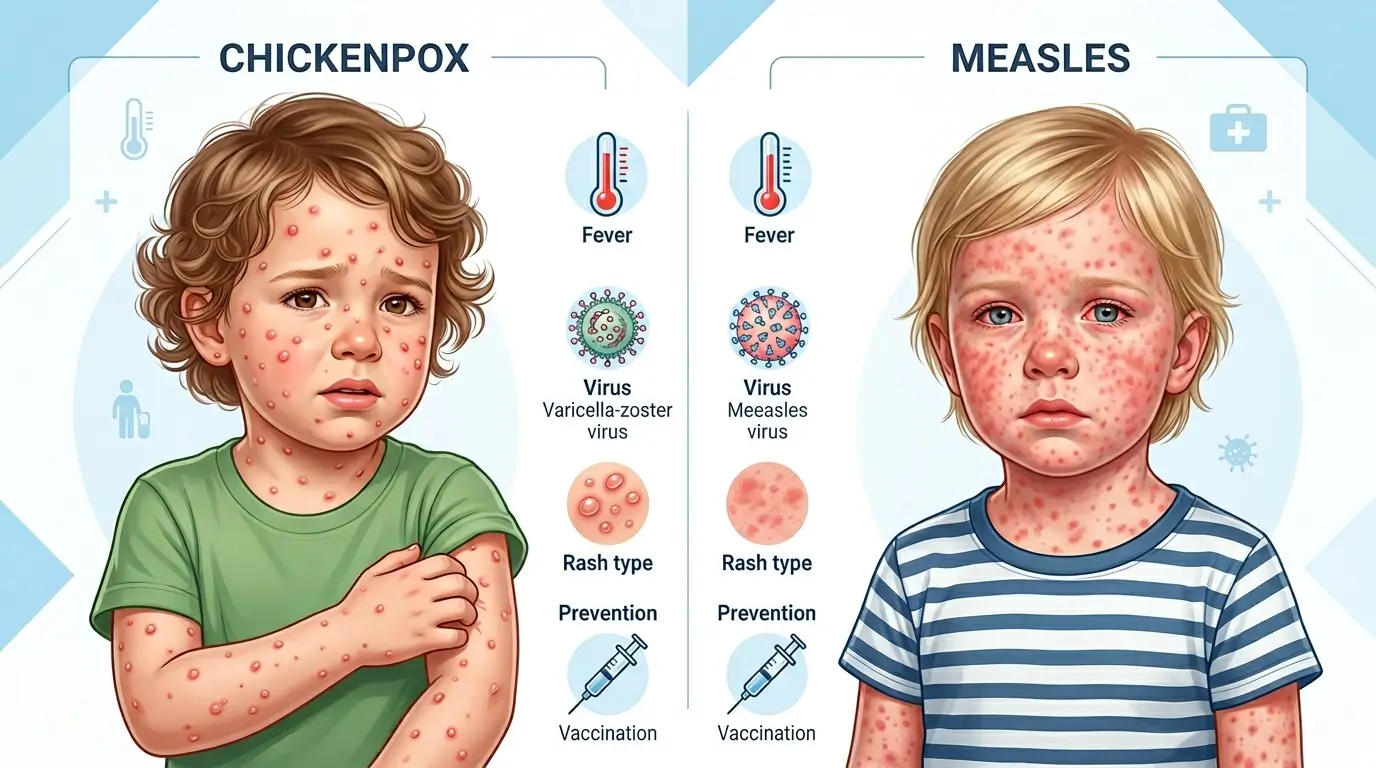
The primary difference is that chickenpox is caused by the Varicella Zoster virus and produces itchy fluid filled blisters, whereas measles is caused by the measles virus and results in a red flat rash accompanied by cough, runny nose, and red eyes.
Why Is Their Difference Necessary to Know for Learners and Experts?
Understanding these diseases is important because they affect public health and community safety. Learners benefit from knowing how infections spread and how vaccines work. Medical experts rely on accurate diagnosis to provide effective treatment and prevent outbreaks.
Knowing the distinction helps:
- Reduce disease transmission.
- Encourage timely vaccination.
- Improve public health awareness.
- Prevent misdiagnosis.
- Support better healthcare decisions.
In modern society, recognizing these illnesses quickly can save lives and protect vulnerable populations.
Pronunciation
| Word | US Pronunciation | UK Pronunciation |
| Chickenpox | CHIK en poks (/ˈtʃɪkənˌpɑːks/) | CHIK en poks (/ˈtʃɪkənpɒks/) |
| Measles | MEE zuhlz (/ˈmiːzəlz/) | MEE zuhlz (/ˈmiːzəlz/) |
Linking Hook
Now that we understand the basic meanings and importance of these diseases, let’s explore the detailed difference between chickenpox and measles through symptoms, causes, appearance, transmission, and other essential characteristics.
Difference Between Chickenpox and Measles
1. Cause
Chickenpox
Caused by the Varicella Zoster virus.
Examples:
- A child catches chickenpox from a classmate.
- An unvaccinated person becomes infected after contact with blisters.
Measles
Caused by the measles virus.
Examples:
- A traveler contracts measles during an outbreak.
- An unvaccinated child gets infected through airborne droplets.
2. Rash Appearance
Chickenpox
Produces itchy fluid filled blisters.
Examples:
- Small blisters appear on the chest.
- Blisters later form crusts and scabs.
Measles
Produces flat red spots.
Examples:
- Red rash starts on the face.
- Rash spreads downward across the body.
3. Itching
Chickenpox
Extremely itchy.
Examples:
- Children constantly scratch the rash.
- Itching may disturb sleep.
Measles
Usually not very itchy.
Examples:
- Patients complain more about fever.
- Rash causes discomfort rather than itching.
4. Fever Pattern
Chickenpox
Mild to moderate fever.
Examples:
- Temperature rises before blisters appear.
- Fever often subsides after a few days.
Measles
High fever.
Examples:
- Fever may exceed 104°F (40°C).
- Fever continues during rash development.
5. Spread of Rash
Chickenpox
Appears in waves.
Examples:
- New blisters emerge daily.
- Different stages exist simultaneously.
Measles
Spreads in a continuous pattern.
Examples:
- Rash begins at the hairline.
- Rash moves downward systematically.
6. Respiratory Symptoms
Chickenpox
Usually mild respiratory symptoms.
Examples:
- Slight cough.
- Mild sore throat.
Measles
Strong respiratory symptoms.
Examples:
- Persistent cough.
- Runny nose and red eyes.
7. Contagious Period
Chickenpox
Contagious until blisters crust over.
Examples:
- Children stay home from school.
- Isolation ends after scabs form.
Measles
Contagious before and after rash appearance.
Examples:
- Infection spreads before diagnosis.
- Airborne particles remain infectious.
8. Vaccination
Chickenpox
Prevented by varicella vaccine.
Examples:
- Children receive routine vaccination.
- Vaccinated individuals often have milder illness.
Measles
Prevented by MMR vaccine.
Examples:
- MMR protects against measles, mumps, and rubella.
- Vaccination reduces outbreaks.
9. Complications
Chickenpox
May cause skin infections.
Examples:
- Scratching leads to bacterial infection.
- Rare cases involve pneumonia.
Measles
Can cause severe complications.
Examples:
- Pneumonia develops in serious cases.
- Brain inflammation may occur.
10. Long Term Effects
Chickenpox
Virus may reactivate later as shingles.
Examples:
- Adults develop shingles decades later.
- Nerve pain follows reactivation.
Measles
No shingles like reactivation.
Examples:
- Recovery usually eliminates active infection.
- Rare neurological complications may persist.
Nature and Behaviour of Both
Chickenpox
Chickenpox is an infectious viral disease characterized mainly by itchy blisters. It spreads through direct contact and respiratory droplets. The disease is generally mild in healthy children but may be serious in adults and people with weakened immune systems.
Measles
Measles is a highly contagious viral disease that primarily affects the respiratory system before causing a widespread rash. It spreads through airborne particles and can result in serious complications if not treated properly.
Why Are People Confused About Their Use?
People often confuse chickenpox and measles because:
- Both are viral infections.
- Both cause fever and rash.
- Both commonly affect children.
- Both are preventable through vaccination.
- Early symptoms may appear similar.
However, the appearance of the rash and associated symptoms differ significantly.
Difference and Similarity Table
| Feature | Chickenpox | Measles | Similarity |
| Cause | Varicella Zoster virus | Measles virus | Both are viral diseases |
| Rash | Fluid filled blisters | Flat red rash | Both cause skin eruptions |
| Itching | Severe | Mild | Both may cause discomfort |
| Fever | Moderate | High | Both involve fever |
| Spread | Contact and droplets | Airborne droplets | Both are contagious |
| Vaccine | Varicella vaccine | MMR vaccine | Both preventable |
| Respiratory Symptoms | Mild | Severe | Both may affect breathing |
| Complications | Skin infections | Pneumonia, encephalitis | Both can become serious |
| Target Group | Mostly children | Mostly children | Common in childhood |
| Recovery | Usually within weeks | Usually within weeks | Both require rest |
Which Is Better in What Situation?
Chickenpox
Chickenpox is generally considered less severe than measles in healthy children. While the itching can be uncomfortable, serious complications are relatively uncommon. Most children recover fully with supportive care and rest. Vaccination has greatly reduced severe cases and hospitalizations. Therefore, if comparing the overall disease burden, chickenpox is often less dangerous than measles.
Measles
Measles is not “better” medically because it tends to be more contagious and can lead to severe complications. However, from a diagnostic perspective, its distinctive respiratory symptoms and characteristic rash pattern may help healthcare professionals identify it quickly during outbreaks. Prevention through vaccination remains the safest approach.
How the Keywords Are Used in Metaphors and Similes
Chickenpox
Metaphors
- “The city map looked like chickenpox after countless construction projects.”
Similes
- “The paper was covered with spots like chickenpox.”
Measles
Metaphors
- “The hillside showed a measles of red flowers.”
Similes
- “The freckles spread like measles across the painting.”
Connotative Meanings
| Word | Connotation | Example |
| Chickenpox | Negative | “The outbreak of chickenpox disrupted school activities.” |
| Measles | Negative | “Measles remains a serious public health concern.” |
Both terms generally carry negative connotations because they refer to illnesses.
Idioms or Proverbs Related to the Words
There are no widely recognized English idioms specifically using “chickenpox” or “measles.” However, related health expressions include:
“An ounce of prevention is worth a pound of cure.”
Example:
Getting vaccinated against chickenpox and measles proves that an ounce of prevention is worth a pound of cure.
“Prevention is better than cure.”
Example:
Parents vaccinate their children because prevention is better than cure.
Works in Literature
Chickenpox
- “Chickenpox” – Children’s Fiction – Remy Simard – 2014
- “Chicken Pox Explosion” – Children’s Literature – Abby Klein – 2007
Measles
- “Measles Book” – Medical Nonfiction – Various Public Health Authors – Multiple Editions
- “The Measles Chronicles” – Historical Medical Writing – Various Authors
Movies Related to the Keywords
Chickenpox
- Chickenpox (2005, India)
- Chicken Pox (Various educational productions)
Measles
- Measles and Rubella Awareness Films (Various countries, educational documentaries)
- The Story of Measles Vaccination (Educational documentary, multiple releases)
Frequently Asked Questions
1. Is chickenpox the same as measles?
No. They are caused by different viruses and produce different types of rashes.
2. Which disease is more contagious?
Measles is generally considered more contagious than chickenpox.
3. Can vaccines prevent both diseases?
Yes. Separate vaccines are available and highly effective.
4. Does chickenpox cause blisters?
Yes. Fluid filled itchy blisters are a hallmark symptom.
5. Can adults get these diseases?
Yes. Adults can contract both illnesses, often with more severe symptoms.
How Both Are Useful for Surroundings
Although these diseases themselves are harmful, studying them benefits society by:
- Improving vaccine development.
- Advancing medical research.
- Enhancing public health systems.
- Teaching disease prevention strategies.
- Encouraging community health awareness.
Final Words for Both
Chickenpox
Chickenpox is a contagious viral disease best known for its itchy blisters. Vaccination and proper care have significantly reduced its impact worldwide.
Measles
Measles remains one of the most contagious viral diseases. Early diagnosis and vaccination are essential for preventing severe complications and outbreaks.
Conclusion
The difference between chickenpox and measles lies in their causes, symptoms, rash characteristics, transmission methods, and potential complications. Chickenpox is caused by the Varicella Zoster virus and typically produces itchy blisters, while measles is caused by the measles virus and is characterized by a red rash accompanied by respiratory symptoms.
Although both diseases affect children and can spread rapidly, they require different approaches to diagnosis and management. Understanding these distinctions helps parents, students, healthcare professionals, and communities respond appropriately to symptoms and prevent transmission.
Most importantly, vaccination remains the most effective tool for protecting individuals and society from both illnesses. By learning the difference between chickenpox and measles, we can make informed healthcare decisions and contribute to a healthier community.

Alexandra “Alex” Monroe is a senior linguistics contributor at WordCompares.com, where she specializes in comparative word analysis, semantics, and language clarity. With over 15 years of academic and editorial experience, Alex helps readers understand subtle differences between commonly confused words and phrases. Her research-driven yet practical writing style strengthens the educational authority of WordCompares.com.