Have you ever heard someone mention Iran when they actually meant Iraq? This happens more often than many people realize. During an international news discussion, a student once confused the two countries while giving a classroom presentation.
Although the names sound similar in English, they are two separate nations with different histories, cultures, languages, governments, and geographical features. Understanding the difference between Iran and Iraq helps people communicate accurately and avoid misunderstandings in education, business, travel, and global affairs.
The difference between Iran and Iraq is not limited to their names. Their people speak different primary languages, follow different political systems, and have distinct historical backgrounds.
Learning the difference between Iran and Iraq also improves geographical knowledge and cultural awareness. Whether you are a student, researcher, traveler, or simply interested in world affairs, knowing the difference between Iran and Iraq is both practical and valuable.
Key Difference Between Iran and Iraq
Although Iran and Iraq share a border in the Middle East, they differ in many important ways.
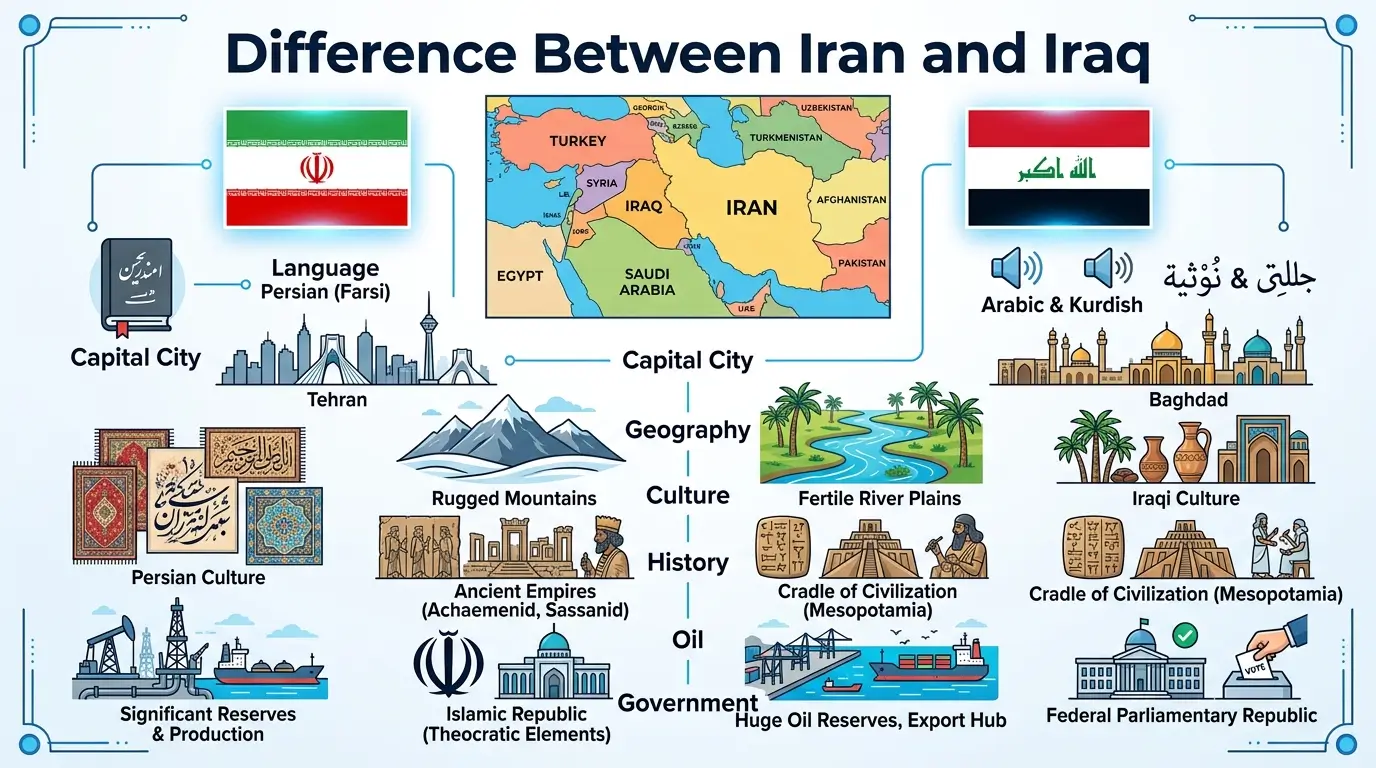
- Iran is officially known as the Islamic Republic of Iran. Persian (Farsi) is its official language, and it has one of the world’s oldest civilizations.
- Iraq is officially known as the Republic of Iraq. Arabic and Kurdish are its official languages, and it is widely recognized as the historical center of ancient Mesopotamia.
Their governments, ethnic composition, culture, economy, historical development, and natural landscapes all differ significantly.
Why Is It Important to Know the Difference Between Iran and Iraq?
Understanding the distinction between these neighboring countries benefits both beginners and experts.
For Students
Students gain a clearer understanding of world geography, history, politics, and culture. It also helps them answer examination questions accurately and avoid common misconceptions.
For Researchers and Academics
Researchers need accurate information when studying Middle Eastern history, international relations, religion, archaeology, economics, and political science.
For Travelers
Knowing the differences helps travelers understand local customs, languages, currencies, and travel regulations before visiting either country.
For Business Professionals
International companies working in the Middle East must understand each country’s legal system, economy, market conditions, and business culture.
For Society
Correctly identifying countries promotes cultural respect and reduces stereotypes. Better geographical knowledge also improves communication in journalism, diplomacy, and international cooperation.
Pronunciation of Iran and Iraq
| Word | US Pronunciation | UK Pronunciation |
| Iran | ih-RAHN (/ɪˈrɑːn/) | ih-RAN (/ɪˈræn/) or ih-RAHN (/ɪˈrɑːn/) |
| Iraq | ih-ROCK (/ɪˈrɑːk/) | ih-RAK (/ɪˈræk/) or ih-RAHK (/ɪˈrɑːk/) |
Pronunciation Tip:
Both names begin with the “ih” sound, but Iran ends with -ran, while Iraq ends with -rak. Listening to native speakers can help improve pronunciation.
Before We Compare Them in Detail…
Now that we understand the basic meaning and importance of these neighboring countries, it is time to explore the difference between Iran and Iraq point by point. The following comparison examines their geography, language, history, government, culture, religion, economy, and many other features using simple explanations and practical examples.
Difference Between Iran and Iraq
1. Geographic Location
One of the biggest differences between Iran and Iraq is their geographical landscape.
Iran
Iran is located in Western Asia. It is bordered by Iraq, Turkey, Armenia, Azerbaijan, Turkmenistan, Afghanistan, and Pakistan. It also has coastlines along the Caspian Sea and the Persian Gulf. Much of Iran consists of mountains and high plateaus.
Examples
- The Zagros Mountains stretch across western Iran.
- Tehran, the capital, lies at the foot of the Alborz Mountains.
Iraq
Iraq is also located in Western Asia but has a very different landscape. It contains broad plains formed by the Tigris and Euphrates Rivers, making much of the country suitable for agriculture.
Examples
- Baghdad is located on the banks of the Tigris River.
- Southern Iraq contains fertile river valleys used for farming.
2. Official Language
Language is another major difference between Iran and Iraq.
Iran
The official language of Iran is Persian (Farsi). It belongs to the Indo-Iranian branch of the Indo-European language family.
Examples
- Most government documents are written in Persian.
- Schools primarily teach in Persian.
Iraq
Iraq has two official languages: Arabic and Kurdish.
Examples
- Arabic is widely spoken across central and southern Iraq.
- Kurdish is commonly used in the Kurdistan Region in northern Iraq.
3. Capital City
Each country has its own capital with unique historical and political importance.
Iran
The capital of Iran is Tehran, which is the country’s largest city and its political, cultural, and economic center.
Examples
- Iran’s parliament meets in Tehran.
- Many universities and museums are located there.
Iraq
The capital of Iraq is Baghdad, one of the oldest cities in the Islamic world.
Examples
- Baghdad served as a major center of learning during the Islamic Golden Age.
- It remains Iraq’s administrative and commercial hub.
4. Population
The two countries differ greatly in population size.
Iran
Iran has a population of over 90 million people, making it one of the largest countries in the Middle East by population.
Examples
- Tehran alone has millions of residents.
- Major cities include Mashhad, Isfahan, and Shiraz.
Iraq
Iraq has a population of approximately 47 million people.
Examples
- Baghdad is the country’s most populous city.
- Basra is another major urban center.
5. History and Civilization
Their historical backgrounds are among the most fascinating differences.
Iran
Iran is the successor to ancient Persia, one of history’s greatest civilizations. It has thousands of years of recorded history.
Examples
- The Achaemenid Empire ruled a vast territory under Cyrus the Great.
- Ancient Persian architecture continues to attract historians and tourists.
Iraq
Iraq is considered the birthplace of ancient Mesopotamia, often called the “Cradle of Civilization.”
Examples
- Ancient Sumerians developed one of the earliest writing systems.
- The cities of Babylon and Nineveh flourished in what is now Iraq.
6. Government and Political System
The political systems of Iran and Iraq are significantly different.
Iran
Iran is an Islamic Republic. It has elected institutions, but the Supreme Leader holds the highest political and religious authority. The country’s government combines democratic elections with religious leadership.
Examples
- Citizens vote in presidential and parliamentary elections.
- The Supreme Leader has significant influence over national policies.
Iraq
Iraq is a Federal Parliamentary Republic. The country has an elected parliament, and the Prime Minister serves as the head of government.
Examples
- Members of parliament are elected through national elections.
- The Prime Minister is responsible for leading the executive branch.
7. Religion
Religion plays an important role in both countries, but there are differences in religious composition and governance.
Iran
The majority of Iranians follow Shia Islam, which is the official state religion. Religious institutions play an important role in the country’s political system.
Examples
- Religious holidays are observed nationwide.
- Many important Shia religious centers are located in Iran.
Iraq
Iraq also has a majority Shia Muslim population, but it is home to significant Sunni Muslim, Christian, Yazidi, and other religious communities.
Examples
- The holy cities of Najaf and Karbala attract millions of pilgrims each year.
- Different religious communities celebrate their own traditions.
8. Economy
The economies of Iran and Iraq rely heavily on natural resources, but they differ in structure and diversification.
Iran
Iran has a relatively diversified economy that includes oil, natural gas, agriculture, manufacturing, mining, and technology.
Examples
- Iran exports petroleum products.
- Manufacturing industries produce automobiles, steel, and household goods.
Iraq
Iraq’s economy depends largely on crude oil exports, which provide most government revenue.
Examples
- Oil exports contribute a major share of Iraq’s national income.
- Agriculture also supports local employment in some regions.
9. Currency
Each country uses a different national currency.
Iran
Iran’s official currency is the Iranian Rial (IRR).
Examples
- Prices in Iran are officially listed in rials.
- People commonly use the term “toman” in everyday conversation, although the official currency remains the rial.
Iraq
Iraq’s official currency is the Iraqi Dinar (IQD).
Examples
- Government salaries are paid in Iraqi dinars.
- Shops throughout Iraq display prices in dinars.
10. Culture and Traditions
Although neighboring countries, Iran and Iraq have distinct cultural identities shaped by their unique histories.
Iran
Iranian culture reflects thousands of years of Persian history, literature, poetry, music, architecture, and art.
Examples
- Families celebrate Nowruz, the Persian New Year.
- Persian carpets are internationally recognized for their craftsmanship.
Iraq
Iraqi culture reflects the heritage of Mesopotamian civilizations together with Arab, Kurdish, Turkmen, and other cultural traditions.
Examples
- Traditional Iraqi music uses instruments such as the oud.
- Iraqi cuisine features dishes like masgouf and dolma.
Nature and Behaviour of Iran and Iraq
Although countries do not have personalities, people often describe them based on their characteristics.
Nature of Iran
Iran is often recognized for its ancient Persian heritage, rich literary traditions, diverse landscapes, and historical monuments. The country has mountains, deserts, forests, and coastlines, making it geographically diverse.
Behaviour of Iran
In international affairs, Iran is known for pursuing an independent foreign policy and maintaining strong regional influence. Domestically, it places considerable emphasis on preserving Persian culture and national identity.
Nature of Iraq
Iraq is widely known as the historical center of ancient Mesopotamia. Its fertile river valleys have supported civilizations for thousands of years.
Behaviour of Iraq
Modern Iraq continues rebuilding its economy and institutions while preserving its diverse cultural heritage. The country remains important because of its natural resources, historical sites, and strategic location.
Why Are People Confused Between Iran and Iraq?
Many people mistakenly think Iran and Iraq are the same country. This confusion happens for several reasons.
- Their names look and sound similar in English.
- Both are located in the Middle East.
- News reports often mention the two countries together because they share a border.
- Both have Muslim-majority populations.
- Many people have limited knowledge of Middle Eastern geography.
- Historical events involving both countries have often received international attention.
- Some learners assume neighboring countries have the same language and culture, which is incorrect.
Understanding their individual identities helps eliminate these common misunderstandings.
Difference and Similarity Between Iran and Iraq
| Feature | Iran | Iraq | Similarity |
| Official Name | Islamic Republic of Iran | Republic of Iraq | Both are sovereign nations. |
| Capital | Tehran | Baghdad | Both capitals are political centers. |
| Official Language | Persian (Farsi) | Arabic and Kurdish | Both have multiple ethnic communities. |
| Currency | Iranian Rial | Iraqi Dinar | Both issue their own national currencies. |
| Population | Over 90 million | About 47 million | Both have growing populations. |
| Geography | Mountains, plateaus, deserts | River plains and deserts | Both share a land border. |
| Major Rivers | Karun, Zayandeh Rud | Tigris and Euphrates | Water resources are important in both countries. |
| Government | Islamic Republic | Federal Parliamentary Republic | Both have national governments. |
| Economy | Oil, gas, manufacturing, agriculture | Oil-based economy with agriculture | Oil is important to both economies. |
| Religion | Majority Shia Muslim | Majority Shia Muslim with greater religious diversity | Islam is the largest religion in both countries. |
| History | Ancient Persia | Ancient Mesopotamia | Both have civilizations thousands of years old. |
| Tourism | Historic cities, Persian architecture, mountains | Archaeological sites, shrines, river valleys | Both attract visitors interested in history and culture. |
Which Is Better in What Situation?
Iran
Iran is an excellent choice for people interested in Persian history, classical literature, traditional architecture, mountain landscapes, and ancient archaeological sites. Travelers, historians, and cultural researchers often appreciate Iran because of its rich artistic heritage, historic cities, and long-standing traditions. Those studying Persian language, poetry, or ancient empires may also find Iran especially valuable. Its diverse geography offers opportunities for exploring deserts, forests, and mountain regions.
Iraq
Iraq is especially valuable for people interested in the history of ancient Mesopotamia, archaeology, Islamic history, and the development of early civilizations. Researchers studying the origins of writing, agriculture, and urban society often focus on Iraq because many of humanity’s earliest cities were located there. Religious pilgrims also visit Iraq’s important holy sites. For historians and archaeologists, Iraq remains one of the world’s most historically significant regions.
Overall: Neither country is objectively “better.” Each has unique strengths depending on a person’s interests, educational goals, travel plans, or research needs.
How Iran and Iraq Are Used in Metaphors and Similes
Although Iran and Iraq are country names rather than common nouns, writers and speakers sometimes use them metaphorically to represent broader ideas.
Iran in Metaphors and Similes
Metaphorical Meaning: Ancient civilization, resilience, cultural richness, and endurance.
Examples
- Her wisdom was as deep as Iran’s ancient history.
- The library became an Iran of knowledge, preserving centuries of learning.
Iraq in Metaphors and Similes
Metaphorical Meaning: The cradle of civilization, historical significance, rebuilding, and perseverance.
Examples
- His ideas flowed like the rivers of Iraq, giving life to every discussion.
- The community rose again like Iraq rebuilding after hardship.
Connotative Meaning of Iran and Iraq
| Word | Positive Connotation | Negative Connotation | Neutral Connotation |
| Iran | Ancient heritage, Persian art, literature, hospitality | Political tensions or international sanctions (depending on context) | A sovereign country in Western Asia |
| Iraq | Birthplace of civilization, rich history, cultural diversity | Conflict or instability (depending on historical context) | A sovereign country in Western Asia |
Examples
Positive
- Iran is admired for its remarkable Persian architecture.
- Iraq is respected as the home of ancient Mesopotamian civilizations.
Negative
- News reports sometimes focus on political conflicts involving Iran.
- Iraq has often been associated with periods of war in international media.
Neutral
- Iran borders several countries in Western Asia.
- Iraq shares borders with six neighboring countries.
Idioms or Proverbs Related to Iran and Iraq
There are no widely recognized English idioms or proverbs that specifically use the words Iran or Iraq. However, writers sometimes use place names in figurative expressions.
Example Sentences
- Studying Iran opened a new world of Persian culture.
- Learning about Iraq takes us back to the cradle of civilization.
Works in Literature Featuring Iran or Iraq
Iran
- Persepolis Memoir/Graphic Novel Marjane Satrapi 2000
- Reading Lolita in Tehran Memoir Azar Nafisi 2003
- The Blind Owl Novel Sadegh Hedayat 1937
- My Uncle Napoleon Satirical Novel Iraj Pezeshkzad 1973
- The Colonel Novel Mahmoud Dowlatabadi 2009
Iraq
- Frankenstein in Baghdad Novel Ahmed Saadawi 2013
- The Corpse Washer Novel Sinan Antoon 2010
- The Book of Collateral Damage Novel Sinan Antoon 2019
- The Long Way Home Memoir Ishmael Beah (includes experiences related to conflict regions) 2013
- The Baghdad Clock Novel Shahad Al Rawi 2016
Films About Iran and Iraq
Movies Related to Iran
- A Separation 2011 Iran
- Children of Heaven 1997 Iran
- The Salesman 2016 Iran
- Taste of Cherry 1997 Iran
- About Elly 2009 Iran
Movies Related to Iraq
- The Hurt Locker 2008 United States
- Green Zone 2010 United States
- Mosul 2019 United States/Iraq
- Son of Babylon 2009 Iraq
- Battle for Haditha 2007 United Kingdom
Frequently Asked Questions (FAQs)
1. What is the main difference between Iran and Iraq?
Iran’s official language is Persian (Farsi), while Iraq’s official languages are Arabic and Kurdish. They also differ in history, government, geography, and culture.
2. Do Iran and Iraq speak the same language?
No. Persian is the primary language in Iran, whereas Arabic and Kurdish are the official languages of Iraq.
3. Are Iran and Iraq neighboring countries?
Yes. They share a long international border in Western Asia.
4. Which country has the larger population?
Iran has a significantly larger population than Iraq.
5. Why do people often confuse Iran and Iraq?
People confuse them because their English names sound similar, both are located in the Middle East, and they are frequently mentioned together in international news.
How Are Iran and Iraq Useful for Their Surroundings?
Both countries play important roles in their region and the wider world.
Iran
Iran contributes through its energy resources, scientific research, manufacturing industries, cultural heritage, and strategic trade routes connecting Central Asia and the Middle East.
Iraq
Iraq contributes through its oil resources, agricultural production, historical heritage, and its geographical position linking different parts of the Middle East.
Both countries also preserve archaeological sites that help researchers understand the origins of human civilization.
Final Words
Although Iran and Iraq are neighboring countries, each has its own identity, language, history, traditions, and political system. Understanding these distinctions promotes accurate communication, encourages cultural appreciation, and strengthens geographical knowledge.
Rather than relying on assumptions based on similar names, learners should explore each country on its own merits. Appreciating their unique contributions helps build a more informed perspective of the Middle East and its rich historical legacy.
Conclusion
The difference between Iran and Iraq extends far beyond their similar-sounding names. Iran is known for its Persian heritage, official Persian language, mountainous landscapes, and long imperial history. Iraq is celebrated as the birthplace of ancient Mesopotamia, with Arabic and Kurdish as its official languages and fertile river valleys shaped by the Tigris and Euphrates.
Although both countries share a border and possess rich cultural traditions, they remain distinct in geography, government, economy, and society. Understanding the difference between Iran and Iraq enables students, travelers, researchers, and professionals to communicate more accurately and appreciate the unique identity of each nation.
Knowledge of these differences also promotes cultural respect and a deeper understanding of one of the world’s most historically significant regions.

Dr. Marcus Reed is a lead editorial author at WordCompares.com and a specialist in communication studies and written clarity. With more than 12 years of university-level teaching experience, he focuses on explaining word distinctions in a clear and structured manner. His work ensures that WordCompares.com maintains accuracy, depth, and reader trust.