Imagine a traveler planning a trip to Europe. While booking flights, he tells his friends that he is visiting Britain. Later, he says he is traveling to the UK. His friends assume both terms mean exactly the same thing. However, they are not identical. This confusion is common among students, tourists, professionals, and even experienced writers.
The difference between Britain and UK is an important geographical and political concept. Many people use these terms interchangeably without understanding their true meanings. Learning the difference between Britain and UK helps avoid mistakes in communication, education, and international affairs.
Whether you are studying geography, reading news reports, or traveling abroad, knowing the difference between Britain and UK can improve your understanding of the world. This guide explains the difference between Britain and UK in simple language with practical examples.
Key Difference Between the Both
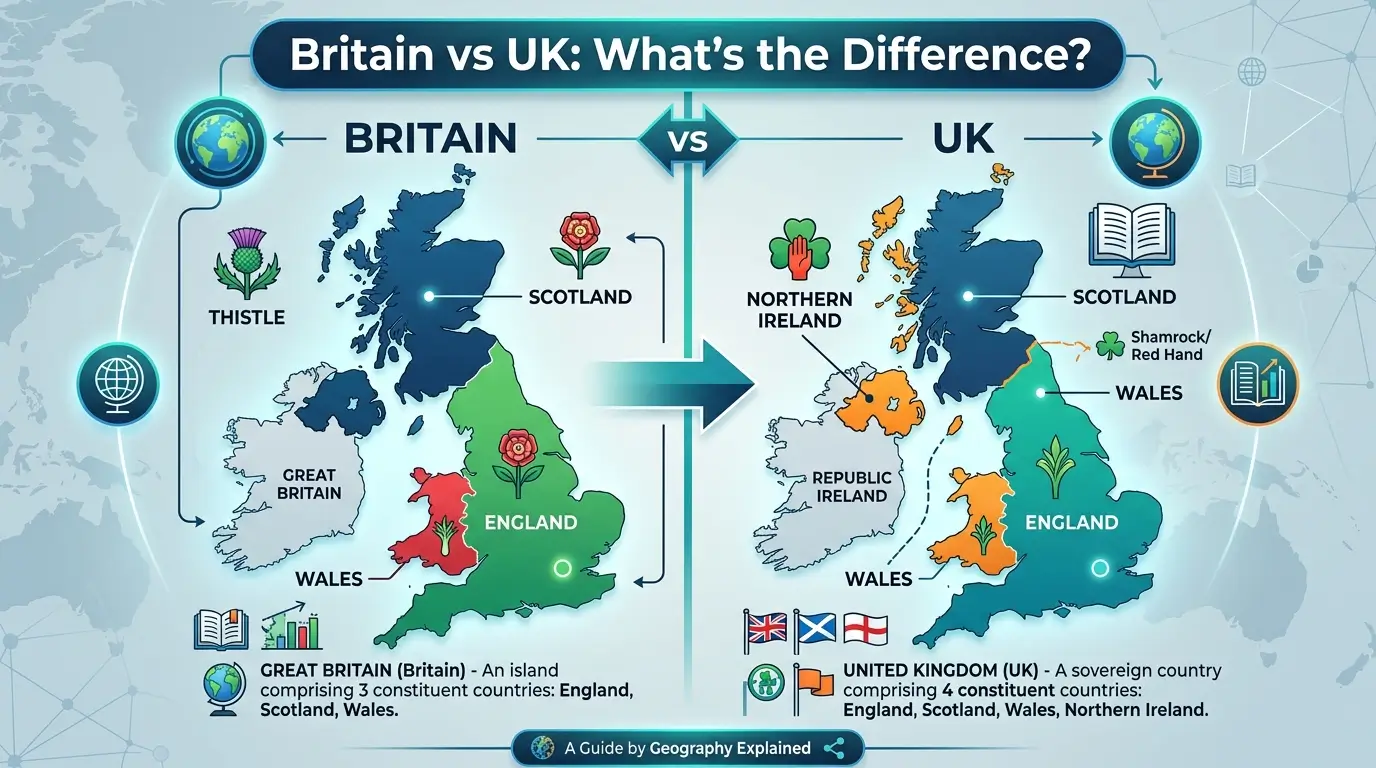
The main difference is that Britain refers primarily to a geographical area, while the United Kingdom (UK) is a political and sovereign state.
Britain generally means Great Britain, the largest island containing England, Scotland, and Wales. The UK includes Great Britain plus Northern Ireland.
Pronunciation of Both Terms
Britain
| Accent | Pronunciation |
| US English | BRIT-un |
| UK English | BRIT-uhn |
UK (United Kingdom)
| Accent | Pronunciation |
| US English | Yoo-Kay |
| UK English | Yoo-Kay |
Why Is Their Difference Necessary to Know for Learners and Experts?
Understanding these terms is important because they are used in geography, politics, history, media, and international relations. Students need accurate knowledge for academic studies. Journalists must use the correct term when reporting news. Businesses operating internationally should understand regional distinctions. Travelers can communicate more accurately with local residents. Experts in diplomacy, economics, and law frequently distinguish between Britain and the UK because political boundaries affect policies, trade agreements, and governance. Knowing the difference helps avoid misunderstandings and demonstrates cultural awareness.
Before exploring the details, let’s examine the specific differences that separate Britain from the UK.
Difference Between Britain and UK
1. Definition
Britain: A geographical term referring to Great Britain.
UK: A sovereign country officially called the United Kingdom.
Examples
Britain:
- England, Scotland, and Wales are in Britain.
- The island of Great Britain is Europe’s largest island.
UK:
- The UK is a member of various international organizations.
- The UK government represents the entire country internationally.
2. Political Status
Britain: Not an independent political state.
UK: An internationally recognized sovereign nation.
Examples
Britain:
- Britain has no separate parliament.
- Britain cannot sign treaties independently.
UK:
- The UK signs international agreements.
- The UK has diplomatic relations worldwide.
3. Components
Britain: Includes England, Scotland, and Wales.
UK: Includes England, Scotland, Wales, and Northern Ireland.
Examples
Britain:
- Edinburgh is in Britain.
- Cardiff is in Britain.
UK:
- Belfast is part of the UK.
- Northern Ireland belongs to the UK.
4. Official Name
Britain: Commonly refers to Great Britain.
UK: Officially called the United Kingdom of Great Britain and Northern Ireland.
Examples
Britain:
- Britain is often used informally.
- Britain appears in historical discussions.
UK:
- The country’s legal documents use the full official name.
- International organizations recognize the UK.
5. Geographic Meaning
Britain: Refers to a physical island.
UK: Refers to a political territory.
Examples
Britain:
- Britain can be located on a map as an island.
- Geography textbooks discuss Britain as landmass.
UK:
- The UK includes territory beyond Great Britain.
- Political maps identify the UK as a nation.
6. Citizenship
Britain: Does not issue citizenship.
UK: Citizens are legally British citizens of the UK.
Examples
Britain:
- No “Britain passport” exists.
- Britain has no citizenship authority.
UK:
- UK passports are internationally recognized.
- UK citizens vote in national elections.
7. Government
Britain: Has no separate government.
UK: Governed by the UK Parliament and government.
Examples
Britain:
- Britain has no independent prime minister.
- Britain has no national cabinet.
UK:
- The UK Prime Minister leads the government.
- UK laws affect all constituent nations in certain areas.
8. International Representation
Britain: Does not officially represent itself.
UK: Represents the country globally.
Examples
Britain:
- Britain has no UN membership.
- Britain cannot appoint ambassadors.
UK:
- The UK participates in international diplomacy.
- The UK maintains embassies worldwide.
9. Sports Usage
Britain: Frequently used in sporting events.
UK: Less commonly used in sports team names.
Examples
Britain:
- Team GB competes in the Olympics.
- British athletes represent Great Britain.
UK:
- The UK is rarely used in Olympic branding.
- Sporting organizations often prefer Britain.
10. Historical Context
Britain: Older geographical term.
UK: Political term created through constitutional developments.
Examples
Britain:
- Ancient writers referred to Britain.
- Historical maps labeled Britain.
UK:
- The modern UK developed through political unions.
- Constitutional history explains the UK’s formation.
Nature and Behaviour of Both
Britain
Britain is primarily geographical in nature. It describes a physical island and often carries cultural and historical meanings. The term is frequently used in discussions about geography, history, and identity.
UK
The UK is political and administrative in nature. It refers to a sovereign state with a government, legal system, international responsibilities, and diplomatic relations.
Why People Are Confused About Their Use?
People become confused because the terms are often used interchangeably in media, conversations, and publications. Many organizations, sports teams, and tourism campaigns use “Britain” when they actually represent the UK. Additionally, both terms share historical connections and include many of the same regions, making the distinction less obvious to non-specialists.
Difference and Similarity Table
| Feature | Britain | UK | Similarity |
| Type | Geographic term | Political state | Both refer to related regions |
| Includes England | Yes | Yes | Shared |
| Includes Scotland | Yes | Yes | Shared |
| Includes Wales | Yes | Yes | Shared |
| Includes Northern Ireland | No | Yes | Related territories |
| Government | No | Yes | Connected historically |
| Citizenship | No | Yes | British identity |
| International Representation | No | Yes | Global recognition |
| Geography | Island | Country | Same region |
| Common Usage | Informal | Official | Frequently used together |
Which Is Better in What Situation?
When Britain Is Better
The term Britain is better when discussing geography, culture, history, or the physical island containing England, Scotland, and Wales. Teachers, historians, and geographers often use Britain when describing landscapes, ancient civilizations, or regional traditions. It provides a simpler geographical reference without involving political boundaries.
When UK Is Better
The term UK is better when discussing government, law, citizenship, economics, diplomacy, or international affairs. Official documents, business contracts, passports, and news reports typically use UK because it accurately identifies the sovereign state. Using UK ensures precision when political or legal matters are involved.
How the Keywords Are Used in Metaphors and Similes
Britain
Metaphor:
- “Britain is the heart of many historic traditions.”
Simile:
- “The old castle stood like a symbol of Britain.”
UK
Metaphor:
- “The UK is a bridge connecting different nations.”
Simile:
- “The UK functions like a family of nations under one roof.”
Connotative Meaning
Britain
Positive:
- Heritage
- Tradition
- Culture
Example:
- Britain is often associated with rich history and literature.
Negative:
- Colonial legacy
Example:
- Some discussions connect Britain with imperial history.
Neutral:
- Geographic island
Example:
- Britain lies off the northwestern coast of Europe.
UK
Positive:
- Unity
- Stability
- Governance
Example:
- The UK is known for strong institutions.
Negative:
- Political disagreements among regions
Example:
- Debates about independence sometimes affect perceptions.
Neutral:
- Sovereign state
Example:
- The UK consists of four constituent nations.
Idioms or Proverbs Related to the Words
There are no major traditional English idioms directly based on “Britain” or “UK.” However, related expressions exist.
Rule Britannia
Meaning:
Britain’s historical strength and influence.
Example:
- During the discussion of naval history, the professor mentioned “Rule Britannia.”
Keep a Stiff Upper Lip
Meaning:
Remain calm during difficulty.
Example:
- She kept a stiff upper lip despite the challenges.
Works in Literature
Britain
- Britannia – John Milton – Poetry – 1670s
- Notes on Britain – Various historical writers – Non-fiction – Various years
- Britain BC – Francis Pryor – History – 2003
UK
- The UK: A Very Short Introduction – Kenneth O. Morgan – Non-fiction – 2007
- The Isles: A History – Norman Davies – History – 1999
- Britons – Linda Colley – History – 1992
Movies Related to Britain and the UK
Britain
- A Royal Night Out (2015, United Kingdom)
- Darkest Hour (2017, United Kingdom)
- The King’s Speech (2010, United Kingdom)
UK
- United Kingdom (2016, United Kingdom)
- This Is England (2006, United Kingdom)
- Brexit: The Uncivil War (2019, United Kingdom)
Frequently Asked Questions
1. Is Britain the same as the UK?
No. Britain refers to Great Britain, while the UK includes Great Britain and Northern Ireland.
2. Does Britain include Northern Ireland?
No. Northern Ireland is part of the UK but not part of Great Britain.
3. Why do people use the terms interchangeably?
Because they overlap geographically and are commonly used in everyday speech.
4. Which term should I use in official writing?
Use “UK” when discussing political, legal, or governmental matters.
5. Is England the same as Britain?
No. England is one country within Great Britain.
How Both Are Useful for Surroundings
Britain contributes geographical identity, cultural heritage, tourism, and historical understanding. The UK contributes political organization, economic stability, public services, and international representation. Together, these concepts help people understand regional identity and national governance.
Final Words for Both
Britain and the UK are closely connected but serve different purposes. Britain helps us understand geography and culture, while the UK helps us understand government and political organization. Using the correct term improves communication and demonstrates knowledge of world affairs.
Conclusion
The difference between Britain and UK may seem small, but it is significant. Britain refers primarily to the geographical island containing England, Scotland, and Wales. The UK refers to the sovereign state that includes those three countries plus Northern Ireland.
Understanding this distinction helps students, travelers, journalists, and professionals communicate more accurately. While the terms are often used interchangeably in everyday conversation, choosing the correct one adds clarity and precision.
By learning the difference between Britain and UK, readers gain a better understanding of geography, politics, history, and international relations. Knowing when to use each term is a valuable skill that improves both academic knowledge and real-world communication.

Alexandra “Alex” Monroe is a senior linguistics contributor at WordCompares.com, where she specializes in comparative word analysis, semantics, and language clarity. With over 15 years of academic and editorial experience, Alex helps readers understand subtle differences between commonly confused words and phrases. Her research-driven yet practical writing style strengthens the educational authority of WordCompares.com.