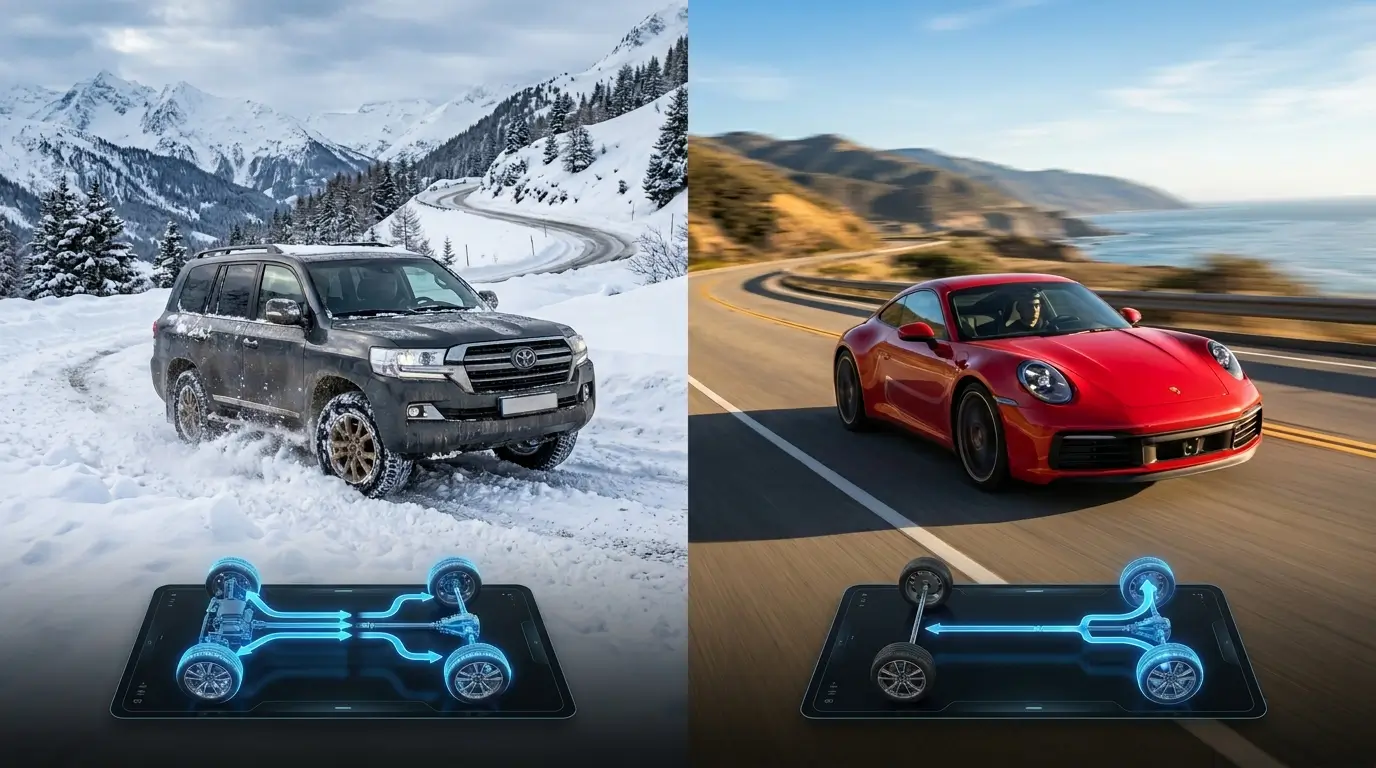
Imagine two friends planning a road trip. One drives through snowy mountain roads with confidence, while the other enjoys smooth highway cruising and sporty handling. The difference in their driving experience often comes down to the vehicle’s drivetrain. This is where understanding the difference between AWD and RWD becomes important.
AWD stands for All-Wheel Drive, while RWD means Rear-Wheel Drive. Both systems deliver power to the wheels differently, affecting traction, performance, fuel economy, and driving comfort. Many car buyers compare these systems before purchasing a vehicle because the difference between AWD and RWD can significantly impact everyday driving.
Whether you are a new driver, automotive student, or experienced enthusiast, learning the difference between AWD and RWD helps you choose the right vehicle for your needs. Throughout this guide, we will explore the difference between AWD and RWD in simple terms with practical examples.
Pronunciation
AWD
US: /ˌeɪ.dʌb.əl.juːˈdiː/ (A-W-D)
UK: /ˌeɪ.dʌb.əl.juːˈdiː/
RWD
US: /ˌɑːr.dʌb.əl.juːˈdiː/ (R-W-D)
UK: /ˌɑː.dʌb.əl.juːˈdiː/
Before comparing them in detail, let’s examine exactly how these two drivetrain systems differ and why those differences matter.
Key Difference Between AWD and RWD
The primary difference is how engine power is distributed.
- AWD (All-Wheel Drive) sends power to all four wheels.
- RWD (Rear-Wheel Drive) sends power only to the rear wheels.
This fundamental distinction affects traction, acceleration, handling, maintenance costs, and driving performance.
Why Is Their Difference Necessary to Know?
Understanding AWD and RWD is valuable because vehicles play a major role in transportation, business, emergency services, and recreation.
For learners, this knowledge improves automotive literacy and helps in making informed purchasing decisions.
For experts, understanding drivetrain systems helps in vehicle design, repair, racing applications, and performance optimization.
In society, selecting the appropriate drivetrain contributes to safer driving, better fuel efficiency, and improved vehicle performance in various weather conditions.
Difference Between AWD and RWD
1. Power Distribution
AWD
Power is sent to all four wheels.
Examples:
- Subaru Outback
- Audi Q5
RWD
Power is delivered only to the rear wheels.
Examples:
- Ford Mustang
- BMW 3 Series
2. Traction
AWD
Provides excellent traction on slippery surfaces.
Examples:
- Driving on snow-covered roads
- Climbing muddy trails
RWD
Traction may decrease on wet or icy roads.
Examples:
- Rainy highways
- Snow-covered parking lots
3. Acceleration
AWD
Offers quicker acceleration because all wheels contribute.
Examples:
- Tesla Model S Plaid
- Nissan GT-R
RWD
Strong acceleration but may experience wheel spin.
Examples:
- Dodge Challenger
- Chevrolet Camaro
4. Fuel Efficiency
AWD
Generally consumes more fuel.
Examples:
- AWD SUV
- AWD crossover
RWD
Usually provides better fuel economy.
Examples:
- RWD sedan
- RWD sports coupe
5. Weight
AWD
Contains additional drivetrain components.
Examples:
- Transfer cases
- Extra driveshafts
RWD
Typically lighter.
Examples:
- Sports cars
- Performance sedans
6. Handling
AWD
Offers stable handling in poor weather.
Examples:
- Wet roads
- Gravel roads
RWD
Provides balanced and engaging handling.
Examples:
- Race tracks
- Performance driving events
7. Maintenance Cost
AWD
More components increase maintenance expenses.
Examples:
- Differential servicing
- Transfer case repairs
RWD
Generally cheaper to maintain.
Examples:
- Fewer drivetrain parts
- Simpler repairs
8. Towing Ability
AWD
Good for moderate towing.
Examples:
- Small trailers
- Camping equipment
RWD
Often preferred for heavy towing.
Examples:
- Pickup trucks
- Large trailers
9. Off-Road Capability
AWD
Performs better on rough terrain.
Examples:
- Dirt roads
- Mountain paths
RWD
Less effective on uneven surfaces.
Examples:
- Sandy trails
- Rocky routes
10. Purchase Price
AWD
Usually costs more.
Examples:
- AWD trim package
- Luxury AWD models
RWD
Often less expensive.
Examples:
- Base model sedan
- Entry-level sports car
Nature and Behaviour of Both
AWD
AWD focuses on stability, traction, and confidence. It automatically adjusts power distribution to maximize grip and control.
RWD
RWD emphasizes performance, balance, and driving enjoyment. It creates a more dynamic driving experience, especially at higher speeds.
Why Are People Confused About Their Use?
Many drivers confuse AWD with four-wheel drive (4WD). Others assume AWD is always superior because it powers all four wheels. In reality, RWD often performs better in sports cars and towing applications. Marketing terms and technical jargon also contribute to confusion.
Difference and Similarity Table
| Feature | AWD | RWD | Similarity |
| Power Delivery | All wheels | Rear wheels | Both transmit engine power |
| Traction | High | Moderate | Improve vehicle movement |
| Fuel Economy | Lower | Higher | Depend on driving habits |
| Maintenance | Higher | Lower | Require regular servicing |
| Handling | Stable | Sporty | Affect driving dynamics |
| Cost | More expensive | Less expensive | Available in many vehicles |
| Towing | Moderate | Excellent | Used for hauling |
| Weight | Heavier | Lighter | Influence performance |
| Weather Performance | Excellent | Average | Function in all seasons |
| Driving Experience | Secure | Engaging | Enhance vehicle control |
Which Is Better in What Situation?
AWD
AWD is better for drivers who frequently encounter rain, snow, ice, gravel roads, or changing weather conditions. Families, outdoor enthusiasts, and commuters often appreciate the added confidence and safety AWD provides. It is particularly useful in regions with harsh winters and unpredictable road conditions.
RWD
RWD is better for drivers seeking performance, handling, and towing capability. Sports car enthusiasts often prefer RWD because it offers balanced weight distribution and responsive driving characteristics. Pickup trucks and performance vehicles commonly use RWD for its durability and driving dynamics.
How AWD and RWD Are Used in Metaphors and Similes
AWD Metaphors
- “Her support system was AWD, providing help from every direction.”
- “The company’s strategy worked like AWD, maintaining traction in every market.”
RWD Metaphors
- “His determination was RWD, pushing him forward from behind.”
- “The project gained momentum like a powerful RWD sports car.”
Similes
- “The team worked like an AWD vehicle, moving together through challenges.”
- “He accelerated through his career like a RWD race car.”
Connotative Meaning
| Term | Connotation | Example |
| AWD | Positive | “The AWD approach ensured stability.” |
| AWD | Neutral | “The SUV comes with AWD.” |
| RWD | Positive | “The athlete moved with RWD-like power.” |
| RWD | Neutral | “The car uses a RWD layout.” |
| RWD | Slightly Negative (contextual) | “The old truck struggled on ice because of its RWD setup.” |
Idioms or Proverbs Related to the Concepts
Although no traditional idioms directly use AWD or RWD, similar expressions apply:
“Keep the wheels turning”
Meaning: Continue making progress.
Example: The manager worked hard to keep the wheels turning during difficult times.
“Back on track”
Meaning: Return to the correct course.
Example: The company got back on track after restructuring.
“Drive your own destiny”
Meaning: Control your future.
Example: Education helps people drive their own destiny.
Works in Literature Related to Driving and Automobiles
- On the Road — Novel, Jack Kerouac, 1957
- Christine — Horror Novel, Stephen King, 1983
- The Great Race — Adventure Literature Adaptation, various editions
- Car — Non-fiction, Mary Walton, 1997
Movies Related to Cars and Driving
- Cars (2006, USA)
- Ford v Ferrari (2019, USA)
- Rush (2013, UK/USA)
- Days of Thunder (1990, USA)
- The Fast and the Furious (2001, USA)
Frequently Asked Questions
1. Is AWD better than RWD?
Not always. AWD excels in traction, while RWD often provides better handling and towing.
2. Which is safer in snow?
AWD generally offers better traction and stability on snowy roads.
3. Does AWD use more fuel?
Yes, AWD typically consumes more fuel because of additional drivetrain components.
4. Why do sports cars often use RWD?
RWD provides balanced handling and strong performance characteristics.
5. Is AWD more expensive to maintain?
Usually yes, because AWD systems contain more mechanical components.
How Both Are Useful for Surroundings
AWD helps people travel safely in difficult weather conditions, supporting transportation, emergency response, and outdoor activities.
RWD contributes to efficient transportation, commercial hauling, motorsports, and performance driving. Both systems serve important roles in modern mobility and transportation infrastructure.
Final Words for Both
AWD represents stability, versatility, and confidence across diverse conditions. It is ideal for drivers prioritizing safety and all-weather capability.
RWD symbolizes performance, balance, and driving enjoyment. It remains a favorite among enthusiasts and professionals who value precise handling and towing strength.
Conclusion
The difference between AWD and RWD lies primarily in how power reaches the wheels, but its effects extend far beyond that simple distinction. AWD provides enhanced traction, stability, and confidence in challenging weather conditions, making it an excellent choice for families and drivers in snowy or rainy regions.
RWD, on the other hand, delivers superior handling, performance, and towing capability, making it popular among sports car enthusiasts and truck owners.
Understanding the difference between AWD and RWD allows drivers to choose a vehicle that matches their lifestyle, driving habits, and environment. Neither system is universally better; the best choice depends on individual needs and priorities.

Alexandra “Alex” Monroe is a senior linguistics contributor at WordCompares.com, where she specializes in comparative word analysis, semantics, and language clarity. With over 15 years of academic and editorial experience, Alex helps readers understand subtle differences between commonly confused words and phrases. Her research-driven yet practical writing style strengthens the educational authority of WordCompares.com.