Imagine a university student preparing a research paper. While reading a long academic article, the student wants to include important information without copying the original text. Sometimes the student writes a brief version of the article’s main ideas, and other times rewrites a specific paragraph using different words. These two techniques are known as summary and paraphrase.
Understanding the difference between summary and paraphrase is essential for students, teachers, researchers, writers, and professionals. Although both methods involve restating information from an original source, they serve different purposes.
The difference between summary and paraphrase affects the amount of detail, length, and writing style used. Knowing the difference between summary and paraphrase helps avoid plagiarism and improves communication skills. Whether in education, business, or everyday life, the difference between summary and paraphrase plays an important role in presenting information accurately and effectively.
Pronunciation
| Word | US Pronunciation | UK Pronunciation |
| Summary | /ˈsʌməri/ | /ˈsʌməri/ |
| Paraphrase | /ˈpærəfreɪz/ | /ˈpærəfreɪz/ |
Before exploring their distinctions, it is important to understand why these two writing techniques are often confused and why mastering both can improve communication skills significantly.
Key Difference Between Summary and Paraphrase
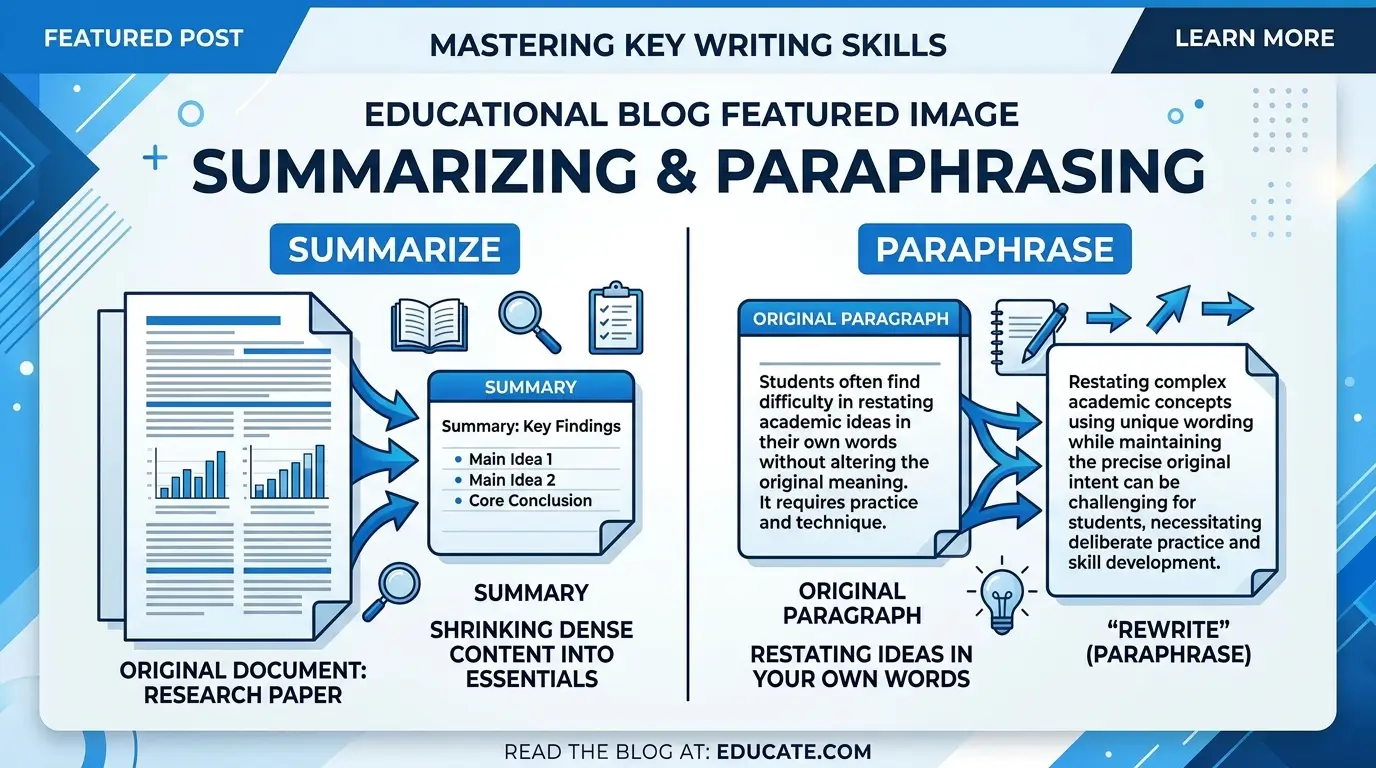
A summary condenses the main ideas of a text into a shorter form while leaving out many details.
A paraphrase rewrites a specific passage in different words while keeping nearly all the original details and meaning.
In simple terms:
- Summary = Shorter version of the whole idea.
- Paraphrase = Same idea with different wording.
Why Is Their Difference Necessary to Know for Learners and Experts?
Understanding the distinction between summary and paraphrase is important because both serve unique functions in communication and learning.
Students use summaries to understand lengthy materials quickly. Researchers use paraphrasing to integrate evidence into their work without direct copying. Journalists summarize events for readers while maintaining key facts. Business professionals summarize reports for executives and paraphrase technical information for broader audiences.
In society, these skills promote clear communication, prevent plagiarism, improve critical thinking, and help people share information effectively. Mastering both techniques allows individuals to process, understand, and present knowledge responsibly.
Difference Between Summary and Paraphrase
1. Length
Summary
A summary is significantly shorter than the original text.
Example 1:
Original: A 20-page report becomes a one-page summary.
Example 2:
Original: A chapter becomes a paragraph.
Paraphrase
A paraphrase is usually similar in length to the original passage.
Example 1:
A 100-word paragraph becomes a 110-word paraphrase.
Example 2:
A sentence remains approximately the same length.
2. Purpose
Summary
Focuses on presenting main ideas.
Example 1:
Summarizing a book review.
Example 2:
Providing a brief news overview.
Paraphrase
Focuses on restating specific information.
Example 1:
Rewriting a scientific explanation.
Example 2:
Explaining legal language in simpler words.
3. Detail Level
Summary
Contains fewer details.
Example 1:
Only major events from a story.
Example 2:
Only key findings from a report.
Paraphrase
Retains most details.
Example 1:
Includes statistics from original text.
Example 2:
Keeps examples and explanations.
4. Focus
Summary
Focuses on overall meaning.
Example 1:
Main message of a speech.
Example 2:
Central idea of a chapter.
Paraphrase
Focuses on a specific section.
Example 1:
One paragraph of an article.
Example 2:
A quoted statement.
5. Writing Style
Summary
Uses condensed language.
Example 1:
Combines multiple ideas into one sentence.
Example 2:
Removes less important information.
Paraphrase
Uses different wording.
Example 1:
Changes vocabulary.
Example 2:
Alters sentence structure.
6. Amount of Information
Summary
Contains selected information.
Example 1:
Major conclusions only.
Example 2:
Key recommendations only.
Paraphrase
Contains nearly all information.
Example 1:
Includes supporting evidence.
Example 2:
Includes explanations and examples.
7. Academic Usage
Summary
Used for literature reviews.
Example 1:
Summarizing research articles.
Example 2:
Creating study notes.
Paraphrase
Used for source integration.
Example 1:
Research writing.
Example 2:
Academic essays.
8. Reading Requirement
Summary
Requires understanding the whole text.
Example 1:
Summarizing a complete report.
Example 2:
Condensing an entire novel.
Paraphrase
Requires understanding a section.
Example 1:
Rewriting one paragraph.
Example 2:
Rephrasing a quotation.
9. Structure
Summary
Structure often changes completely.
Example 1:
Combines multiple sections.
Example 2:
Reorders information logically.
Paraphrase
Structure may remain similar.
Example 1:
Sentence sequence remains intact.
Example 2:
Paragraph organization stays similar.
10. Citation Importance
Summary
Requires source acknowledgment.
Example 1:
Summarized journal article.
Example 2:
Summarized report.
Paraphrase
Also requires source acknowledgment.
Example 1:
Paraphrased textbook content.
Example 2:
Paraphrased research findings.
Nature and Behavior of Summary and Paraphrase
Nature of Summary
- Condenses information.
- Focuses on major points.
- Omits unnecessary details.
- Saves time for readers.
- Provides broad understanding.
Nature of Paraphrase
- Retains detailed meaning.
- Changes wording and structure.
- Preserves original message.
- Clarifies complex language.
- Enhances comprehension.
Why Are People Confused About Their Use?
People often confuse summary and paraphrase because both involve restating information from another source. In both cases, writers use their own words rather than copying directly. However, a summary shortens information considerably, while a paraphrase maintains most details. The similarity of rewriting content causes many learners to use the terms interchangeably.
Difference and Similarity Between Summary and Paraphrase
| Feature | Summary | Paraphrase | Similarity |
| Purpose | Condense information | Reword information | Both explain original content |
| Length | Shorter | Similar length | Both may be shorter than original |
| Detail | Limited | Extensive | Both retain meaning |
| Focus | Main ideas | Specific details | Both communicate information |
| Structure | Often changed | Slightly changed | Both use new wording |
| Academic Use | Overview | Evidence integration | Both require citations |
| Reading Skill | Broad understanding | Detailed understanding | Both require comprehension |
Which Is Better in What Situation?
When Summary Is Better
A summary is better when readers need quick understanding of lengthy information. It is ideal for executive reports, study notes, book reviews, news articles, and literature reviews.
When time is limited and only key points matter, summaries provide efficient communication. They help readers grasp the essential message without reading the entire original source.
When Paraphrase Is Better
A paraphrase is better when detailed information must be preserved while avoiding direct quotations. Researchers, students, journalists, and professionals often paraphrase to explain complex ideas clearly.
It allows writers to maintain accuracy while adapting language for different audiences. Paraphrasing is especially useful when discussing evidence, technical concepts, or detailed explanations.
How the Keywords Are Used in Metaphors and Similes
Summary
Metaphor:
“A summary is a roadmap through a long journey.”
Simile:
“A summary is like a trailer for a movie.”
Paraphrase
Metaphor:
“A paraphrase is a mirror reflecting the same idea differently.”
Simile:
“A paraphrase is like translating thoughts into a new voice.”
Connotative Meaning
Summary
Connotation: Mostly Positive and Neutral
Positive Example:
“Her summary saved everyone hours of reading.”
Neutral Example:
“The manager requested a summary of the report.”
Paraphrase
Connotation: Mostly Positive and Neutral
Positive Example:
“His paraphrase made the concept easier to understand.”
Neutral Example:
“The teacher asked students to write a paraphrase.”
Idioms or Proverbs Related to the Concepts
“Cut to the Chase”
Meaning: Get to the main point.
Example:
“Instead of explaining every detail, she cut to the chase and gave a summary.”
“In Other Words”
Meaning: Explain differently.
Example:
“In other words, the scientist provided a paraphrase of the complex theory.”
“Long Story Short”
Meaning: Brief summary.
Example:
“Long story short, the project was successful.”
Works in Literature Related to Summary and Paraphrase
Summary
- The Elements of Style – William Strunk Jr. & E.B. White (Style Guide, 1959)
- How to Read a Book – Mortimer Adler (Educational, 1940)
- The Craft of Research – Booth, Colomb & Williams (Research Guide, 1995)
Paraphrase
- A Manual for Writers of Research Papers – Kate Turabian (Academic Writing, 1937)
- Writing Research Papers – James Lester (Educational, 1976)
- The Bedford Handbook – Diana Hacker (Writing Guide, 1982)
Movies Related to Summary or Paraphrasing Themes
There are no major films specifically titled “Summary” or “Paraphrase.” However, films centered on writing, communication, and interpretation include:
- Finding Forrester (2000, USA)
- Dead Poets Society (1989, USA)
- Freedom Writers (2007, USA)
- The Paper Chase (1973, USA)
Frequently Asked Questions
1. What is the main difference between summary and paraphrase?
A summary shortens information, while a paraphrase rewrites it with similar detail.
2. Which is usually longer?
A paraphrase is usually longer than a summary.
3. Do both require citations?
Yes. Both require proper source citation in academic writing.
4. Is paraphrasing easier than summarizing?
Not always. Effective paraphrasing requires preserving meaning accurately.
5. Can a summary include personal opinions?
No. A summary should present the original ideas objectively.
How Both Are Useful for Surroundings
Summaries help people quickly understand reports, news, books, and discussions. They improve efficiency in schools, workplaces, and communities. Paraphrases help simplify difficult information and make communication more accessible. Together, they support education, professional communication, and knowledge sharing in everyday life.
Final Words for Both
Summary and paraphrase are powerful communication tools. A summary highlights the most important ideas, while a paraphrase preserves details in new wording. Learning both skills improves writing, reading, research, and professional communication.
Conclusion
The difference between summary and paraphrase lies mainly in purpose, length, and detail. A summary condenses information into its essential points, whereas a paraphrase restates information while retaining most of the original details.
Both techniques require a clear understanding of the source material and are valuable for academic, professional, and everyday communication. Understanding the difference between summary and paraphrase helps individuals avoid plagiarism, improve comprehension, and communicate ideas more effectively.
Whether you are a student preparing assignments, a researcher writing papers, or a professional presenting information, mastering both summary and paraphrase skills can significantly enhance the quality and clarity of your work.

Jordan L. Carter is a contributing language analyst at WordCompares.com, focusing on modern English usage, evolving vocabulary trends, and digital communication language. With over a decade of writing experience, Jordan provides insightful word comparisons that make complex language differences simple for everyday readers.