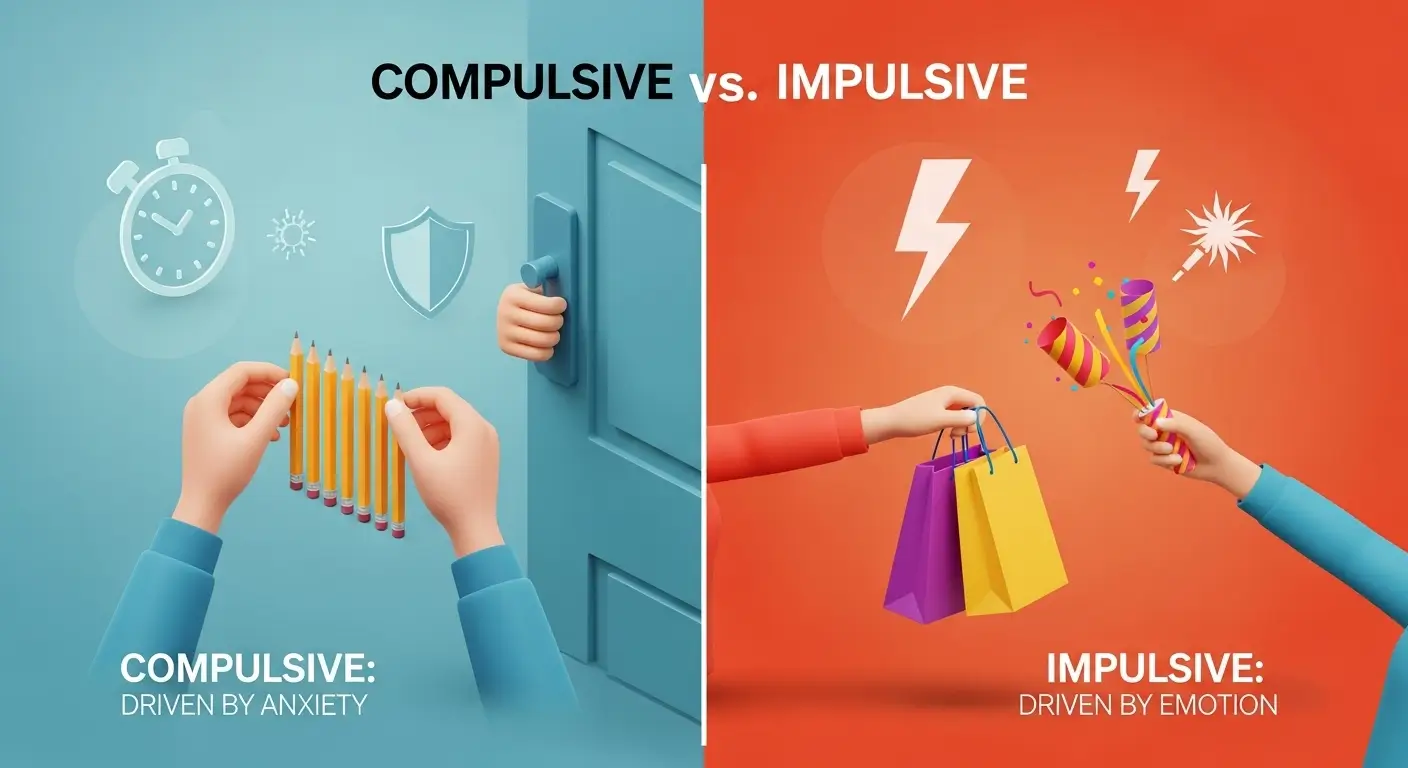
Imagine a person who repeatedly checks whether the door is locked before leaving home. Now imagine another person who suddenly buys an expensive gadget without thinking twice. Both actions may look unusual, but they come from very different mental patterns. This is where understanding the difference between compulsive and impulsive becomes important.
The difference between compulsive and impulsive lies in motivation and control. Compulsive behavior is driven by anxiety and repeated urges, while impulsive behavior is driven by sudden emotions or desires. Many people use these words interchangeably, but the difference between compulsive and impulsive is crucial in psychology, communication, and everyday decision-making. Recognizing the difference between compulsive and impulsive helps us better understand human behavior, mental health, and even social interactions.
Key Difference Between the Both
The main difference between compulsive and impulsive is that compulsive actions are repetitive and performed to reduce anxiety, whereas impulsive actions are sudden and performed without thinking about consequences.
Why is the difference necessary to Know for Learners and Experts?
Understanding the difference between compulsive and impulsive is important in fields like psychology, education, and social work. For learners, it improves vocabulary and helps in accurate expression. For experts such as therapists or teachers, distinguishing between these behaviors helps in proper diagnosis, counseling, and behavior management.
In society, this distinction prevents misunderstandings for example, labeling someone as careless when they are actually struggling with compulsive habits. Recognizing this difference encourages empathy and promotes better mental health awareness.
Pronunciation of Both Words
| Word | US Pronunciation | UK Pronunciation |
| Compulsive | /kəmˈpʌl.sɪv/ | /kəmˈpʌl.sɪv/ |
| Impulsive | /ɪmˈpʌl.sɪv/ | /ɪmˈpʌl.sɪv/ |
Let’s explore their differences in detail to understand how they affect behavior, language, and social perception.
Difference Between Compulsive and Impulsive
1. Meaning
- Compulsive: Involves repeated actions driven by anxiety or obsession.
- Example 1: She keeps washing her hands even when they are already clean.
- Example 2: He checks his email every few minutes due to worry.
- Impulsive: Involves sudden actions without planning or thinking.
- Example 1: She bought shoes she didn’t need just because they were on sale.
- Example 2: He quit his job in a moment of anger.
2. Motivation Behind Behavior
- Compulsive: Motivated by fear, stress, or obsessive thoughts.
- Example 1: Locking doors repeatedly to avoid imagined danger.
- Example 2: Reorganizing items again and again to feel calm.
- Impulsive: Motivated by excitement, emotion, or curiosity.
- Example 1: Eating junk food suddenly despite dieting.
- Example 2: Posting a comment online without thinking.
3. Level of Control
- Compulsive: The person feels forced to act even when they know it is unnecessary.
- Example 1: She knows the stove is off but still checks repeatedly.
- Example 2: He counts steps while walking because he feels compelled.
- Impulsive: The person acts quickly without considering control at the moment.
- Example 1: He shouted at his friend during an argument.
- Example 2: She signed up for a course on a whim.
4. Frequency of Action
- Compulsive: Actions are repeated regularly or ritualistically.
- Example 1: Rewriting notes multiple times.
- Example 2: Constantly arranging objects symmetrically.
- Impulsive: Actions are occasional and triggered by situations.
- Example 1: Buying snacks suddenly at the checkout.
- Example 2: Making a last-minute travel plan.
5. Emotional State
- Compulsive: Linked with anxiety, tension, or discomfort.
- Example 1: Cleaning repeatedly to reduce stress.
- Example 2: Rechecking work due to fear of mistakes.
- Impulsive: Linked with excitement, anger, or strong emotions.
- Example 1: Sending an angry message instantly.
- Example 2: Accepting a risky challenge for thrill.
6. Planning vs Spontaneity
- Compulsive: Actions follow a fixed pattern or routine.
- Example 1: Always arranging books in a certain order.
- Example 2: Performing a specific ritual before leaving home.
- Impulsive: Actions are spontaneous and unplanned.
- Example 1: Changing travel plans suddenly.
- Example 2: Buying a gift without prior thought.
7. Psychological Association
- Compulsive: Often linked with obsessive-compulsive tendencies or disorders.
- Example 1: Repetitive checking associated with OCD.
- Example 2: Excessive cleaning beyond necessity.
- Impulsive: Often linked with poor self-control or emotional regulation.
- Example 1: Risky driving during emotional distress.
- Example 2: Sudden spending during mood swings.
8. Consequences Awareness
- Compulsive: The person knows the action is unnecessary but still repeats it.
- Example 1: Knowing repeated washing damages skin but continuing.
- Example 2: Realizing constant checking wastes time.
- Impulsive: The person often realizes consequences only after acting.
- Example 1: Regretting a sudden purchase later.
- Example 2: Apologizing after a heated argument.
9. Duration of Behavior
- Compulsive: Long-term and persistent.
- Example 1: Years of repetitive routines.
- Example 2: Daily ritualistic behaviors.
- Impulsive: Short-lived and moment-based.
- Example 1: A sudden decision lasting only minutes.
- Example 2: Acting quickly in a temporary mood.
10. Impact on Daily Life
- Compulsive: Can interfere with daily functioning due to repetition.
- Example 1: Being late due to repeated checking.
- Example 2: Spending hours cleaning unnecessarily.
- Impulsive: Can cause social or financial problems due to rash decisions.
- Example 1: Overspending leading to debt.
- Example 2: Damaged relationships due to sudden reactions.
Nature and Behaviour of Both
Compulsive behavior is rigid, repetitive, and driven by inner pressure. People often feel relief only after completing the action.
Impulsive behavior is spontaneous, flexible, and driven by immediate emotion or desire. People usually feel excitement first and regret later.
Why People Are Confused About Their Use
People confuse these terms because both involve a lack of self-control. However, compulsive actions are repetitive and anxiety-driven, while impulsive actions are sudden and emotion-driven. Since both can lead to poor decisions, they are often mistakenly used as synonyms in everyday speech.
Table Showing Difference and Similarity
| Aspect | Compulsive | Impulsive | Similarity |
| Motivation | Anxiety and obsession | Sudden emotion or desire | Both involve strong internal urges |
| Timing | Repeated and ongoing | Sudden and momentary | Both may feel uncontrollable |
| Awareness | Aware but unable to stop | Acts before thinking | Both may cause regret |
| Pattern | Ritualistic | Spontaneous | Both affect behavior |
| Psychological link | OCD tendencies | Poor impulse control | Both studied in psychology |
Which Is Better in What Situation?
Compulsive behavior is rarely beneficial because it is driven by anxiety and repetition. However, in mild forms, it may help people stay organized or detail-oriented, such as checking work carefully before submission. In such cases, controlled compulsive tendencies can improve accuracy and discipline.
Impulsive behavior can sometimes be useful in situations requiring quick decisions, creativity, or spontaneity. For example, entrepreneurs or artists may benefit from impulsive thinking when exploring new ideas. However, excessive impulsivity can lead to risky or harmful outcomes, so balance is essential.
Use in Metaphors and Similes
- Compulsive:
- “He checked his phone like a compulsive clock, every minute.”
- Impulsive:
- “She jumped into the plan like an impulsive spark.”
These figurative uses emphasize repetition for compulsive and suddenness for impulsive behavior.
Connotative Meaning
| Word | Connotation | Example |
| Compulsive | Mostly negative | “His compulsive habits made daily life difficult.” |
| Impulsive | Neutral to negative | “Her impulsive decision surprised everyone.” |
Idioms or Proverbs Related to the Words
- “Act on impulse” – means acting without thinking
- Example: He acted on impulse and bought the car.
- “Creature of habit” – often relates to compulsive repetition
- Example: She is a creature of habit and follows the same routine daily.
Works in Literature Featuring the Themes
- Crime and Punishment – Psychological novel, Fyodor Dostoevsky, 1866
- The Strange Case of Dr Jekyll and Mr Hyde – Gothic novella, Robert Louis Stevenson, 1886
These works explore impulsive crimes and compulsive guilt or behavior.
Movies Related to Compulsive or Impulsive Behavior
- As Good as It Gets – 1997, USA (focus on compulsive behavior)
- The Wolf of Wall Street – 2013, USA (focus on impulsive decisions)
Frequently Asked Questions
1. Are compulsive and impulsive the same?
No, compulsive actions are repetitive and anxiety-driven, while impulsive actions are sudden and emotion-driven.
2. Can a person be both compulsive and impulsive?
Yes, some individuals may show both behaviors in different situations.
3. Which is more dangerous?
Both can be harmful if extreme, but impulsive behavior often leads to immediate consequences.
4. Is compulsive behavior always linked to a disorder?
Not always. Mild compulsive habits can exist without clinical conditions.
5. Why do people misuse these words?
Because both involve acting without full control, people assume they mean the same thing.
How Both Are Useful for the Surroundings
Compulsive individuals may maintain cleanliness, order, and structure in shared spaces. Impulsive individuals may bring creativity, quick decision-making, and energy into group environments. When balanced, both traits can positively contribute to teamwork and innovation.
Final Words for Both
Compulsive and impulsive behaviors represent two different responses to internal urges one rooted in anxiety and repetition, the other in spontaneity and emotion. Understanding both helps in communication, empathy, and personal development.
Conclusion
In everyday life, the difference between compulsive and impulsive is more than just a linguistic detail it reflects how people think, react, and cope with stress or excitement. Compulsive behavior is repetitive and driven by fear or obsession, while impulsive behavior is sudden and driven by emotion or desire. Recognizing these patterns allows individuals to better manage their actions and understand others.
Whether in psychology, education, or social relationships, knowing this distinction improves clarity, reduces misunderstanding, and supports mental health awareness. Ultimately, learning the difference between compulsive and impulsive helps create a more empathetic and informed society.

Dr. Marcus Reed is a lead editorial author at WordCompares.com and a specialist in communication studies and written clarity. With more than 12 years of university-level teaching experience, he focuses on explaining word distinctions in a clear and structured manner. His work ensures that WordCompares.com maintains accuracy, depth, and reader trust.