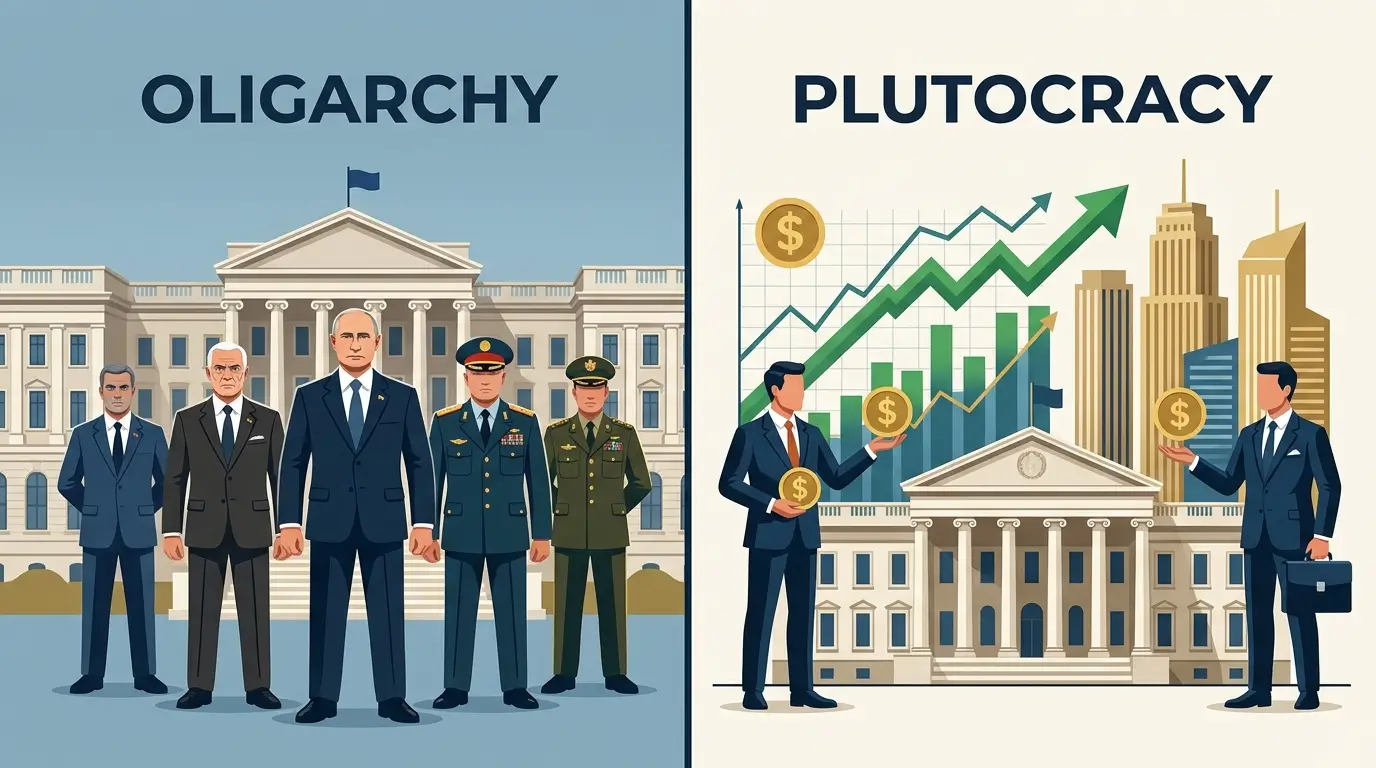
Imagine a country where a handful of influential individuals make all major decisions. Now imagine another country where the wealthiest citizens control political power because of their immense fortunes. At first glance, these systems may seem identical, but they are actually different. This is where understanding the difference between oligarchy and plutocracy becomes important.
The difference between oligarchy and plutocracy often appears in discussions about politics, economics, and governance. While both systems concentrate power in the hands of a few people, the basis of that power differs significantly. Knowing the difference between oligarchy and plutocracy helps students, researchers, political analysts, and ordinary citizens better understand how societies function. The difference between oligarchy and plutocracy also sheds light on how power influences public policies, economic opportunities, and social equality.
Understanding these concepts can help us evaluate governments more accurately and recognize patterns of influence in modern societies.
Key Difference Between Oligarchy and Plutocracy
The primary difference is that an oligarchy is governed by a small group of powerful individuals, while a plutocracy is governed specifically by wealthy individuals whose financial resources give them political influence.
In an oligarchy, power may come from military strength, family connections, religion, or political status. In a plutocracy, wealth is the main source of power.
Why Is Their Difference Necessary to Know?
Understanding the distinction between oligarchy and plutocracy is important because these systems affect how decisions are made in society.
For learners, it improves political literacy and helps them analyze historical and modern governments accurately. For experts, the distinction allows deeper analysis of power structures, economic inequality, and governance models.
In society, recognizing whether influence comes from wealth or from a broader elite group helps citizens understand why certain policies exist and who benefits from them. This knowledge promotes informed civic participation and critical thinking.
Pronunciation
Oligarchy
| Accent | Pronunciation |
| US | oh LIG ar kee |
| UK | ol IG ah kee |
Plutocracy
| Accent | Pronunciation |
| US | ploo TOCK ruh see |
| UK | ploo TOCK ruh see |
Understanding the basic distinction is only the beginning. To fully grasp the difference between oligarchy and plutocracy, we must compare their origins, structures, and real world effects.
Difference Between Oligarchy and Plutocracy
1. Source of Power
Oligarchy
Power comes from a small group of elites.
Examples:
- Military leaders ruling a nation.
- Influential political families controlling decisions.
Plutocracy
Power comes primarily from wealth.
Examples:
- Billionaires influencing legislation.
- Wealthy business owners directing public policy.
2. Membership Requirements
Oligarchy
Members may gain influence through status, heritage, religion, or authority.
Examples:
- Royal families.
- Senior military officers.
Plutocracy
Membership is based largely on financial wealth.
Examples:
- Corporate tycoons.
- Wealthy investors.
3. Economic Influence
Oligarchy
Economic wealth may or may not be necessary.
Examples:
- Religious leaders with authority.
- Military rulers with limited personal wealth.
Plutocracy
Economic wealth is essential.
Examples:
- Financial magnates.
- Industrial billionaires.
4. Decision Making Basis
Oligarchy
Decisions reflect elite group interests.
Examples:
- Political elite councils.
- Military committees.
Plutocracy
Decisions often protect wealth accumulation.
Examples:
- Tax benefits for the rich.
- Policies favoring large corporations.
5. Historical Origins
Oligarchy
Originates from the Greek word meaning “rule by the few.”
Examples:
- Ancient Greek city states.
- Aristocratic governments.
Plutocracy
Originates from the Greek word meaning “rule by wealth.”
Examples:
- Wealth dominated societies.
- Financially controlled governments.
6. Social Mobility
Oligarchy
Entry may depend on connections rather than money.
Examples:
- Noble families.
- Political dynasties.
Plutocracy
Entry generally requires substantial wealth.
Examples:
- Self made billionaires.
- Wealthy heirs.
7. Public Perception
Oligarchy
Viewed as concentrated elite rule.
Examples:
- Military juntas.
- Aristocratic councils.
Plutocracy
Viewed as government controlled by the rich.
Examples:
- Corporate domination concerns.
- Wealth driven politics.
8. Main Objective
Oligarchy
Maintain elite control.
Examples:
- Protecting political power.
- Preserving family influence.
Plutocracy
Protect and expand wealth.
Examples:
- Economic monopolies.
- Favorable business regulations.
9. Composition of Rulers
Oligarchy
Can include military, religious, political, or economic elites.
Examples:
- Clerical councils.
- Military leadership groups.
Plutocracy
Mostly consists of wealthy individuals.
Examples:
- Billionaire investors.
- Large business owners.
10. Modern Examples
Oligarchy
Elite political groups dominate governance.
Examples:
- Certain authoritarian regimes.
- Powerful ruling families.
Plutocracy
Wealth significantly shapes political influence.
Examples:
- Extreme lobbying systems.
- Governments heavily influenced by billionaires.
Nature and Behaviour of Oligarchy
Oligarchies tend to centralize power among a select group. They often prioritize stability, authority, and preservation of elite interests. Decision making can be efficient but may limit public participation.
Nature and Behaviour of Plutocracy
Plutocracies emphasize wealth as the pathway to influence. Wealthy individuals often shape policies that protect investments, businesses, and financial interests. Economic power frequently translates into political power.
Why Are People Confused About Their Use?
People often confuse these terms because both involve a small number of individuals holding significant power. In many cases, oligarchs are also wealthy, creating overlap between the concepts. However, not all oligarchs are rich, and not every wealthy individual belongs to an oligarchic ruling group.
Difference and Similarity Table
| Feature | Oligarchy | Plutocracy | Similarity |
| Meaning | Rule by a few | Rule by the wealthy | Power concentrated among few |
| Basis of Power | Elite status | Wealth | Limited public control |
| Membership | Various elites | Rich individuals | Exclusive groups |
| Focus | Authority | Financial interests | Preservation of influence |
| Decision Making | Elite priorities | Wealth priorities | Public influence reduced |
| Social Equality | Often limited | Often limited | Can increase inequality |
| Political Participation | Restricted | Restricted | Few dominate power |
Which Is Better in What Situation?
Oligarchy
Supporters argue that an oligarchy can sometimes provide stability during crises when experienced leaders coordinate decisions quickly. If the ruling group possesses expertise and acts responsibly, decision making may be efficient. However, accountability remains a major concern because power is concentrated among a few individuals.
Plutocracy
Advocates may argue that wealthy individuals often possess business experience and economic knowledge that can contribute to national development. However, plutocracy can increase inequality because policies may favor financial interests over public welfare. Therefore, many political scholars view excessive plutocratic influence as problematic for democratic representation.
How the Keywords Are Used in Metaphors and Similes
Oligarchy
Metaphors
- “The company became an oligarchy.”
- “The committee was an oligarchy of insiders.”
Similes
- “They ruled like an oligarchy.”
- “The leadership acted like a closed oligarchy.”
Plutocracy
Metaphors
- “The city was a plutocracy of billionaires.”
- “The industry became a plutocracy.”
Similes
- “The economy operated like a plutocracy.”
- “The board functioned like a plutocracy.”
Connotative Meanings
Oligarchy
Positive
- Expertise based leadership.
- Stability in governance.
Negative
- Elitism.
- Lack of representation.
Neutral
- Rule by a limited group.
Plutocracy
Positive
- Economic efficiency.
- Business oriented decision making.
Negative
- Wealth inequality.
- Favoritism toward the rich.
Neutral
- Governance influenced by wealth.
Idioms and Proverbs Related to the Concepts
Neither word has common traditional idioms, but related expressions include:
“Money talks”
Meaning: Wealth brings influence.
Example: In a plutocracy, money talks louder than public opinion.
“The rich get richer”
Meaning: Wealth accumulates among those who already have it.
Example: Critics argue that plutocracy reflects the idea that the rich get richer.
“Power corrupts”
Meaning: Excessive power can lead to abuse.
Example: Some historians use this proverb when discussing oligarchies.
Works in Literature
Oligarchy
- Politics – Aristotle – Political Philosophy – 4th Century BCE
- The Republic – Plato – Philosophy – c. 375 BCE
- The Prince – Niccolò Machiavelli – Political Treatise – 1532
Plutocracy
- The Theory of the Leisure Class – Thorstein Veblen – Sociology – 1899
- Capital – Karl Marx – Economics – 1867
- The Wealth of Nations – Adam Smith – Economics – 1776
Movies Related to the Concepts
Oligarchy Themes
- The Godfather (1972, USA)
- Snowpiercer (2013, South Korea/Czech Republic)
- Dune (2021, USA)
Plutocracy Themes
- Citizen Kane (1941, USA)
- Wall Street (1987, USA)
- The Wolf of Wall Street (2013, USA)
Frequently Asked Questions
1. What is the main difference between oligarchy and plutocracy?
An oligarchy is ruled by a small elite group, while a plutocracy is ruled by wealthy individuals.
2. Can a plutocracy also be an oligarchy?
Yes. Wealthy elites may form a small ruling group, creating both systems simultaneously.
3. Which system is more common today?
Many analysts argue that elements of both systems can appear in modern governments.
4. Is wealth necessary in an oligarchy?
No. Power can come from military, religious, political, or family influence.
5. Why do political scientists distinguish between them?
Because the source of power differs, leading to different political and social outcomes.
How Both Are Useful for Surroundings
Studying oligarchy and plutocracy helps citizens understand how influence operates in governments, businesses, and organizations. These concepts encourage critical thinking about leadership, accountability, economic inequality, and public participation. They also help researchers evaluate historical and contemporary political systems.
Final Words for Both
Oligarchy and plutocracy are closely related concepts that reveal how power can become concentrated in society. Understanding their distinctions helps us recognize whether influence comes from elite status or financial wealth. Both remain important tools for analyzing political and economic systems around the world.
Conclusion
The difference between oligarchy and plutocracy lies primarily in the source of power. Oligarchy refers to rule by a small group of elites, while plutocracy refers specifically to rule by the wealthy. Although these systems often overlap, they are not identical.
Understanding the difference between oligarchy and plutocracy enables students, scholars, and citizens to evaluate governments more accurately and recognize how power shapes society. By examining their structures, behaviors, and impacts, we gain a deeper understanding of political authority and economic influence.
Ultimately, knowing the difference between oligarchy and plutocracy promotes informed discussions about fairness, representation, and governance in the modern world.

Alexandra “Alex” Monroe is a senior linguistics contributor at WordCompares.com, where she specializes in comparative word analysis, semantics, and language clarity. With over 15 years of academic and editorial experience, Alex helps readers understand subtle differences between commonly confused words and phrases. Her research-driven yet practical writing style strengthens the educational authority of WordCompares.com.