Imagine reading a news report about a convicted criminal being sent to a prison, while another article mentions someone serving time in a penitentiary.
Many people assume these terms mean exactly the same thing. In everyday conversation, they are often used interchangeably. However, there are subtle distinctions that can help us better understand the criminal justice system.
The difference between prison and penitentiary is a topic that interests students, legal professionals, writers, and curious readers alike. Understanding the difference between prison and penitentiary can improve communication and prevent misunderstandings.
While both institutions confine people convicted of crimes, their historical origins, purpose, and usage vary. This article explores the difference between prison and penitentiary in detail and explains why the difference between prison and penitentiary remains relevant today.
Pronunciation
Prison
US: /ˈprɪz.ən/
UK: /ˈprɪz.ən/
Penitentiary
US: /ˌpen.ɪˈten.ʃər.i/
UK: /ˌpen.ɪˈten.tʃər.i/
Before comparing these terms in detail, it helps to understand how they developed and why legal systems continue to use them differently.
Key Difference Between the Both
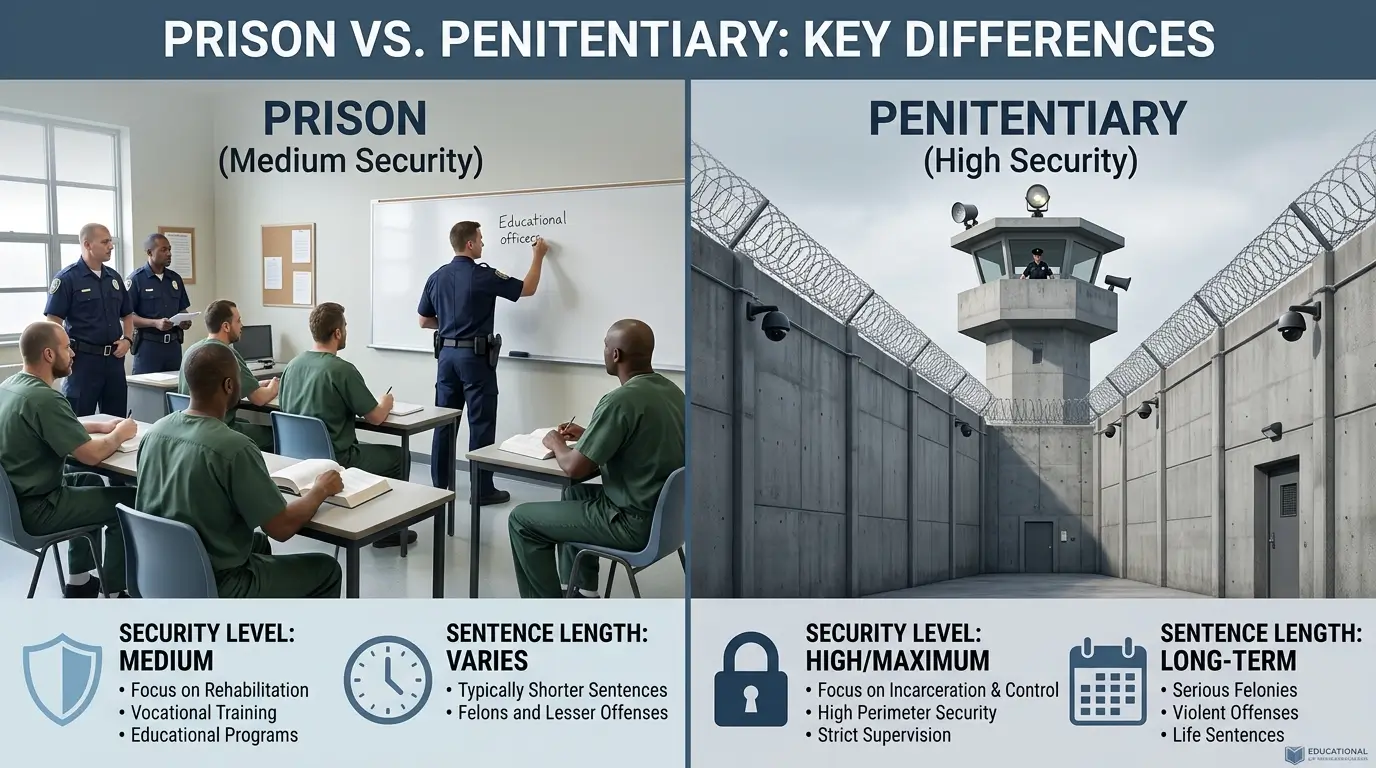
The primary difference is that a prison is a general correctional institution where convicted criminals serve sentences, while a penitentiary traditionally refers to a high-security prison designed for serious offenders and emphasizes punishment and rehabilitation.
Today, every penitentiary is a prison, but not every prison is a penitentiary.
Why Is Their Difference Necessary to Know for Learners and Experts?
Understanding these terms improves legal literacy and communication. Students studying law, criminology, sociology, and criminal justice often encounter both words in textbooks and legal documents.
For experts, distinguishing between prison and penitentiary helps ensure accuracy in reports, research papers, court discussions, and public policy debates. Society benefits when people understand the different levels of correctional facilities because it promotes informed discussions about crime, punishment, rehabilitation, and public safety.
Difference Between Prison and Penitentiary
1. Definition
Prison
A general facility used to confine convicted offenders.
Examples:
- A burglar serves five years in a state prison.
- A fraud offender is transferred to a prison after sentencing.
Penitentiary
A specialized prison, often for serious crimes and long-term sentences.
Examples:
- A convicted murderer is sent to a federal penitentiary.
- A gang leader serves a sentence in a maximum-security penitentiary.
2. Historical Origin
Prison
The term comes from the Latin word prehendere, meaning “to seize.”
Examples:
- Medieval prisons held debtors.
- Early prisons detained suspects awaiting trial.
Penitentiary
Derived from “penitence,” emphasizing repentance and reform.
Examples:
- Early American penitentiaries promoted reflection.
- Religious reformers supported penitentiary systems.
3. Security Level
Prison
May have minimum, medium, or maximum security.
Examples:
- A low-risk offender stays in a minimum-security prison.
- A repeat offender may enter a medium-security prison.
Penitentiary
Usually refers to maximum-security institutions.
Examples:
- Dangerous criminals are placed in penitentiaries.
- Violent offenders often serve time in penitentiaries.
4. Type of Offenders
Prison
Houses a wide variety of offenders.
Examples:
- Tax evaders may serve in prison.
- Drug offenders may serve in prison.
Penitentiary
Generally houses serious and violent criminals.
Examples:
- Serial offenders are sent to penitentiaries.
- Armed robbers may be assigned to penitentiaries.
5. Length of Sentence
Prison
Can accommodate short or long sentences.
Examples:
- A person receives a two-year prison term.
- Another serves ten years in prison.
Penitentiary
Usually associated with lengthy sentences.
Examples:
- A life sentence is served in a penitentiary.
- A 25-year sentence may lead to a penitentiary assignment.
6. Purpose
Prison
Focuses on detention and punishment.
Examples:
- Prison prevents offenders from harming society.
- Prison enforces legal consequences.
Penitentiary
Traditionally focuses on repentance and rehabilitation.
Examples:
- Inmates attend counseling programs.
- Educational opportunities encourage reform.
7. Usage in Legal Systems
Prison
Widely used worldwide.
Examples:
- Canada uses the term prison.
- Many European countries use prison.
Penitentiary
More common in North American legal terminology.
Examples:
- Federal penitentiary is common in the United States.
- Some Canadian facilities use the term penitentiary.
8. Public Perception
Prison
Viewed as a general correctional institution.
Examples:
- News reports commonly mention prisons.
- People usually understand the term prison.
Penitentiary
Often sounds more severe.
Examples:
- Movies portray penitentiaries as intimidating.
- The word suggests stricter confinement.
9. Administrative Structure
Prison
Can be managed by state, local, or private authorities.
Examples:
- State prisons operate under state governments.
- Private companies may manage prisons.
Penitentiary
Often operated by federal authorities.
Examples:
- Federal penitentiaries house federal offenders.
- National correctional agencies supervise penitentiaries.
10. Common Usage
Prison
Used frequently in everyday language.
Examples:
- “He went to prison.”
- “The prison is nearby.”
Penitentiary
Used more formally or legally.
Examples:
- “He was transferred to a federal penitentiary.”
- “The penitentiary houses dangerous offenders.”
Nature and Behaviour of Both
Prison
Prisons vary widely in security, inmate population, and correctional programs. Their nature depends on the jurisdiction and offender category.
Penitentiary
Penitentiaries are generally stricter, more controlled, and designed for offenders who pose greater security risks. They often maintain intensive monitoring and security measures.
Why Are People Confused About Their Use?
People are confused because both facilities confine convicted criminals. Modern media often uses the terms interchangeably. Furthermore, many penitentiaries are technically prisons, making the distinction less obvious to the public. Historical meanings have also evolved, causing overlap in everyday usage.
Difference and Similarity Table
| Feature | Prison | Penitentiary | Similarity |
| Definition | General correctional facility | Specialized prison | Both confine offenders |
| Security | Various levels | Usually high security | Both provide security |
| Offenders | Broad range | Serious offenders | Both house criminals |
| Sentence Length | Short or long | Usually long-term | Both enforce sentences |
| Purpose | Punishment and detention | Punishment and reform | Both support justice |
| Administration | State, local, private | Often federal | Both government regulated |
| Public Image | General institution | More severe image | Both associated with crime |
| Legal Usage | Common worldwide | More specific term | Both legal terms |
Which Is Better in What Situation?
When Prison Is Better
A prison is more suitable when authorities need facilities for offenders with varying security needs. It offers flexibility and accommodates different sentence lengths. Many prisons also provide vocational training and rehabilitation programs appropriate for non-violent offenders.
When Penitentiary Is Better
A penitentiary is more appropriate for dangerous offenders who require strict supervision. High-security facilities help protect society while providing structured rehabilitation opportunities. Penitentiaries are especially useful for inmates serving long sentences or those who present significant security concerns.
How the Keywords Are Used in Metaphors and Similes
Prison
Metaphor:
- “His fear became a prison.”
Simile:
- “She felt trapped like a prisoner in a prison.”
Penitentiary
Metaphor:
- “The office felt like a penitentiary of endless rules.”
Simile:
- “The strict school operated like a penitentiary.”
Connotative Meaning
| Word | Connotation | Example |
| Prison | Mostly Negative | “Debt became a prison for him.” |
| Prison | Neutral in legal context | “The prison houses 500 inmates.” |
| Penitentiary | Strongly Negative | “The criminal feared the penitentiary.” |
| Penitentiary | Slightly Neutral in law | “The offender was assigned to a federal penitentiary.” |
Idioms and Proverbs Related to Prison
Prison of One’s Own Making
Meaning: Problems created by oneself.
Example:
“His lies became a prison of his own making.”
Prisoner of Circumstances
Meaning: Controlled by situations beyond one’s control.
Example:
“She was a prisoner of circumstances after losing her job.”
Jailbird
Meaning: A person frequently imprisoned.
Example:
“The town knew him as a jailbird.”
There are few common idioms specifically containing the word “penitentiary.”
Works in Literature
Prison
- The Count of Monte Cristo — Adventure, Alexandre Dumas, 1844
- The Ballad of Reading Gaol — Poem, Oscar Wilde, 1898
- One Day in the Life of Ivan Denisovich — Historical Fiction, Aleksandr Solzhenitsyn, 1962
Penitentiary
- Inside the Walls of the Penitentiary — Prison Memoir, various editions
- The Penitentiary — Historical prison narratives and reform literature in the 19th century
Movies Related to Prison or Penitentiary
- The Shawshank Redemption (1994, USA)
- Escape from Alcatraz (1979, USA)
- The Green Mile (1999, USA)
- Brubaker (1980, USA)
- Penitentiary (1979, USA)
Frequently Asked Questions
1. Is a penitentiary the same as a prison?
No. A penitentiary is generally a specific type of prison, often associated with higher security and serious offenders.
2. Why is it called a penitentiary?
The term comes from “penitence,” reflecting the original goal of encouraging repentance and reform.
3. Are all penitentiaries prisons?
Yes. Every penitentiary is a prison, but not every prison is a penitentiary.
4. Which term is more common today?
“Prison” is more commonly used in everyday language.
5. Which houses more dangerous criminals?
Penitentiaries typically house offenders considered more dangerous or requiring stricter supervision.
How Both Are Useful for Surroundings
Prisons and penitentiaries contribute to public safety by separating offenders from society while they serve their sentences.
They also support rehabilitation programs that help reduce future crime. By enforcing laws and promoting accountability, these institutions play an important role in maintaining social order and community security.
Final Words for Both
Prison and penitentiary share the same broad purpose of incarceration, but they differ in historical meaning, security level, offender type, and public perception. Understanding these distinctions improves legal knowledge and communication.
Conclusion
The difference between prison and penitentiary may seem minor at first, but it reveals important details about how correctional systems operate. A prison is a broad term covering many correctional facilities, while a penitentiary traditionally refers to a more secure institution designed for serious offenders and long-term sentences.
Knowing the difference between prison and penitentiary helps students, professionals, writers, and everyday readers use these terms accurately. Although modern usage sometimes overlaps, understanding their origins and functions provides a clearer picture of criminal justice systems.
Ultimately, both institutions serve society by enforcing the law, protecting the public, and offering opportunities for rehabilitation and reform.

Dr. Marcus Reed is a lead editorial author at WordCompares.com and a specialist in communication studies and written clarity. With more than 12 years of university-level teaching experience, he focuses on explaining word distinctions in a clear and structured manner. His work ensures that WordCompares.com maintains accuracy, depth, and reader trust.