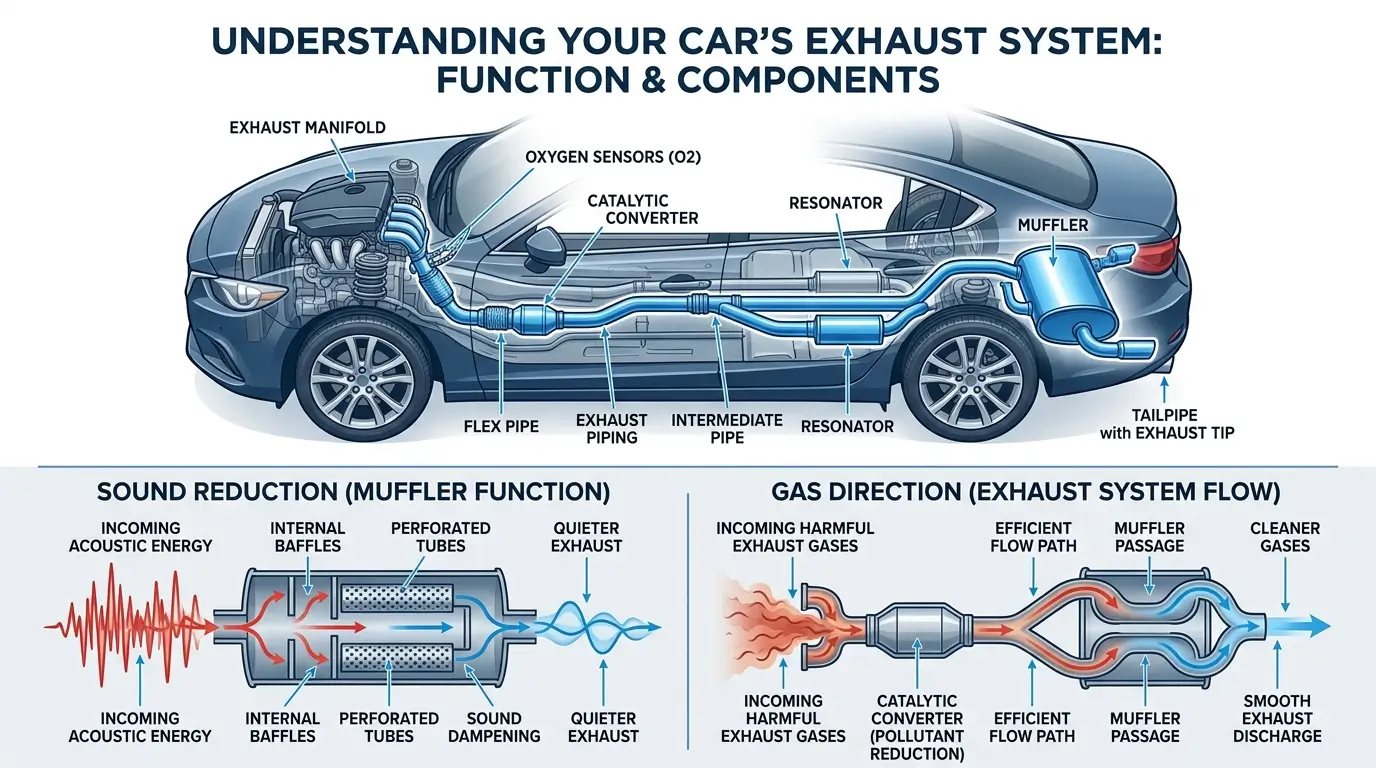
Imagine driving through a busy city street early in the morning. One car passes quietly while another produces a loud roaring sound that attracts everyone’s attention. The reason often lies in the condition of its muffler and exhaust system. Although these terms are frequently used interchangeably, they do not mean the same thing.
Understanding the difference between muffler and exhaust is important for vehicle owners, mechanics, students, and automotive enthusiasts. The exhaust system removes harmful gases from the engine, while the muffler is a component that reduces noise. Knowing the difference between muffler and exhaust helps in vehicle maintenance, troubleshooting, and performance improvements.
Many people search for the difference between muffler and exhaust because these parts work together but serve different purposes. This guide explains the difference between muffler and exhaust in a simple and practical way.
Pronunciation
Muffler
- US: /ˈmʌf.lɚ/
- UK: /ˈmʌf.lə/
Exhaust
- US: /ɪɡˈzɔːst/
- UK: /ɪɡˈzɔːst/
Understanding these terms is only the beginning. To appreciate how vehicles operate efficiently and safely, it is important to explore their functions, differences, and practical uses.
Key Difference Between Muffler and Exhaust
The primary difference is that an exhaust is the complete system responsible for directing harmful engine gases away from the vehicle, while a muffler is just one component within that system that reduces engine noise.
Why Is Their Difference Necessary to Know?
Understanding the distinction is valuable for both learners and professionals.
- Helps vehicle owners diagnose problems accurately.
- Assists mechanics in recommending proper repairs.
- Improves knowledge of vehicle safety systems.
- Supports environmental awareness by understanding emissions control.
- Helps automotive students learn vehicle engineering concepts.
- Prevents confusion when purchasing replacement parts.
In modern society, efficient exhaust systems contribute to cleaner air, reduced noise pollution, and safer transportation.
Difference Between Muffler and Exhaust
1. Definition
Muffler
A device designed to reduce engine noise.
Examples:
- A damaged muffler makes a car louder.
- Sports cars often use performance mufflers.
Exhaust
The complete system that carries gases from the engine.
Examples:
- The exhaust directs gases away from passengers.
- A leaking exhaust can affect engine performance.
2. Function
Muffler
Controls and minimizes sound waves.
Examples:
- It reduces engine rumbling.
- It helps meet noise regulations.
Exhaust
Removes combustion gases.
Examples:
- It releases carbon dioxide safely.
- It prevents toxic fumes from entering the cabin.
3. Size
Muffler
One specific part.
Examples:
- Usually located near the rear.
- Can be replaced independently.
Exhaust
A complete assembly.
Examples:
- Includes pipes and catalytic converter.
- Extends from engine to tailpipe.
4. Components
Muffler
Contains chambers and tubes.
Examples:
- Resonating chambers reduce sound.
- Internal baffles redirect noise.
Exhaust
Contains multiple parts.
Examples:
- Exhaust manifold.
- Catalytic converter and muffler.
5. Noise Control
Muffler
Primary noise-control device.
Examples:
- Makes driving quieter.
- Reduces engine vibration sounds.
Exhaust
Contributes indirectly.
Examples:
- Pipes channel sound.
- Entire system affects noise level.
6. Cost
Muffler
Generally cheaper.
Examples:
- Replacement is affordable.
- Small repairs cost less.
Exhaust
Usually more expensive.
Examples:
- Full-system replacement is costly.
- Multiple components increase expenses.
7. Maintenance
Muffler
Needs inspection for rust and holes.
Examples:
- Corrosion can create loud noises.
- Internal damage affects performance.
Exhaust
Requires comprehensive checks.
Examples:
- Pipe leaks need repair.
- Catalytic converter failures require attention.
8. Impact on Environment
Muffler
Mainly reduces noise pollution.
Examples:
- Makes urban areas quieter.
- Limits excessive vehicle noise.
Exhaust
Controls emissions.
Examples:
- Works with catalytic converters.
- Helps reduce harmful gases.
9. Performance Effect
Muffler
Can influence sound and airflow.
Examples:
- Performance mufflers improve airflow.
- Restrictive designs may reduce efficiency.
Exhaust
Strongly affects vehicle performance.
Examples:
- Better flow increases efficiency.
- Poor exhaust design reduces power.
10. Replacement Purpose
Muffler
Replaced mainly for noise issues.
Examples:
- Rusted muffler replacement.
- Upgrading sound quality.
Exhaust
Replaced for broader system problems.
Examples:
- Severe leaks.
- Major corrosion throughout the system.
Nature and Behaviour of Both
Muffler
The muffler behaves as a sound-control device. Its nature is to absorb, reflect, and cancel sound waves generated by the engine. It focuses primarily on reducing noise and improving driving comfort.
Exhaust
The exhaust behaves as a gas-management system. Its nature is to transport, filter, and release combustion gases efficiently. It directly impacts safety, emissions, and engine performance.
Why Are People Confused About Their Use?
People often confuse mufflers and exhausts because the muffler is a visible part of the exhaust system. When someone hears loud vehicle noise, they commonly say, “The exhaust is broken,” even when only the muffler is damaged. Additionally, automotive advertisements frequently use the terms together, creating misunderstanding among non-experts.
Difference and Similarity Table
| Feature | Muffler | Exhaust | Similarity |
| Purpose | Reduce noise | Remove gases | Both improve vehicle operation |
| Type | Single component | Complete system | Both belong to vehicle exhaust assembly |
| Size | Smaller | Larger | Both installed underneath vehicle |
| Cost | Lower | Higher | Both require maintenance |
| Performance Impact | Moderate | Significant | Both affect driving experience |
| Environmental Role | Reduces noise pollution | Controls emissions | Both contribute to public welfare |
| Replacement | Easier | More complex | Both can wear out over time |
Which Is Better in What Situation?
When a Muffler Is Better
A muffler is the better focus when the main concern is reducing noise. If a vehicle becomes unusually loud, replacing or repairing the muffler is often the best solution. Drivers living in urban areas especially benefit from an efficient muffler because it minimizes disturbance and improves comfort.
When an Exhaust System Is Better
The exhaust system is more important when dealing with emissions, safety, fuel efficiency, and engine performance. If there are gas leaks, poor fuel economy, or emission test failures, attention should be given to the entire exhaust system rather than just the muffler.
Muffler and Exhaust in Metaphors and Similes
Muffler
Metaphors
- “She became the muffler of the argument.”
- “His calm words were a muffler for the team’s frustration.”
Similes
- “Quiet as a muffler on a luxury car.”
- “He softened criticism like a muffler softens engine noise.”
Exhaust
Metaphors
- “The meeting became an exhaust for everyone’s frustration.”
- “Writing is her emotional exhaust.”
Similes
- “Thoughts escaped like exhaust from a tailpipe.”
- “Stress flowed out like exhaust gases.”
Connotative Meaning
Muffler
- Positive: Quietness, peace, control.
- Example: “Her diplomacy acted as a muffler during conflict.”
- Negative: Suppression, silence.
- Example: “The policy became a muffler on creativity.”
- Neutral: Noise-reduction device.
- Example: “The mechanic replaced the muffler.”
Exhaust
- Positive: Release, outlet.
- Example: “Exercise is a healthy exhaust for energy.”
- Negative: Pollution, waste.
- Example: “Industrial exhaust affects air quality.”
- Neutral: Vehicle gas system.
- Example: “The exhaust needed inspection.”
Idioms and Related Expressions
Although there are no famous idioms directly based on these words, related expressions exist.
Running Out of Steam
Meaning: Losing energy.
Example:
“The project team ran out of steam before completion.”
Blow Off Steam
Meaning: Release stress.
Example:
“He plays football to blow off steam after work.”
Keep a Lid On It
Meaning: Control emotions or reactions.
Example:
“She kept a lid on her anger during the meeting.”
Literary Works Featuring the Keywords
Muffler
- The Muffler – Short Story, Various Anthologies, 20th Century
- References appear in automotive and industrial fiction.
Exhaust
- Exhaust by K. Sello Duiker (Literary Fiction, South Africa, 2006)
- Frequently used symbolically in modern poetry and urban literature.
Movies Related to the Keywords
Muffler
- No major internationally recognized films titled Muffler.
Exhaust
- Exhausted (2013, United Kingdom)
- Exhausted (2022, United States)
Frequently Asked Questions
1. Is a muffler part of the exhaust system?
Yes. The muffler is one component within the larger exhaust system.
2. Can a car run without a muffler?
Yes, but it will be extremely noisy and may violate local regulations.
3. Does the exhaust affect engine performance?
Yes. Exhaust design directly influences airflow and efficiency.
4. Which costs more to replace?
A complete exhaust system usually costs much more than a muffler.
5. Can a damaged exhaust be dangerous?
Yes. Exhaust leaks may allow harmful gases to enter the vehicle.
How Both Are Useful for the Surroundings
The muffler helps reduce noise pollution, creating quieter communities and improving quality of life. The exhaust system contributes to environmental protection by directing gases through emission-control components that reduce harmful pollutants. Together, they support cleaner, safer, and more comfortable transportation systems.
Final Words for Both
The muffler and exhaust work together but perform different functions. One controls noise, while the other manages engine gases. Understanding their individual roles helps drivers maintain vehicles more effectively and appreciate the engineering behind modern transportation.
Conclusion
The difference between muffler and exhaust becomes clear when we understand their purposes. A muffler is a specialized component designed to reduce engine noise, whereas the exhaust is the complete system responsible for carrying and treating engine gases before releasing them into the atmosphere.
Both are essential for vehicle safety, performance, environmental responsibility, and driver comfort. Whether you are a learner studying automotive systems or a professional mechanic diagnosing vehicle problems, recognizing the distinction helps improve communication and decision-making.
By understanding how these components work together, vehicle owners can maintain their cars more effectively and ensure safer, cleaner, and quieter roads for everyone.

Alexandra “Alex” Monroe is a senior linguistics contributor at WordCompares.com, where she specializes in comparative word analysis, semantics, and language clarity. With over 15 years of academic and editorial experience, Alex helps readers understand subtle differences between commonly confused words and phrases. Her research-driven yet practical writing style strengthens the educational authority of WordCompares.com.