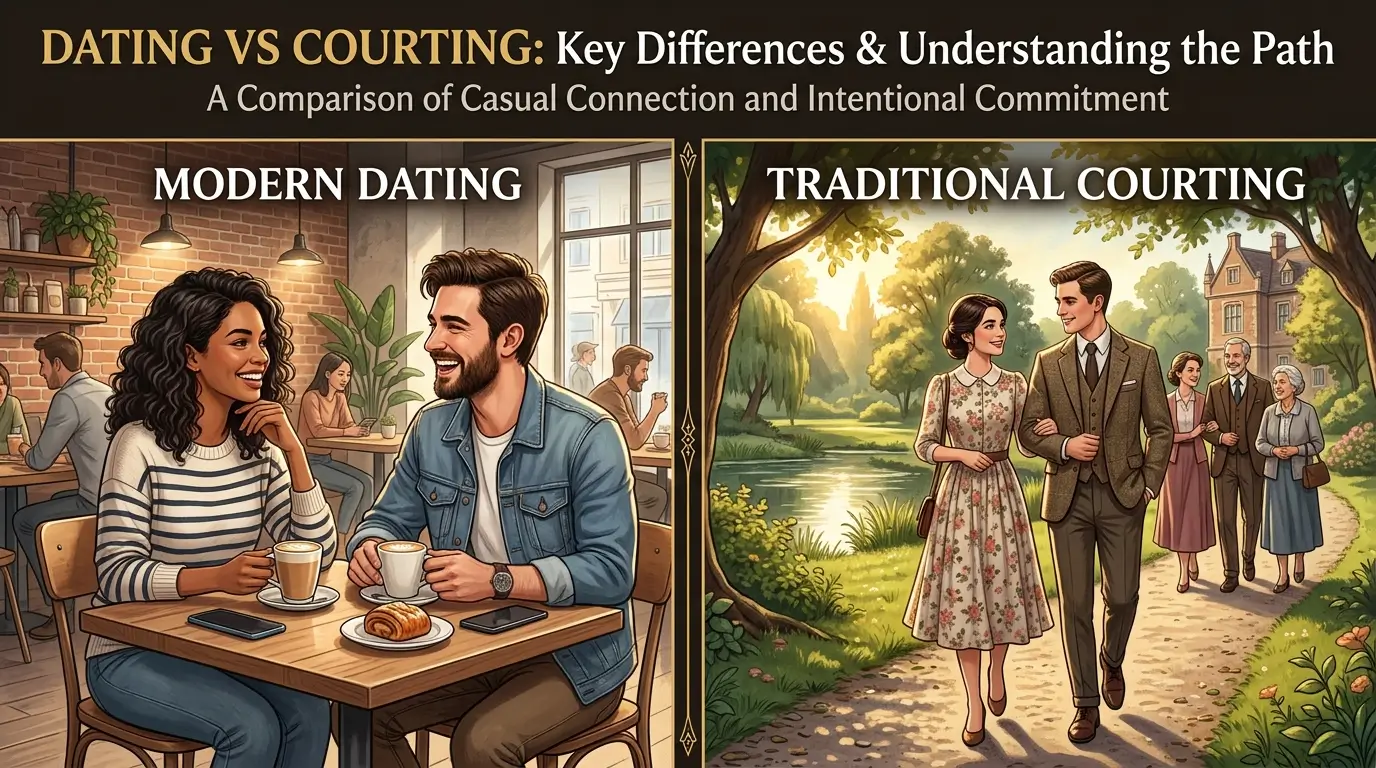
Imagine two people meeting for coffee after connecting online. They spend time together, learn about each other’s interests, and decide whether they are compatible. This is commonly known as dating. Now imagine another couple whose relationship begins with a clear intention of marriage, involving family support, serious commitment, and long-term planning. This is known as courting.
The difference between dating and courting is an important topic in modern relationships. While both involve getting to know a potential partner, their goals, expectations, and approaches are often very different.
Understanding the difference between dating and courting helps individuals make informed relationship choices. In today’s changing society, many people use these terms interchangeably, which creates confusion.
Learning the difference between dating and courting can improve communication, relationship success, and personal values. Whether you are young, experienced, or simply curious, knowing the difference between dating and courting provides valuable insight into human relationships.
Key Difference Between Dating and Courting
The primary difference is that dating focuses on exploring compatibility, while courting focuses on pursuing a committed relationship with marriage as the intended goal. Dating is generally more casual and flexible, whereas courting is usually serious, intentional, and long-term.
Why is the difference necessary to Know?
Understanding the distinction benefits both learners and relationship experts because relationships shape families and society.
- It helps people set clear expectations.
- It reduces misunderstandings between partners.
- It supports healthier communication.
- It allows individuals to choose relationship styles that match their values.
- It strengthens family and social structures.
- It improves relationship education and counseling.
A clear understanding of these concepts helps society promote respectful and meaningful relationships.
Pronunciation
Dating
| Accent | Pronunciation |
| US | DAY-ting (/ˈdeɪ.t̬ɪŋ/) |
| UK | DAY-ting (/ˈdeɪ.tɪŋ/) |
Courting
| Accent | Pronunciation |
| US | KOR-ting (/ˈkɔːr.tɪŋ/) |
| UK | KAW-ting (/ˈkɔː.tɪŋ/) |
From Casual Meetings to Lifelong Commitment
Although dating and courting both involve romantic interest, they differ significantly in purpose, expectations, and social involvement. Let’s examine these differences in detail.
Difference Between Dating and Courting
1. Purpose
Dating
Dating aims to explore compatibility and mutual attraction.
Examples:
- Two coworkers go out to see if they enjoy each other’s company.
- A couple dates casually before deciding on exclusivity.
Courting
Courting aims to find a spouse and build a future together.
Examples:
- A couple discusses marriage within the first few months.
- Families support the relationship from the beginning.
2. Level of Commitment
Dating
Commitment may vary and can be temporary.
Examples:
- Someone dates multiple people before choosing one.
- A relationship ends if compatibility is lacking.
Courting
Commitment is usually established early.
Examples:
- Both partners agree on long-term intentions.
- Relationship decisions are made together.
3. Family Involvement
Dating
Family involvement is often minimal initially.
Examples:
- Parents may not know about the relationship.
- Family meetings happen much later.
Courting
Families are frequently involved from the start.
Examples:
- Parents meet early in the relationship.
- Family guidance influences decisions.
4. Relationship Structure
Dating
More flexible and informal.
Examples:
- Couples create their own rules.
- Relationship stages vary widely.
Courting
Usually follows traditional expectations.
Examples:
- Clear relationship boundaries are set.
- Future planning occurs early.
5. Time Frame
Dating
Can last weeks, months, or years without marriage plans.
Examples:
- College students date casually.
- Couples date while focusing on careers.
Courting
Generally progresses toward marriage.
Examples:
- Engagement follows a period of courtship.
- Relationship milestones are intentional.
6. Exclusivity
Dating
May or may not be exclusive.
Examples:
- A person dates several people.
- Exclusivity is discussed later.
Courting
Usually exclusive from the beginning.
Examples:
- Both partners commit to one another.
- Romantic attention is focused on one person.
7. Decision-Making
Dating
Decisions are often based on personal preference.
Examples:
- Couples focus on enjoyment.
- Short-term goals guide choices.
Courting
Decisions consider long-term compatibility.
Examples:
- Financial goals are discussed.
- Future family plans are considered.
8. Social Expectations
Dating
Modern society generally views dating as normal exploration.
Examples:
- Casual dates are socially accepted.
- Online dating is common.
Courting
Associated with traditional values.
Examples:
- Religious communities encourage courtship.
- Cultural customs influence behavior.
9. Emotional Investment
Dating
Emotional involvement develops gradually.
Examples:
- Partners take time to trust each other.
- Feelings may remain uncertain.
Courting
Emotional investment is intentional and serious.
Examples:
- Couples discuss future expectations.
- Strong emotional bonds develop early.
10. End Goal
Dating
The relationship may or may not lead to marriage.
Examples:
- Some relationships remain casual.
- Partners may decide to separate.
Courting
Marriage is typically the desired outcome.
Examples:
- Courtship leads to engagement.
- Marriage planning begins early.
Nature and Behaviour of Dating
Dating is generally:
- Exploratory
- Flexible
- Individual-focused
- Informal
- Compatibility-centered
People who date often seek enjoyment, companionship, and personal growth while evaluating potential partners.
Nature and Behaviour of Courting
Courting is generally:
- Intentional
- Goal-oriented
- Commitment-focused
- Family-oriented
- Marriage-centered
People who court usually prioritize long-term compatibility and shared values.
Why Are People Confused About Their Use?
People often confuse dating and courting because:
- Both involve romantic relationships.
- Media frequently uses the terms interchangeably.
- Modern courtship sometimes resembles dating.
- Cultural definitions vary.
- Relationship norms continue to evolve.
Difference and Similarity Table
| Feature | Dating | Courting | Similarity |
| Purpose | Explore compatibility | Seek marriage | Both involve romantic interest |
| Commitment | Flexible | Serious | Require communication |
| Family Role | Limited | Significant | Families may eventually participate |
| Exclusivity | Optional | Usually expected | Both can become exclusive |
| Duration | Variable | Goal-oriented | Require time together |
| Structure | Informal | Traditional | Relationship building |
| Future Planning | Not always | Essential | Discussing goals |
| Emotional Bond | Gradual | Intentional | Emotional connection develops |
| Social View | Modern | Traditional | Widely recognized |
| Outcome | Various possibilities | Marriage-focused | May lead to long-term partnership |
Which Is Better in What Situation?
Dating
Dating is often better when individuals are still discovering their preferences, life goals, and relationship expectations. It allows flexibility and provides opportunities to meet different people. Young adults, busy professionals, and those uncertain about marriage may find dating more suitable because it encourages exploration without immediate long-term obligations.
Courting
Courting is often better for people seeking a serious relationship leading directly to marriage. Individuals with strong cultural, religious, or traditional values may prefer courtship because it provides structure, commitment, and clear intentions. Those who value family involvement and long-term planning may find courting more effective than casual dating.
How the Keywords Are Used in Metaphors and Similes
Dating
Metaphors
- Dating is a journey of discovery.
- Dating is a bridge between strangers and partners.
Similes
- Dating is like trying different paths in a forest.
- Dating is like sampling dishes before choosing a favorite meal.
Courting
Metaphors
- Courting is the foundation of a future home.
- Courting is a roadmap to marriage.
Similes
- Courting is like planting a tree for future generations.
- Courting is like building a house brick by brick.
Connotative Meanings
Dating
| Type | Meaning | Example |
| Positive | Freedom and exploration | “Dating helped her understand herself.” |
| Negative | Lack of commitment | “Some see dating as too casual.” |
| Neutral | Social interaction | “They have been dating for months.” |
Courting
| Type | Meaning | Example |
| Positive | Commitment and sincerity | “Their courting reflected strong values.” |
| Negative | Restrictive or old-fashioned | “Some consider courting too formal.” |
| Neutral | Traditional relationship process | “They began courting last year.” |
Idioms and Proverbs Related to Romance
1. Love is blind.
Example: Love is blind; he ignored all her flaws while dating.
2. Match made in heaven.
Example: Their courtship seemed like a match made in heaven.
3. The course of true love never did run smooth.
Example: Their dating journey proved that the course of true love never did run smooth.
4. Birds of a feather flock together.
Example: During courting, they discovered they shared the same values.
5. Follow your heart.
Example: She followed her heart when choosing between dating and courtship.
Works in Literature
Dating
- Modern Romance — Nonfiction, Aziz Ansari, 2015
- The Rules — Relationship Guide, Ellen Fein & Sherrie Schneider, 1995
- Attached — Psychology, Amir Levine, 2010
Courting
- The Courtship of Miles Standish — Narrative Poem, Henry Wadsworth Longfellow, 1858
- Courtship and Marriage — Social Studies, Various Authors, multiple editions
- Pride and Prejudice — Romance Novel, Jane Austen, 1813
Movies Related to Dating
- The Dating Game (2017, USA)
- Dating Amber (2020, Ireland)
- Blind Dating (2006, USA)
Movies Related to Courting
- The Courtship of Eddie’s Father (1963, USA)
- The Courtship (2022, USA)
- Love Comes Softly (2003, USA)
Frequently Asked Questions
1. Is courting more serious than dating?
Yes. Courting generally involves a stronger commitment and marriage-focused intentions.
2. Can dating lead to marriage?
Yes. Many successful marriages begin through dating.
3. Is family involvement necessary in courting?
Traditionally, yes, though modern courtship practices vary.
4. Can courting exist without religious influence?
Yes. While often associated with religion, courting can be secular.
5. Which is more common today?
Dating is more common in contemporary societies.
How Both Are Useful for Society
Dating helps individuals learn about compatibility, communication, and relationship preferences. It encourages social interaction and personal growth.
Courting supports commitment, family involvement, and long-term relationship planning. It helps establish stable partnerships and strong family foundations.
Together, both approaches contribute to healthy social relationships and community development.
Final Words for Both
Dating offers freedom, flexibility, and opportunities for self-discovery. Courting offers intention, commitment, and a clear path toward marriage. Neither is universally superior; the best choice depends on personal values, goals, and cultural expectations.
Conclusion
The difference between dating and courting lies primarily in their purpose, level of commitment, and expectations for the future. Dating is often an exploratory process that allows individuals to learn about themselves and potential partners.
Courting, on the other hand, is generally a deliberate pursuit of a long-term relationship leading to marriage. Both approaches have strengths and can result in meaningful partnerships when practiced with honesty and respect.
By understanding the difference between dating and courting, individuals can choose the relationship style that best aligns with their beliefs, life goals, and emotional needs. Clear expectations and open communication remain the keys to success in either approach.

Jordan L. Carter is a contributing language analyst at WordCompares.com, focusing on modern English usage, evolving vocabulary trends, and digital communication language. With over a decade of writing experience, Jordan provides insightful word comparisons that make complex language differences simple for everyday readers.