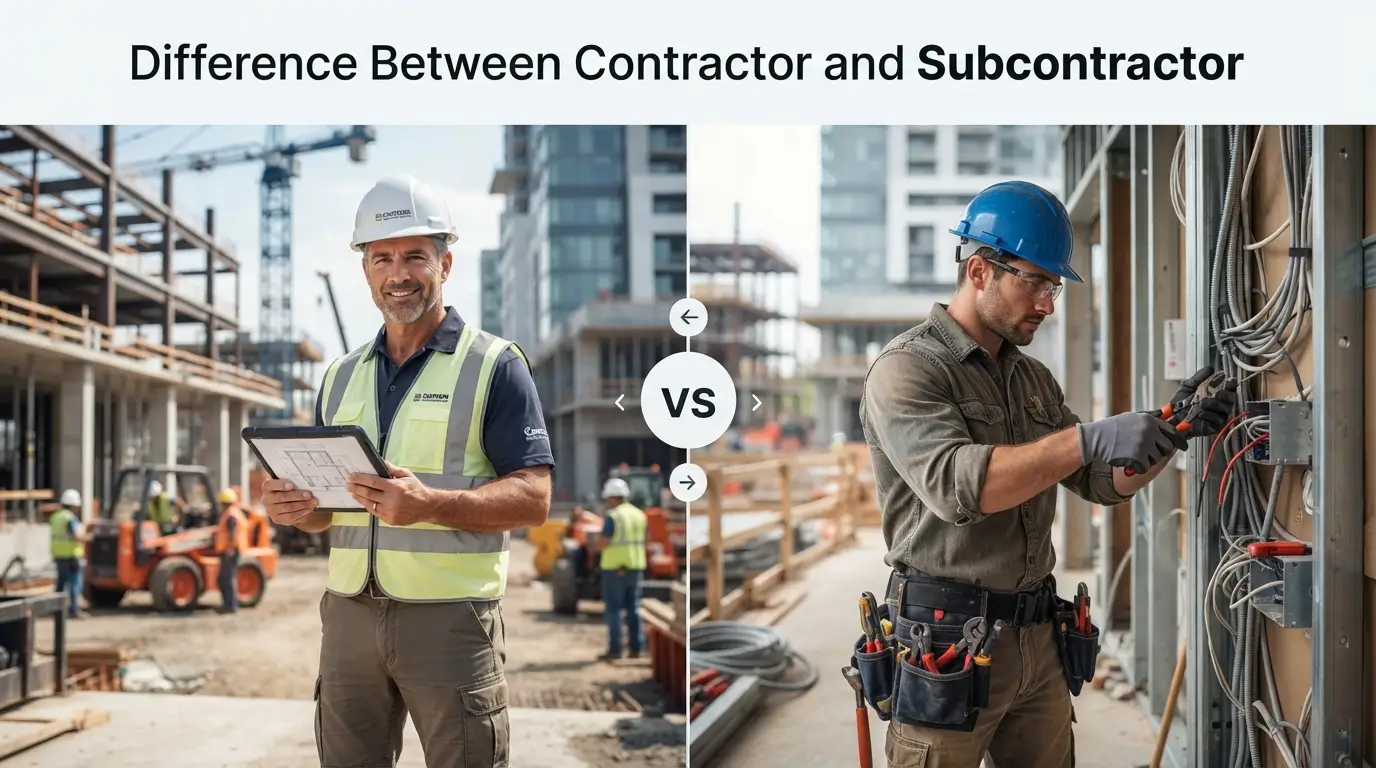
Imagine a family deciding to build their dream home. They hire one professional to oversee the entire construction project, manage workers, purchase materials, and ensure everything is completed on time. That person is the contractor. However, the contractor cannot do every specialized task alone.
They hire electricians, plumbers, painters, and roofers to perform specific jobs. These specialists are known as subcontractors. This simple example helps explain the difference between contractor and subcontractor in everyday life.
Understanding the difference between contractor and subcontractor is important because both play essential roles in construction and many other industries. Although they work toward the same project goals, their responsibilities, authority, and relationships with clients are different.
Learning the difference between contractor and subcontractor helps students, professionals, business owners, and homeowners communicate more effectively and avoid misunderstandings. If you are planning a project or exploring career opportunities, knowing the difference between contractor and subcontractor will help you make informed decisions.
Key Difference Between Contractor and Subcontractor
The main difference between contractor and subcontractor is their relationship with the client and their level of responsibility.
A contractor signs a direct agreement with the client and manages the entire project. They are responsible for planning, budgeting, scheduling, and ensuring the work meets the agreed standards.
A subcontractor, on the other hand, works under the contractor. They specialize in a particular task or trade, such as electrical work, plumbing, masonry, flooring, or painting. Their agreement is usually with the contractor rather than the client.
In simple words:
- A contractor manages the whole project.
- A subcontractor completes a specific part of the project.
Why Is Their Difference Necessary to Know for Learners and Experts?
Knowing the difference is valuable because contractors and subcontractors have different responsibilities that affect the success of every project.
For learners, understanding these terms builds a strong foundation in business, engineering, architecture, and construction studies. It also improves workplace communication and prepares them for future careers.
For professionals, the distinction helps in assigning responsibilities, managing contracts, controlling budgets, reducing legal disputes, and improving project efficiency.
In society, contractors and subcontractors work together to build homes, hospitals, schools, bridges, roads, factories, and offices. Their teamwork supports economic growth, creates employment opportunities, and ensures projects are completed safely and professionally. Recognizing their different roles helps everyone appreciate how large projects are successfully completed.
Pronunciation
| Word | US Pronunciation | UK Pronunciation |
| Contractor | /ˈkɑːn.træk.tɚ/ | /kənˈtræk.tə/ |
| Subcontractor | /ˌsʌb.kənˈtræk.tɚ/ | /ˌsʌb.kənˈtræk.tə/ |
Every successful project depends on both contractors and subcontractors, but their duties differ in many important ways. Let’s explore the difference between contractor and subcontractor in detail through ten practical comparison points.
Difference Between Contractor and Subcontractor
1. Relationship with the Client
A contractor works directly with the client. They negotiate the project, sign the contract, discuss deadlines, and accept responsibility for delivering the completed work.
A subcontractor usually has no direct agreement with the client. Instead, they are hired by the contractor to perform a specific portion of the project.
Contractor Example 1
A homeowner signs a contract with a construction company to build a new house.
Contractor Example 2
A city government hires a contractor to construct a new public library.
Subcontractor Example 1
The contractor hires an electrician to install all electrical wiring.
Subcontractor Example 2
The contractor hires a roofing specialist to install the roof.
2. Scope of Work
A contractor is responsible for the entire project from beginning to end. They coordinate every activity, monitor progress, and ensure all tasks are completed according to the contract.
A subcontractor focuses on one specialized task within the project. They complete only the work assigned to them.
Contractor Example 1
A contractor supervises excavation, framing, plumbing, electrical work, roofing, and finishing.
Contractor Example 2
A contractor manages the complete renovation of an office building.
Subcontractor Example 1
A plumber installs water pipes and drainage systems only.
Subcontractor Example 2
A flooring company installs hardwood floors without handling other construction work.
3. Level of Responsibility
The contractor carries overall responsibility for the project’s quality, safety, budget, and completion. If problems occur, the client generally contacts the contractor first.
A subcontractor is responsible only for the quality and completion of their assigned specialty.
Contractor Example 1
If construction falls behind schedule, the contractor must create a recovery plan.
Contractor Example 2
If building materials arrive late, the contractor finds alternative suppliers.
Subcontractor Example 1
An HVAC subcontractor ensures the heating and cooling system works correctly.
Subcontractor Example 2
A painting subcontractor corrects any defects in the painted walls.
4. Hiring Authority
The contractor has the authority to hire subcontractors, laborers, suppliers, and equipment operators as needed.
Subcontractors generally hire only their own employees or assistants to complete their specialized work.
Contractor Example 1
A contractor hires plumbing, electrical, and masonry companies.
Contractor Example 2
A contractor brings in landscaping experts after construction is complete.
Subcontractor Example 1
A plumbing subcontractor hires two licensed plumbers for pipe installation.
Subcontractor Example 2
A painting subcontractor employs several painters to complete interior walls.
5. Payment Process
The contractor receives payment directly from the client according to the contract terms. After receiving payment, the contractor pays subcontractors for the work they have completed.
Subcontractors invoice the contractor instead of the client.
Contractor Example 1
A homeowner pays the contractor after completing each construction phase.
Contractor Example 2
A business owner pays the contractor monthly during a commercial building project.
Subcontractor Example 1
An electrician submits an invoice to the contractor after wiring the building.
Subcontractor Example 2
A tile installer receives payment from the contractor after completing the flooring work.
6. Decision-Making Authority
A contractor has the authority to make major decisions about the project. They decide how resources will be used, coordinate schedules, communicate with the client, and solve problems that affect the overall work.
A subcontractor makes decisions only within their area of expertise. They cannot change the project’s overall plan without the contractor’s approval.
Contractor Example 1
A contractor changes the construction schedule because heavy rain delays the foundation work.
Contractor Example 2
A contractor chooses a different supplier when building materials become unavailable.
Subcontractor Example 1
An electrician decides the safest route for electrical wiring within the approved design.
Subcontractor Example 2
A plumber selects the most suitable pipe fittings for the plumbing system.
7. Area of Expertise
Contractors usually have broad knowledge of project management. They understand how different trades work together and ensure every part of the project is completed in the correct order.
Subcontractors are specialists. They have advanced skills in one specific trade or profession.
Contractor Example 1
A general contractor coordinates electricians, plumbers, carpenters, painters, and roofers.
Contractor Example 2
A commercial contractor manages the construction of an office complex from start to finish.
Subcontractor Example 1
A welding subcontractor specializes in fabricating and joining steel structures.
Subcontractor Example 2
A glass installation subcontractor installs windows and glass doors.
8. Legal Responsibility
The contractor is legally responsible for delivering the completed project according to the agreement with the client. If the project fails to meet contract requirements, the contractor is generally held accountable.
A subcontractor is legally responsible for performing only the work described in their agreement with the contractor.
Contractor Example 1
A contractor resolves construction defects reported by the property owner.
Contractor Example 2
A contractor ensures the building complies with local safety regulations.
Subcontractor Example 1
An electrical subcontractor repairs faulty wiring covered under their work agreement.
Subcontractor Example 2
A roofing subcontractor fixes leaks caused by poor roof installation.
9. Communication Channel
The contractor serves as the primary point of contact between the client and everyone working on the project. They receive instructions from the client and communicate them to subcontractors.
Subcontractors usually communicate with the contractor rather than directly with the client.
Contractor Example 1
A contractor updates the homeowner about weekly construction progress.
Contractor Example 2
A contractor discusses design modifications with the project owner.
Subcontractor Example 1
A painter informs the contractor that additional preparation is needed before painting.
Subcontractor Example 2
A flooring installer reports material shortages to the contractor.
10. Business Risk and Profit
Contractors generally take greater financial and business risks because they manage the entire project, control budgets, and are responsible for meeting deadlines. Their profit depends on successful project management.
Subcontractors face lower overall project risk because they focus on completing one specialized task, although they remain responsible for the quality of their own work.
Contractor Example 1
A contractor loses profit because unexpected material costs increase the project budget.
Contractor Example 2
A contractor earns additional profit by completing the project ahead of schedule.
Subcontractor Example 1
A masonry subcontractor profits by completing brickwork efficiently.
Subcontractor Example 2
A painting subcontractor increases earnings by finishing multiple projects within the planned timeline.
Nature and Behavior of Both
Nature of a Contractor
A contractor is primarily a project manager and coordinator. Their work involves planning, organizing, supervising, budgeting, and ensuring every stage of the project runs smoothly. Contractors often possess leadership, communication, negotiation, and problem-solving skills because they manage multiple teams at once.
Behavior of a Contractor
- Leads the entire project.
- Communicates directly with clients.
- Coordinates different specialists.
- Solves unexpected problems.
- Manages budgets and schedules.
- Ensures quality and safety standards are maintained.
Nature of a Subcontractor
A subcontractor is a technical expert who performs specialized work. Their success depends on professional skills, accuracy, efficiency, and craftsmanship within a particular trade.
Behavior of a Subcontractor
- Focuses on a specific task.
- Follows project specifications.
- Works according to the contractor’s schedule.
- Maintains technical quality.
- Uses specialized equipment and expertise.
- Cooperates with other trades when necessary.
Why Are People Confused About Their Use?
Many people confuse contractor and subcontractor because both work on the same project and are often seen at the same construction site. Since they may wear similar safety equipment and collaborate closely, it can appear that they have the same role.
Another reason is that both terms contain the word contract, making them seem nearly identical. In everyday conversations, people sometimes use them interchangeably without realizing that a contractor works directly for the client, while a subcontractor works for the contractor.
The confusion also increases because some professionals may act as contractors on one project and subcontractors on another, depending on the type of agreement they have.
Difference and Similarity Between Contractor and Subcontractor
| Feature | Contractor | Subcontractor | Similarity |
| Contract | Signs directly with the client | Signs with the contractor | Both work under legal agreements |
| Main Role | Manages the complete project | Performs specialized work | Both contribute to project success |
| Client Contact | Direct communication | Usually indirect communication | Both may attend project meetings |
| Responsibility | Entire project | Assigned portion only | Both are responsible for quality |
| Decision Authority | Makes overall project decisions | Makes technical decisions within their work | Both solve work-related problems |
| Payment | Paid by the client | Paid by the contractor | Both receive payment for completed work |
| Risk Level | Higher business risk | Lower overall project risk | Both face professional responsibility |
| Skills | Management and leadership | Technical specialization | Both require experience and expertise |
| Team Management | Supervises multiple teams | Supervises own crew if needed | Both may lead workers |
| Goal | Deliver the whole project | Complete assigned work successfully | Both aim for a successful project |
Which Is Better in What Situation?
When a Contractor Is Better
A contractor is the better choice when you need someone to manage an entire project from beginning to end. For example, if you are building a house, renovating a commercial property, or constructing a school, a contractor handles planning, budgeting, scheduling, permits, and coordination among different specialists. Hiring a contractor saves time because you communicate with one person who takes responsibility for the entire project.
When a Subcontractor Is Better
A subcontractor is the better choice when only one specialized service is needed. If your home only requires electrical repairs, plumbing installation, roofing replacement, or interior painting, hiring a qualified subcontractor or specialist can be more cost-effective and efficient. Their focused expertise often results in higher-quality workmanship for that particular task without paying for full project management services.
How the Keywords Are Used in Metaphors and Similes
Although contractor and subcontractor are primarily professional terms, writers sometimes use them metaphorically.
Contractor as a Metaphor
A contractor can symbolize a leader, organizer, or architect of success.
Examples
- She became the contractor of her own future by carefully planning every career move.
- A great teacher is the contractor of young minds, building strong foundations for lifelong learning.
Subcontractor as a Metaphor
A subcontractor may symbolize someone who supports a larger mission or contributes specialized skills behind the scenes.
Examples
- Every volunteer became a subcontractor in the community’s success.
- His creativity acted like a subcontractor, adding valuable details to the team’s big vision.
Contractor in Similes
- He organized the event like a contractor managing a large construction project.
- She planned her studies like a contractor following a detailed blueprint.
Subcontractor in Similes
- The designer worked like a subcontractor, focusing on one important piece of the project.
- The research assistant contributed like a subcontractor completing a specialized assignment.
Connotative Meaning of Both Keywords
Contractor
Positive Connotation
A contractor often represents leadership, responsibility, reliability, organization, and accountability.
Examples
- The contractor completed the hospital ahead of schedule.
- Everyone trusted the contractor because of his honesty.
Negative Connotation
Sometimes the word suggests delays, cost overruns, or management problems when projects are poorly handled.
Examples
- The contractor ignored safety rules.
- The contractor failed to finish the project on time.
Neutral Connotation
The term simply refers to a person or company hired through a contract.
Example
- The contractor submitted the final project report.
Subcontractor
Positive Connotation
A subcontractor often represents expertise, precision, craftsmanship, and specialized knowledge.
Examples
- The subcontractor installed the electrical system perfectly.
- The subcontractor solved a difficult technical problem.
Negative Connotation
Occasionally the word may imply limited authority or dependence on another company.
Examples
- The subcontractor had to wait for approval before starting work.
- The subcontractor could not change the project schedule independently.
Neutral Connotation
The word simply describes a specialist hired by another contractor.
Example
- The subcontractor completed the plumbing installation.
Idioms or Proverbs Related to the Words
There are no common English idioms or traditional proverbs that specifically use the words contractor or subcontractor. However, several construction-related idioms closely relate to their work.
1. Build Bridges, Not Walls
Meaning: Create good relationships instead of conflict.
Example:
The contractor encouraged everyone to build bridges, not walls, by resolving disagreements peacefully.
2. Lay the Foundation
Meaning: Prepare for future success.
Example:
The contractor laid the foundation for a successful project through careful planning.
3. Brick by Brick
Meaning: Progress slowly and steadily.
Example:
The subcontractor improved the building brick by brick until it was complete.
4. On Solid Ground
Meaning: Safe, secure, or well-prepared.
Example:
Because the contractor followed all safety rules, the project remained on solid ground.
5. Measure Twice, Cut Once
Meaning: Plan carefully before taking action.
Example:
The subcontractor measured every cabinet twice before making the final cuts.
Works in Literature Featuring the Keywords
The exact words “contractor” and “subcontractor” rarely appear in the titles of famous literary works. However, they are commonly discussed in books about business, construction, engineering, and project management.
Contractor
- The Construction MBA – Matt Stevens – Business/Construction Management – 2008
- Construction Project Management – Frederick Gould & Nancy Joyce – Educational/Engineering – 2009
- Modern Construction Management – Frank Harris & Ronald McCaffer – Construction Management – Latest editions from 2013 onward
- Project Management for Construction – Chris Hendrickson – Engineering/Project Management – 1989
Subcontractor
Subcontractors are discussed extensively in the following works, although the word is generally used within the content rather than the title.
- Construction Contracts – Jimmie Hinze – Construction Law – Multiple editions
- Managing the Construction Process – Frederick Gould & Nancy Joyce – Construction Management – 2014
- Construction Law – Julian Bailey – Legal Reference – 2011
Movies Related to Contractor or Subcontractor
There are very few well-known films whose titles contain the words contractor or subcontractor. However, the following movie is directly related.
Contractor
- The Contractor – 2007 – United States/United Kingdom
- The Contractor – 2022 – United States
Subcontractor
There are no widely recognized international movies with “Subcontractor” as the official title.
However, subcontractors frequently appear as supporting characters in construction, engineering, and infrastructure-themed films and documentaries.
Frequently Asked Questions (FAQs)
1. What is the main difference between a contractor and a subcontractor?
A contractor signs a contract directly with the client and manages the entire project. A subcontractor works for the contractor and completes a specialized part of the project.
2. Can a subcontractor work without a contractor?
Usually, no. A subcontractor is normally hired by a contractor. However, a specialist may work directly for a client if they are hired as an independent contractor rather than as a subcontractor.
3. Who gets paid by the client?
The client usually pays the contractor. The contractor then pays the subcontractors according to their agreements.
4. Is a subcontractor responsible for the whole project?
No. A subcontractor is responsible only for the work assigned to them, while the contractor is responsible for the overall project.
5. Can one person be both a contractor and a subcontractor?
Yes. A company or professional may act as a contractor on one project and as a subcontractor on another, depending on the type of contract and their role.
How Both Are Useful for Surroundings
Contractors and subcontractors play an essential role in improving communities and supporting economic development.
Contractors manage projects that create homes, schools, hospitals, roads, offices, shopping centers, bridges, and public facilities. Their planning and coordination ensure these projects are completed safely, efficiently, and within budget.
Subcontractors contribute specialized skills that improve the quality of these projects. Electricians provide safe electrical systems, plumbers install reliable water networks, roofers protect buildings from weather, and painters give structures their finished appearance. Their expertise ensures that each part of a project meets professional standards.
Together, contractors and subcontractors create safer neighborhoods, stronger infrastructure, more employment opportunities, and better living conditions for society.
Final Words for Both
Although contractors and subcontractors work toward the same goal, they perform different but equally valuable functions.
A contractor acts as the leader who plans, organizes, coordinates, and delivers the complete project. A subcontractor focuses on specialized work that requires technical expertise and precision.
Neither role is more important than the other. Successful projects depend on cooperation, communication, and mutual trust between both. Understanding their differences helps clients choose the right professional, enables students to learn industry terminology correctly, and allows businesses to manage projects more effectively.
Conclusion
Understanding the difference between contractor and subcontractor is essential for anyone involved in construction, business, engineering, or project management. While a contractor oversees the entire project and works directly with the client, a subcontractor contributes specialized expertise by completing specific tasks assigned by the contractor.
Both roles complement each other and are necessary for delivering safe, efficient, and high-quality projects. Knowing when to hire a contractor or a subcontractor can save time, reduce costs, and improve communication throughout a project.
If you are a student, homeowner, business owner, or industry professional, recognizing these distinctions will help you make informed decisions and appreciate the teamwork behind every successful construction project.

Alexandra “Alex” Monroe is a senior linguistics contributor at WordCompares.com, where she specializes in comparative word analysis, semantics, and language clarity. With over 15 years of academic and editorial experience, Alex helps readers understand subtle differences between commonly confused words and phrases. Her research-driven yet practical writing style strengthens the educational authority of WordCompares.com.