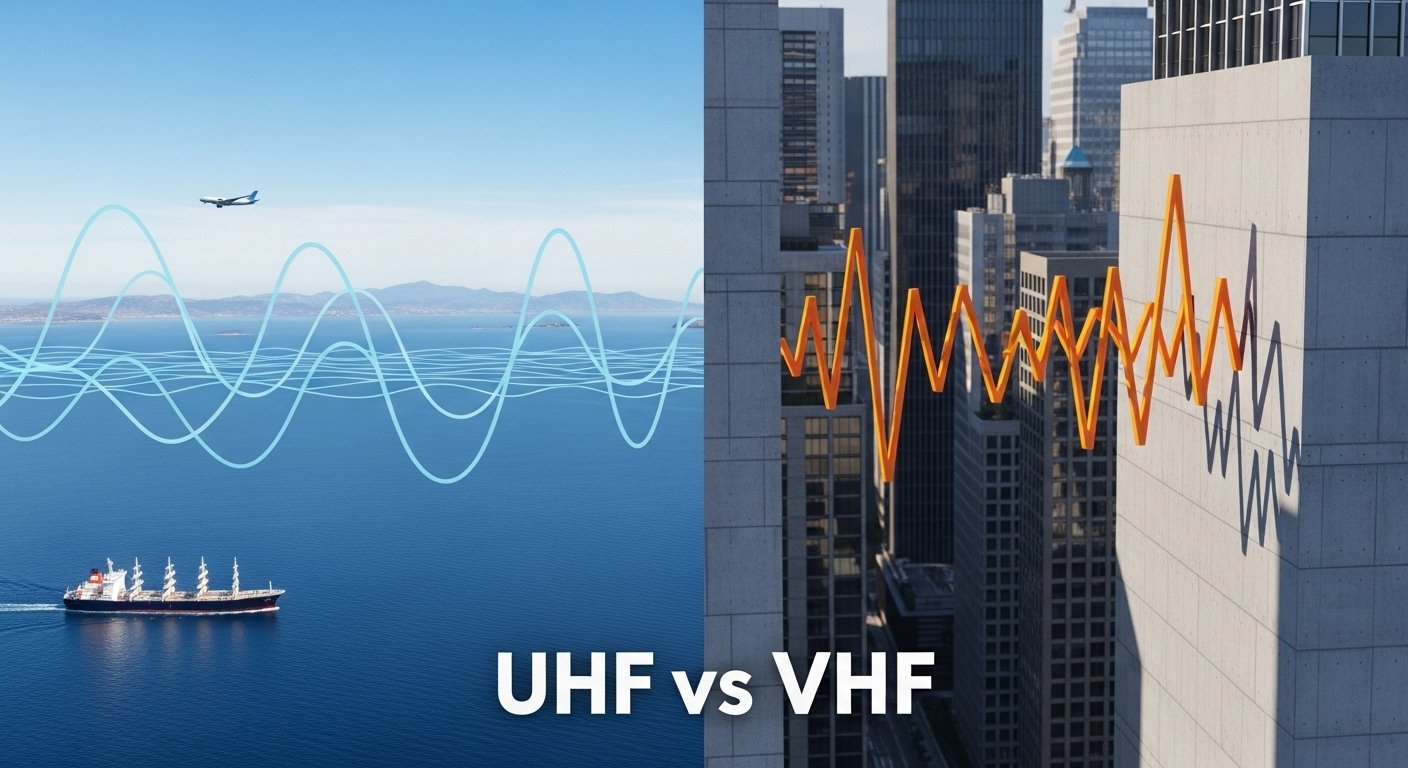
When I was helping a friend choose walkie-talkies for a hiking trip, we kept hearing two confusing terms: UHF and VHF. The shopkeeper insisted that understanding the difference between UHF and VHF would help us pick the right device. At first, both sounded like complicated technical jargon, but they actually describe how radio signals travel through air and obstacles.
As we researched more, we realized that the difference between UHF and VHF affects everything from TV signals to aviation communication. Whether you are a hobbyist, engineer, or student, knowing the difference between UHF and VHF helps you understand how wireless communication works in daily life. This article explains the difference between UHF and VHF in simple language with real-world examples.
Key Difference Between the Both
The main difference between UHF and VHF lies in their frequency ranges and how their signals behave in different environments. VHF (Very High Frequency) uses lower frequencies with longer wavelengths, while UHF (Ultra High Frequency) uses higher frequencies with shorter wavelengths. This affects their range, penetration, and usage in technology.
Why is the difference necessary to Know?
Understanding the difference between UHF and VHF is important for students, engineers, broadcasters, pilots, and even security teams. Society relies heavily on wireless communication systems such as television broadcasting, emergency radios, aviation, maritime navigation, and mobile networks.
Choosing the wrong frequency band can lead to weak signals, communication failure, or safety risks. For example, pilots use VHF because it works better over long open distances, while indoor communication systems rely on UHF due to its ability to penetrate walls.
Pronunciation of Both (US & UK)
UHF
- UK: /ˌjuː.eɪtʃˈef/
- US: /ˌjuː.eɪtʃˈef/
VHF
- UK: /ˌviː.eɪtʃˈef/
- US: /ˌviː.eɪtʃˈef/
Linking Hook
Now that you understand what UHF and VHF mean and why they matter, let’s explore their detailed differences, behaviors, and real-world applications step by step.
Difference Between UHF and VHF
10 Points of Difference
1. Frequency Range
VHF: 30 300 MHz
UHF: 300 MHz 3 GHz
Examples:
- FM radio uses VHF.
- Mobile phones use UHF.
2. Wavelength Length
VHF: Longer wavelength
UHF: Shorter wavelength
Examples:
- Long wavelengths travel farther in open areas.
- Short wavelengths allow compact antennas in smartphones.
3. Signal Range
VHF: Longer range in open terrain
UHF: Shorter range but stable in cities
Examples:
- Marine radios use VHF.
- Security radios in malls use UHF.
4. Obstacle Penetration
VHF: Struggles with walls
UHF: Passes through buildings better
Examples:
- Airports use VHF outdoors.
- Hospitals use UHF indoors.
5. Power Consumption
VHF: Requires less power
UHF: Requires more power
Examples:
- Handheld outdoor radios last longer on VHF.
- High-frequency TV transmitters consume more energy.
6. Antenna Size
VHF: Needs longer antennas
UHF: Uses shorter antennas
Examples:
- Old TV antennas were long due to VHF.
- Modern wireless mics have small antennas due to UHF.
7. Signal Clarity
VHF: Less crowded spectrum
UHF: More crowded but supports more channels
Examples:
- Aviation communication stays clear on VHF.
- UHF supports many TV channels.
8. Typical Applications
VHF: Aviation, marine, FM radio
UHF: Television, cellular networks, Wi-Fi
Examples:
- Air traffic control uses VHF.
- Digital TV broadcasting uses UHF.
9. Coverage Area
VHF: Better for rural and coastal areas
UHF: Better for urban environments
Examples:
- Fishermen rely on VHF at sea.
- Construction workers use UHF in cities.
10. Data Transmission Capability
VHF: Limited bandwidth
UHF: Higher bandwidth for data
Examples:
- VHF supports voice communication.
- UHF supports video broadcasting and mobile data.
Nature and Behaviour of Both
VHF Behaviour
VHF signals travel long distances in straight lines and follow the curvature of the earth slightly. They perform best in open spaces such as oceans, fields, and airspace.
UHF Behaviour
UHF signals travel in a line-of-sight pattern but reflect and scatter, allowing them to penetrate buildings and obstacles, making them suitable for dense environments.
Why People Are Confused About Their Use
People often confuse UHF and VHF because both are types of radio frequencies and their names sound similar. Their applications overlap in devices like walkie-talkies, TVs, and radios. Without technical knowledge, users may not realize that environmental conditions determine which frequency works better.
Table Showing Difference and Similarity
| Feature | VHF | UHF | Similarity |
| Full Form | Very High Frequency | Ultra High Frequency | Both are radio frequency bands |
| Frequency | Lower | Higher | Both transmit wireless signals |
| Range | Longer in open areas | Shorter but stable | Both affected by obstacles |
| Antenna | Long | Short | Both require antennas |
| Uses | Aviation, marine | TV, mobile phones | Used in communication systems |
Which Is Better in What Situation?
VHF Best Situations
VHF is better in outdoor and long-distance communication environments such as maritime navigation, aviation communication, farming areas, and hiking trips. Its longer wavelengths allow signals to travel farther with less power when there are no obstacles.
This makes VHF ideal for ships communicating over oceans or aircraft communicating across large airspaces. In rural or mountainous regions, VHF radios are often preferred because they maintain stable communication over long distances without requiring repeaters.
UHF Best Situations
UHF is better in cities, buildings, factories, hospitals, and shopping malls. Its higher frequency allows signals to penetrate walls, metal structures, and concrete more effectively than VHF. This makes UHF suitable for indoor communication systems, wireless microphones, television broadcasting, and mobile networks.
Security teams, event organizers, and construction workers often rely on UHF radios because they work reliably in crowded environments where VHF signals would be blocked or weakened.
How the Keywords Are Used in Metaphors and Similes
- “His voice reached people like VHF signals across an open sea.”
- “Her ideas spread like UHF waves through city walls.”
These metaphors compare communication effectiveness to signal behavior.
Connotative Meaning of Both Keywords
VHF Connotations
- Positive: Reliable, far-reaching
- Neutral: Traditional communication
- Negative: Outdated technology
Example:
- “The company still relies on VHF systems, showing a conservative approach.”
UHF Connotations
- Positive: Modern, powerful, advanced
- Neutral: Technical or scientific
- Negative: Complex or power-hungry
Example:
- “The project needed UHF equipment, which increased costs.”
Idioms or Proverbs Related to the Words
There are no traditional idioms specifically based on UHF or VHF, but similar radio-based expressions exist:
- “On the same wavelength” meaning people understand each other.
Example: “After the meeting, the team was finally on the same wavelength.”
Works in Literature Featuring the Keywords
- “Radio Communication Handbook” Technical guide, RSGB, 2007
- “Practical RF Handbook” Engineering manual, Ian Hickman, 2006
Movies Featuring the Keywords or Radio Communication
- “Frequency” (2000, USA) Science fiction involving radio signals across time
- “The Boat That Rocked” (2009, UK) Focuses on radio broadcasting
Frequently Asked Questions
1. What is the main difference between UHF and VHF?
The main difference is frequency range, which affects signal behavior, range, and penetration.
2. Which is better for walkie-talkies?
UHF is better indoors, while VHF is better outdoors.
3. Why do airplanes use VHF instead of UHF?
Because VHF provides clearer long-distance communication in open skies.
4. Does UHF travel farther than VHF?
Not usually; VHF travels farther in open environments, while UHF works better through obstacles.
5. Are UHF and VHF still used today?
Yes, both are widely used in modern communication systems.
How Both Are Useful for Surroundings
UHF and VHF help maintain public safety, navigation, entertainment, and daily communication. From emergency services to television broadcasting, they support the technological infrastructure that modern society depends on.
Final Words for Both
UHF and VHF are not competitors but complementary technologies. Each serves specific purposes depending on environment and communication needs.
Conclusion
Understanding the difference between UHF and VHF is essential for anyone working with wireless technology or even using everyday communication devices. VHF offers long-distance transmission and performs best in open environments, while UHF provides better penetration and reliability in cities and buildings. Their unique characteristics make them suitable for different industries, including aviation, maritime navigation, television broadcasting, and mobile communication.
By learning how these frequencies behave, individuals can choose the right equipment, improve communication clarity, and avoid technical problems. In a world that depends on wireless signals, knowing the difference between UHF and VHF is not just technical knowledge it is practical awareness that supports efficient and safe communication.

Jordan L. Carter is a contributing language analyst at WordCompares.com, focusing on modern English usage, evolving vocabulary trends, and digital communication language. With over a decade of writing experience, Jordan provides insightful word comparisons that make complex language differences simple for everyday readers.