Imagine a student writing an essay for school. In one sentence, he writes, “She walked toward the library,” and in another, he writes, “She walked towards the library.” His teacher marks neither as wrong, leaving him confused. This is a common situation for English learners worldwide. Understanding the difference between toward and towards can help improve writing accuracy and confidence.
The words toward and towards both indicate movement, direction, or relation to something. They are among the most commonly used prepositions in English, yet many people wonder If one is more correct than the other.
The difference between toward and towards is primarily based on regional usage rather than meaning. Learning the difference between toward and towards helps writers choose the appropriate style for their audience. In this guide, we will explore the difference between toward and towards in detail with examples, comparisons, and practical tips.
Key Difference Between Toward and Towards
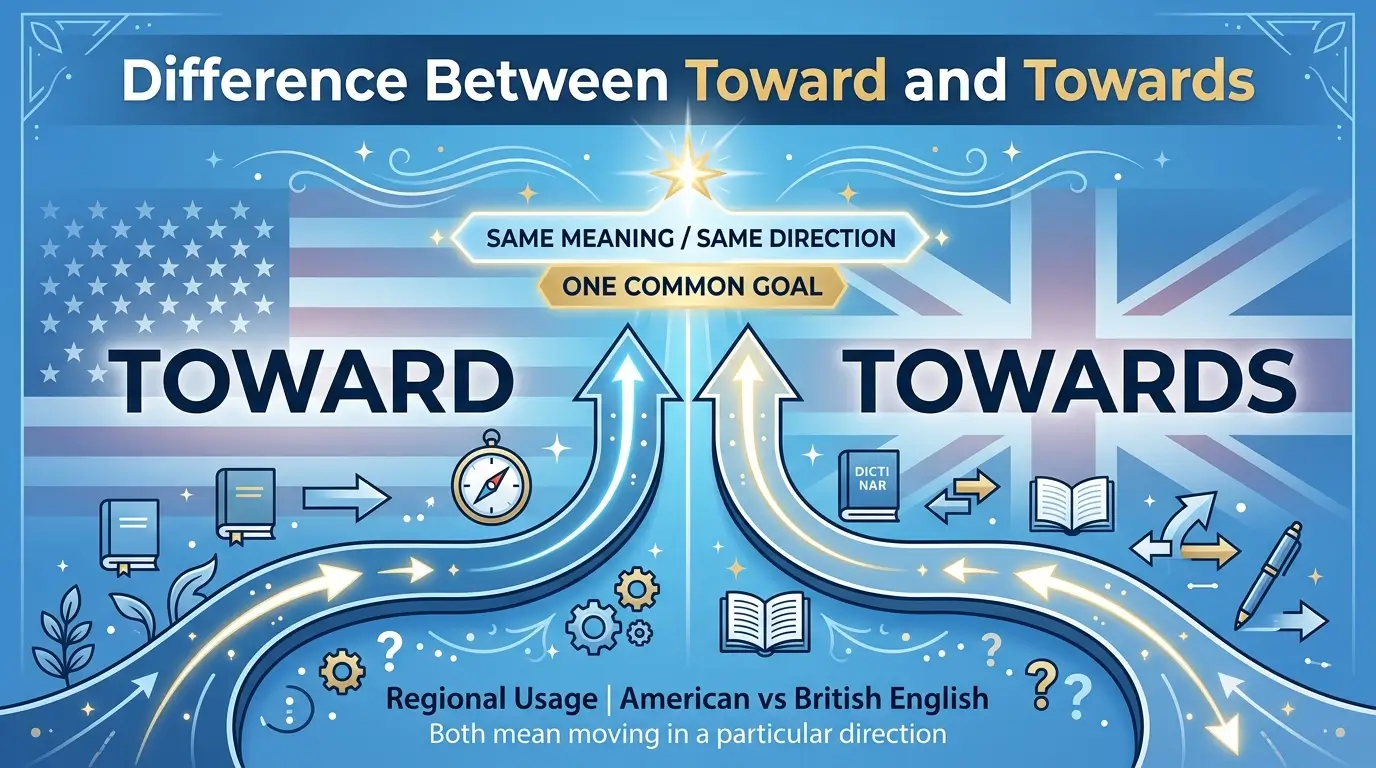
The primary difference is that toward is more commonly used in American English, while towards is preferred in British English and many other English-speaking regions.
Both words have the same meaning and grammatical function. They express direction, movement, attitude, or relationship toward a person, place, object, or idea.
Why Is Their Difference Necessary to Know for Learners and Experts?
Understanding the distinction is important because language varies across regions. Students, teachers, writers, journalists, researchers, and professionals often write for international audiences. Choosing the preferred form can make writing appear more natural and polished.
For learners, knowing the difference improves grammar confidence and prevents unnecessary corrections. For experts, consistency in academic, professional, and creative writing enhances credibility. Since English is a global language used in business, education, and communication, understanding regional variations such as toward and towards contributes to effective communication in society.
Pronunciation of Toward and Towards
| Word | US Pronunciation | UK Pronunciation |
| Toward | /təˈwɔːrd/ | /təˈwɔːd/ |
| Towards | /təˈwɔːrdz/ | /təˈwɔːdz/ |
Linking Hook
Although both words seem nearly identical, subtle differences in usage patterns, regional preferences, and writing styles make them worth exploring. Let’s examine their distinctions in detail.
Difference Between Toward and Towards
1. Regional Preference
Toward: Preferred in American English.
Examples:
- The car moved toward the bridge.
- She looked toward the stage.
Towards: Preferred in British English.
Examples:
- The car moved towards the bridge.
- She looked towards the stage.
2. Academic Writing
Toward: Frequently appears in American academic publications.
Examples:
- Researchers worked toward a solution.
- The policy moved toward reform.
Towards: More common in British academic writing.
Examples:
- Researchers worked towards a solution.
- The policy moved towards reform.
3. Newspaper Style Guides
Toward: Many American newspapers recommend it.
Examples:
- Efforts toward peace continue.
- Funds moved toward education.
Towards: Common in UK newspapers.
Examples:
- Efforts towards peace continue.
- Funds moved towards education.
4. Business Communication
Toward: Often used by U.S. companies.
Examples:
- We are working toward growth.
- The company is moving toward innovation.
Towards: Often used in British business documents.
Examples:
- We are working towards growth.
- The company is moving towards innovation.
5. Government Publications
Toward: More common in U.S. government documents.
Examples:
- Steps toward sustainability were introduced.
- Progress toward equality is evident.
Towards: Common in UK government reports.
Examples:
- Steps towards sustainability were introduced.
- Progress towards equality is evident.
6. Length of Form
Toward: Slightly shorter.
Examples:
- Move toward the exit.
- Walk toward the gate.
Towards: Contains an additional “s.”
Examples:
- Move towards the exit.
- Walk towards the gate.
7. Style Consistency
Toward: Matches American style guides.
Examples:
- Attitude toward learning matters.
- Movement toward progress is important.
Towards: Matches British style guides.
Examples:
- Attitude towards learning matters.
- Movement towards progress is important.
8. Publishing Preferences
Toward: Often preferred by U.S. publishers.
Examples:
- The story moves toward its climax.
- Attention shifted toward science.
Towards: Common among UK publishers.
Examples:
- The story moves towards its climax.
- Attention shifted towards science.
9. Frequency in American Literature
Toward: Appears more often in American texts.
Examples:
- He ran toward home.
- She turned toward the window.
Towards: Less common in American literature.
Examples:
- He ran towards home.
- She turned towards the window.
10. Global English Usage
Toward: Dominates in the United States.
Examples:
- Efforts toward success paid off.
- She leaned toward acceptance.
Towards: Dominates in Britain, Australia, and other Commonwealth countries.
Examples:
- Efforts towards success paid off.
- She leaned towards acceptance.
Nature and Behavior of Both Words
Toward
- Preposition
- Indicates direction or movement.
- Common in American English.
- Suitable for formal and informal writing.
- Expresses physical or abstract relationships.
Towards
- Preposition
- Indicates direction or movement.
- Common in British English.
- Suitable for formal and informal writing.
- Expresses physical or abstract relationships.
Why Are People Confused About Their Use?
People become confused because both words have identical meanings and functions. Unlike many English word pairs, there is no difference in definition. The confusion arises mainly from regional spelling preferences. Learners often encounter both forms in books, websites, movies, and educational materials, making it difficult to know which one to use.
Difference and Similarity Table
| Feature | Toward | Towards | Similarity |
| Meaning | Direction or relation | Direction or relation | Same meaning |
| Part of Speech | Preposition | Preposition | Both are prepositions |
| American English | Preferred | Less common | Both understood |
| British English | Less common | Preferred | Both accepted |
| Formal Writing | Accepted | Accepted | Equally correct |
| Informal Writing | Accepted | Accepted | Equally correct |
| Direction | Yes | Yes | Same function |
| Relationship | Yes | Yes | Same function |
| Grammar | Correct | Correct | No grammatical difference |
| Usage | Regional preference | Regional preference | Same purpose |
Which Is Better in What Situation?
Toward
Toward is generally better when writing for an American audience. It aligns with major American style guides and appears more frequently in U.S. newspapers, books, academic journals, and professional documents. If your readers are primarily in the United States, using toward can make your writing feel more natural and consistent.
Towards
Towards is better when writing for readers in the United Kingdom, Australia, New Zealand, and other Commonwealth countries. British publishers, schools, and organizations often favor towards. If your audience follows British English conventions, using towards helps maintain consistency and regional authenticity.
How the Keywords Are Used in Metaphors and Similes
Toward
Metaphorical Examples:
- She moved toward success with determination.
- The nation stepped toward a brighter future.
Simile Examples:
- He rushed toward the finish line like a racing horse.
- She leaned toward knowledge like a sunflower toward sunlight.
Towards
Metaphorical Examples:
- Their actions moved towards peace.
- Society is progressing towards equality.
Simile Examples:
- The child ran towards his mother like an arrow.
- Investors moved towards the opportunity like bees to flowers.
Connotative Meaning of Both Keywords
| Word | Connotation |
| Toward | Neutral |
| Towards | Neutral |
Examples
Toward (Positive)
- Her attitude toward learning is inspiring.
Toward (Negative)
- His behavior toward coworkers was rude.
Towards (Positive)
- The community worked towards improvement.
Towards (Negative)
- Their actions towards nature were harmful.
Idioms and Proverbs Related to Direction
1. Head Toward the Right Direction
Meaning: To make progress.
Example:
- The company is heading toward the right direction after the reforms.
2. Move Toward Better Things
Meaning: To improve one’s situation.
Example:
- After graduation, she moved toward better things.
3. A Step Towards Success
Meaning: Progress toward a goal.
Example:
- Completing the course was a step towards success.
Works in Literature Featuring the Words
Toward
- Toward the End of Time — Novel, John Updike, 1997
- Toward Democracy — Poetry, Edward Carpenter, 1883
- Toward a Psychology of Being — Psychology, Abraham Maslow, 1962
Towards
- Towards Zero — Mystery Novel, Agatha Christie, 1944
- Towards the Mountain — Memoir, Yui Morales, 2021
- Towards Another Summer — Novel, Janet Frame, 2007
Movies Featuring the Keywords
Toward
- Toward the Unknown (1956, USA)
Towards
- Towards Darkness (2007, USA)
- Towards Zero (2025, UK)
Frequently Asked Questions
1. Is toward or towards grammatically correct?
Both are grammatically correct.
2. Which form is used in American English?
American English generally prefers toward.
3. Which form is used in British English?
British English generally prefers towards.
4. Do they have different meanings?
No. They share the same meaning.
5. Can I use them interchangeably?
Yes, but consistency with regional style is recommended.
How Both Are Useful for Surroundings
Both words help people describe movement, direction, goals, relationships, and progress. They are useful in navigation, education, business communication, literature, science, and everyday conversation. By clearly expressing direction and intention, these words improve understanding and communication within communities and societies.
Final Words for Both
Toward and towards are excellent examples of how English changes across regions while preserving meaning. Neither is more correct than the other. The best choice depends on your audience and the style of English you are using.
Conclusion
The difference between toward and towards is surprisingly simple. Both words function as prepositions that indicate direction, movement, relationship, or progress. Their meanings are identical, and neither is grammatically superior.
The main distinction lies in regional preference: toward is favored in American English, while towards is more common in British English and other Commonwealth countries. Understanding this variation helps writers maintain consistency and communicate effectively with their intended audience.
If you choose toward or towards, the key is to use one form consistently throughout your writing. By mastering this subtle difference, learners and professionals can improve their accuracy, confidence, and overall command of English.

Dr. Marcus Reed is a lead editorial author at WordCompares.com and a specialist in communication studies and written clarity. With more than 12 years of university-level teaching experience, he focuses on explaining word distinctions in a clear and structured manner. His work ensures that WordCompares.com maintains accuracy, depth, and reader trust.