Imagine traveling from a hot desert to a dense rainforest. Along the way, you notice dramatic changes in climate, plants, animals, and landscapes. Scientists use terms like biome and ecosystem to describe these natural environments, but many people confuse them because they are closely connected.
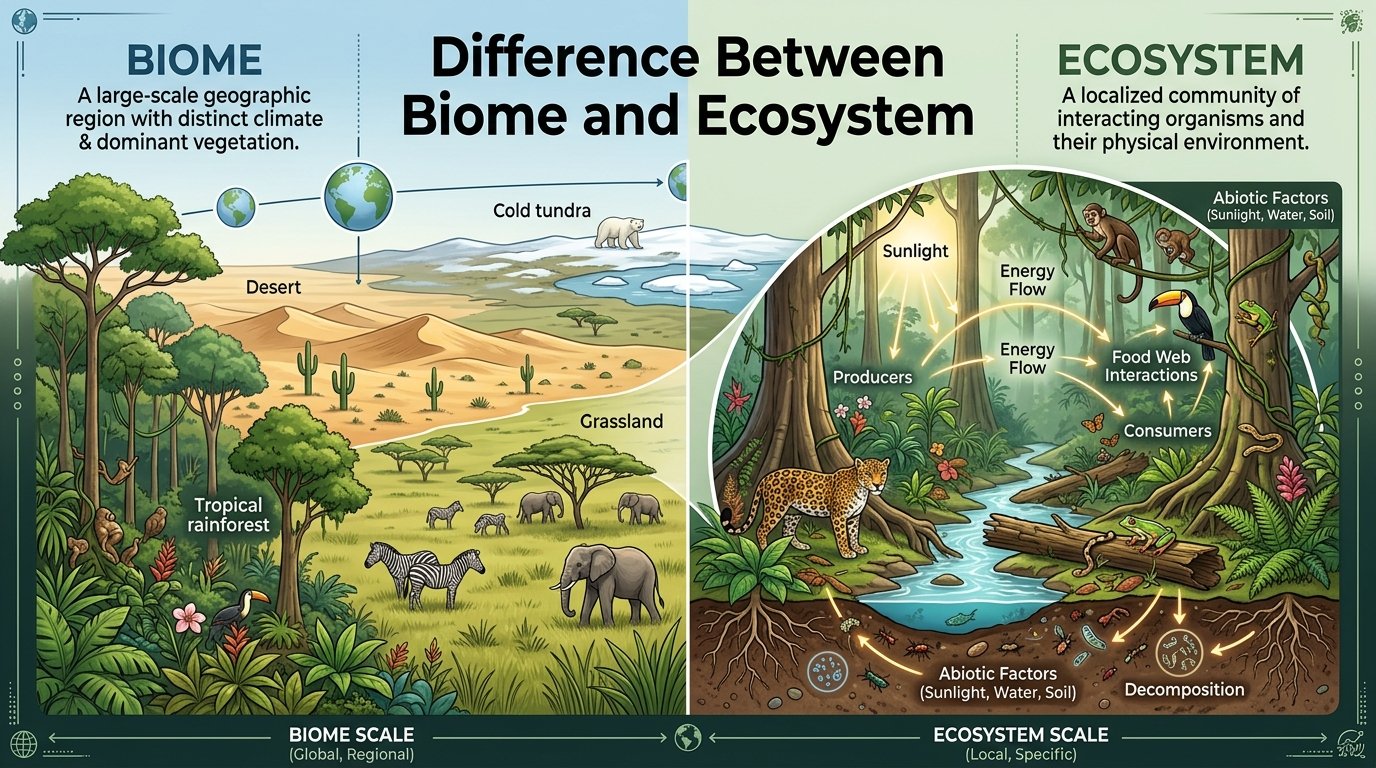
Understanding the difference between biome and ecosystem helps us better appreciate how nature functions. A biome is a large geographical region characterized by climate and dominant vegetation, while an ecosystem is a community of living organisms interacting with their physical environment.
The difference between biome and ecosystem is important for students, researchers, conservationists, and anyone interested in environmental science. Learning the difference between biome and ecosystem also helps explain how living things adapt to different conditions. Throughout this article, we will explore the difference between biome and ecosystem in a simple and practical way.
Pronunciation
Biome
US: /ˈbaɪ.oʊm/ (BY-ohm)
UK: /ˈbaɪ.əʊm/ (BY-ohm)
Ecosystem
US: /ˈiː.koʊˌsɪs.təm/ (EE-koh-sis-tuhm)
UK: /ˈiː.kəʊˌsɪs.təm/ (EE-koh-sis-tuhm)
A Linking Hook
Although both terms describe natural environments, they operate at different scales and serve different purposes in environmental science. Understanding their distinctions reveals how Earth’s living systems are organized.
Key Difference Between Biome and Ecosystem
A biome is a large geographical area defined mainly by climate, vegetation, and wildlife.
An ecosystem is a specific community of organisms interacting with each other and their physical surroundings.
Simply put, a biome contains many ecosystems, while an ecosystem is a smaller functional unit within a biome.
Why Is Their Difference Necessary to Know for Learners and Experts?
Understanding the difference is important because it helps people study nature more accurately.
For Learners
- Improves understanding of environmental science.
- Helps classify habitats correctly.
- Builds awareness about biodiversity.
For Experts
- Assists in conservation planning.
- Supports climate change research.
- Helps manage natural resources effectively.
Importance in Society
- Encourages environmental protection.
- Supports sustainable development.
- Helps governments create ecological policies.
- Promotes awareness of biodiversity conservation.
Difference Between Biome and Ecosystem
| No. | Biome | Ecosystem |
| 1 | Large geographical region | Smaller environmental unit |
| 2 | Defined mainly by climate | Defined by interactions |
| 3 | Contains multiple ecosystems | Exists within a biome |
| 4 | Covers vast areas | Can be very small |
| 5 | Focuses on vegetation types | Focuses on organism relationships |
| 6 | Less detailed | More detailed |
| 7 | Examples include deserts and tundras | Examples include ponds and forests |
| 8 | Classified by temperature and rainfall | Classified by living and nonliving components |
| 9 | Global-scale concept | Local-scale concept |
| 10 | Broader ecological category | Functional ecological system |
1. Scale of Size
A biome covers enormous geographic regions.
An ecosystem covers a specific location.
Biome Examples
- Sahara Desert Biome
- Tropical Rainforest Biome
Ecosystem Examples
- Oasis ecosystem
- Amazon River ecosystem
2. Basis of Classification
Biomes are classified according to climate patterns.
Ecosystems are classified according to interactions among organisms and the environment.
Biome Examples
- Grassland biome
- Tundra biome
Ecosystem Examples
- Pond ecosystem
- Coral reef ecosystem
3. Composition
A biome consists of many ecosystems.
An ecosystem contains living and nonliving elements interacting together.
Biome Examples
- Desert biome
- Taiga biome
Ecosystem Examples
- Lake ecosystem
- Forest ecosystem
4. Geographic Coverage
Biomes may span continents.
Ecosystems can occupy a few square meters.
Biome Examples
- Arctic biome
- Savanna biome
Ecosystem Examples
- Garden ecosystem
- Wetland ecosystem
5. Focus of Study
Biome studies focus on climate and vegetation.
Ecosystem studies focus on energy flow and interactions.
Biome Examples
- Temperate forest biome
- Chaparral biome
Ecosystem Examples
- River ecosystem
- Mangrove ecosystem
6. Biodiversity Characteristics
Different biomes support different biodiversity levels.
Each ecosystem contains unique species interactions.
Biome Examples
- Rainforest biome
- Desert biome
Ecosystem Examples
- Freshwater ecosystem
- Saltwater ecosystem
7. Environmental Factors
Biomes are influenced mainly by temperature and rainfall.
Ecosystems are influenced by both biotic and abiotic factors.
Biome Examples
- Alpine biome
- Tundra biome
Ecosystem Examples
- Marsh ecosystem
- Forest ecosystem
8. Number Present
There are relatively few major biomes worldwide.
There are countless ecosystems.
Biome Examples
- Grassland biome
- Desert biome
Ecosystem Examples
- Pond ecosystem
- Stream ecosystem
9. Human Impact
Human activities affect entire biomes.
Humans can alter individual ecosystems quickly.
Biome Examples
- Amazon rainforest biome
- Arctic biome
Ecosystem Examples
- Urban park ecosystem
- Agricultural ecosystem
10. Ecological Function
Biomes determine broad environmental conditions.
Ecosystems perform specific ecological processes.
Biome Examples
- Tropical biome
- Boreal biome
Ecosystem Examples
- Estuary ecosystem
- Coral reef ecosystem
Nature and Behaviour of Both
Biome
A biome behaves as a broad ecological region. Its climate determines what plants and animals can survive there. Biomes change slowly over long periods.
Ecosystem
An ecosystem behaves as a dynamic system where organisms constantly interact with one another and with their environment. Ecosystems can change relatively quickly due to natural or human influences.
Why People Are Confused About Their Use?
People often confuse biome and ecosystem because both describe natural environments and include living organisms. Additionally, ecosystems exist within biomes, making them closely related. Many educational materials discuss them together, which further contributes to misunderstanding.
Difference and Similarity Between Biome and Ecosystem
| Feature | Biome | Ecosystem | Similarity |
| Size | Very large | Small to medium | Both describe natural environments |
| Climate | Major factor | One factor among many | Both influenced by climate |
| Organisms | Broad groups | Specific communities | Both contain living organisms |
| Geography | Regional/global | Local | Both occupy physical space |
| Function | Classification | Interaction | Both support life |
| Conservation | Large-scale planning | Local-scale management | Both require protection |
Which Is Better in What Situation?
When Biome Is Better
A biome is more useful when studying large-scale environmental patterns, climate zones, biodiversity distribution, and global ecological changes. Scientists use biome classifications to understand how temperature and rainfall affect life across continents. It is particularly valuable in climate change research and environmental planning.
When Ecosystem Is Better
An ecosystem is more useful when studying specific interactions among plants, animals, microorganisms, and physical surroundings. Environmental managers often focus on ecosystems because they can directly observe nutrient cycles, food webs, and habitat conditions. Ecosystem studies provide detailed insights into local environmental health and conservation efforts.
How the Keywords Are Used in Metaphors and Similes
Biome
Metaphor
“Her company was a biome of creativity.”
Simile
“The city functioned like a biome, supporting many forms of life.”
Ecosystem
Metaphor
“The startup ecosystem encouraged innovation.”
Simile
“The classroom worked like an ecosystem where everyone depended on one another.”
Connotative Meaning
Biome
Positive
- Diversity
- Balance
- Natural beauty
Example: “The rainforest biome symbolizes abundance.”
Negative
- Harsh climate
Example: “The desert biome can represent isolation.”
Neutral
- Geographic ecological region
Example: “Scientists classified the area as a biome.”
Ecosystem
Positive
- Cooperation
- Sustainability
Example: “A healthy business ecosystem promotes growth.”
Negative
- Fragility
Example: “The ecosystem collapsed after pollution.”
Neutral
- Interacting environmental system
Example: “The pond ecosystem supports many species.”
Idioms or Proverbs Related to the Words
There are no traditional English idioms specifically containing “biome” or “ecosystem.”
However, related expressions include:
“Everything is connected.”
Example: In an ecosystem, everything is connected.
“No man is an island.”
Example: Organisms in an ecosystem depend on one another, proving that no man is an island.
“You reap what you sow.”
Example: Damaging ecosystems often leads to environmental consequences.
Works in Literature Related to the Keywords
Biome
- Biome (Science Reference Book) – Various Authors – Educational Genre – Various Editions
- Biomes of the World – Michael Allaby – Science/Education – 2010
Ecosystem
- The Ecosystem Approach – David Waltner-Toews – Environmental Science – 2008
- Thinking in Systems – Donella Meadows – Ecology/Systems Theory – 2008
Movies Related to the Keywords
Biome-Related
- Planet Earth (2006, UK)
- Our Planet (2019, UK/USA)
Ecosystem-Related
- David Attenborough: A Life on Our Planet (2020, UK)
- The Serengeti Rules (2018, USA)
Frequently Asked Questions
1. What is the main difference between biome and ecosystem?
A biome is a large climate-based region, while an ecosystem is a specific interacting community of organisms and their environment.
2. Can one biome contain many ecosystems?
Yes. A biome contains multiple ecosystems.
3. Which is larger, a biome or an ecosystem?
A biome is much larger than an ecosystem.
4. Is a forest a biome or an ecosystem?
It can be both. A forest biome contains many forest ecosystems.
5. Why are ecosystems important?
They support life through nutrient cycling, energy flow, and species interactions.
How Both Are Useful for Surroundings
Biomes
- Regulate global climate.
- Support biodiversity.
- Influence if patterns.
- Store carbon and water resources.
Ecosystems
- Purify air and water.
- Support food production.
- Recycle nutrients.
- Provide habitats for wildlife.
Final Words for Both
A biome provides the broad environmental framework that shapes life across vast regions. An ecosystem represents the detailed interactions that make life possible within those regions. Together, they form the foundation of Earth’s ecological balance.
Conclusion
The difference between biome and ecosystem lies mainly in scale and function. A biome is a large ecological region defined by climate, vegetation, and wildlife, whereas an ecosystem is a smaller unit where living organisms interact with each other and with their environment.
While biomes help scientists understand global ecological patterns, ecosystems reveal the complex relationships that sustain life locally. Both concepts are essential for environmental education, conservation, and sustainable resource management.
By understanding the difference between biome and ecosystem, learners and experts alike can better appreciate the interconnected nature of life on Earth and make informed decisions that support environmental protection and biodiversity.

Alexandra “Alex” Monroe is a senior linguistics contributor at WordCompares.com, where she specializes in comparative word analysis, semantics, and language clarity. With over 15 years of academic and editorial experience, Alex helps readers understand subtle differences between commonly confused words and phrases. Her research-driven yet practical writing style strengthens the educational authority of WordCompares.com.