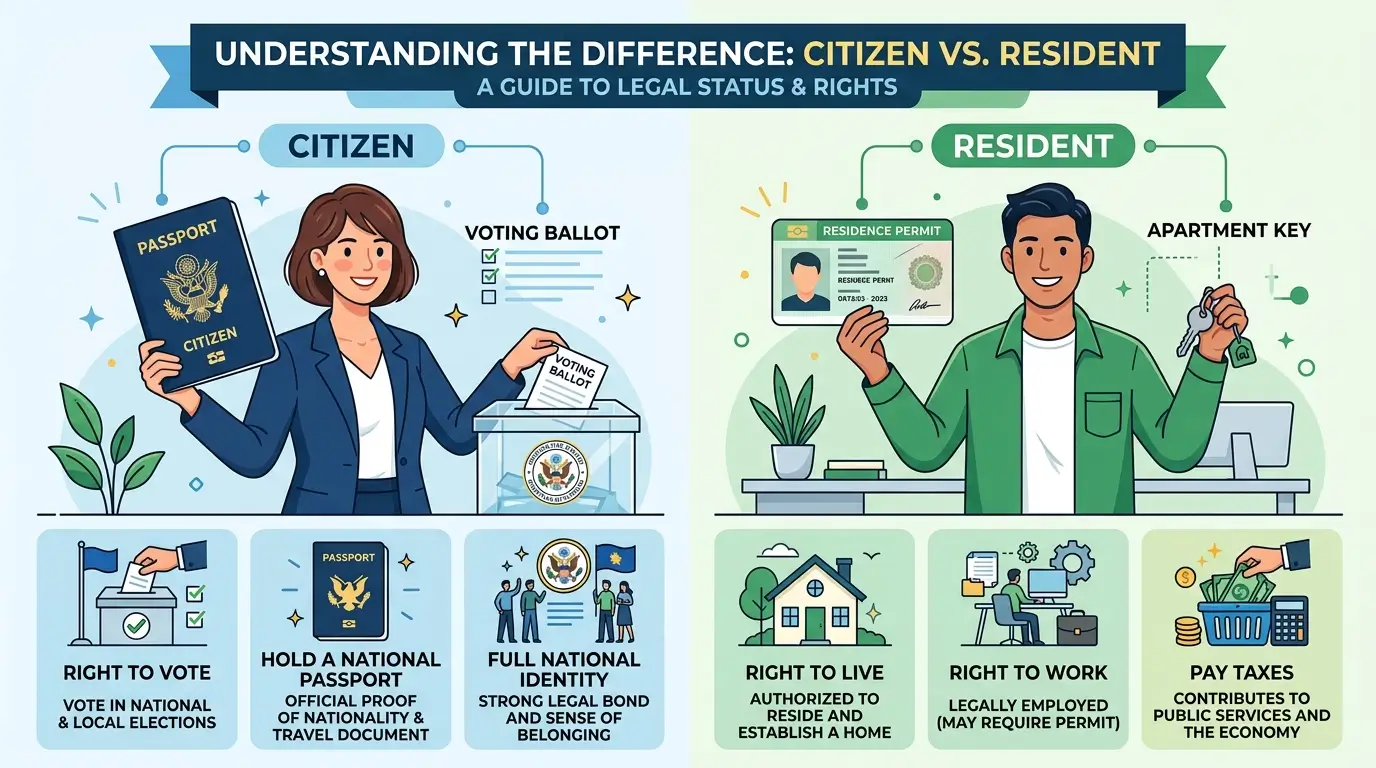
Imagine two neighbors living on the same street in a country. Both work, pay taxes, and contribute to their community. However, one can vote in national elections and obtain a national passport, while the other cannot. This difference often comes down to whether a person is a citizen or a resident.
Understanding the difference between citizen and resident is important because these terms are frequently used in legal, social, and political discussions. Many people assume they mean the same thing, but they represent different legal statuses.
The difference between citizen and resident affects voting rights, travel privileges, government benefits, and civic responsibilities. Whether you are a student, traveler, immigrant, or professional, learning the difference between citizen and resident helps you better understand laws and social systems. This guide explains the difference between citizen and resident in a simple and practical way.
Pronunciation
| Word | US Pronunciation | UK Pronunciation |
| Citizen | /ˈsɪt̬.ə.zən/ | /ˈsɪt.ɪ.zən/ |
| Resident | /ˈrez.ɪ.dənt/ | /ˈrez.ɪ.dənt/ |
Before exploring their distinctions in detail, it is helpful to understand why these terms are often confused and why their differences matter in everyday life.
Key Difference Between Citizen and Resident
A citizen is a person who legally belongs to a country and enjoys full political and civil rights.
A resident is a person who lives in a country or area, either permanently or temporarily, but may not possess full citizenship rights.
The main distinction is that citizenship establishes legal membership in a nation, while residency only indicates where a person lives.
Why Is Their Difference Necessary to Know for Learners and Experts?
Understanding the difference between citizen and resident is important because it influences legal rights, social participation, and public responsibilities.
For learners, it helps clarify concepts in civics, geography, law, and social studies. For experts, including lawyers, policymakers, educators, and immigration professionals, the distinction is essential for interpreting laws and regulations accurately.
In society, citizenship often determines voting rights, eligibility for public office, and national identity. Residency affects taxation, healthcare access, education eligibility, and local obligations. Knowing the difference helps people understand their rights and responsibilities within a community.
Difference Between Citizen and Resident
1. Legal Status
Citizen: Legally recognized as a member of a nation.
Examples:
- Maria is a citizen of Canada by birth.
- Ahmed became a citizen through naturalization.
Resident: Legally lives in a place without necessarily being a citizen.
Examples:
- John is a permanent resident of Australia.
- Elena is a temporary resident studying abroad.
2. Voting Rights
Citizen: Usually has the right to vote in national elections.
Examples:
- Citizens voted for the new president.
- A citizen participated in a national referendum.
Resident: Often cannot vote in national elections.
Examples:
- A resident may observe elections but not vote.
- Many foreign residents lack federal voting rights.
3. Passport Eligibility
Citizen: Can obtain the country’s passport.
Examples:
- A U.S. citizen receives a U.S. passport.
- Citizens use national passports for travel.
Resident: Generally keeps the passport of another country.
Examples:
- A resident uses their home country’s passport.
- Permanent residents travel with foreign passports.
4. Political Participation
Citizen: Can run for many public offices.
Examples:
- A citizen became a member of parliament.
- Citizens may hold government positions.
Resident: Usually faces restrictions.
Examples:
- A resident may not become president.
- Many offices require citizenship.
5. National Loyalty
Citizen: Has a formal legal bond with the nation.
Examples:
- Citizens pledge allegiance to their country.
- National laws recognize citizens as members.
Resident: Connected mainly through place of living.
Examples:
- Residents support local communities.
- Residency does not always imply national membership.
6. Tax Responsibilities
Citizen: May owe taxes under citizenship-based systems.
Examples:
- Citizens report income according to national laws.
- Citizens abroad may still have tax obligations.
Resident: Usually taxed based on residence.
Examples:
- Residents pay taxes where they live.
- Temporary residents may have limited tax duties.
7. Deportation Risk
Citizen: Cannot normally be deported from their own country.
Examples:
- Citizens retain the right to remain.
- Governments cannot easily remove citizens.
Resident: May be deported under certain conditions.
Examples:
- Visa violations may affect residents.
- Criminal offenses can lead to removal proceedings.
8. Acquisition Method
Citizen: Obtained by birth, descent, or naturalization.
Examples:
- Sarah became a citizen through birth.
- David gained citizenship after several years.
Resident: Obtained by living in a location.
Examples:
- Workers become residents through visas.
- Students may receive temporary residency.
9. Duration
Citizen: Usually lifelong.
Examples:
- Citizenship often continues permanently.
- Most citizens retain status indefinitely.
Resident: Can be temporary or permanent.
Examples:
- A tourist is a short-term resident.
- Residency permits may expire.
10. Government Protection
Citizen: Receives stronger diplomatic protection abroad.
Examples:
- Embassies assist citizens overseas.
- Citizens can seek consular services.
Resident: Protection mainly comes from their citizenship country.
Examples:
- Foreign residents contact their own embassy.
- Residents depend on their nationality for consular help.
Nature and Behavior of Citizen
A citizen represents formal membership in a nation. Citizens generally participate in civic activities, obey national laws, vote in elections, and contribute to national development. Their relationship with the state is permanent and legally recognized.
Nature and Behavior of Resident
A resident primarily represents a living arrangement rather than national membership. Residents contribute economically and socially to a community while residing there. Their connection may be temporary, long-term, or permanent depending on legal status.
Why People Are Confused About Their Use?
People often confuse citizen and resident because both terms describe individuals living within a country. In daily conversation, the distinction may not seem important since citizens and residents often work, study, and pay taxes together. The confusion increases because some permanent residents enjoy many rights similar to citizens. However, legal and political rights create important differences.
Difference and Similarity Table
| Feature | Citizen | Resident | Similarity |
| Lives in the country | Yes | Yes | Both may live there |
| Legal membership | Yes | No | Both follow laws |
| Voting rights | Usually yes | Usually no | Both can engage in communities |
| Passport access | National passport | Foreign passport | Both can travel |
| Political office | Often eligible | Usually restricted | Both may influence society |
| Tax obligations | Yes | Yes | Both may pay taxes |
| Government protection | Full | Limited | Both receive legal protections |
| Deportation risk | Very low | Possible | Both must obey laws |
| Duration | Usually permanent | May be temporary | Both can stay long-term |
| National identity | Strongly linked | Not necessarily linked | Both contribute to society |
Which Is Better in What Situation?
Citizen
Citizenship is generally better when someone wants full participation in a country’s political and social life. Citizens can vote, run for office, obtain national passports, and enjoy greater legal security. For people planning a permanent future in a country, citizenship often provides the broadest rights and opportunities.
Resident
Residency is often better for individuals who want to live, work, or study in a country without changing their nationality. It allows flexibility while maintaining ties to another nation. Professionals, students, retirees, and temporary workers may find residency sufficient for their goals without pursuing citizenship.
How the Keywords Are Used in Metaphors and Similes
Citizen
Metaphor: “She is a citizen of the digital world.”
- Meaning: She actively belongs to an online community.
Simile: “He moved through the city like a proud citizen.”
- Meaning: He felt connected and responsible.
Resident
Metaphor: “Fear became a resident of his mind.”
- Meaning: Fear remained there continuously.
Simile: “She stayed like a resident in the village.”
- Meaning: She lived there for an extended period.
Connotative Meanings
Citizen
Positive Connotation
- Responsible citizen
- Active citizen
Examples:
- She is a responsible citizen who volunteers regularly.
- Good citizens strengthen democracy.
Neutral Connotation
- Citizen of a country
- Registered citizen
Examples:
- He is a citizen of Spain.
- Every citizen received information.
Resident
Positive Connotation
- Long-term resident
- Community resident
Examples:
- Residents helped improve the neighborhood.
- A respected resident organized charity events.
Neutral Connotation
- Temporary resident
- Foreign resident
Examples:
- She is a resident of the city.
- Residents completed registration forms.
Idioms and Proverbs Related to the Words
There are no widely recognized English idioms directly using “citizen” or “resident,” but related expressions include:
Good Citizen
Example:
- Maria is a good citizen who follows laws and helps neighbors.
Citizen of the World
Example:
- After traveling extensively, he became a citizen of the world.
Permanent Resident (Common Expression)
Example:
- The family became permanent residents after years abroad.
Works in Literature
Citizen
- Citizen: An American Lyric Poetry/Essay, Claudia Rankine, 2014
- The Citizen’s Almanac Civic Education, U.S. Citizenship and Immigration Services, 2007
Resident
- The Resident Patient Mystery Fiction, Arthur Conan Doyle, 1893
- The Resident Contemporary Fiction, David Jackson, 2014
Movies Related to the Keywords
Citizen
- Citizen Kane 1941, United States
- Citizen X 1995, United States
Resident
- Resident Evil 2002, Germany/United Kingdom/United States
- The Resident 2011, United States
Frequently Asked Questions
1. Can a resident become a citizen?
Yes. Many countries allow residents to apply for citizenship after meeting legal requirements.
2. Can a citizen lose citizenship?
In some countries, citizenship can be renounced or revoked under special circumstances.
3. Does every citizen live in their country?
No. Citizens may live abroad while retaining citizenship.
4. Are all residents foreign nationals?
No. Citizens are also residents if they live in their country.
5. Which status provides more rights?
Citizenship generally provides more political and legal rights than residency.
How Both Are Useful for Surroundings
Citizens contribute to governance, voting, public service, and national development. Residents contribute through work, taxes, cultural diversity, and community participation. Together, citizens and residents help build stronger economies, healthier communities, and more inclusive societies.
Final Words for Both
A citizen represents formal membership and full participation in a nation, while a resident represents lawful presence and contribution within a place. Both roles are important and valuable in modern societies.
Conclusion
The difference between citizen and resident lies mainly in legal membership and rights. A citizen belongs officially to a nation and usually enjoys full political privileges such as voting and holding public office. A resident, on the other hand, lives in a country but may not possess all citizenship rights.
Despite these differences, both citizens and residents contribute significantly to society through work, taxes, community involvement, and cultural development. Understanding the difference between citizen and resident helps learners, professionals, and everyday individuals navigate legal systems, immigration matters, and civic responsibilities more effectively. By recognizing the unique roles of each status, people can better appreciate how nations and communities function together.

Dr. Marcus Reed is a lead editorial author at WordCompares.com and a specialist in communication studies and written clarity. With more than 12 years of university-level teaching experience, he focuses on explaining word distinctions in a clear and structured manner. His work ensures that WordCompares.com maintains accuracy, depth, and reader trust.