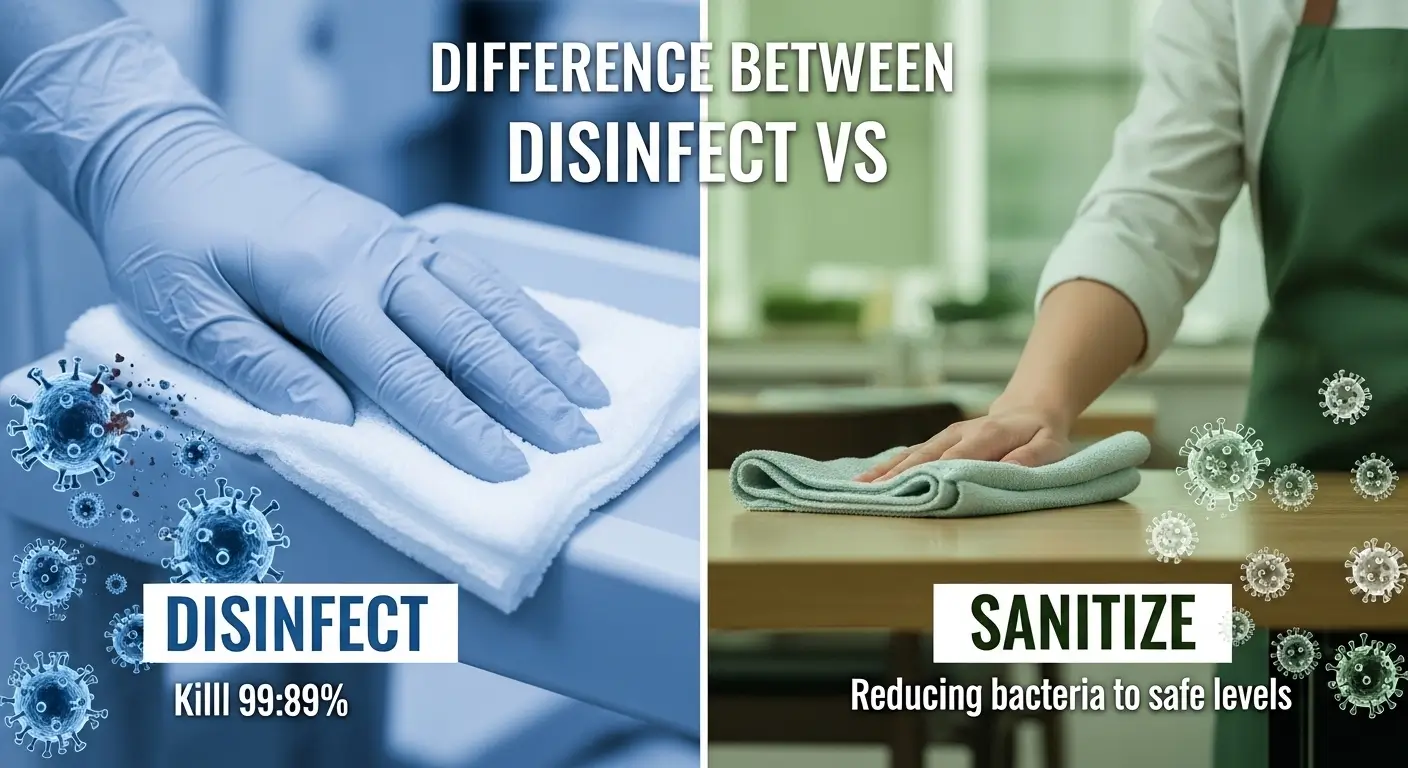
A few years ago, during a flu outbreak, a restaurant owner carefully wiped down tables after every customer. He believed he was keeping the space clean, yet health inspectors later advised him to sanitize the surfaces rather than just clean them and in some cases, to disinfect them. This real-life scenario highlights a common confusion about the difference between disinfect and sanitize.
Many people use these words interchangeably, but the difference between disinfect and sanitize is important in homes, hospitals, and public spaces. Understanding the difference between disinfect and sanitize helps us choose the right method to reduce germs effectively. Whether you are a student, a cleaner, or a healthcare professional, knowing the difference between disinfect and sanitize can protect health and improve hygiene practices.
Key Difference Between the Both
The main difference between disinfect and sanitize lies in their strength and purpose. Sanitizing reduces the number of germs to safe levels, while disinfecting destroys most harmful microorganisms on surfaces. Sanitizing is often used for everyday cleaning, whereas disinfecting is used when there is a higher risk of infection or contamination.
Why Is Their Difference Necessary to Know for Learners and Experts?
Understanding this distinction is essential in modern society, where hygiene plays a vital role in preventing diseases. Students in science and healthcare fields must grasp this concept for academic accuracy, while professionals especially in food services, healthcare, and sanitation must apply the correct method to meet safety standards.
Incorrect usage can lead to ineffective cleaning, spreading infections, or even legal issues in regulated industries. Knowing when to disinfect and when to sanitize ensures public safety, proper sanitation practices, and compliance with health regulations.
Pronunciation of Both Words
| Word | US Pronunciation | UK Pronunciation |
| Disinfect | /ˌdɪs.ɪnˈfekt/ | /ˌdɪs.ɪnˈfekt/ |
| Sanitize | /ˈsæn.ə.taɪz/ | /ˈsæn.ɪ.taɪz/ |
Linking Hook to the Main Discussion
Now that we understand why these terms matter and how they are used, let’s explore the detailed difference between disinfect and sanitize through practical examples and comparisons.
Difference Between Disinfect and Sanitize
Below are ten key points explaining how disinfecting and sanitizing differ in everyday and professional contexts.
1. Definition
Disinfecting means killing most bacteria, viruses, and fungi on surfaces.
Sanitizing means reducing germs to a safe level as defined by public health standards.
Examples:
- A hospital disinfects surgical tools to eliminate harmful microbes.
- A restaurant sanitizes tables after customers leave.
2. Strength of Chemicals
Disinfectants contain stronger chemicals than sanitizers.
Examples:
- Bleach is commonly used as a disinfectant.
- Mild chlorine solutions are often used as sanitizers.
3. Purpose of Use
Disinfecting is used in high-risk environments, while sanitizing is used for routine hygiene.
Examples:
- Laboratories disinfect workstations after experiments.
- Households sanitize kitchen counters daily.
4. Time Required
Disinfecting usually requires more contact time to work effectively.
Examples:
- A disinfectant spray may need 10 minutes to kill germs.
- A sanitizer may work in 30 seconds.
5. Areas of Application
Disinfecting is common in hospitals and clinics; sanitizing is common in homes and restaurants.
Examples:
- Hospital floors are disinfected daily.
- Grocery carts are sanitized between uses.
6. Level of Germ Reduction
Disinfecting kills nearly all microorganisms; sanitizing reduces them to safe levels.
Examples:
- Disinfecting removes dangerous viruses during outbreaks.
- Sanitizing reduces bacteria on cutting boards.
7. Regulatory Standards
Sanitizing often follows food safety guidelines, while disinfecting follows medical standards.
Examples:
- Food safety agencies require sanitizing in kitchens.
- Healthcare regulations require disinfecting patient areas.
8. Types of Products Used
Different chemical formulations are used for each purpose.
Examples:
- Alcohol-based sprays are used for disinfecting electronics.
- Sanitizing wipes are used for quick cleaning in offices.
9. Safety Considerations
Disinfectants can be more hazardous and require careful handling.
Examples:
- Disinfectants may irritate skin or eyes.
- Sanitizers are usually safe for frequent use.
10. Effectiveness Against Viruses
Disinfectants are generally more effective against viruses than sanitizers.
Examples:
- Disinfectants are used during pandemics to kill viruses.
- Sanitizers are used for routine hygiene maintenance.
Nature and Behaviour of Both
Disinfecting is aggressive and thorough. It focuses on eliminating pathogens completely and is associated with clinical and emergency situations.
Sanitizing is preventive and moderate. It maintains cleanliness and reduces risk rather than eliminating all germs.
Why People Are Confused About Their Use
People often confuse these terms because both involve cleaning and germ control. Many product labels also use the terms interchangeably, and advertisements simplify the meanings, leading to misunderstanding. Additionally, everyday language does not emphasize scientific distinctions, making it difficult for non-experts to differentiate between them.
Table Showing Difference and Similarity
| Aspect | Disinfect | Sanitize | Similarity |
| Purpose | Kill germs | Reduce germs | Both improve hygiene |
| Strength | Stronger chemicals | Milder chemicals | Both use chemical agents |
| Usage | Hospitals, labs | Homes, restaurants | Both used on surfaces |
| Time | Longer contact time | Shorter contact time | Both require application time |
| Safety | More hazardous | Safer | Both require proper use |
Which Is Better in What Situation?
Disinfecting is better in situations where there is a high risk of infection, such as hospitals, bathrooms after illness, or during disease outbreaks. It ensures that dangerous microorganisms are destroyed and prevents the spread of serious diseases.
Sanitizing is better for everyday cleaning tasks such as wiping kitchen counters, cleaning toys, or maintaining office hygiene. It is quicker, safer, and sufficient when there is no immediate threat of harmful pathogens.
Use in Metaphors and Similes
Both words are sometimes used metaphorically to describe emotional or social cleansing.
- “She disinfected her life of toxic relationships.”
- “The new policy sanitized the company’s image.”
Connotative Meaning
| Word | Connotation | Example |
| Disinfect | Neutral to serious | “The city disinfected the area after the outbreak.” |
| Sanitize | Positive to neutral | “The report was sanitized to remove offensive content.” |
Idioms or Proverbs Related to the Words
Although there are no direct idioms with these exact words, similar expressions exist:
- “Clean slate” – meaning to start fresh
Example: After the scandal, the company tried to sanitize its reputation and start with a clean slate. - “Out of sight, out of mind” – sometimes used in the sense of hiding issues rather than disinfecting them.
Works in Literature
- “The Sanitized Society” – Sociology, Zygmunt Bauman, 2000
- “Disinfection and the Human Condition” – Essay, Ivan Illich, 1976
Movies Related to the Keywords
- “Outbreak” – 1995, USA (focuses on disinfection and disease control)
- “Contagion” – 2011, USA (shows sanitizing and disinfecting in a pandemic setting)
Frequently Asked Questions
1. Is disinfecting the same as sanitizing?
No, disinfecting kills most germs, while sanitizing only reduces them to safe levels.
2. Should I disinfect my home every day?
No, daily sanitizing is usually enough unless someone is sick or there is contamination.
3. Are disinfectants harmful to humans?
Some disinfectants can be harmful if misused, so they should be handled carefully.
4. Can a product both disinfect and sanitize?
Yes, some products are designed to perform both functions depending on how they are used.
5. Which is better for kitchens?
Sanitizing is usually sufficient for routine kitchen cleaning, while disinfecting is used when contamination occurs.
How Both Are Useful for Surroundings
Sanitizing keeps everyday environments clean and reduces routine exposure to germs, while disinfecting helps control serious infections and outbreaks. Together, they maintain public health and hygiene in homes, workplaces, and public spaces.
Final Words for Both Terms
Both disinfecting and sanitizing play essential roles in modern hygiene practices. Rather than competing methods, they complement each other and should be used based on the level of risk involved.
Conclusion
Understanding the difference between disinfect and sanitize is more than a matter of vocabulary it is a matter of health and safety. While sanitizing maintains everyday cleanliness, disinfecting offers deeper protection in high-risk situations. Confusing the two can lead to ineffective cleaning and increased risk of disease transmission.
By learning when and how to use each method correctly, individuals and professionals can create safer, healthier environments. In a world increasingly focused on hygiene and disease prevention, this knowledge is both practical and essential.

Dr. Marcus Reed is a lead editorial author at WordCompares.com and a specialist in communication studies and written clarity. With more than 12 years of university-level teaching experience, he focuses on explaining word distinctions in a clear and structured manner. His work ensures that WordCompares.com maintains accuracy, depth, and reader trust.