Imagine visiting a pet store to buy a colorful bird. You notice two beautiful birds in neighboring cages. One is labeled “Parrot,” while the other is labeled “Parakeet.” At first glance, they seem very similar. Both have curved beaks, bright feathers, and playful personalities. This situation often leads people to wonder about the difference between parrot and parakeet.
Understanding the difference between parrot and parakeet is important because these birds belong to related groups but have distinct characteristics.
Whether you are a bird enthusiast, pet owner, student, or wildlife researcher, knowing the difference between parrot and parakeet helps in proper identification, care, and appreciation of these fascinating creatures. In this article, we will explore the difference between parrot and parakeet in detail through simple explanations, examples, comparisons, and practical insights.
Key Difference Between the Both
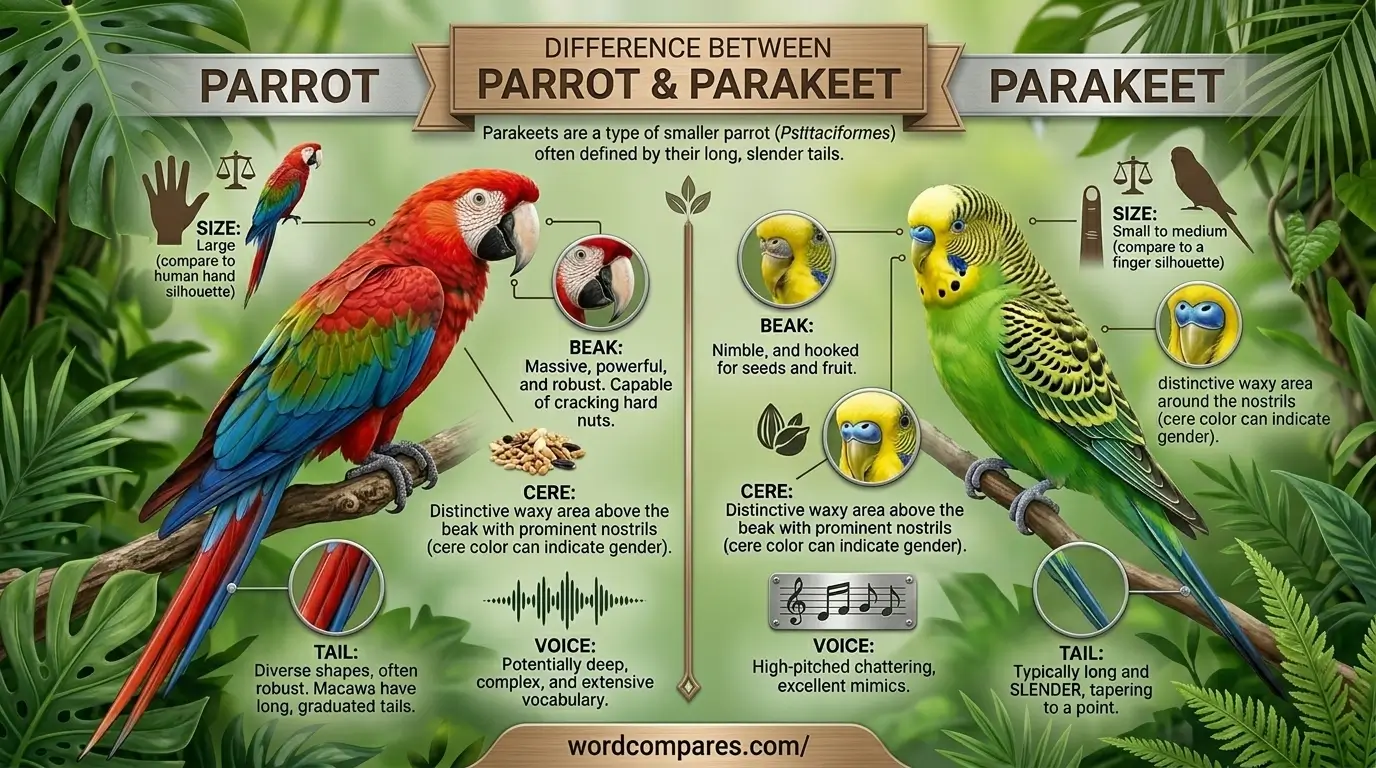
The main difference is that a parrot is a broad category of birds belonging to the order Psittaciformes, while a parakeet is a specific type of small-to-medium-sized parrot with a long tail.
In simple terms, all parakeets are parrots, but not all parrots are parakeets.
Why Is Their Difference Necessary to Know for Learners and Experts?
Understanding the distinction between parrots and parakeets is valuable for bird identification, pet care, wildlife conservation, and scientific research.
For learners, it improves knowledge about bird classification and biodiversity. For experts, it assists in accurate species management, breeding programs, and conservation planning. Since parrots play significant ecological roles such as seed dispersal and maintaining forest ecosystems, understanding their subgroups, including parakeets, helps society protect wildlife more effectively.
Pronunciation
Parrot
- US Pronunciation: /ˈper.ət/
- UK Pronunciation: /ˈpær.ət/
Parakeet
- US Pronunciation: /ˈper.əˌkiːt/
- UK Pronunciation: /ˈpær.əˌkiːt/
Linking Hook
Now that we understand the basic relationship between these birds, let’s examine the detailed differences that distinguish parrots from parakeets.
Difference Between Parrot and Parakeet
1. Classification
Parrot
A parrot refers to a large group of birds.
Examples:
- Macaw
- Cockatoo
Parakeet
A parakeet is a specific subgroup within the parrot family.
Examples:
- Budgerigar
- Indian Ringneck Parakeet
2. Size
Parrot
Parrots range from small to very large.
Examples:
- Hyacinth Macaw
- African Grey Parrot
Parakeet
Parakeets are generally smaller.
Examples:
- Budgie
- Monk Parakeet
3. Tail Length
Parrot
Tail length varies greatly among species.
Examples:
- Cockatoo (shorter tail)
- Amazon Parrot (medium tail)
Parakeet
Most parakeets have long, slender tails.
Examples:
- Budgerigar
- Ringneck Parakeet
4. Body Shape
Parrot
Many parrots have stockier bodies.
Examples:
- African Grey
- Eclectus Parrot
Parakeet
Parakeets often have slimmer bodies.
Examples:
- Budgie
- Alexandrine Parakeet
5. Vocabulary and Speech Ability
Parrot
Many parrots are excellent mimics.
Examples:
- African Grey Parrot
- Amazon Parrot
Parakeet
Some parakeets can talk well but usually have smaller vocabularies.
Examples:
- Budgerigar
- Indian Ringneck
6. Lifespan
Parrot
Larger parrots generally live longer.
Examples:
- Macaw (50+ years)
- Cockatoo (40–70 years)
Parakeet
Most parakeets have shorter lifespans.
Examples:
- Budgie (5–15 years)
- Monk Parakeet (15–20 years)
7. Cost
Parrot
Many parrots are expensive.
Examples:
- Hyacinth Macaw
- African Grey
Parakeet
Parakeets are usually affordable.
Examples:
- Budgerigar
- Monk Parakeet
8. Care Requirements
Parrot
Large parrots need extensive care and attention.
Examples:
- Macaw
- Cockatoo
Parakeet
Parakeets are generally easier for beginners.
Examples:
- Budgie
- Ringneck Parakeet
9. Popularity as Pets
Parrot
Often preferred by experienced bird owners.
Examples:
- African Grey
- Macaw
Parakeet
Very common among first-time bird owners.
Examples:
- Budgie
- Monk Parakeet
10. Diversity
Parrot
Includes hundreds of species.
Examples:
- Cockatoo
- Lovebird
Parakeet
Represents a smaller subgroup.
Examples:
- Budgerigar
- Alexandrine Parakeet
Nature and Behaviour
Parrot
Parrots are intelligent, curious, social, and emotionally expressive. They often form strong bonds with humans and can learn tricks, words, and problem-solving tasks.
Parakeet
Parakeets are energetic, friendly, playful, and highly social. They enjoy flying, chirping, and interacting with both humans and other birds.
Why People Are Confused About Their Use?
People are confused because parakeets share many characteristics with parrots, including curved beaks, colorful feathers, intelligence, and social behavior. Since pet stores and bird enthusiasts often use the terms interchangeably, many assume they are separate unrelated birds when parakeets are actually a type of parrot.
Difference and Similarity Table
| Feature | Parrot | Parakeet | Similarity |
| Classification | Broad group | Type of parrot | Both belong to Psittaciformes |
| Size | Small to large | Usually small | Both vary by species |
| Tail | Variable | Usually long | Both have tails |
| Intelligence | High | High | Both learn quickly |
| Speech | Often excellent | Good in some species | Both can mimic sounds |
| Lifespan | Often longer | Usually shorter | Both can live many years |
| Cost | Often expensive | Usually affordable | Both sold as pets |
| Care | More demanding | Easier | Both require attention |
| Body Shape | Stocky to varied | Slim | Both have curved beaks |
| Social Nature | Highly social | Highly social | Both enjoy companionship |
Which Is Better in What Situation?
When a Parrot Is Better
A parrot is better for people seeking a highly intelligent companion with advanced talking abilities and long-term interaction. Experienced bird owners often prefer parrots because of their problem-solving skills, emotional intelligence, and ability to learn complex behaviors. However, they require significant time, space, and commitment.
When a Parakeet Is Better
A parakeet is better for beginners, families, and people with limited space. They are generally less expensive, easier to care for, and still provide companionship and entertainment. Their smaller size makes them suitable for apartments and first-time bird owners.
How the Keywords Are Used in Metaphors and Similes
Parrot
Metaphor:
“He is a parrot in meetings.”
Meaning: He repeats others’ words without original thinking.
Simile:
“She repeated the instructions like a parrot.”
Parakeet
Metaphor:
“The classroom was a flock of parakeets.”
Meaning: The room was lively and noisy.
Simile:
“They chatted like cheerful parakeets.”
Connotative Meaning
Parrot
Positive
- Intelligent
- Colorful
- Communicative
Example: “She is a parrot when it comes to learning languages.”
Negative
- Repetitive
- Mimicking without understanding
Example: “Don’t be a parrot; think for yourself.”
Neutral
- A talking bird
Parakeet
Positive
- Friendly
- Cheerful
- Social
Example: “Her bright personality is like a parakeet.”
Negative
- Noisy
Example: “The room sounded like a group of parakeets.”
Neutral
- Small pet bird
Idioms and Proverbs Related to the Words
Parrot
Parrot-fashion
Meaning: Memorized without understanding.
Example:
“The student learned the answer parrot-fashion.”
Parrot Someone’s Words
Meaning: Repeat exactly what another person says.
Example:
“He simply parroted his teacher’s opinion.”
Parakeet
There are no widely recognized English idioms specifically involving the word “parakeet.”
Works in Literature
Parrot
- Flaubert’s Parrot — Novel, Julian Barnes, 1984
- The Parrot Who Owned Me — Memoir, Joanna Burger, 2001
- Polly: A Parrot’s Own Story — Children’s Literature, Don Freeman, 1964
Parakeet
- The Parakeet — Memoir, Marie-Helene Bertino, 2020
- The Parakeet Named Dreidel — Children’s Literature, Isaac Bashevis Singer, 1979
Movies Featuring the Keywords
Parrot
- Paulie (1998, USA)
- Rio (2011, USA)
- Rio 2 (2014, USA)
Parakeet
- The Parakeet (2016, France)
- Various documentary features on pet parakeets and budgerigars
Frequently Asked Questions
1. Is a parakeet a parrot?
Yes. A parakeet is a type of parrot.
2. Which is smarter, a parrot or a parakeet?
Most large parrots are generally smarter, although some parakeets are highly intelligent.
3. Can both birds talk?
Yes. Both can mimic sounds and words, though parrots usually have larger vocabularies.
4. Which is easier to keep as a pet?
Parakeets are generally easier for beginners.
5. Do parrots and parakeets live in the same habitats?
Many species share tropical and subtropical environments, but habitats vary by species.
How Both Are Useful for Surroundings
Parrots and parakeets contribute to ecosystems by dispersing seeds, supporting plant growth, and maintaining biodiversity. As pets, they provide companionship, emotional support, and educational opportunities. Their presence also raises awareness about wildlife conservation and environmental protection.
Final Words for Both
Parrots represent one of the most intelligent and diverse bird groups on Earth. Parakeets, as a subgroup of parrots, offer many of the same appealing qualities in a smaller and more manageable form. Both birds deserve appreciation for their beauty, intelligence, and ecological importance.
Conclusion
The difference between parrot and parakeet mainly lies in classification, size, and physical characteristics. A parrot is a broad category containing hundreds of species, while a parakeet is a specific type of parrot usually recognized by its smaller body and longer tail. Despite their differences, both birds share remarkable intelligence, social behavior, and colorful appearances.
Understanding the difference between parrot and parakeet helps pet owners, students, researchers, and bird enthusiasts make informed decisions and appreciate avian diversity more fully. Whether you choose a large parrot or a lively parakeet, both birds offer unique companionship and play valuable roles in nature and human society.

Dr. Marcus Reed is a lead editorial author at WordCompares.com and a specialist in communication studies and written clarity. With more than 12 years of university-level teaching experience, he focuses on explaining word distinctions in a clear and structured manner. His work ensures that WordCompares.com maintains accuracy, depth, and reader trust.