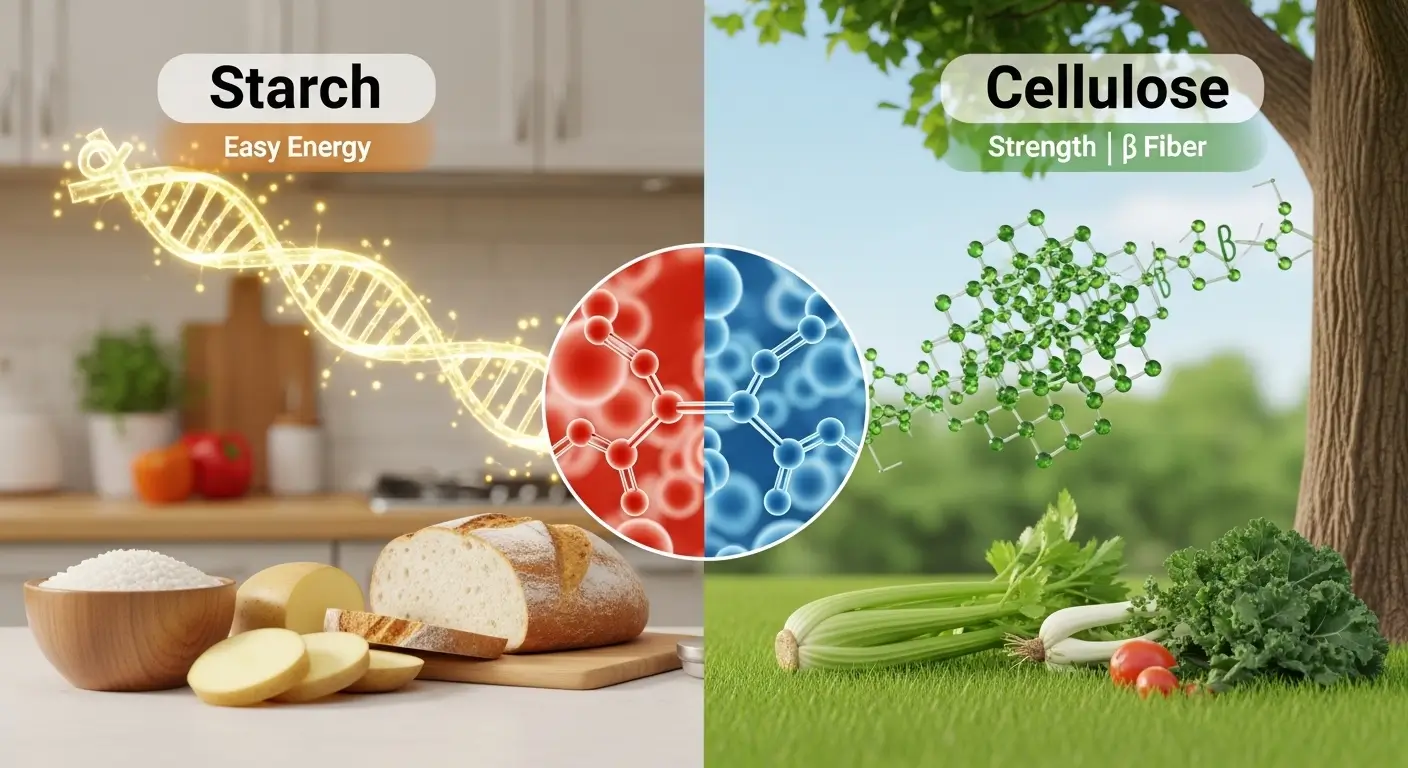
Imagine walking through a grocery store and picking up a bag of rice and a bundle of fresh vegetables. Both come from plants, yet they affect your body very differently. The reason lies in the difference between starch and cellulose, two essential plant carbohydrates. While starch provides energy when you eat rice or potatoes, cellulose forms the tough fibers in vegetables that your body cannot digest.
Understanding the difference between starch and cellulose helps explain why some plant foods give calories while others support digestion. From biology textbooks to nutrition labels, the difference between starch and cellulose appears in many real-world contexts. Whether you are a student, a scientist, or simply someone interested in healthy eating, learning the difference between starch and cellulose reveals how plant chemistry shapes human life. 🌱
Key Difference Between the Both
The main difference lies in how glucose molecules are arranged. Starch stores energy in plants and is digestible by humans, while cellulose forms plant cell walls and is indigestible because of its strong structural bonds.
Why Knowing Their Difference Is Important
Understanding the difference between starch and cellulose is important for students of biology, nutritionists, farmers, and even environmental scientists. Starch is a major food source and affects global food security. Cellulose, on the other hand, is vital for paper, textiles, and eco-friendly materials. In society, this knowledge helps people make healthier dietary choices, supports industrial production like cotton and paper, and aids scientific research in biofuels and biodegradable plastics. 🌍
Pronunciation
| Term | US Pronunciation | UK Pronunciation |
| Starch | /stɑːrtʃ/ | /stɑːtʃ/ |
| Cellulose | /ˈsɛl.jə.loʊs/ | /ˈsel.jʊ.ləʊs/ |
Linking Hook
Now that we understand their importance, let’s explore in detail how starch and cellulose differ in structure, function, and everyday applications.
Difference Between Starch and Cellulose
1. Function in Plants
Starch: Stores energy for plant growth.
Examples: Potatoes store starch; rice grains store starch for seed development.
Cellulose: Provides structural support.
Examples: Tree trunks remain rigid due to cellulose; leafy vegetables maintain shape because of cellulose fibers.
2. Digestibility in Humans
Starch: Easily digested into glucose.
Examples: Bread turns into sugar during digestion; boiled rice provides quick energy.
Cellulose: Cannot be digested by human enzymes.
Examples: Eating lettuce adds fiber but not calories; celery passes mostly undigested.
3. Chemical Bond Type
Starch: Contains alpha-1,4 glycosidic bonds.
Examples: Amylose chains in starch; amylopectin branches in grains.
Cellulose: Contains beta-1,4 glycosidic bonds.
Examples: Cotton fibers; wood cell walls.
4. Structure
Starch: Coiled and compact structure.
Examples: Corn starch powder; starch granules in wheat.
Cellulose: Straight and rigid fibers.
Examples: Paper sheets; plant stems.
5. Solubility in Water
Starch: Swells and partially dissolves in hot water.
Examples: Thickening of soup; formation of glue paste.
Cellulose: Insoluble in water.
Examples: Cotton does not dissolve; paper stays intact in water.
6. Role in Human Diet
Starch: Primary carbohydrate energy source.
Examples: Pasta for athletes; cereals for breakfast.
Cellulose: Acts as dietary fiber.
Examples: Bran improving digestion; vegetable fiber preventing constipation.
7. Storage vs Structure
Starch: Energy storage polysaccharide.
Examples: Stored in seeds; stored in tubers.
Cellulose: Structural polysaccharide.
Examples: Bark strength; leaf support.
8. Industrial Uses
Starch: Used in food and adhesives.
Examples: Sauce thickening; biodegradable packaging.
Cellulose: Used in paper and textiles.
Examples: Newspaper production; cotton clothing.
9. Biological Occurrence
Starch: Found in storage organs.
Examples: Bananas; sweet potatoes.
Cellulose: Found in cell walls.
Examples: Bamboo; grasses.
10. Energy Content
Starch: Provides calories.
Examples: Rice gives energy; bread fuels physical activity.
Cellulose: Provides no calories.
Examples: Eating spinach adds fiber; cabbage adds bulk but little energy.
Nature and Behaviour
Starch behaves as an energy reserve, breaking down into glucose when needed.
Cellulose behaves as a structural material, remaining strong and resistant to breakdown.
Why People Are Confused About Their Use
People are confused because both starch and cellulose are made from glucose and are found in plants. Their similar names and classification as carbohydrates make them seem identical, even though their structures and roles differ significantly.
Table Showing Difference and Similarity
| Feature | Starch | Cellulose | Similarity |
| Type | Storage polysaccharide | Structural polysaccharide | Both are carbohydrates |
| Digestibility | Digestible | Indigestible | Both made of glucose |
| Structure | Coiled | Straight | Long polymer chains |
| Function | Energy storage | Cell wall support | Found in plants |
Which Is Better in What Situation?
Starch is better when the body needs quick and sustained energy. Athletes, growing children, and laborers rely on starch-rich foods such as rice, wheat, and potatoes to maintain stamina and strength. It plays a key role in metabolism and energy balance.
Cellulose is better for digestive health and environmental sustainability. High-fiber foods prevent constipation, regulate blood sugar, and support gut bacteria. In industry, cellulose is preferred for making eco-friendly materials like paper and biodegradable fabrics. 🌿
Metaphors and Similes
- Starch is like a battery storing energy for the plant.
- Cellulose is like the steel framework of a building.
Connotative Meanings
| Word | Connotation | Example |
| Starch | Neutral to positive (energy, sustenance) | “He needed starch in his diet to stay active.” |
| Cellulose | Neutral (structure, fiber) | “The book pages were made from cellulose pulp.” |
Idioms or Proverbs
There are no direct idioms, but related expressions exist:
- “Backbone of society” – similar to cellulose providing structure.
- “Fuel for the body” – similar to starch providing energy.
Example:
“Education is the backbone of society, just as cellulose is the backbone of plants.”
Works in Literature
- “The Secret Life of Plants” – Non-fiction, Peter Tompkins & Christopher Bird, 1973
- “Botany for Gardeners” – Educational, Brian Capon, 1990
Movies Related to Plants and Plant Science
- “The Martian” – 2015, USA (focuses on growing potatoes and starch as food)
- “Fantastic Fungi” – 2019, USA (discusses plant structures including cellulose ecosystems)
Frequently Asked Questions
1. Are starch and cellulose both carbohydrates?
Yes, both are complex carbohydrates made from glucose units.
2. Why can humans digest starch but not cellulose?
Humans lack the enzyme cellulase needed to break beta bonds in cellulose.
3. Is cellulose useless to humans?
No, it is essential as dietary fiber for digestive health.
4. Which foods contain high starch?
Rice, potatoes, wheat, and corn.
5. Which foods contain high cellulose?
Leafy vegetables, whole grains, and fruits with skins.
How Both Are Useful for Surroundings
Starch supports human survival as a primary energy source and plays a role in food industries and biodegradable plastics. Cellulose supports environmental balance by forming plant structures, producing oxygen, and providing raw material for paper, textiles, and sustainable packaging. 🌎
Final Words for Both
Starch represents energy, nourishment, and food security, while cellulose represents strength, sustainability, and environmental stability.
Conclusion
In summary, the difference between starch and cellulose lies in their structure, digestibility, and function. Though both are made from glucose and occur in plants, starch serves as an energy reserve while cellulose provides structural strength. This difference explains why some plant foods fuel the body while others support digestion and environmental health.
Understanding the difference between starch and cellulose helps students grasp biology concepts, enables professionals to innovate in industries, and allows individuals to make better dietary and environmental choices. Together, these two carbohydrates illustrate how small molecular changes can produce huge differences in nature and human life. 🌱

Dr. Marcus Reed is a lead editorial author at WordCompares.com and a specialist in communication studies and written clarity. With more than 12 years of university-level teaching experience, he focuses on explaining word distinctions in a clear and structured manner. His work ensures that WordCompares.com maintains accuracy, depth, and reader trust.