Imagine downloading your favorite song from the internet. You click one file, and it plays only music. You click another, and suddenly you see a full video with visuals, subtitles, and sound. This is where the difference between MP4 and MP3 becomes important in everyday digital life. Many people use these formats daily whether streaming music, sharing videos, or storing media on their phones yet they often don’t understand the difference between MP4 and MP3.
Knowing the difference between MP4 and MP3 helps users choose the right format for storage, editing, and sharing. In today’s digital world, understanding the difference between MP4 and MP3 is not just useful for tech experts but also for students, content creators, and casual users who deal with media files regularly.
Key Difference Between MP4 and MP3
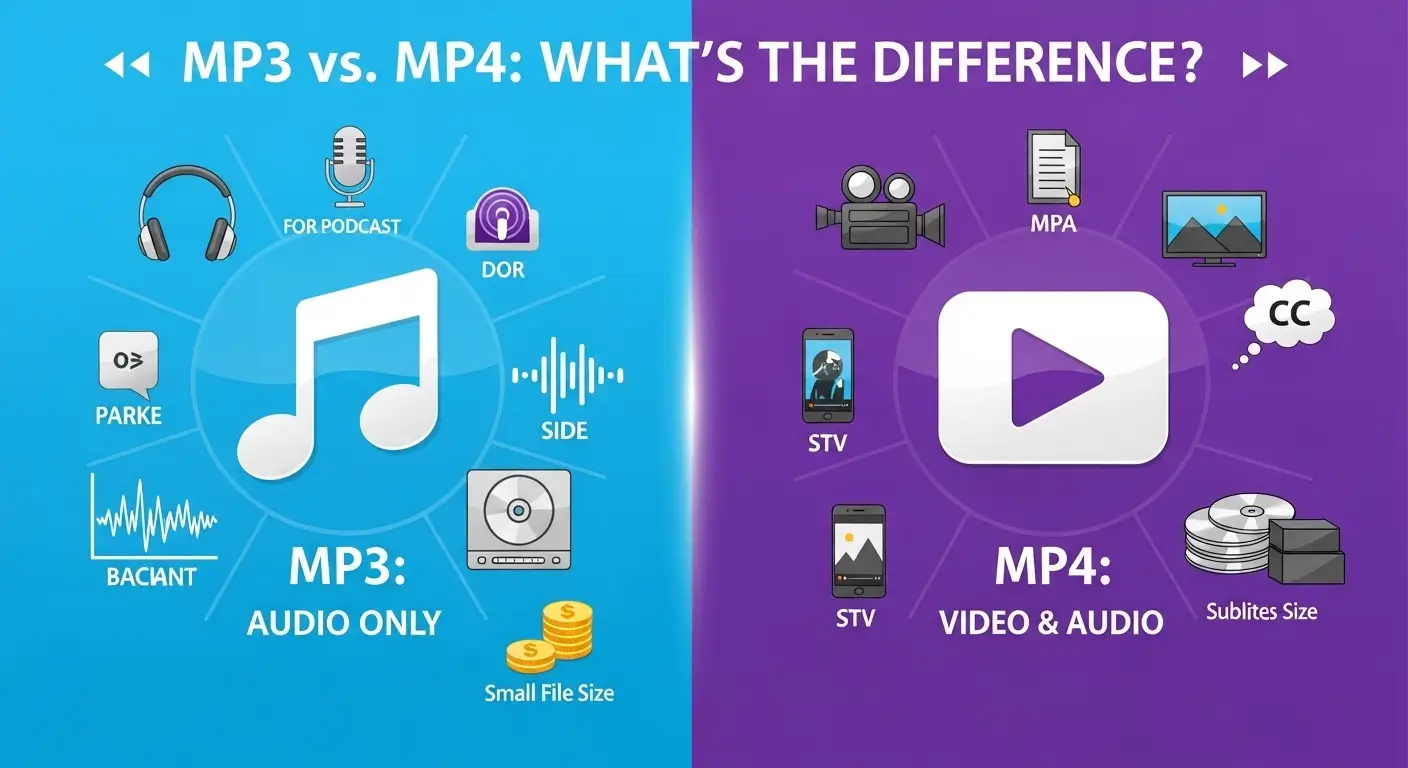
The main difference is simple: MP3 stores only audio, while MP4 can store audio, video, images, and subtitles in one file.
Why It Is Important to Know the Difference
Understanding the difference between these formats helps people save storage space, choose better quality files, and avoid compatibility issues. Students use MP3 files for lectures, while professionals and creators rely on MP4 for video presentations.
In media production, marketing, education, and entertainment, choosing the correct format ensures efficiency, clarity, and better user experience. Society increasingly depends on digital media, so knowing file formats is now part of digital literacy.
Pronunciation
| Format | US Pronunciation | UK Pronunciation |
| MP3 | em-pee-three | em-pee-three |
| MP4 | em-pee-four | em-pee-four |
Linking Hook
Now that we understand their basic purpose and importance, let’s explore the difference between MP4 and MP3 in detail by comparing their features, uses, and behavior.
Difference Between MP4 and MP3
1. Type of Media Stored
MP3: Stores only audio.
Examples:
- A downloaded song file
- A podcast recording
MP4: Stores video, audio, images, and subtitles.
Examples:
- A movie file
- A YouTube video download
2. File Size
MP3: Smaller because it contains only sound.
Examples:
- A 5-minute song may be 5 MB
- A lecture recording may be 20 MB
MP4: Larger because it includes video and extra data.
Examples:
- A 5-minute video may be 50 MB
- A movie can be several gigabytes
3. Quality of Output
MP3: Focuses on sound quality only.
Examples:
- High-quality music playback
- Clear voice recordings
MP4: Provides both audio and visual quality.
Examples:
- HD video playback
- Music videos with visuals
4. Compression Method
MP3: Uses lossy audio compression.
Examples:
- Removes silent frequencies
- Reduces file size while keeping sound recognizable
MP4: Uses advanced compression for both audio and video.
Examples:
- Compresses video frames
- Maintains balance between quality and file size
5. Device Compatibility
MP3: Supported by almost all devices.
Examples:
- MP3 players
- Car stereos
MP4: Supported by modern smartphones and computers.
Examples:
- Smartphones
- Smart TVs
6. Purpose of Creation
MP3: Designed for music sharing and storage.
Examples:
- Online music libraries
- Audio streaming platforms
MP4: Designed for multimedia sharing.
Examples:
- Video streaming websites
- Educational video content
7. Editing and Conversion
MP3: Easier to edit because it is audio-only.
Examples:
- Cutting audio clips
- Mixing songs
MP4: Requires video editing software.
Examples:
- Adding subtitles
- Trimming video clips
8. Streaming Performance
MP3: Streams faster due to smaller size.
Examples:
- Online radio
- Audio podcasts
MP4: Requires more internet bandwidth.
Examples:
- Video streaming
- Online lectures with visuals
9. Storage Requirements
MP3: Ideal for saving storage space.
Examples:
- Thousands of songs on a phone
- Long voice recordings on small memory
MP4: Consumes more storage.
Examples:
- Movies taking up several gigabytes
- Recorded gameplay videos
10. File Extension and Structure
MP3: Uses .mp3 extension with simple structure.
Examples:
- song.mp3
- lecture.mp3
MP4: Uses .mp4 extension with complex container format.
Examples:
- movie.mp4
- tutorial.mp4
Nature and Behavior of MP3
MP3 behaves as a lightweight and portable format. It is optimized for fast sharing, quick downloads, and easy playback. It prioritizes convenience and audio clarity.
Nature and Behavior of MP4
MP4 behaves as a multimedia container. It is versatile, flexible, and capable of handling multiple data streams, making it ideal for modern digital communication and entertainment.
Why People Are Confused About Their Use
People often assume both formats are similar because their names differ by only one number. Also, both are used for entertainment files downloaded from the internet. Many users see an MP4 video converted into MP3 audio and think they are interchangeable formats rather than formats with different purposes.
Table Showing Differences and Similarities
| Feature | MP3 | MP4 | Similarity |
| Media Type | Audio only | Audio + Video | Both store digital media |
| File Size | Small | Large | Both use compression |
| Quality | Sound quality | Audio + Visual quality | Both can be high quality |
| Usage | Music, podcasts | Movies, videos | Both used in entertainment |
| Compatibility | Very high | High | Both supported by most devices |
Which Is Better in What Situation?
MP3 is better when the goal is to store or share audio files efficiently. It is perfect for music lovers, students recording lectures, and anyone who wants to save storage space. Its smaller size makes it ideal for quick downloads and offline listening.
MP4 is better when visual content is necessary. It is the preferred format for watching movies, creating tutorials, and sharing videos online. Content creators, teachers, and marketers rely on MP4 because it supports video, subtitles, and high-quality sound in one file.
Metaphors and Similes
- MP3 is like a radio you hear the content but don’t see it.
- MP4 is like a television you both see and hear the story.
Connotative Meaning
MP3: Neutral to positive associated with portability and convenience.
Example: “He shared the lecture in MP3 format for easy listening.”
MP4: Positive associated with modern multimedia and visual storytelling.
Example: “The MP4 presentation made the topic easier to understand.”
Idioms or Proverbs Related to the Words
No direct idioms are using MP3 or MP4, but related expressions exist:
“Seeing is believing.”
Example: An MP4 video proves the event happened because you can see it.
“Music to my ears.”
Example: The MP3 recording of her voice was music to my ears.
Works in Literature Mentioning the Formats
- “Digital Minimalism” – Non-fiction, Cal Newport, 2019 (mentions digital media formats)
- “The Circle” – Novel, Dave Eggers, 2013 (discusses digital file sharing)
Movies Related to the Keywords
- “Downloaded” – 2013, USA (documentary about digital media and file sharing)
- “The Social Dilemma” – 2020, USA (covers digital content and media consumption)
Frequently Asked Questions
1. Is MP4 better quality than MP3?
MP4 can have better overall quality because it supports both video and high-quality audio, but MP3 can match audio quality in many cases.
2. Can an MP4 file be converted to MP3?
Yes, the audio track can be extracted and saved as an MP3 file.
3. Why are MP3 files smaller than MP4?
Because MP3 stores only sound, while MP4 stores video and other data.
4. Which format is best for music?
MP3 is usually best for music because it saves space and works on all devices.
5. Which format is best for YouTube uploads?
MP4 is preferred because it supports video, subtitles, and high-quality audio.
How Both Are Useful for Surroundings
MP3 helps people learn and relax by providing music, audiobooks, and recorded lectures. MP4 enhances communication, education, and entertainment by combining visuals with sound, making complex ideas easier to understand and share.
Final Words for Both Formats
MP3 represents simplicity, speed, and portability, while MP4 represents versatility, multimedia, and modern digital communication. Both formats play an essential role in the digital ecosystem and complement each other rather than compete.
Conclusion
The difference between MP4 and MP3 lies in their purpose, structure, and functionality. MP3 is designed purely for audio, making it efficient and lightweight, while MP4 serves as a powerful multimedia container capable of handling video, sound, and subtitles.
Understanding this difference helps users choose the right format for their needs, whether they are listening to music, watching videos, or sharing digital content. As digital media continues to grow, knowing these formats is an important part of everyday technological knowledge.

Alexandra “Alex” Monroe is a senior linguistics contributor at WordCompares.com, where she specializes in comparative word analysis, semantics, and language clarity. With over 15 years of academic and editorial experience, Alex helps readers understand subtle differences between commonly confused words and phrases. Her research-driven yet practical writing style strengthens the educational authority of WordCompares.com.