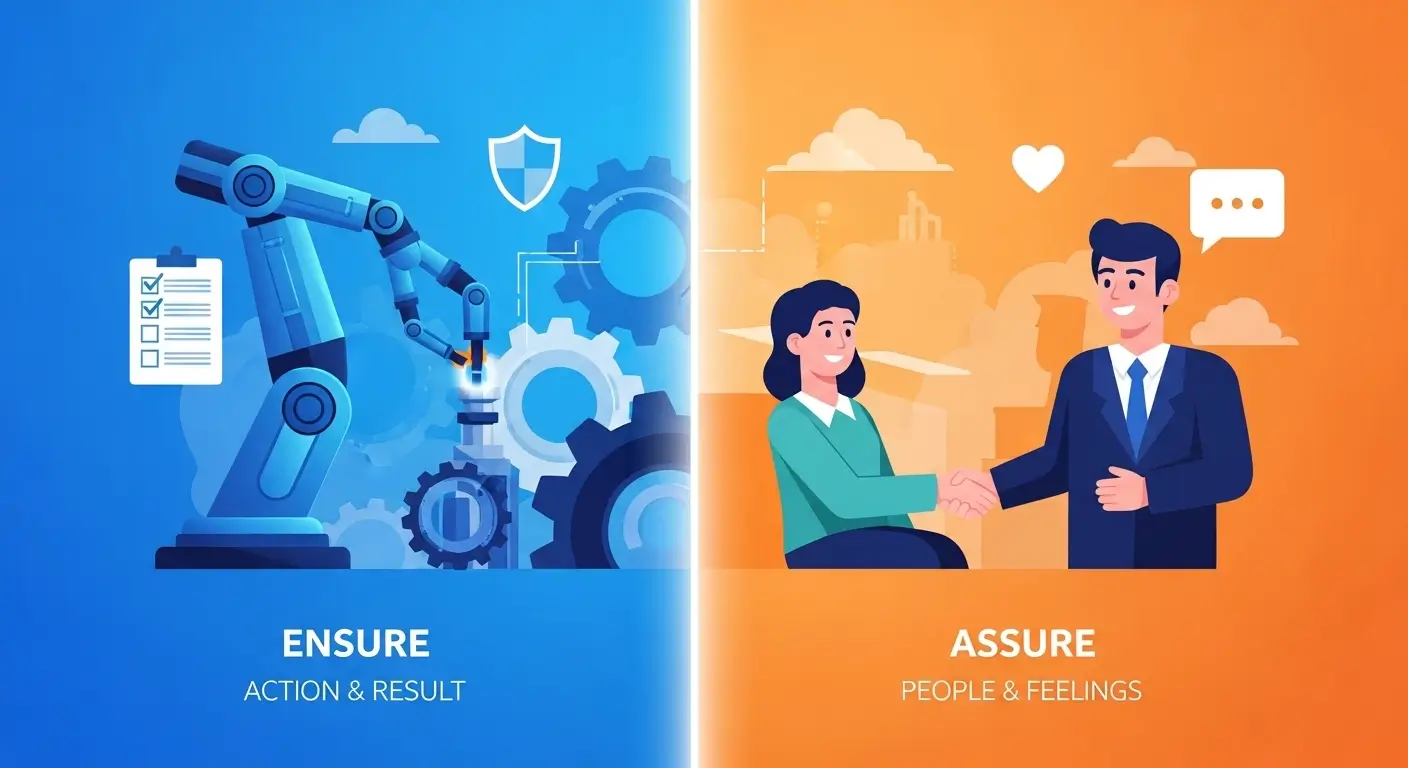
Imagine a manager speaking to two different people on the same day. To the team, she says, “I will ensure the project is completed on time.” Later, when a worried client calls, she says, “I assure you that everything is under control.” Both sentences sound similar, yet the intent is different.
This is where the difference between ensure and assure becomes important. Many learners struggle to understand the difference between ensure and assure, even though both words appear in daily conversations, professional emails, and formal writing. Knowing the difference between ensure and assure helps you communicate more clearly and confidently. In fact, mastering the difference between ensure and assure is essential for students, professionals, and anyone who wants to write precise English.
Key Difference Between the Both
The main difference lies in their purpose:
- Ensure means to make certain that something happens.
- Assure means to remove doubt or give confidence to someone.
In simple terms, ensure focuses on actions and results, while assure focuses on people and feelings.
Why Their Difference Is Necessary to Know for Learners and Experts
Understanding the correct usage of ensure and assure is crucial in academic writing, business communication, and public speaking. Using the wrong word can change the meaning of a sentence or make your message unclear. In professional settings such as contracts, policies, and official emails precision in language builds trust and credibility. Learners who know the difference between ensure and assure avoid grammatical errors and express ideas more confidently. Experts, writers, and educators rely on this distinction to maintain clarity and professionalism. In society, where communication shapes relationships and decisions, choosing the right word ensures understanding and assures confidence showing how both words play a meaningful role in everyday life.
Pronunciation (US & UK)
| Word | US Pronunciation | UK Pronunciation |
| Ensure | /ɪnˈʃʊr/ | /ɪnˈʃɔː/ |
| Assure | /əˈʃʊr/ | /əˈʃɔː/ |
A Linking Hook to the Main Discussion
Now that you understand the basic meanings and importance of these two commonly confused words, let’s explore the difference between ensure and assure in detail through practical examples, contexts, and comparisons.
Difference Between Ensure and Assure
1. Purpose of the Word
- Ensure is used to guarantee an outcome.
- Assure is used to comfort or convince a person.
Examples:
- Ensure: The teacher ensured that every student submitted the assignment.
- Ensure: She ensured the door was locked before leaving.
- Assure: The doctor assured the patient that the treatment was safe.
- Assure: He assured his parents that he would arrive home early.
2. Focus of Action
- Ensure focuses on tasks or situations.
- Assure focuses on people.
Examples:
- Ensure: The company ensured quality control in every product.
- Ensure: They ensured proper lighting in the hall.
- Assure: The manager assured the employees about job security.
- Assure: She assured her friend that she would help.
3. Emotional vs Practical Meaning
- Ensure is practical and action-based.
- Assure is emotional and reassurance-based.
Examples:
- Ensure: The guard ensured safety at the event.
- Ensure: The chef ensured the food was fresh.
- Assure: The guide assured tourists that the trip was safe.
- Assure: She assured the child that monsters were not real.
4. Common Grammar Structure
- Ensure is often followed by that + clause or an object.
- Assure is followed by a person + that clause.
Examples:
- Ensure: He ensured that the system was working.
- Ensure: They ensured accuracy in the report.
- Assure: She assured me that everything was fine.
- Assure: The officer assured the crowd that help was coming.
5. Usage in Formal Writing
- Ensure is frequently used in official documents.
- Assure appears more in conversational reassurance.
Examples:
- Ensure: Policies are designed to ensure public safety.
- Ensure: The agreement ensures equal opportunities.
- Assure: The spokesperson assured the public of transparency.
- Assure: The principal assured parents about school security.
6. Relation to Responsibility
- Ensure implies responsibility for results.
- Assure implies responsibility for calming or convincing someone.
Examples:
- Ensure: The supervisor ensured the machines were turned off.
- Ensure: She ensured the meeting started on time.
- Assure: The counselor assured the student about exam preparation.
- Assure: He assured his team that success was near.
7. Tone of the Word
- Ensure sounds authoritative and procedural.
- Assure sounds supportive and empathetic.
Examples:
- Ensure: The law ensures equal rights for citizens.
- Ensure: The checklist ensures all steps are completed.
- Assure: She assured her colleague during a stressful project.
- Assure: The host assured guests they were welcome.
8. Frequency in Professional Emails
- Ensure is used when describing actions taken.
- Assure is used when addressing concerns.
Examples:
- Ensure: We will ensure that your order is delivered on time.
- Ensure: Please ensure all documents are attached.
- Assure: I assure you that we value your feedback.
- Assure: The company assures customers of data privacy.
9. Relation to Future Outcomes
- Ensure is linked to making something happen in the future.
- Assure is linked to building present trust.
Examples:
- Ensure: The training ensures better performance next year.
- Ensure: Regular backups ensure data safety.
- Assure: The CEO assured investors about future growth.
- Assure: She assured him that she believed in his abilities.
10. Replaceability with Similar Words
- Ensure can often be replaced with guarantee.
- Assure can often be replaced with reassure.
Examples:
- Ensure: This policy guarantees fair treatment.
- Ensure: The lock guarantees security.
- Assure: She reassured her sister before the exam.
- Assure: He reassured the audience during the crisis.
Nature and Behaviour of Both Words
Ensure behaves like an action-oriented verb. It deals with systems, processes, and measurable outcomes. It is logical, procedural, and result-focused.
Assure, on the other hand, behaves like an emotion-oriented verb. It relates to communication, relationships, and psychological comfort. It is supportive and human-focused.
Why People Are Confused About Their Use
People often confuse ensure and assure because they look similar in spelling, share the same root, and are pronounced almost the same. Additionally, both words can appear in sentences involving promises or guarantees, making their meanings overlap in certain contexts. In fast communication especially in emails or messages writers may choose one randomly, assuming they are interchangeable, which increases confusion among learners.
Table Showing Difference and Similarity
| Feature | Ensure | Assure | Similarity |
| Meaning | Make something certain | Remove someone’s doubt | Both relate to certainty |
| Focus | Action or outcome | Person or emotion | Both are verbs |
| Tone | Formal and procedural | Personal and comforting | Used in professional communication |
| Replacement | Guarantee | Reassure | Express confidence |
| Usage | Policies, instructions | Conversations, support | Used in future contexts |
Which Is Better in What Situation?
Ensure is better when the goal is to describe responsibility, process, or results. In technical, legal, or academic writing, ensure is the preferred word because it clearly shows that steps are being taken to make something happen. For example, safety instructions, business contracts, and project plans commonly use ensure.
Assure is better when speaking to people who need confidence or emotional support. It is commonly used in customer service, healthcare, teaching, and personal relationships. When the intention is to calm fears, build trust, or express sincerity, assure becomes the more appropriate and effective choice.
How the Words Are Used in Metaphors and Similes
- Ensure: “A good education ensures success like a strong foundation supports a building.”
- Assure: “Her words assured him like a warm blanket on a cold night.”
These figurative uses highlight how ensure relates to stability and structure, while assure relates to comfort and emotional security.
Connotative Meaning of Both Words
| Word | Connotation | Example |
| Ensure | Neutral to positive | The system ensures fairness for all applicants. |
| Assure | Positive and comforting | The teacher assured the child before the competition. |
Idioms or Proverbs Related to the Words
While there are no direct idioms using ensure or assure, similar expressions exist:
- “Actions speak louder than words.”
Example: To ensure success, actions speak louder than words. - “Put someone’s mind at ease.”
Example: The manager assured the team and put their minds at ease.
Works in Literature Featuring the Keywords
- Ensure Justice – Legal essay collection, non-fiction, various authors, 2010
- Assure Me of the Moon – Romantic fiction, novel, Lila Bennett, 2018
Movies Using the Keywords in Titles
- Assured Trust – 2019, United States, drama
- Ensure the Future – 2021, United Kingdom, documentary
Five Frequently Asked Questions
1. Can ensure and assure be used interchangeably?
No, they serve different purposes one for actions, the other for people.
2. Which word is more formal?
Ensure is generally more formal and commonly used in official writing.
3. Is assure only used with people?
Yes, it usually takes a person as its object.
4. Can I say “ensure someone”?
No. You should say “assure someone” instead.
5. Which word is used in legal documents?
Ensure is more common in legal and procedural language.
How Both Words Are Useful for Our Surroundings
In everyday life, we rely on systems that ensure safety traffic rules, quality checks, and health regulations. At the same time, we depend on people who assure us parents, teachers, doctors, and leaders. One word supports structure, while the other supports emotional well-being. Together, they reflect how society balances efficiency and empathy.
Final Words for Both
Ensure represents certainty through action.
Assure represents certainty through reassurance.
Both words complement each other and are essential for complete and effective communication.
Conclusion
Understanding the difference between ensure and assure is not just a grammar lesson it is a practical communication skill. These two words may look similar, but their roles in language are distinct and meaningful. Ensure helps us describe responsibility and outcomes, while assure helps us build trust and comfort among people.
By learning when and how to use each word correctly, writers and speakers can avoid confusion, express ideas more precisely, and communicate with confidence in both personal and professional situations.

Alexandra “Alex” Monroe is a senior linguistics contributor at WordCompares.com, where she specializes in comparative word analysis, semantics, and language clarity. With over 15 years of academic and editorial experience, Alex helps readers understand subtle differences between commonly confused words and phrases. Her research-driven yet practical writing style strengthens the educational authority of WordCompares.com.