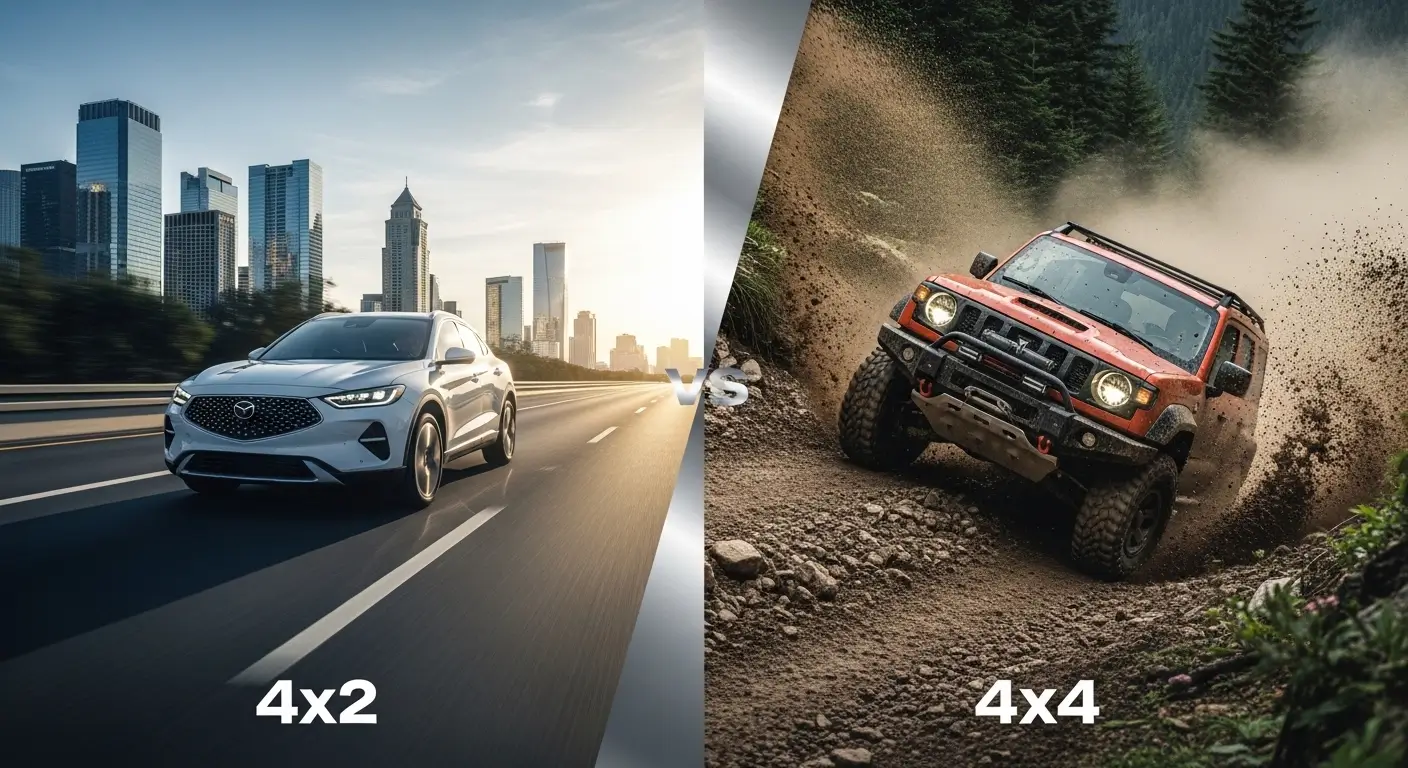
A few years ago, a friend of mine bought a new pickup truck. At the dealership, he was asked whether he wanted a 4×2 or 4×4 version. He was confused because both vehicles looked identical, yet there was a noticeable price difference. Like many buyers, he didn’t fully understand the difference between 4×2 and 4×4, and he later realized that his choice affected fuel efficiency, road performance, and maintenance costs.
In simple terms, 4×2 and 4×4 refer to how power from a vehicle’s engine is distributed to its wheels. Understanding the difference between 4×2 and 4×4 is important not only for car buyers but also for drivers who want better control, safety, and performance. Whether you drive in cities or rough terrains, knowing the difference between 4×2 and 4×4 can help you choose the right vehicle for your needs and budget.
Key Difference Between the Both
The main difference lies in how many wheels receive power from the engine.
- 4×2 vehicles send power to only two wheels—either the front or the rear.
- 4×4 vehicles send power to all four wheels, giving better traction and control, especially on rough or slippery surfaces.
Why Is This Difference Necessary to Know?
Understanding the difference between 4×2 and 4×4 is important for both beginners and experts because it affects:
- vehicle safety
- fuel consumption
- performance in different environments
- long term maintenance costs
In society, vehicles are used for commuting, agriculture, construction, and emergency services. A farmer working on muddy land needs a 4×4, while a city commuter may benefit more from a fuel efficient 4×2. Knowing the difference helps people make smarter financial and practical decisions.
Pronunciation of Both Terms
| Term | US Pronunciation | UK Pronunciation |
| 4×2 | four by two /fɔːr baɪ tuː/ | four by two /fɔː baɪ tuː/ |
| 4×4 | four by four /fɔːr baɪ fɔːr/ | four by four /fɔː baɪ fɔː/ |
Linking Hook
Now that we understand what these terms mean and why they matter, let’s explore the difference between 4×2 and 4×4 in detail through practical comparisons and real world examples.
Difference Between 4×2 and 4×4
1. Power Distribution
4×2: Power goes to two wheels only.
- Example 1: A sedan sending power to front wheels.
- Example 2: A pickup truck with rear wheel drive.
4×4: Power is distributed to all four wheels.
- Example 1: An SUV climbing a rocky hill.
- Example 2: A jeep moving through deep mud.
2. Traction and Grip
4×2: Limited traction on slippery surfaces.
- Example 1: A 4×2 car slipping on wet grass.
- Example 2: A rear wheel drive pickup struggling in snow.
4×4: Superior traction in rough conditions.
- Example 1: A 4×4 crossing sandy dunes.
- Example 2: A rescue vehicle moving during heavy rain.
3. Fuel Efficiency
4×2: Consumes less fuel because fewer components are engaged.
- Example 1: Daily city commuting with lower fuel cost.
- Example 2: Long highway drives with better mileage.
4×4: Uses more fuel due to heavier drivetrain.
- Example 1: Off road SUV burning more fuel in city traffic.
- Example 2: Constant power to all wheels increases engine load.
4. Vehicle Weight
4×2: Lighter because it has fewer mechanical parts.
- Example 1: A compact car designed for urban driving.
- Example 2: Delivery vans optimized for fuel economy.
4×4: Heavier due to extra differential and transfer case.
- Example 1: Military trucks designed for rough terrain.
- Example 2: Off road SUVs built with stronger frames.
5. Maintenance Costs
4×2: Lower maintenance due to simpler design.
- Example 1: Fewer parts to repair in a front wheel drive car.
- Example 2: Cheaper servicing at regular intervals.
4×4: Higher maintenance because of complex mechanics.
- Example 1: Transfer case oil changes.
- Example 2: Additional drivetrain components requiring repair.
6. Purchase Price
4×2: Usually cheaper to buy.
- Example 1: Base model pickup trucks.
- Example 2: Budget friendly family cars.
4×4: More expensive due to added technology.
- Example 1: Premium SUVs with all wheel capability.
- Example 2: Off road vehicles with advanced suspension.
7. Off Road Capability
4×2: Limited off road performance.
- Example 1: Getting stuck on muddy roads.
- Example 2: Difficulty climbing steep hills.
4×4: Designed for tough terrain.
- Example 1: Driving on mountain trails.
- Example 2: Crossing shallow rivers safely.
8. Towing and Load Handling
4×2: Adequate for light towing.
- Example 1: Pulling a small trailer.
- Example 2: Carrying light cargo in city logistics.
4×4: Better for heavy towing.
- Example 1: Pulling boats or caravans.
- Example 2: Transporting heavy equipment in rural areas.
9. Driving Experience
4×2: Smoother and quieter on paved roads.
- Example 1: Comfortable daily commuting.
- Example 2: Less vibration at high speed.
4×4: Slightly rougher due to mechanical complexity.
- Example 1: Noticeable drivetrain noise.
- Example 2: Slightly heavier steering feel.
10. Resale Value
4×2: Lower resale value in off road markets.
- Example 1: Rural buyers prefer 4×4.
- Example 2: Limited demand in mountainous regions.
4×4: Higher resale value due to versatility.
- Example 1: Popular in adventure tourism regions.
- Example 2: Strong demand in farming communities.
Nature and Behaviour of Both
4×2 vehicles behave like city friendly machines—efficient, economical, and smooth on highways. They are designed for paved roads and daily commuting.
4×4 vehicles behave like rugged explorers. They are built to handle uneven terrain, slippery roads, and challenging environments where traction is crucial.
Why People Are Confused About Their Use
People often confuse 4×2 and 4×4 because:
- both vehicles look similar externally
- marketing terms like AWD and 4WD are used interchangeably
- many drivers never experience off road conditions, so they don’t notice the difference
Comparison Table: Difference and Similarities
| Feature | 4×2 | 4×4 | Similarity |
| Power to wheels | Two wheels | Four wheels | Both use internal combustion or electric motors |
| Fuel economy | Better | Lower | Both require fuel/energy |
| Cost | Cheaper | Expensive | Both available in same vehicle models |
| Terrain capability | Limited | Excellent | Both can drive on paved roads |
| Maintenance | Low | High | Both need regular servicing |
Which Is Better in What Situation?
4×2 in Urban and Highway Use (100 words)
A 4×2 vehicle is better for drivers who spend most of their time on paved roads. It offers better fuel efficiency, lower maintenance costs, and smoother driving experience. City commuters, delivery drivers, and families who travel mostly on highways benefit from this drivetrain.
Since there are fewer mechanical parts, repairs are cheaper and the vehicle is lighter. In countries where road infrastructure is good, a 4×2 vehicle provides all the performance needed without the extra cost of a 4×4 system.
4×4 in Off Road and Extreme Conditions (100 words)
A 4×4 vehicle is ideal for people who frequently drive on rough terrain, mountains, snow, or muddy roads. Farmers, adventure travelers, and rescue teams rely on 4×4 vehicles for their superior traction and stability.
Power distributed to all four wheels prevents slipping and helps the vehicle move even when one wheel loses grip. Although 4×4 vehicles are more expensive and consume more fuel, their reliability in challenging environments makes them a valuable investment for those who need performance over efficiency.
Metaphors and Similes
- A 4×2 is like a runner wearing light shoes—fast and efficient on smooth tracks.
- A 4×4 is like a mountain climber with boots—slower but capable of handling difficult paths.
Connotative Meaning
| Term | Connotation | Example |
| 4×2 | Neutral to positive | “He chose a 4×2 for its practicality.” |
| 4×4 | Positive and rugged | “The 4×4 gave them confidence on dangerous roads.” |
Idioms or Proverbs Related to the Words
Although there are no direct idioms for 4×2 or 4×4, related vehicle idioms include:
- “Backseat driver” – someone who gives unwanted advice
- Example: He acted like a backseat driver while I was choosing between a 4×2 and 4×4.
- “Drive something into the ground” – use something until it stops working
- Example: He drove his old 4×2 into the ground before buying a new 4×4.
Works in Literature Mentioning Vehicles
- The Grapes of Wrath (1939) – Genre: Social realism – Writer: John Steinbeck
- On the Road (1957) – Genre: Beat literature – Writer: Jack Kerouac
Movies Featuring 4×4 Vehicles
- Mad Max: Fury Road – Released: 2015 – Country: Australia/USA
- Jurassic Park – Released: 1993 – Country: USA
Frequently Asked Questions
1. Is a 4×4 always better than a 4×2?
No. A 4×4 is better only in rough terrain, while a 4×2 is better for daily driving.
2. Does 4×4 mean all wheels are always powered?
Not always. Some systems allow switching between 2WD and 4WD modes.
3. Are 4×4 vehicles safer?
They provide better traction but still require careful driving and braking.
4. Is maintenance expensive for 4×4 vehicles?
Yes, because they have more mechanical components than 4×2 vehicles.
5. Can a 4×2 go off road?
It can handle light off road conditions but may struggle in mud, sand, or snow.
How Both Are Useful for Surroundings
4×2 vehicles help reduce fuel consumption and emissions in urban environments, making them environmentally friendly for city life.
4×4 vehicles support industries like farming, mining, and emergency services by allowing transportation in areas where regular vehicles cannot operate.
Final Words for Both
Both 4×2 and 4×4 vehicles serve important roles in modern transportation. One focuses on efficiency and affordability, while the other emphasizes power and adaptability.
Conclusion
Understanding the difference between 4×2 and 4×4 is essential for anyone planning to buy or use a vehicle. While a 4×2 drivetrain offers better fuel economy, lower cost, and smoother performance on paved roads, a 4×4 system provides superior traction and control in challenging environments.
The right choice depends on how and where the vehicle will be used. For daily commuting, a 4×2 is often sufficient, but for off road adventures or rural work, a 4×4 is the more reliable option. By knowing the strengths and limitations of each, drivers can make informed decisions that balance performance, safety, and budget.

Dr. Marcus Reed is a lead editorial author at WordCompares.com and a specialist in communication studies and written clarity. With more than 12 years of university-level teaching experience, he focuses on explaining word distinctions in a clear and structured manner. His work ensures that WordCompares.com maintains accuracy, depth, and reader trust.