Imagine you are at a high-end paint store, trying to match a specific shade of “sunset orange” from a photograph. The clerk takes a device, presses it against your photo, and suddenly, a screen displays the exact chemical pigments needed to recreate that color. In that moment, you aren’t just looking at light; you are measuring it.
This is the world of light science, where the difference between spectrometer and spectrophotometer becomes the line between seeing a color and understanding its soul. Whether you are a student or a lab pro, grasping the difference between spectrometer and spectrophotometer is like learning the difference between a compass and a GPS—both help you navigate, but one gives you the full map. When you master the difference between spectrometer and spectrophotometer, you unlock the ability to analyze everything from the stars above to the water in your glass.
Key Difference Between the Both
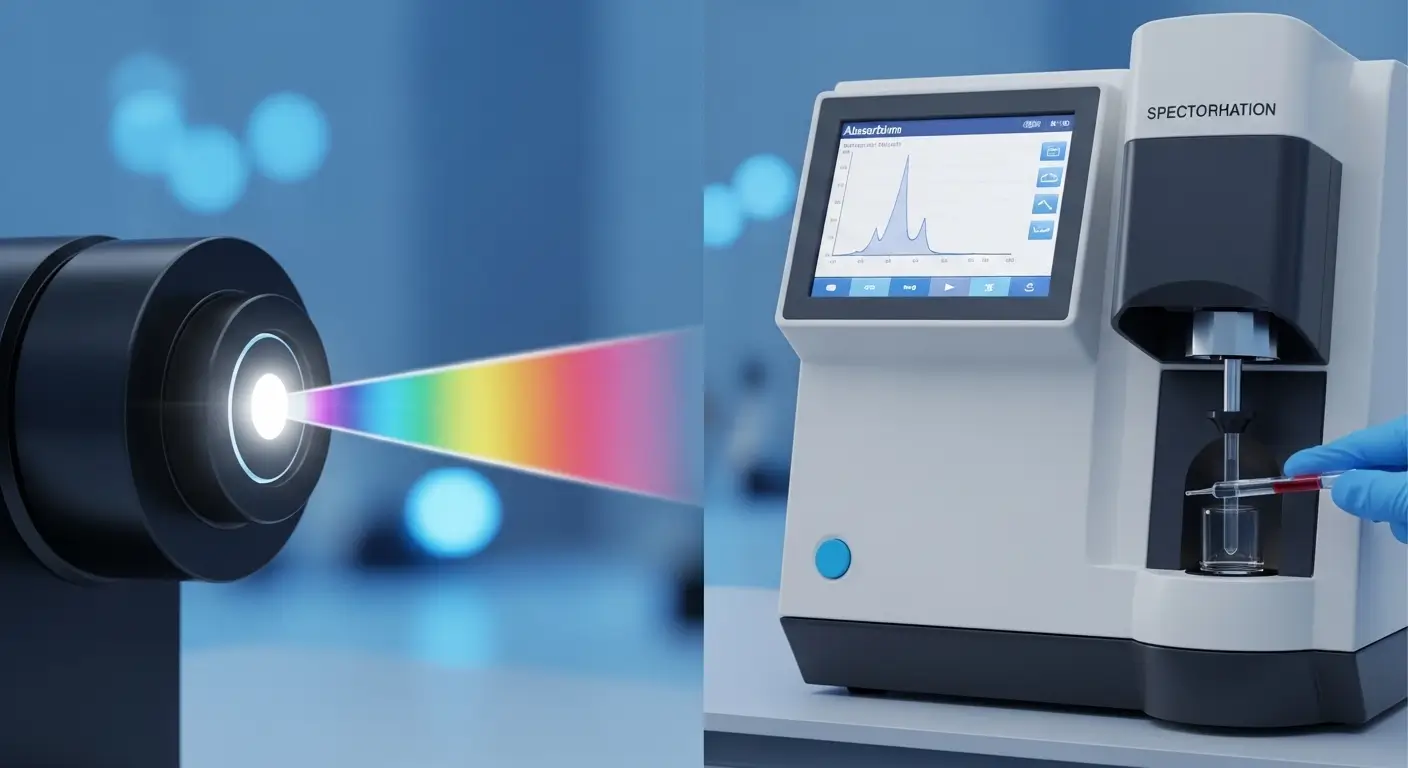
At its core, a spectrometer is a component that breaks light into its constituent wavelengths, while a spectrophotometer is a complete system that uses a spectrometer to measure how much light a chemical substance absorbs or transmits.
Why Their Difference is Necessary for Learners and Experts
Understanding this distinction is vital for the advancement of modern society. In medicine, knowing the difference between spectrometer and spectrophotometer allows technicians to measure blood oxygen levels or detect toxins accurately. In environmental science, it helps experts monitor pollutants in our oceans. For learners, distinguishing the two helps ensure they use the right tool for the right job, preventing costly research errors that could lead to breakthroughs in sustainable energy or food safety.
Pronunciation Guide
- Spectrometer
- US: /spɛkˈtrɑː.mɪ.t̬ɚ/ (spek-TRAH-mi-ter)
- UK: /spɛkˈtrɒm.ɪ.tə/ (spek-TROM-i-ter)
- Spectrophotometer
- US: /ˌspɛk.troʊ.fəˈtɑː.mɪ.t̬ɚ/ (spek-tro-fo-TRAH-mi-ter)
- UK: /ˌspɛk.trəʊ.fəˈtɒm.ɪ.tə/ (spek-truh-fo-TROM-i-ter)
Think of the spectrometer as the “eye” and the spectrophotometer as the “entire brain” processing the vision. Let’s dive deeper into what sets them apart.
Difference Between Spectrometer and Spectrophotometer
1. Fundamental Definition
- Spectrometer: An instrument used to scatter light into a spectrum.
- Example 1: Used in telescopes to see what stars are made of.
- Example 2: Used in handheld devices to identify minerals in rocks.
- Spectrophotometer: A device that measures the intensity of light as a function of its color.
- Example 1: Used in labs to check the concentration of a protein in a liquid.
- Example 2: Used in food quality control to measure juice clarity.
2. Composition and Parts
- Spectrometer: Contains a slit, a grating or prism, and a detector.
- Example 1: A simple prism held up to a window is a early spectrometer.
- Example 2: An optical bench setup in a physics lab.
- Spectrophotometer: Includes a light source, a spectrometer, a sample holder, and a display.
- Example 1: A benchtop machine in a chemistry department.
- Example 2: A portable water-testing kit used by field biologists.
3. Primary Purpose
- Spectrometer: To identify the “fingerprint” of light.
- Example 1: Identifying the specific gases in a neon sign.
- Example 2: Determining the temperature of a distant galaxy.
- Spectrophotometer: To quantify how much light a sample “eats” or lets through.
- Example 1: Testing how much dye is in a fabric sample.
- Example 2: Measuring the sugar content in a grape harvest.
4. Method of Operation
- Spectrometer: It simply captures and spreads light.
- Example 1: Capturing the glow of a flame test.
- Example 2: Monitoring the emission of a laser beam.
- Spectrophotometer: It shines a light through a sample and compares it to a reference.
- Example 1: Comparing pure water to lake water to find impurities.
- Example 2: Measuring how cloudy a bacterial culture has become.
5. Data Output
- Spectrometer: Produces a graph of light intensity vs. wavelength (a spectrum).
- Example 1: A rainbow-like chart showing peaks at certain colors.
- Example 2: A digital list of wavelengths present in a light bulb.
- Spectrophotometer: Produces a value for absorbance or transmittance.
- Example 1: A reading of “0.5 Abs” on a digital screen.
- Example 2: A percentage showing 90% light transmission.
6. Independence
- Spectrometer: Can function as a standalone unit for light analysis.
- Example 1: Attaching it to a telescope to analyze starlight.
- Example 2: Using it as a sensor in an industrial furnace.
- Spectrophotometer: Is a composite machine that cannot exist without a spectrometer inside it.
- Example 1: A medical diagnostic machine.
- Example 2: A laboratory analyzer for DNA purity.
7. Physical Size
- Spectrometer: Can be incredibly tiny, even fitting on a microchip.
- Example 1: Integrated sensors in modern smartphones.
- Example 2: Small modules used in drone-based agriculture.
- Spectrophotometer: Usually larger, often the size of a microwave or a large shoebox.
- Example 1: Heavy-duty industrial equipment.
- Example 2: Benchtop units in pharmaceutical labs.
8. Use of Light Source
- Spectrometer: Often uses an external light source (like the sun or a star).
- Example 1: Analyzing the sun’s rays during an eclipse.
- Example 2: Measuring the light emitted by a smartphone screen.
- Spectrophotometer: Always has a built-in, calibrated light source.
- Example 1: A Tungsten lamp inside the machine for visible light.
- Example 2: A Deuterium lamp for ultraviolet testing.
9. Sample Interaction
- Spectrometer: Does not necessarily require a sample holder (cuvette).
- Example 1: Pointing a sensor at a remote forest to see tree health.
- Example 2: Analyzing the exhaust of a car from a distance.
- Spectrophotometer: Requires the sample to be placed inside a specific chamber.
- Example 1: Placing a liquid vial (cuvette) into a slot.
- Example 2: Inserting a solid glass filter to test its coating.
10. Range of Application
- Spectrometer: Broadly used in physics, astronomy, and telecommunications.
- Example 1: Checking signal quality in fiber optic cables.
- Example 2: Researching the atomic structure of new materials.
- Spectrophotometer: Primarily used in chemistry, biology, and clinical medicine.
- Example 1: Determining the concentration of a new drug.
- Example 2: Testing the “whiteness” of paper in a mill.
Nature and Behavior
Spectrometer: It acts like a prism on steroids. Its nature is passive and analytical; it waits for light to arrive so it can dissect it. It behaves as a “decoder,” turning messy light into a readable code.
Spectrophotometer: It acts like a rigorous investigator. Its nature is active and comparative. It creates its own light, forces it through a medium, and calculates the “tax” the sample took from that light.
Why the Confusion?
The confusion stems from the fact that one is inside the other. Since every spectrophotometer contains a spectrometer, people often use the terms interchangeably. It’s like calling a car an “engine.” While the engine is the heart of the car, the car also has wheels, seats, and a steering wheel that allow the engine to be useful for travel.
Comparison Table
| Feature | Spectrometer | Spectrophotometer |
| Main Function | Disperses light into wavelengths | Measures light intensity/absorption |
| Light Source | External or internal | Always internal/controlled |
| Output | Wavelength peaks (Spectrum) | Numerical Absorbance/Transmittance |
| Complexity | Simple component | Integrated system |
| Common Use | Astronomy, Physics | Chemistry, Medicine |
| Similarity | Both use optical detectors | Both use optical detectors |
| Similarity | Both analyze electromagnetic radiation | Both analyze electromagnetic radiation |
Which is Better in What Situation?
If your goal is to identify what is emitting light—such as determining if a streetlamp is sodium or LED—a spectrometer is better. It is designed for spectral analysis and identifying the “fingerprint” of the light source itself without needing to touch a sample.
However, if you need to know how much of a substance is present in a liquid—such as checking the level of nitrates in a swimming pool—a spectrophotometer is superior. It provides the controlled environment and the math necessary to turn light readings into concentration data.
Metaphors, Similes, and Connotations
- Metaphor: A spectrometer is a “Light Translator.” A spectrophotometer is a “Chemical Accountant.”
- Simile: A spectrometer is like a rainbow caught in a box; a spectrophotometer is like a gatekeeper measuring every person who walks through a door.
| Word | Connotative Meaning | Example |
| Spectrometer | Neutral/Exploratory (Discovery) | “The spectrometer revealed the secret of the star.” |
| Spectrophotometer | Positive/Precise (Accuracy) | “The spectrophotometer ensured the medicine was safe.” |
Idioms and Proverbs
(Note: While these devices are technical, we can apply their “essence” to idioms.)
- “To see through a different spectrum” (Inspired by spectrometer): To understand a situation from a new perspective.
- Example: “By talking to the locals, the journalist began to see the conflict through a different spectrum.”
- “Measuring to the last drop” (Inspired by spectrophotometer): Being extremely precise.
- Example: “She managed the budget like a spectrophotometer, measuring every last drop of the company’s funds.”
Literature and Film
- Literature:
- The Spectrometer of the Soul (Poetry Collection, A. V. Raine, 2012) – Genre: Modern Poetry.
- Spectrophotometry in Clinical Diagnosis (Technical Guide, Richard J. Henry, 1964) – Genre: Medical Reference.
- Movies:
- The Spectrum (2015, USA) – A sci-fi short involving light manipulation.
- Interstellar (2014, USA) – While not named in the title, spectrometers are the silent heroes used to analyze the gravity and atmosphere of planets.
Frequently Asked Questions (FAQ)
- Can I use a spectrometer as a spectrophotometer?
Not easily. You would need to add a stable light source and a precise sample holder to make it work. - Which one is more expensive?
Generally, spectrophotometers are more expensive because they include more components (light sources, electronics, and software). - Do they only use visible light?
No, both can work in Ultraviolet (UV) and Infrared (IR) ranges. - Is a colorimeter the same as a spectrophotometer?
No, a colorimeter is a simpler version that only measures specific colors (RGB), whereas a spectrophotometer looks at the entire spectrum. - Which one do I need for a school chemistry project?
Usually, a spectrophotometer is required to measure reaction rates or concentrations.
Usefulness for Surroundings
These tools act as the “silent guardians” of our environment. They check the air for carbon dioxide levels, ensure the water from your tap is free of heavy metals, and even help farmers know when to harvest crops by checking the sugar levels in fruit without damaging the plant.
Final Words
Whether you are peering into a microscope or gazing at a nebula, the difference between spectrometer and spectrophotometer is what allows us to quantify the invisible. One shows us the colors of the universe; the other tells us exactly what those colors are hiding.
Conclusion
Navigating the technicalities of lab equipment can feel like learning a new language. However, the difference between a spectrometer and a spectrophotometer is quite intuitive once you look at the “big picture.”
The spectrometer is the expert at breaking light apart, while the spectrophotometer is the master of using that light to measure the world. From the food we eat to the medicine that heals us, these two instruments work in tandem to provide a level of precision that was once thought impossible.
By understanding their unique roles, you aren’t just memorizing definitions you are learning how we measure the very fabric of reality.

Alexandra “Alex” Monroe is a senior linguistics contributor at WordCompares.com, where she specializes in comparative word analysis, semantics, and language clarity. With over 15 years of academic and editorial experience, Alex helps readers understand subtle differences between commonly confused words and phrases. Her research-driven yet practical writing style strengthens the educational authority of WordCompares.com.