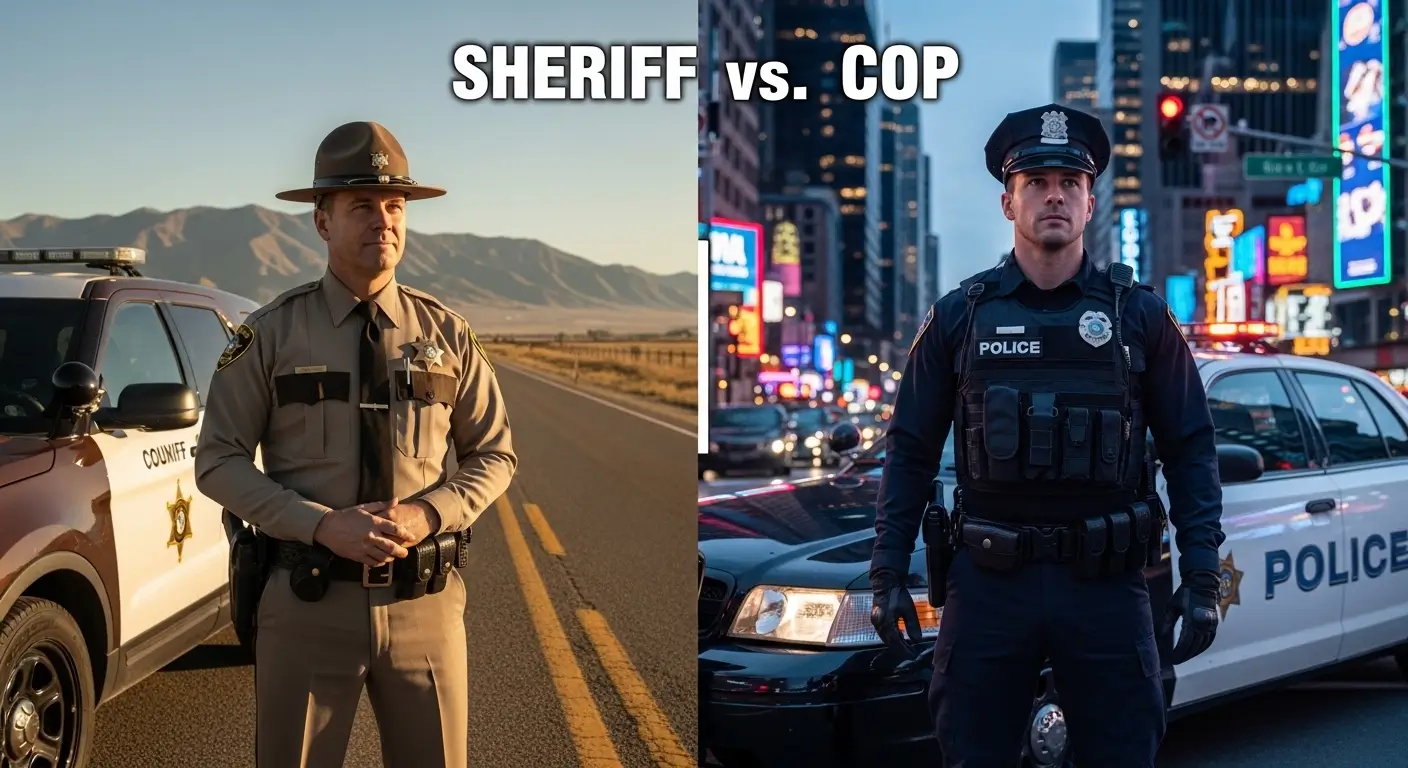
Understanding the difference between sheriff and cop is crucial, especially if you are fascinated by law enforcement or studying criminal justice. Imagine a small town in the United States, where the sheriff patrols rural areas, handling legal and administrative duties, while cops manage city streets, traffic, and everyday law enforcement.
Many people confuse the roles of sheriff and cop, assuming they are the same, but they serve different purposes in society. The difference between sheriff and cop is not only about jurisdiction but also about powers, responsibilities, and even public perception. Whether you are a learner or an expert in law enforcement, knowing the difference between sheriff and cop helps you understand how communities maintain order.
Pronunciation:
- Sheriff: US /ˈʃɛrɪf/, UK /ˈʃerɪf/
- Cop: US /kɑp/, UK /kɒp/
Let’s dive deeper into the roles and explore why this distinction is so important.
Difference Between Sheriff and Cop
1. Jurisdiction
- Sheriff: Operates primarily in counties, including rural areas.
- Example 1: A sheriff handles a dispute on a county road.
- Example 2: Sheriffs manage jail facilities in the county.
- Cop: Works within city or municipal limits.
- Example 1: A cop issues a parking ticket in the city.
- Example 2: Cops patrol neighborhoods for local crimes.
2. Election vs. Appointment
- Sheriff: Usually elected by local citizens.
- Example 1: Voters elect a sheriff every four years.
- Example 2: Campaign promises affect a sheriff’s policies.
- Cop: Hired by the police department.
- Example 1: Police officers undergo training before joining.
- Example 2: Promotions are based on seniority or merit.
3. Powers and Duties
- Sheriff: Oversees law enforcement, court security, and county jail.
- Example 1: Deputies enforce court orders for a sheriff.
- Example 2: Sheriffs coordinate county emergency responses.
- Cop: Focuses on crime prevention, traffic, and arrests in cities.
- Example 1: A cop investigates a burglary downtown.
- Example 2: Traffic enforcement during rush hours.
4. Geographic Coverage
- Sheriff: Covers large, often rural areas.
- Cop: Operates in smaller, urban areas.
5. Administrative Responsibilities
- Sheriff: Manages staff, jail, and court operations.
- Cop: Limited administrative tasks, mainly enforcement.
6. Community Engagement
- Sheriff: Works closely with county residents.
- Cop: Interacts with city residents and local organizations.
7. Reporting Structure
- Sheriff: Independent; reports to the public through elections.
- Cop: Reports to the police chief or department hierarchy.
8. Funding Source
- Sheriff: Funded by county budgets.
- Cop: Funded by city or municipal budgets.
9. Authority Scope
- Sheriff: Broader, sometimes statewide backup authority.
- Cop: Limited to city limits.
10. Specialized Units
- Sheriff: May have specialized deputies for courts, jails, or investigations.
- Cop: May serve in traffic, narcotics, or SWAT units.
Nature and Behavior
- Sheriff: Authoritative, administrative, and community-focused.
- Cop: Tactical, responsive, and law enforcement-focused.
People often confuse sheriffs and cops because both wear uniforms, carry firearms, and maintain law and order. However, their jurisdiction, duties, and authority clearly differ.
Table: Sheriff vs Cop
| Feature | Sheriff | Cop | Similarity |
| Jurisdiction | County/Rural | City/Municipal | Enforce law |
| Appointment | Elected | Hired | Can arrest suspects |
| Duties | Administrative & law | Law enforcement | Serve public |
| Reporting | Public via election | Police chief | Wear uniforms |
| Community focus | County | City | Maintain order |
| Funding | County budget | City budget | Funded by government |
Which is Better in What Situation?
- Sheriff: Best in rural or county-level situations requiring administrative authority or jail management. Their elected position ensures accountability to local citizens.
- Cop: Better in urban areas for quick responses, patrol, and traffic control. They provide immediate enforcement and crime prevention in cities.
Metaphors, Similes, and Connotative Meaning
- Sheriff: “Like the anchor of the county” – positive, responsible.
- Cop: “As vigilant as a hawk on city streets” – neutral to positive.
Idioms / Proverbs:
- “Sheriff of a town” – denotes authority.
- “Cop on the beat” – someone maintaining order actively.
Works in Literature:
- The Sheriff of Nottingham (Fiction, Anthony Burgess, 1976)
- Cop Town (Crime Novel, Karin Slaughter, 2014)
Movies:
- Sheriff of Tombstone (1954, USA)
- Cop Land (1997, USA)
FAQs
- Are sheriffs higher in rank than cops?
Not exactly; sheriffs have broader administrative authority, while cops focus on city law enforcement. - Can a sheriff act within a city?
Only if the city requests assistance or in certain legal situations. - Do sheriffs carry out traffic duties?
Rarely, except on county highways. - Is a cop elected?
No, cops are hired employees. - Can sheriffs and cops work together?
Yes, especially for investigations crossing city and county lines.
How Both Are Useful for Surroundings
Sheriffs maintain order in rural areas and manage jails, ensuring county stability. Cops handle city law enforcement, traffic, and immediate emergencies, keeping urban life safe. Together, they form a law enforcement ecosystem.
Final Words
Both sheriffs and cops are crucial for law and order. While sheriffs manage broader county-level authority, cops provide immediate protection in cities. Understanding their roles enriches our perspective on public safety.
Conclusion
Knowing the difference between sheriff and cop helps us appreciate how law enforcement functions at multiple levels. Sheriffs oversee administrative and county-wide duties, while cops respond to daily urban challenges.
Both work together to keep communities safe, though in distinct ways. By understanding their roles, responsibilities, and authority, citizens, learners, and experts can make informed decisions about law enforcement.

Dr. Marcus Reed is a lead editorial author at WordCompares.com and a specialist in communication studies and written clarity. With more than 12 years of university-level teaching experience, he focuses on explaining word distinctions in a clear and structured manner. His work ensures that WordCompares.com maintains accuracy, depth, and reader trust.