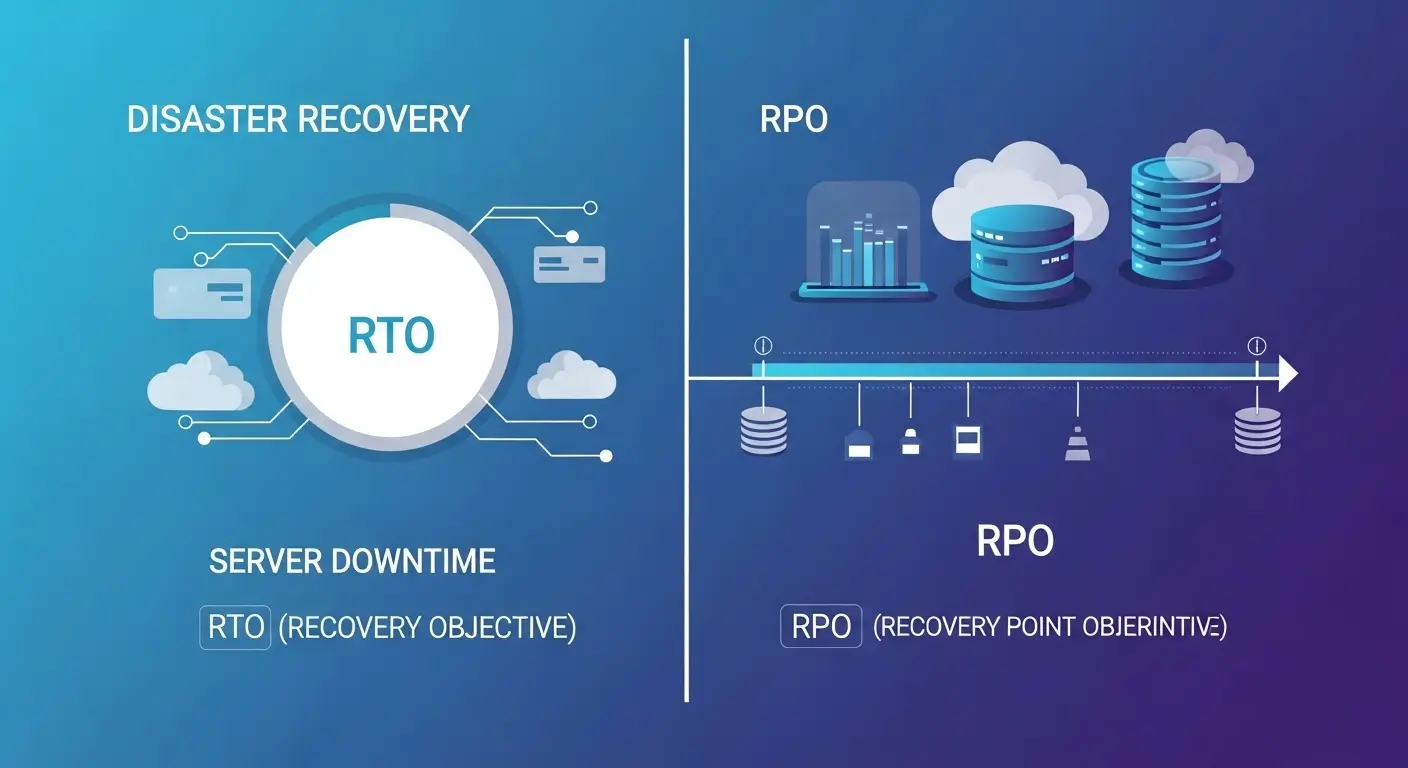
Imagine a busy online store that suddenly loses access to its database because of a server crash. Customers cannot place orders, and the business begins losing money every minute. The IT team immediately starts recovery procedures, but two important questions arise: How quickly must the system come back online? and How much data loss is acceptable?
These questions are exactly where RTO (Recovery Time Objective) and RPO (Recovery Point Objective) come into play. In modern IT infrastructure, understanding the difference between RTO and RPO is essential for maintaining reliable systems and protecting valuable information. Businesses, cloud services, and even government institutions rely on these concepts to plan for unexpected failures.
The difference between RTO and RPO helps organizations determine how fast systems should recover and how much data can be lost during a disaster. Without knowing the difference between RTO and RPO, companies risk long downtimes and severe data loss. Therefore, understanding the difference between RTO and RPO is a fundamental part of disaster recovery and business continuity planning.
Key Difference Between the Two
The main difference between RTO and RPO lies in their focus:
- RTO measures how quickly a system must be restored after a failure.
- RPO measures how much data loss is acceptable during a failure.
In simple terms:
- RTO = Time to restore services
- RPO = Maximum acceptable data loss
Why Their Difference Is Important for Learners and Experts
Understanding the difference between RTO and RPO is crucial for both beginners and professionals in the IT field. For learners, it builds a strong foundation in cybersecurity, cloud computing, and disaster recovery strategies. It helps students understand how organizations protect their systems and data from unexpected disruptions.
For experts and organizations, the difference determines how infrastructure is designed. Companies that handle financial transactions, healthcare records, or online services must carefully define RTO and RPO targets to minimize damage during system failures. These concepts also influence backup strategies, cloud architecture, and emergency response plans. In society, reliable digital services depend heavily on well-planned recovery strategies based on RTO and RPO.
Pronunciation
RTO (Recovery Time Objective)
- US pronunciation: /ˌɑːr tiː ˈoʊ/
- UK pronunciation: /ˌɑː tiː ˈəʊ/
RPO (Recovery Point Objective)
- US pronunciation: /ˌɑːr piː ˈoʊ/
- UK pronunciation: /ˌɑː piː ˈəʊ/
Linking Hook
Now that we understand the basic meanings, let’s explore the difference between RTO and RPO in greater detail by comparing them across several practical aspects used in real-world IT environments.
Difference Between RTO and RPO
1. Definition
RTO:
The maximum time allowed to restore systems after a failure.
Examples:
- Example 1: A banking system may set an RTO of 30 minutes, meaning services must be restored within half an hour.
- Example 2: A small business website might set an RTO of 4 hours after a server crash.
RPO:
The maximum acceptable amount of data loss measured in time.
Examples:
- Example 1: A company with an RPO of 10 minutes can lose only the last 10 minutes of data.
- Example 2: A backup system running hourly means the RPO is 1 hour.
2. Focus
RTO focuses on system downtime.
Examples:
- Example 1: An e-commerce site needs its checkout system restored quickly.
- Example 2: An airline booking system must resume operations immediately after failure.
RPO focuses on data recovery limits.
Examples:
- Example 1: A hospital database must not lose patient records.
- Example 2: A cloud storage service limits acceptable data loss.
3. Measurement
RTO is measured in downtime duration.
Examples:
- Example 1: 15 minutes downtime allowed.
- Example 2: 2 hours downtime allowed.
RPO is measured in data loss timeframe.
Examples:
- Example 1: Data loss limited to last 5 minutes.
- Example 2: Data loss limited to last 24 hours.
4. Priority
RTO prioritizes service restoration.
Examples:
- Example 1: Streaming platforms must restore services quickly.
- Example 2: Customer support systems need quick access restoration.
RPO prioritizes data protection.
Examples:
- Example 1: Financial systems must not lose transactions.
- Example 2: Research institutions must preserve experimental data.
5. Impact
RTO impacts business operations.
Examples:
- Example 1: Long downtime affects customer experience.
- Example 2: Production systems stopping may halt manufacturing.
RPO impacts data integrity.
Examples:
- Example 1: Lost sales records create accounting issues.
- Example 2: Lost emails may cause communication breakdowns.
6. Implementation
RTO uses disaster recovery systems.
Examples:
- Example 1: Failover servers automatically replace failed systems.
- Example 2: Cloud replication restores services quickly.
RPO uses backup strategies.
Examples:
- Example 1: Continuous data replication.
- Example 2: Frequent automated backups.
7. Cost
Lower RTO requires higher cost.
Examples:
- Example 1: Real-time backup infrastructure.
- Example 2: High-availability servers.
Lower RPO also increases costs.
Examples:
- Example 1: Continuous database replication.
- Example 2: Real-time cloud storage backups.
8. Business Type
RTO is critical for service-based industries.
Examples:
- Example 1: Online banking.
- Example 2: Streaming platforms.
RPO is critical for data-driven industries.
Examples:
- Example 1: Medical research databases.
- Example 2: Financial trading systems.
9. Recovery Strategy
RTO determines recovery speed strategy.
Examples:
- Example 1: Hot standby servers.
- Example 2: Automated failover systems.
RPO determines backup frequency strategy.
Examples:
- Example 1: Hourly backups.
- Example 2: Continuous replication.
10. Business Continuity Role
RTO ensures operations restart quickly.
Examples:
- Example 1: A retail site restoring checkout service.
- Example 2: A telecom network restoring connectivity.
RPO ensures important data remains safe.
Examples:
- Example 1: Backup of customer records.
- Example 2: Secure storage of financial transactions.
Nature and Behaviour of Both
RTO Nature:
RTO is time-focused and operational. Its behavior revolves around restoring functionality as quickly as possible.
RPO Nature:
RPO is data-focused and protective. Its behavior centers on minimizing information loss.
Why People Are Confused About Their Use
People often confuse RTO and RPO because both are used in disaster recovery planning and both relate to system failures. Their abbreviations also look similar, which leads to misunderstanding. However, remembering that RTO deals with time and RPO deals with data loss can easily clarify the difference.
Table Showing Difference and Similarity
| Aspect | RTO | RPO | Similarity |
| Full Form | Recovery Time Objective | Recovery Point Objective | Both part of disaster recovery |
| Focus | System restoration time | Data loss tolerance | Both protect business operations |
| Measurement | Time to restore services | Time of acceptable data loss | Both measured in time |
| Purpose | Minimize downtime | Minimize data loss | Both improve system resilience |
Which Is Better in What Situation?
When RTO Is More Important
RTO becomes more important in situations where continuous service availability is critical. For example, online banking systems, airline reservation platforms, and emergency communication networks cannot afford long periods of downtime. In such environments, the ability to restore operations quickly is essential to maintain trust and prevent financial losses. Organizations often invest in high-availability infrastructure to meet strict RTO requirements.
When RPO Is More Important
RPO becomes more important when preserving data accuracy is the top priority. Industries such as healthcare, finance, and scientific research depend heavily on precise records. Losing even a few minutes of data could lead to serious consequences. In these cases, organizations design systems with continuous data backups and replication to ensure minimal data loss.
Metaphors and Similes
- RTO is like fixing a broken road quickly so traffic can move again.
- RPO is like making copies of important documents before storing them.
Simile examples:
- RTO works like an emergency repair crew restoring electricity after a storm.
- RPO acts like a safety net protecting valuable information.
Connotative Meaning
RTO
- Positive: Efficiency, quick response
- Neutral: Recovery measurement
- Negative: Pressure for immediate system restoration
Example:
“Strict RTO targets push companies to build faster recovery systems.”
RPO
- Positive: Data protection and reliability
- Neutral: Backup measurement
- Negative: Potential data loss tolerance
Example:
“A low RPO ensures sensitive records remain safe.”
Idioms or Proverbs (Conceptual Use)
Although no idioms exist specifically for RTO or RPO, related expressions include:
- “Time is money.”
Example: Companies maintain low RTO because time directly affects revenue. - “Better safe than sorry.”
Example: Organizations maintain strict RPO to avoid losing critical data.
Works in Literature or Academic Writing
- Disaster Recovery Planning – Michael Wallace (Technology/IT, 2017)
- Business Continuity Management – Andrew Hiles (Management/Technology, 2014)
- Cloud Computing Security – Ronald Krutz & Russell Vines (Technology, 2010)
Movies Related to Disaster Recovery and System Failures
- Blackhat – 2015 – USA
- Live Free or Die Hard – 2007 – USA
- Snowden – 2016 – USA
Frequently Asked Questions
1. What is the main difference between RTO and RPO?
RTO focuses on system downtime, while RPO focuses on acceptable data loss.
2. Which is more important, RTO or RPO?
Both are important, but their priority depends on business needs and industry.
3. Can a system have low RTO and high RPO?
Yes. A system may recover quickly but still lose several minutes or hours of data.
4. How are RTO and RPO determined?
They are defined through risk assessments and business impact analysis.
5. Do cloud services use RTO and RPO?
Yes, most cloud providers design their backup and recovery services around these metrics.
How Both Are Useful for Our Surroundings
RTO and RPO play a vital role in maintaining digital reliability in modern society. Banks, hospitals, transportation systems, and online businesses depend on them to recover quickly from unexpected disruptions. By defining clear recovery objectives, organizations ensure that services remain available and data remains secure. This helps maintain public trust and keeps digital infrastructure stable.
Final Words for Both
RTO represents the urgency of restoring operations, while RPO represents the importance of protecting data. Together, they create a balanced disaster recovery strategy that supports reliable digital systems.
Conclusion
Understanding the difference between RTO and RPO is essential in today’s technology-driven world. These two concepts form the foundation of disaster recovery and business continuity planning. While RTO focuses on how quickly systems must be restored after a failure, RPO determines how much data loss is acceptable.
Both play equally important roles in protecting businesses from financial loss, operational disruption, and data damage. Organizations must carefully evaluate their needs and define appropriate RTO and RPO targets to maintain reliable services. By implementing effective backup systems and recovery strategies, companies can ensure continuity even during unexpected failures.

Dr. Marcus Reed is a lead editorial author at WordCompares.com and a specialist in communication studies and written clarity. With more than 12 years of university-level teaching experience, he focuses on explaining word distinctions in a clear and structured manner. His work ensures that WordCompares.com maintains accuracy, depth, and reader trust.