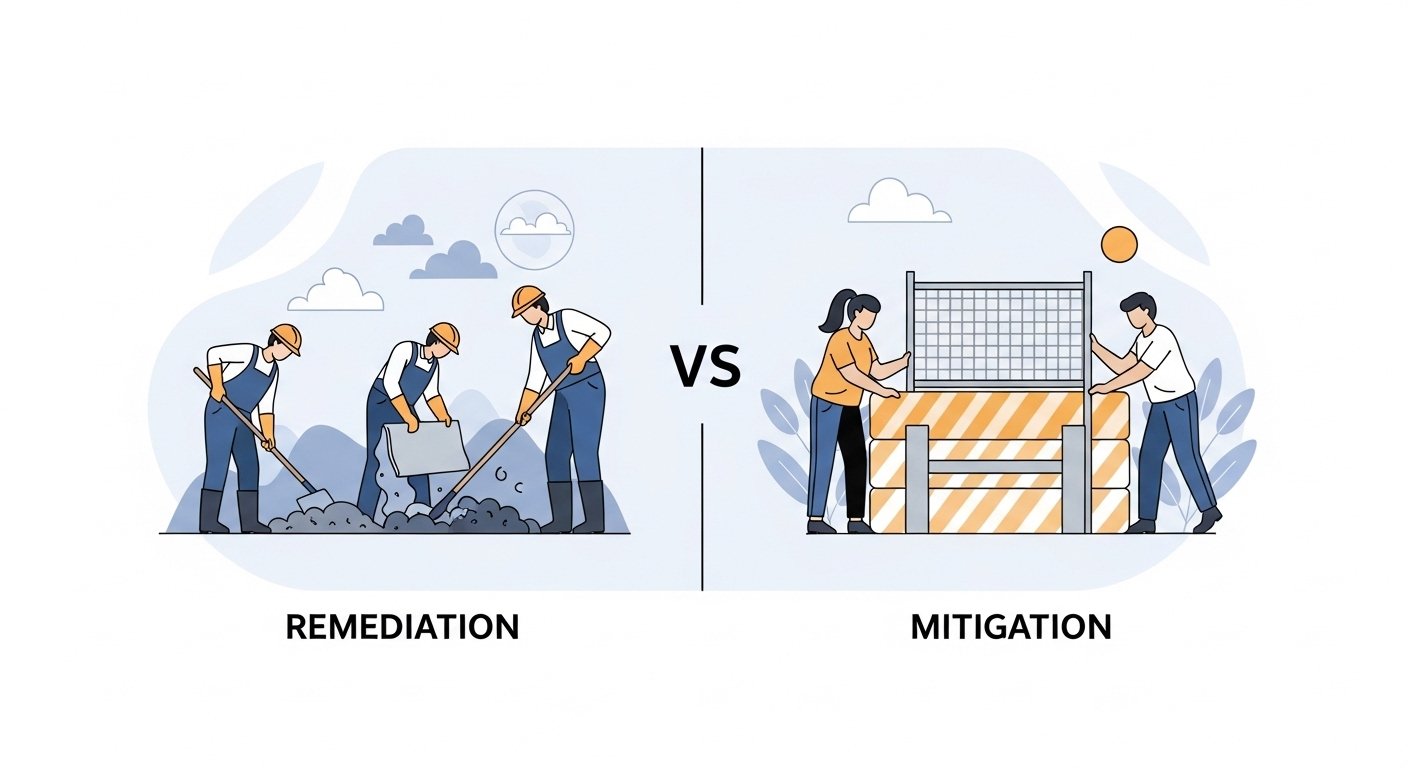
A few years ago, a small factory near a river discovered that some chemicals had leaked into the soil. The local authorities asked the company to take action. First, the company tried to reduce the harm by placing barriers and limiting the spread of contamination. Later, they hired experts to completely remove the polluted soil and restore the land. These two steps illustrate the difference between remediation and mitigation in real life.
When people talk about environmental protection, risk management, or cybersecurity, they often discuss the difference between remediation and mitigation. Both terms focus on solving problems, but they work in different ways. Understanding the difference between remediation and mitigation helps individuals and organizations respond properly to risks. In many industries, knowing the difference between remediation and mitigation can prevent serious damage and guide smarter decisions.
Key Difference Between the Both
The main difference between remediation and mitigation is that remediation removes or fixes the root problem, while mitigation reduces the severity or impact of the problem without necessarily eliminating it.
Why Their Difference Is Important for Learners and Experts
Understanding the difference between remediation and mitigation is important for students, professionals, and organizations. In cybersecurity, mitigation might block a threat temporarily, while remediation removes the vulnerability completely. In environmental science, mitigation limits damage while remediation restores the ecosystem.
For society, the distinction ensures responsible action. Governments design mitigation strategies to minimize disasters, but remediation programs repair damage afterward. Experts rely on this knowledge to create better safety systems, improve environmental protection, and maintain technological reliability.
Pronunciation
Remediation
- US: /rɪˌmiːdiˈeɪʃən/
- UK: /rɪˌmiːdiˈeɪʃən/
Mitigation
- US: /ˌmɪtɪˈɡeɪʃən/
- UK: /ˌmɪtɪˈɡeɪʃən/
Linking Hook:
Now that we understand the basic idea, let us explore the detailed difference between remediation and mitigation with practical comparisons and examples.
Difference Between Remediation and Mitigation
1. Purpose
Remediation:
Remediation focuses on fixing or removing the root cause of a problem.
Examples:
- Cleaning contaminated soil after an oil spill.
- Fixing a software vulnerability permanently.
Mitigation:
Mitigation focuses on reducing damage or risk.
Examples:
- Building flood barriers to limit water damage.
- Installing fire alarms to reduce harm during fires.
2. Timing
Remediation:
Usually occurs after the problem is identified or damage occurs.
Examples:
- Restoring polluted land.
- Repairing corrupted databases.
Mitigation:
Often happens before or during a risk.
Examples:
- Strengthening buildings before earthquakes.
- Installing antivirus software to reduce threats.
3. Goal
Remediation:
Goal is complete correction or restoration.
Examples:
- Removing toxic waste.
- Fixing broken infrastructure.
Mitigation:
Goal is minimizing harm.
Examples:
- Reducing carbon emissions gradually.
- Using protective gear in hazardous jobs.
4. Scope
Remediation:
Targets a specific problem directly.
Examples:
- Cleaning polluted water sources.
- Rewriting faulty code.
Mitigation:
Focuses on broader risk control.
Examples:
- Disaster preparedness programs.
- Safety regulations in industries.
5. Long Term vs Short Term
Remediation:
Usually a long term permanent solution.
Examples:
- Replanting forests after deforestation.
- Repairing a damaged bridge.
Mitigation:
Often temporary or preventive.
Examples:
- Sandbags during floods.
- Temporary security patches.
6. Approach
Remediation:
Directly eliminates the cause.
Examples:
- Removing mold from buildings.
- Fixing a system bug.
Mitigation:
Controls or limits the effects.
Examples:
- Using masks during pollution.
- Installing filters.
7. Cost Perspective
Remediation:
Often more expensive because it involves full correction.
Examples:
- Environmental cleanup projects.
- Complete system upgrades.
Mitigation:
Usually less costly initially.
Examples:
- Risk insurance policies.
- Safety warnings and training.
8. Application Areas
Remediation:
Common in environmental science and cybersecurity.
Examples:
- Soil restoration.
- Malware removal.
Mitigation:
Common in disaster management and planning.
Examples:
- Evacuation plans.
- Climate adaptation strategies.
9. Effectiveness
Remediation:
Eliminates the issue permanently.
Examples:
- Replacing faulty equipment.
- Removing contamination sources.
Mitigation:
Reduces damage but may not remove the cause.
Examples:
- Fire suppression systems.
- Protective barriers.
10. Outcome
Remediation:
Produces restoration and recovery.
Examples:
- Ecosystem restoration.
- Secure computer systems.
Mitigation:
Produces risk reduction.
Examples:
- Reduced flood damage.
- Controlled cyber threats.
Nature and Behaviour of Both
Remediation:
Remediation behaves as a corrective strategy. It focuses on solving the underlying problem and restoring systems to normal conditions.
Mitigation:
Mitigation behaves as a preventive or protective strategy. It aims to reduce risk, impact, or severity.
Why People Are Confused About Their Use
People often confuse these terms because both deal with problem management. In many situations they are used together. For example, a company may mitigate cyber threats with firewalls while remediating vulnerabilities later. Because they work toward similar goals—safety and recovery—the difference can seem subtle.
Table Showing Difference and Similarity
| Aspect | Remediation | Mitigation |
| Main goal | Fix the root problem | Reduce the impact |
| Timing | After damage or issue | Before or during risk |
| Nature | Corrective | Preventive |
| Scope | Direct solution | Risk control |
| Result | Full recovery | Damage reduction |
| Similarity | Both aim to manage risks and protect people, systems, or environments |
Which Is Better in What Situation?
Remediation:
Remediation is better when the root cause of a problem is known and can be fixed. For example, removing contaminated soil or repairing software vulnerabilities ensures long term safety. Organizations often rely on remediation to restore systems and prevent the same problem from returning.
Mitigation:
Mitigation is better when risks cannot be fully removed or when immediate action is needed. Disaster management often depends on mitigation strategies such as evacuation plans or protective infrastructure. These actions reduce damage even when the problem cannot be eliminated completely.
Use in Metaphors and Similes
Remediation
- “Education acts as remediation for social inequality.”
- “Therapy can be remediation for emotional wounds.”
Mitigation
- “Kind words act as mitigation for anger.”
- “Rules are like mitigation against chaos.”
Connotative Meaning
Remediation
- Connotation: Positive
Examples: - “The remediation plan restored the forest.”
- “Training served as remediation for skill gaps.”
Mitigation
- Connotation: Neutral to Positive
Examples: - “Policies helped in mitigation of risks.”
- “Early warnings provided mitigation against disasters.”
Idioms or Proverbs Related to the Ideas
- “Prevention is better than cure.”
Example: Mitigation measures often follow this idea. - “Fix the root of the problem.”
Example: Remediation focuses on fixing the root cause.
Works in Literature
Remediation
- Remediation: Understanding New Media — Jay David Bolter & Richard Grusin (Media theory, 1999)
Mitigation
- Appears in environmental policy writings and climate change literature discussing risk reduction.
Movies Related to the Themes
- Erin Brockovich (2000, USA) – environmental remediation story.
- The Day After Tomorrow (2004, USA) – disaster mitigation themes.
- Dark Waters (2019, USA) – industrial pollution and remediation.
Frequently Asked Questions
1. What is the main difference between remediation and mitigation?
Remediation fixes the root cause of a problem, while mitigation reduces its harmful impact.
2. Is mitigation always temporary?
Not always, but it often serves as a preventive or protective measure rather than a permanent solution.
3. Can mitigation and remediation be used together?
Yes. Many organizations mitigate risks first and then remediate the underlying problem later.
4. Which comes first in risk management?
Mitigation usually comes first to reduce harm, followed by remediation to correct the issue.
5. In which fields are these terms common?
They are widely used in environmental science, cybersecurity, disaster management, and business risk planning.
How Both Are Useful for Surroundings
Both remediation and mitigation help protect communities, ecosystems, and technological systems. Mitigation prevents disasters from causing major harm, while remediation restores damaged environments and systems. Together they ensure sustainable development and safer living conditions.
Final Words for Both
Remediation represents correction and restoration, while mitigation represents protection and prevention. Each plays a vital role in solving problems responsibly.
Conclusion
The difference between remediation and mitigation lies mainly in their approach to problem-solving. Remediation focuses on fixing the root cause and restoring normal conditions, while mitigation aims to reduce the severity or impact of a problem.
Both strategies are essential in fields such as environmental protection, cybersecurity, disaster management, and public policy. Understanding their roles allows individuals and organizations to respond effectively to risks and crises.
When used together, mitigation can limit damage immediately while remediation provides long-term recovery and stability. Therefore, recognizing the difference between remediation and mitigation is crucial for better decision-making and sustainable solutions in modern society.

Jordan L. Carter is a contributing language analyst at WordCompares.com, focusing on modern English usage, evolving vocabulary trends, and digital communication language. With over a decade of writing experience, Jordan provides insightful word comparisons that make complex language differences simple for everyday readers.