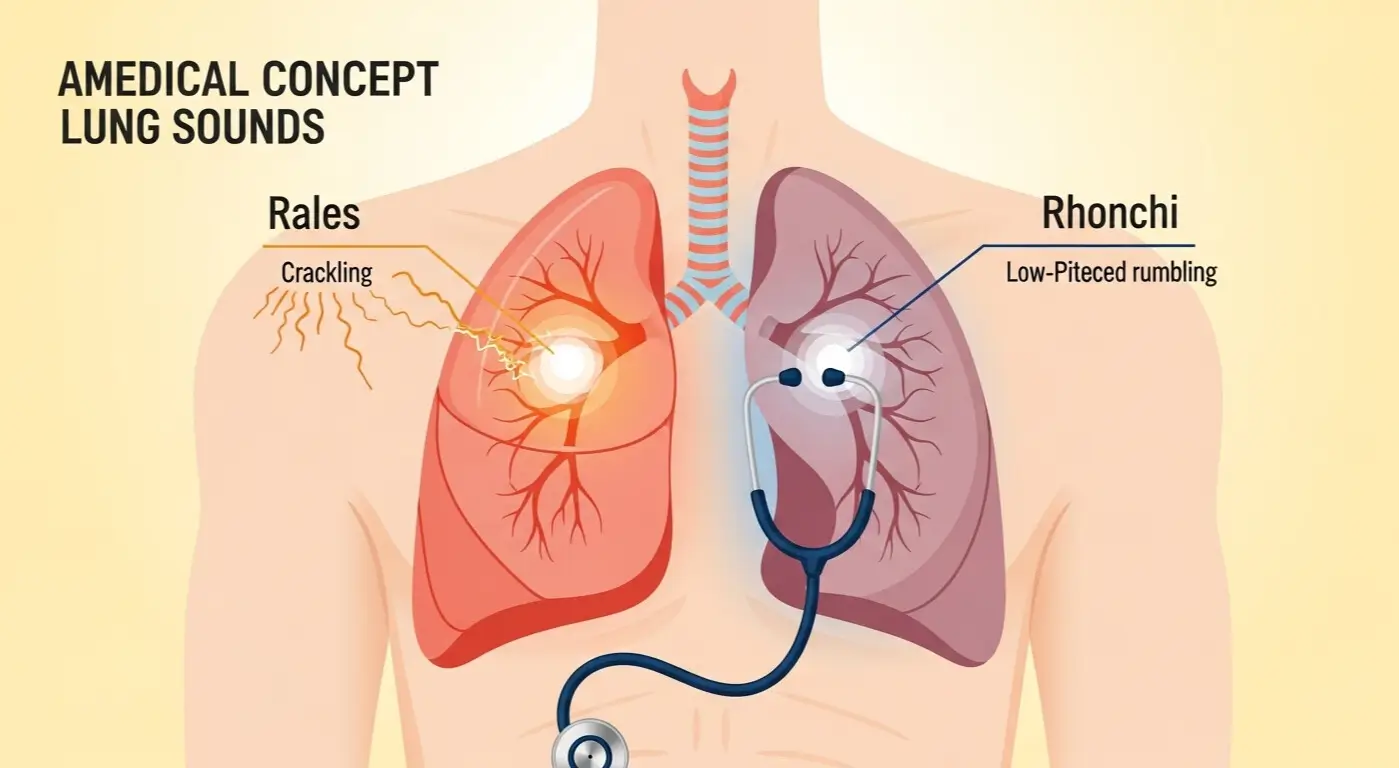
Imagine walking into a hospital room and hearing strange sounds as a patient breathes. Some doctors hear gentle crackles, while others detect deeper, rumbling tones. These sounds are medically known as rales and rhonchi, two common lung sounds that are often confused. Understanding the difference between rales and rhonchi is crucial not only for healthcare professionals but also for students, caregivers, and anyone interested in medical knowledge.
Rales (pronounced /reɪlz/ in US, /reɪlz/ in UK) are high-pitched, crackling sounds, whereas rhonchi (pronounced /ˈrɒŋkaɪ/ in US, /ˈrɒŋki/ in UK) are low-pitched, snoring-like noises. Knowing these differences helps doctors make accurate diagnoses, and it empowers learners to identify lung conditions effectively.
This article explores the difference between rales and rhonchi, their characteristics, and why distinguishing between them is important. Let’s dive into the main differences and understand how they behave in real-world medical scenarios.
Difference Between Rales and Rhonchi
Here are 10 key differences between rales and rhonchi, with simple explanations and examples:
- Sound Type
- Rales: Crackling, popping sounds like bubbles popping in water.
- Example 1: A patient with pneumonia has crackling rales at the lung base.
- Example 2: Congestive heart failure may produce fine rales during inhalation.
- Rhonchi: Low-pitched, snoring or rumbling sounds.
- Example 1: A patient with chronic bronchitis exhibits rhonchi in the upper airways.
- Example 2: Bronchial obstruction can cause loud rhonchi during exhalation.
- Rales: Crackling, popping sounds like bubbles popping in water.
- Cause
- Rales: Caused by fluid in the alveoli or small airways.
- Rhonchi: Caused by obstruction or secretions in larger bronchi.
- Timing in Breathing Cycle
- Rales: Heard mostly during inhalation.
- Rhonchi: Heard mostly during exhalation.
- Pitch
- Rales: High-pitched, brief sounds.
- Rhonchi: Low-pitched, continuous sounds.
- Location
- Rales: Detected in lung bases or peripheral areas.
- Rhonchi: Detected in central or larger airway areas.
- Clearing with Cough
- Rales: Usually not cleared by coughing.
- Rhonchi: Often cleared or reduced after coughing.
- Nature
- Rales: Dry or moist crackles, can indicate serious conditions.
- Rhonchi: Snoring-like, usually indicates mucus or airway blockage.
- Common Conditions
- Rales: Pneumonia, heart failure, pulmonary edema.
- Rhonchi: Chronic bronchitis, COPD, airway obstruction.
- Clinical Significance
- Rales: Suggest alveolar involvement and fluid accumulation.
- Rhonchi: Suggest airway obstruction and secretion buildup.
- Behavior Over Time
- Rales: Can appear suddenly and may be intermittent.
- Rhonchi: Often persistent and changes after coughing.
Nature and Behavior of Both
- Rales: Sharp, discontinuous, short-lived; often indicative of fluid in small airways.
- Rhonchi: Continuous, low-pitched, may shift location after cough; often due to mucus in large airways.
Why People Are Confused
Many confuse these sounds because both indicate respiratory problems and are abnormal lung sounds. Moreover, their audible patterns may overlap, especially in mixed respiratory conditions.
Table: Difference and Similarity Between Rales and Rhonchi
| Feature | Rales | Rhonchi | Similarity |
| Sound | High-pitched crackling | Low-pitched rumbling | Both abnormal lung sounds |
| Cause | Fluid in alveoli | Obstruction in bronchi | Indicate respiratory issues |
| Timing | Inhalation | Exhalation | Can suggest lung disease |
| Cough Response | Not cleared | Often cleared | Detected via stethoscope |
| Location | Lung bases | Large airways | Important for diagnosis |
Which Is Better in What Situation?
- Rales: Useful for detecting fluid in the lungs early, like in pneumonia or heart failure. They alert doctors to intervene promptly.
- Rhonchi: Helpful in identifying airway obstruction or mucus buildup, guiding treatments like physiotherapy, bronchodilators, or suctioning.
Metaphors and Similes
- Rales: “Like the soft crunch of fresh snow underfoot” (positive-neutral).
- Rhonchi: “Like a low, rumbling thunder in the chest” (neutral-negative).
Connotative Meaning
- Rales: Neutral, but indicates potential health issues.
- Rhonchi: Slightly negative, suggesting obstruction or chronic conditions.
Idioms or Proverbs
- “Every cloud has a silver lining” Rales in heart failure can indicate early detection and treatment.
- “Still waters run deep” Rhonchi may signal underlying chronic conditions.
Works in Literature
- “The House of God” (Novel, Samuel Shem, 1978) mentions rales in medical training.
- “Breathless” (Novel, Dean Koontz, 2000) references rhonchi in suspenseful medical scenes.
Movies Related to Keywords
- “Something the Lord Made” (2004, USA) depicts medical students learning rales.
- “Contagion” (2011, USA) shows patients with rhonchi in respiratory disease outbreaks.
Frequently Asked Questions
- Can rales and rhonchi occur together?
- Yes, in mixed lung conditions like pneumonia with chronic bronchitis.
- Are rales dangerous?
- They indicate fluid; underlying cause determines severity.
- Can rhonchi be cured?
- Treating the obstruction or infection often clears rhonchi.
- Which is easier to hear?
- Rhonchi, due to low-pitched continuous sound.
- Do both need treatment?
- Yes, but treatment targets the cause, not the sound itself.
How Both Are Useful for Surroundings
Rales and rhonchi alert caregivers and medical staff to changes in a patient’s respiratory condition, promoting timely interventions and reducing community health risks.
Final Words
Recognizing the difference between rales and rhonchi empowers learners, doctors, and caregivers alike. Each provides unique diagnostic clues, essential for patient care and respiratory health awareness.
Conclusion
Distinguishing between rales and rhonchi is not just academic it is practical and lifesaving. Rales signal fluid in the lungs, while rhonchi highlight obstructions. Proper identification guides effective treatment, early intervention, and better health outcomes.
For learners, mastering these differences strengthens clinical skills, while experts rely on them for accurate diagnoses.
In society, awareness of lung sounds enhances caregiving and promotes respiratory health. Understanding these subtle yet critical differences ensures that medical professionals can respond appropriately to varied pulmonary conditions.

Dr. Marcus Reed is a lead editorial author at WordCompares.com and a specialist in communication studies and written clarity. With more than 12 years of university-level teaching experience, he focuses on explaining word distinctions in a clear and structured manner. His work ensures that WordCompares.com maintains accuracy, depth, and reader trust.