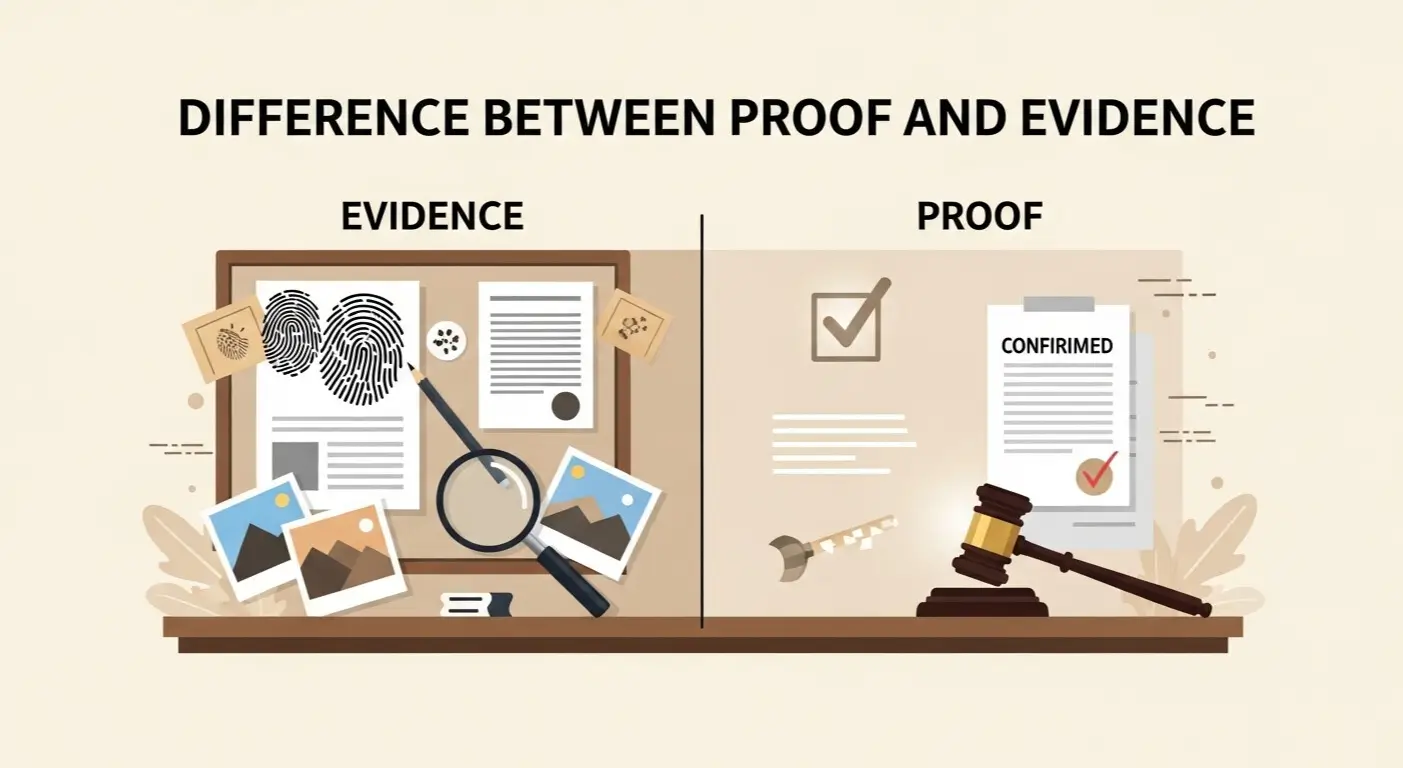
Imagine a courtroom where a detective presents fingerprints found at a crime scene. While these fingerprints are strong indicators, they are just one part of the puzzle. To truly understand the situation, one must recognize the difference between proof and evidence. While evidence suggests a possibility, proof provides the ultimate confirmation.
In everyday life, we often see situations where these two terms are confused. However, understanding the difference between proof and evidence helps us think more clearly, evaluate facts accurately, and make better decisions. If you are discussing legal matters, scientific facts, or simple arguments, the difference between proof and evidence lies in the level of certainty they provide: evidence supports a claim, but proof confirms it completely.
Key Difference Between the Both
The main difference between proof and evidence is certainty. Evidence is information that supports or suggests a claim, while proof is the final confirmation that shows something is unquestionably true.
Why Is Their Difference Necessary to Know for Learners and Experts?
Understanding the difference between proof and evidence is important in education, law, science, and everyday reasoning. Learners need to know how to collect evidence before reaching a conclusion. Experts such as lawyers, scientists, and journalists rely on evidence to support their arguments, but they must reach proof before declaring something true.
In society, this distinction prevents misinformation and improves critical thinking. For example, in scientific research, evidence may suggest a theory, but proof requires repeated testing and verification. Similarly, in legal systems, evidence is presented during trials, but proof must be strong enough to convince a judge or jury. Therefore, recognizing the difference helps people evaluate information responsibly.
Pronunciation
| Word | US Pronunciation | UK Pronunciation |
| Proof | /pruːf/ | /pruːf/ |
| Evidence | /ˈevɪdəns/ | /ˈevɪdəns/ |
Linking Hook
Now that we understand the general idea, let us explore the difference between proof and evidence in detail through practical comparisons and examples.
Difference Between Proof and Evidence
1. Level of Certainty
Proof shows absolute certainty, while evidence only suggests a possibility.
Examples of proof:
- A mathematical calculation proving that 2 + 2 = 4.
- DNA testing confirming a person’s identity.
Examples of evidence:
- Witness statements in a trial.
- Footprints found at a crime scene.
2. Role in Argument
Proof ends an argument, while evidence supports an argument.
Examples of proof:
- A solved equation proving a mathematical theorem.
- A verified video showing exactly what happened.
Examples of evidence:
- Photos used to support a news story.
- Documents suggesting financial fraud.
3. Strength of Information
Proof is stronger and conclusive, while evidence can be weak or strong.
Examples of proof:
- A signed legal document confirming ownership.
- A laboratory test confirming a disease.
Examples of evidence:
- Suspicious bank transactions.
- Messages hinting at a plan.
4. Use in Law
Evidence is presented in court, while proof must convince the judge or jury.
Examples of proof:
- A confession supported by verified facts.
- DNA confirming a suspect.
Examples of evidence:
- Security camera footage.
- Witness testimonies.
5. Use in Science
Evidence supports scientific theories, while proof comes after repeated verification.
Examples of proof:
- A law of physics confirmed through repeated experiments.
- Mathematical proof in scientific formulas.
Examples of evidence:
- Data collected from experiments.
- Observations recorded by scientists.
6. Possibility of Doubt
Proof removes doubt, while evidence may still allow doubt.
Examples of proof:
- Satellite data confirming a planet’s position.
- Verified identity through biometric data.
Examples of evidence:
- Social media posts suggesting an event happened.
- News reports about a developing story.
7. Quantity vs Quality
Evidence often comes in large amounts, while proof may be a single decisive fact.
Examples of proof:
- A decisive lab report.
- A verified legal certificate.
Examples of evidence:
- Multiple testimonies.
- Several documents supporting a claim.
8. Logical Role
Proof is a logical conclusion, while evidence is the reasoning path.
Examples of proof:
- A solved logic puzzle.
- A final conclusion in a mathematical argument.
Examples of evidence:
- Clues in a mystery story.
- Facts used in research papers.
9. Time of Use
Evidence is gathered first, proof comes later.
Examples of proof:
- Final research results confirming a theory.
- Official verification of a claim.
Examples of evidence:
- Early experiment results.
- Initial reports about an incident.
10. Interpretation
Evidence requires interpretation, while proof usually does not.
Examples of proof:
- A confirmed scientific formula.
- A verified identity document.
Examples of evidence:
- Survey results needing analysis.
- Clues in an investigation.
Nature and Behaviour of Both
Nature of Proof
Proof is definite, conclusive, and final. It establishes truth beyond doubt and usually ends debates or questions.
Nature of Evidence
Evidence is supportive and suggestive. It builds the path toward truth but may require interpretation or additional verification.
Why Are People Confused About Their Use?
People often confuse these words because evidence sometimes becomes strong enough to feel like proof. In everyday conversation, people use them interchangeably. Additionally, in media or informal discussions, the distinction is rarely explained clearly.
Difference and Similarity Table
| Aspect | Proof | Evidence | Similarity |
| Meaning | Final confirmation | Supporting information | Both relate to truth |
| Certainty | Absolute | Partial | Used in arguments |
| Role | Ends debate | Supports claim | Used in research |
| Interpretation | Usually none | Often required | Both require reasoning |
| Usage | Math, law, science | Law, science, investigation | Help in decision-making |
Which Is Better in What Situation?
Proof
Proof is better when a final decision is required. In mathematics, law, or scientific conclusions, proof eliminates uncertainty. For example, in court cases or scientific theories, proof provides the strongest confirmation of truth. Without proof, conclusions may remain questionable.
Evidence
Evidence is better during investigation or research stages. It helps people explore possibilities and support claims before reaching a final conclusion. Evidence is essential for collecting facts, testing ideas, and building arguments in fields like journalism, science, and law.
Use in Metaphors and Similes
Examples:
- “His success was proof that hard work pays off.”
- “The dark clouds were evidence that a storm was coming.”
- “Her smile was proof of her happiness.”
- “His silence was evidence of guilt.”
Connotative Meaning
Proof (Neutral to Positive)
Examples:
- “Winning the award was proof of her dedication.”
- “His achievements are proof of his talent.”
Evidence (Neutral)
Examples:
- “The broken glass was evidence of a break-in.”
- “The data provided evidence for the theory.”
Idioms and Proverbs
1. Proof is in the pudding
Meaning: Results show the real value.
Example: “The product seemed good, but the proof is in the pudding.”
2. Give proof of something
Example: “His actions gave proof of his honesty.”
3. Evidence speaks for itself
Example: “The investigation was clear; the evidence speaks for itself.”
Works in Literature
Proof
- Proof — Drama by David Auburn (2000)
Evidence
- Evidence — Poetry collection by Mary Oliver (2009)
Movies Related to the Keywords
Proof
- Proof (2005, USA)
Evidence
- Evidence (2013, USA)
Frequently Asked Questions
1. What is the main difference between proof and evidence?
Evidence supports a claim, while proof confirms it completely.
2. Can evidence become proof?
Yes, when evidence is strong and verified, it can lead to proof.
3. Which is stronger, proof or evidence?
Proof is stronger because it removes doubt.
4. Are proof and evidence used in science?
Yes, scientists collect evidence before establishing proof.
5. Why do people mix these words?
Because both relate to facts and truth in discussions.
How Both Are Useful for Surroundings
Proof and evidence help society make informed decisions. Evidence allows investigators, scientists, and researchers to explore facts, while proof ensures reliable conclusions. Together, they improve justice systems, scientific discoveries, and everyday reasoning.
Final Words for Both
Proof represents certainty and final truth, while evidence represents the journey toward that truth. Both are essential in understanding reality and making logical conclusions.
Conclusion
The difference between proof and evidence lies mainly in certainty and purpose. Evidence provides supporting facts that help us investigate and build arguments, while proof confirms a claim beyond doubt. Both play essential roles in law, science, education, and daily life.
Understanding their distinction helps people analyze information more carefully and avoid false conclusions. Evidence encourages exploration and learning, while proof establishes truth and clarity. Together, they create a balanced process for discovering facts and making reliable decisions in society.

Alexandra “Alex” Monroe is a senior linguistics contributor at WordCompares.com, where she specializes in comparative word analysis, semantics, and language clarity. With over 15 years of academic and editorial experience, Alex helps readers understand subtle differences between commonly confused words and phrases. Her research-driven yet practical writing style strengthens the educational authority of WordCompares.com.