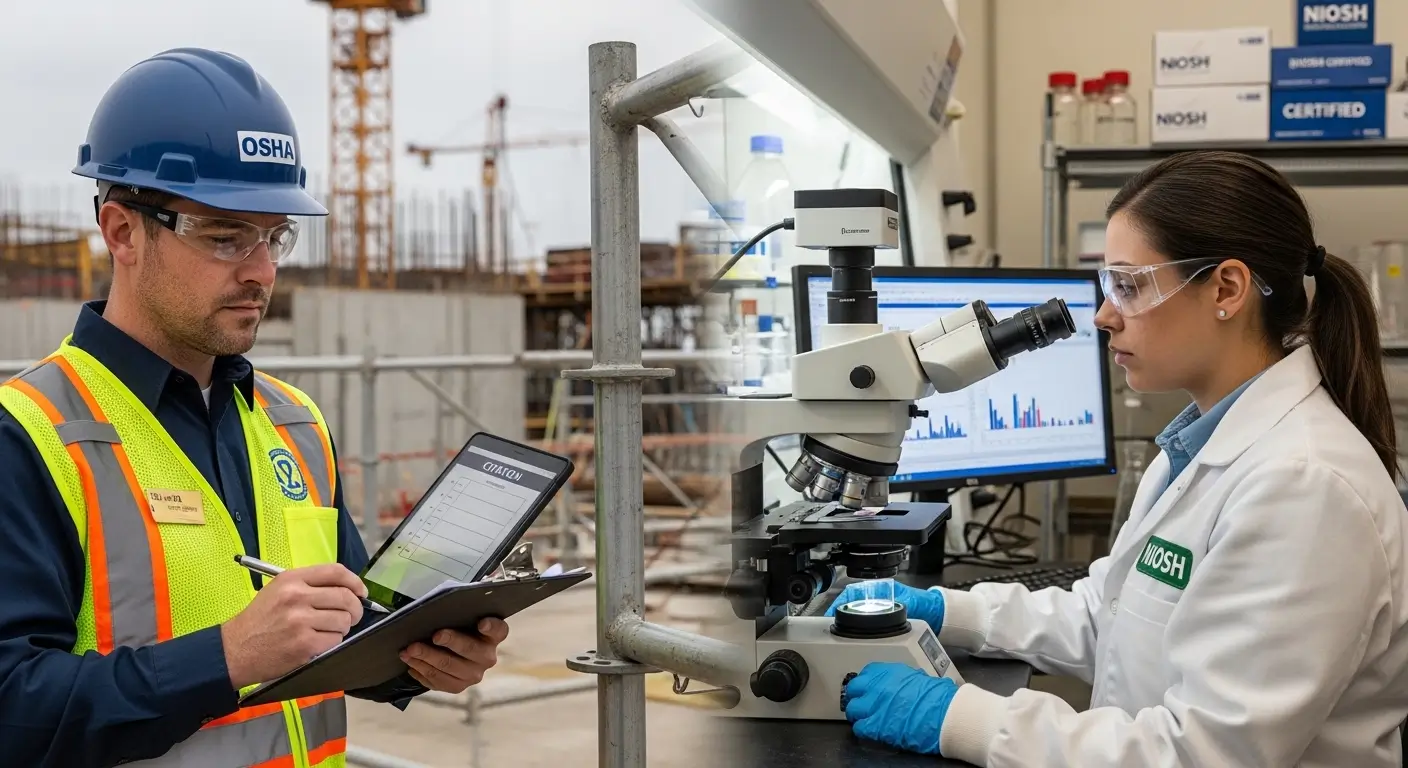
Imagine a bustling construction site in downtown Chicago. A foreman notices a new type of chemical sealant being used that emits a strange, pungent odor. He immediately looks for two things. First, he checks the difference between OSHA and NIOSH to see which agency sets the legal limit for exposure so he doesn’t get fined. Second, he wonders if anyone has actually researched the long-term effects of that smell on the human lungs.
In this real-world scenario, the foreman is navigating a complex web of safety. He relies on one agency to enforce the rules and another to provide the scientific data that created those rules in the first place. Understanding the difference between OSHA and NIOSH is often the line between a workplace that just “follows the law” and one that truly protects its people. While they are often mentioned in the same breath, the difference between OSHA and NIOSH is a matter of power versus knowledge one has the badge, and the other has the microscope.
Pronunciation Guide
- OSHA: * US: /ˈoʊʃə/ (OH-shuh)
- UK: /ˈəʊʃə/ (OH-shuh)
- NIOSH: * US: /ˈnaɪɒʃ/ (NYE-osh)
- UK: /ˈnaɪɒʃ/ (NYE-osh)
Hook: While they both live under the umbrella of workplace protection, confusing a legal inspector with a research scientist can lead to major compliance headaches. Let’s dive into the specifics.
Key Difference Between OSHA and NIOSH
The fundamental difference between OSHA and NIOSH lies in their “teeth.” OSHA (Occupational Safety and Health Administration) is a regulatory agency under the Department of Labor. It writes the laws and issues fines. NIOSH (National Institute for Occupational Safety and Health) is a research agency under the CDC. It explores how injuries happen and recommends ways to prevent them but has no legal authority to punish anyone.
Why This Difference is Vital for Experts and Society
For safety professionals and learners, knowing this distinction is a matter of professional survival. Society benefits because this “division of labor” prevents a conflict of interest; scientists (NIOSH) can focus on pure data without worrying about the political or economic cost of enforcement, while regulators (OSHA) can focus on the logistics of keeping millions of job sites across the country uniform and safe.
10 Points of Difference Between OSHA and NIOSH
| # | Point of Difference | OSHA | NIOSH |
| 1 | Department | Part of the Department of Labor. | Part of the Dept. of Health & Human Services (CDC). |
| 2 | Core Mission | To enforce workplace safety laws. | To conduct research and provide training. |
| 3 | Authority | Can issue citations and legal fines. | Cannot issue fines or legal penalties. |
| 4 | Standard Setting | Creates Permissible Exposure Limits (PELs). | Suggests Recommended Exposure Limits (RELs). |
| 5 | Inspections | Conducts surprise legal inspections. | Conducts Health Hazard Evaluations (HHEs) upon request. |
| 6 | Training Focus | Focuses on worker rights and compliance. | Focuses on professional education and science. |
| 7 | Funding | Focused on administration and enforcement. | Focused on laboratory research and grants. |
| 8 | Equipment | Does not “approve” equipment, but mandates use. | Tests and certifies respirators and PPE. |
| 9 | Legal Power | Derived from the OSH Act of 1970. | Derived from research mandates in the same Act. |
| 10 | Public Image | The “Police officer” of the job site. | The “Scientist” or “Professor” of the job site. |
Nature and Behavior
- OSHA’s Behavior: Reactive and Strict. OSHA often responds to complaints or accidents to ensure the law was followed. It behaves like an auditor.
- NIOSH’s Behavior: Proactive and Analytical. NIOSH looks at emerging trends (like 3D printing fumes) to see what might be a problem in ten years.
Why the Confusion?
Most people are confused because both were created by the same 1970 Act of Congress. Since their names sound similar and they both deal with “Occupational Safety,” the average worker assumes they are two branches of the same office.
Comparison Table: Similarities and Differences
| Feature | OSHA | NIOSH |
| Goal | Safe Workplaces | Safe Workplaces |
| Origin | OSH Act (1970) | OSH Act (1970) |
| Can Fine You? | Yes | No |
| Do Research? | No (Limited) | Yes (Primary) |
| Approve Masks? | No | Yes |
Which is Better in What Situation?
When you are facing a workplace hazard immediately: OSHA is better. You need the legal weight of the government to force an employer to provide safety harnesses or fix a broken railing. OSHA provides the immediate protection of the law.
When you are trying to understand a new health risk: NIOSH is better. If your team is getting headaches from a new type of LED light or chemical, NIOSH scientists can come in, study the air and environment, and give you a scientific report without the fear of anyone going to jail.
Figurative Language and Connotations
Metaphors and Similes
- Metaphor: OSHA is the shield; NIOSH is the blueprint for the shield.
- Simile: OSHA is like a traffic cop checking your speed; NIOSH is like the engineer who decided what speed is safe for that curve.
Connotative Meanings
- OSHA (Neutral to Negative): Often carries a “bureaucratic” or “punitive” connotation.
- Example: “We have to be careful, OSHA is coming today.” (Implies fear of trouble).
- NIOSH (Positive): Carries a connotation of “expertise” and “help.”
- Example: “This mask is NIOSH-certified.” (Implies high quality and trust).
Idioms, Literature, and Media
Related Idioms
- “By the book” (Following OSHA regulations strictly).
- Example: “If we don’t do this by the book, OSHA will shut us down.”
- “Back to the drawing board” (What happens when NIOSH research proves a method unsafe).
- Example: “NIOSH found the chemicals are toxic, so it’s back to the drawing board for our lab.”
Works in Literature
- Title: The Job Safety Survival Guide (Non-fiction) | Author: Various | Year: Ongoing updates (References OSHA/NIOSH standards).
- Title: The OSH Act of 1970 (Legal Text) | Writer: U.S. Congress | Year: 1970.
Movies/Documentaries
- A Civil Action (1998, USA) – Touches on workplace health and chemical exposure.
- Silkwood (1983, USA) – Highlights the need for the safety standards these agencies provide.
Frequently Asked Questions (FAQ)
- Can NIOSH shut down my business? No, NIOSH has no enforcement power.
- Does OSHA test N95 masks? No, NIOSH is the agency that tests and certifies respirators.
- Who should I call for a safety complaint? You should contact OSHA.
- Is NIOSH part of OSHA? No, they are separate agencies in different departments.
- Which standards are stricter? NIOSH’s recommended limits (RELs) are often stricter than OSHA’s legal limits (PELs) because they focus on health over cost.
Final Words and Conclusion
Understanding the difference between OSHA and NIOSH is about recognizing the two pillars of modern industry: Law and Science. OSHA ensures that the minimum safety requirements are met through enforcement, while NIOSH ensures we are constantly learning how to make the workplace even healthier through deep-dive research.
By utilizing OSHA for compliance and NIOSH for guidance, companies create a “surround-sound” safety culture that protects both the company’s bottom line and the worker’s life. Whether you are a business owner or an entry level employee, knowing who to turn to for rules versus research is the first step toward a safer career.

Dr. Marcus Reed is a lead editorial author at WordCompares.com and a specialist in communication studies and written clarity. With more than 12 years of university-level teaching experience, he focuses on explaining word distinctions in a clear and structured manner. His work ensures that WordCompares.com maintains accuracy, depth, and reader trust.