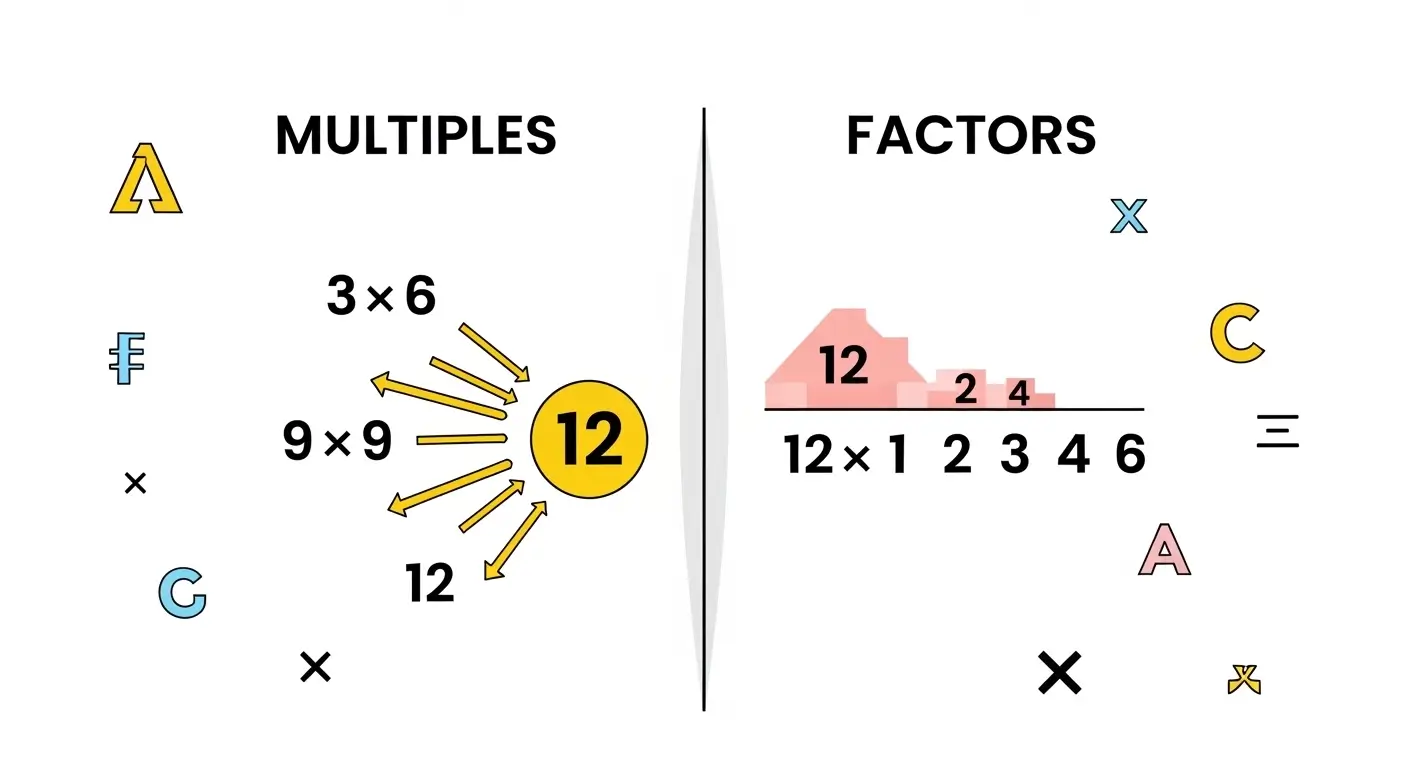
Imagine a teacher writing the number 12 on a classroom board and asking students to explore it. Some students begin multiplying the number with other integers such as 12 × 2, 12 × 3, and 12 × 4. Others start dividing the same number to see which values fit into it evenly, like 2, 3, 4, and 6. Surprisingly, both groups are studying the same number but from completely different directions. This simple classroom moment clearly illustrates the difference between multiples and factors.
Understanding the difference between multiples and factors is one of the first steps in learning mathematics correctly. Students often mix these concepts because both involve multiplication and number relationships. However, the difference between multiples and factors becomes easier to understand when we see how numbers either grow through multiplication or break into smaller parts through division.
In everyday mathematics learning, teachers frequently explain the difference between multiples and factors so students can solve problems more efficiently and understand how numbers relate to one another.
Pronunciation
Multiples
US: MUL-tuh-puhlz /ˈmʌl.tə.pəlz/
UK: MUL-tuh-puhlz /ˈmʌl.tɪ.pəlz/
Factors
US: FAK-terz /ˈfæk.tɚz/
UK: FAK-tuhz /ˈfæk.təz/
Key Difference Between the Two
The main difference between multiples and factors lies in their direction and purpose.
- Multiples are numbers produced when a number is multiplied by different integers.
- Factors are numbers that divide another number exactly without leaving a remainder.
In simple terms, the first concept expands numbers outward through multiplication, while the second breaks numbers inward into smaller parts.
Why Their Difference Is Important for Learners and Experts
Knowing the difference between multiples and factors is essential for students, teachers, engineers, and scientists. In mathematics education, factors help learners simplify fractions, determine the greatest common divisor, and understand divisibility rules. Numbers produced through repeated multiplication help solve problems related to sequences, patterns, and least common multiples.
In society, these concepts appear in many real-life activities. For example, scheduling repeating events, grouping objects equally, planning measurements in construction, and designing computer algorithms all depend on understanding number relationships. Without knowledge of these concepts, solving many practical problems would be much harder. Therefore, recognizing their difference strengthens logical thinking and mathematical accuracy.
A Linking Hook to the Main Discussion
Now that we understand the basic idea, let us explore the difference between multiples and factors in greater detail with clear explanations and practical examples.
Difference Between Multiples and Factors
1. Definition
Multiples
These are numbers obtained when a number is multiplied by different integers.
Examples
Multiples of 4 → 4, 8, 12, 16
Multiples of 7 → 7, 14, 21, 28
Factors
Factors are numbers that divide another number exactly.
Examples
Factors of 12 → 1, 2, 3, 4, 6, 12
Factors of 18 → 1, 2, 3, 6, 9, 18
2. Direction of Calculation
Multiples
This concept moves forward through multiplication, creating a sequence of growing numbers.
Examples
5 × 1 = 5
5 × 2 = 10
Factors
This concept works backward through division, identifying numbers that divide evenly.
Examples
10 ÷ 2 = 5
10 ÷ 5 = 2
3. Quantity
Multiples
Numbers produced through multiplication are infinite because the process can continue forever.
Examples
3, 6, 9, 12…
10, 20, 30, 40…
Factors
Factors are limited because only certain numbers divide evenly.
Examples
Factors of 10 → 1, 2, 5, 10
Factors of 15 → 1, 3, 5, 15
4. Size Compared to the Original Number
Multiples
These numbers are usually equal to or greater than the original number.
Examples
6 → 6, 12, 18
9 → 9, 18, 27
Factors
These numbers are equal to or smaller than the original number.
Examples
Factors of 16 → 1, 2, 4, 8, 16
Factors of 20 → 1, 2, 4, 5, 10, 20
5. Mathematical Operation Used
Multiples
Generated using multiplication.
Examples
8 × 2 = 16
8 × 3 = 24
Factors
Identified using division.
Examples
16 ÷ 8 = 2
24 ÷ 8 = 3
6. Role in Mathematical Problems
Multiples
Useful for identifying repeating sequences and finding the least common multiple.
Examples
LCM of 4 and 6
Repeating events every 5 days
Factors
Useful for simplifying numbers and determining the greatest common factor.
Examples
Reducing fractions
Finding the GCF
7. Representation
Multiples
Examples
2, 4, 6, 8 (from 2)
3, 6, 9, 12 (from 3)
Factors
Examples
Factors of 8 → 1, 2, 4, 8
Factors of 9 → 1, 3, 9
8. Relationship With the Original Number
Multiples
Examples
20 is obtained by multiplying 5
24 is obtained by multiplying 6
Factors
Examples
5 divides 20 exactly
6 divides 24 exactly
9. Use in Patterns
Multiples
Examples
Counting by 3 → 3, 6, 9
Counting by 4 → 4, 8, 12
Factors
Examples
Factor pairs of 24 → (1,24), (2,12), (3,8), (4,6)
Factor pairs of 30 → (1,30), (2,15), (3,10), (5,6)
10. Learning Stage
Multiples
Introduced in multiplication tables and number sequences.
Examples
Learning the table of 5
Learning counting patterns
Factors
Introduced in division, fractions, and algebra.
Examples
Simplifying fractions
Solving equations
Nature and Behaviour
Multiples
Numbers generated through multiplication grow larger as the sequence continues, forming endless patterns.
Factors
Factors remain limited because they depend on how many numbers divide the original value exactly.
Why People Are Confused About Their Use
People often confuse these concepts because both involve multiplication and number relationships. Another reason is that the same numbers appear in both ideas but in reversed roles. For example, 12 can be obtained from 3 through multiplication, while 3 divides 12 exactly. This reversed relationship often leads to confusion for beginners.
Table Showing Difference and Similarity
| Aspect | Multiples | Factors | Similarity |
| Definition | Result of multiplication | Numbers dividing exactly | Both involve multiplication |
| Quantity | Infinite | Limited | Both relate to one number |
| Operation | Multiplication | Division | Both are arithmetic concepts |
| Size | Equal or larger | Equal or smaller | Both include the original number |
| Purpose | Patterns and sequences | Divisibility | Both explain number relationships |
Which Is Better in What Situation?
Multiples
Numbers produced through multiplication are useful when studying repeating patterns, sequences, and schedules. For example, if buses arrive every 15 minutes, the arrival times follow a repeating numerical pattern based on multiplication. This concept is also important when finding the least common multiple, which helps solve problems involving fractions, ratios, and time intervals.
Factors
Factors are more useful when simplifying numbers or analyzing their structure. They help students reduce fractions, identify common divisors, and break large numbers into smaller components. In mathematics, engineering, and computer science, factors are essential for solving equations and understanding how numbers are constructed.
Use in Metaphors and Similes
Even though these are mathematical terms, they can sometimes appear metaphorically.
Multiples Example
“Success creates multiples of opportunity.”
Factors Example
“Hard work is a major factor in achievement.”
Connotative Meaning
Multiples
Positive meaning — growth or expansion
Example: “His creative ideas produced multiples of innovation.”
Factors
Neutral meaning — influence or cause
Example: “Weather is a factor in crop production.”
Idioms or Proverbs Related to the Words
There are no direct idioms using these mathematical terms, but similar expressions exist.
Examples
“Many factors contribute to success.”
“Small efforts can create multiples of results.”
Works in Literature Using the Keywords
- Elementary Number Theory — Mathematics textbook
- Basic Mathematics — Serge Lang (1971)
Movies Based on the Keywords
No major movies have been produced with these mathematical terms as titles.
Frequently Asked Questions
What is the main difference between multiples and factors?
Multiples are produced through multiplication, while factors divide a number exactly.
Are multiples infinite?
Yes, the sequence can continue indefinitely.
Are factors always smaller than the number?
Yes, except for the number itself.
Can a number be both?
Yes. For example, 6 comes from multiplying 3, while 3 divides 6.
Why are these concepts important?
They help in fractions, divisibility rules, number patterns, and algebra.
How Both Are Useful in Our Surroundings
Numbers produced through multiplication help us understand repeating patterns, time schedules, and sequences. Factors help divide objects into equal groups, simplify calculations, and analyze numerical structures in science and technology.
Final Words
Both concepts are fundamental building blocks of mathematics. Together they explain how numbers expand through multiplication and how they break into smaller parts through division.
Conclusion
Understanding the difference between multiples and factors helps learners build a strong mathematical foundation. One concept shows how numbers grow through multiplication, while the other explains how numbers can be divided evenly. Although both ideas involve the same numbers, their direction and purpose are completely different.
Students who clearly understand this distinction can solve mathematical problems more easily, simplify fractions, and recognize patterns in numbers. In everyday life, these ideas appear in scheduling, grouping objects, and performing calculations. Therefore, mastering these concepts improves logical thinking and strengthens mathematical skills.

Dr. Marcus Reed is a lead editorial author at WordCompares.com and a specialist in communication studies and written clarity. With more than 12 years of university-level teaching experience, he focuses on explaining word distinctions in a clear and structured manner. His work ensures that WordCompares.com maintains accuracy, depth, and reader trust.