A few years ago, a tourist boat guide in Florida pointed toward a large, slow-moving shape beneath the water and said, “That’s a manatee.” Months later, a traveler in Australia saw a similar creature and called it the same only to be corrected: “That’s a dugong.” This real-world confusion shows how easily people mix up these gentle marine mammals.
The difference between manatee and dugong is subtle but important for scientists, conservationists, and nature lovers. While both belong to the same order, they differ in appearance, habitat, and behavior. Understanding the difference between manatee and dugong helps protect their ecosystems and avoid misinformation. In fact, learning the difference between manatee and dugong also highlights the incredible diversity of marine life and why each species matters in its own unique way.
Key Difference Between the Both
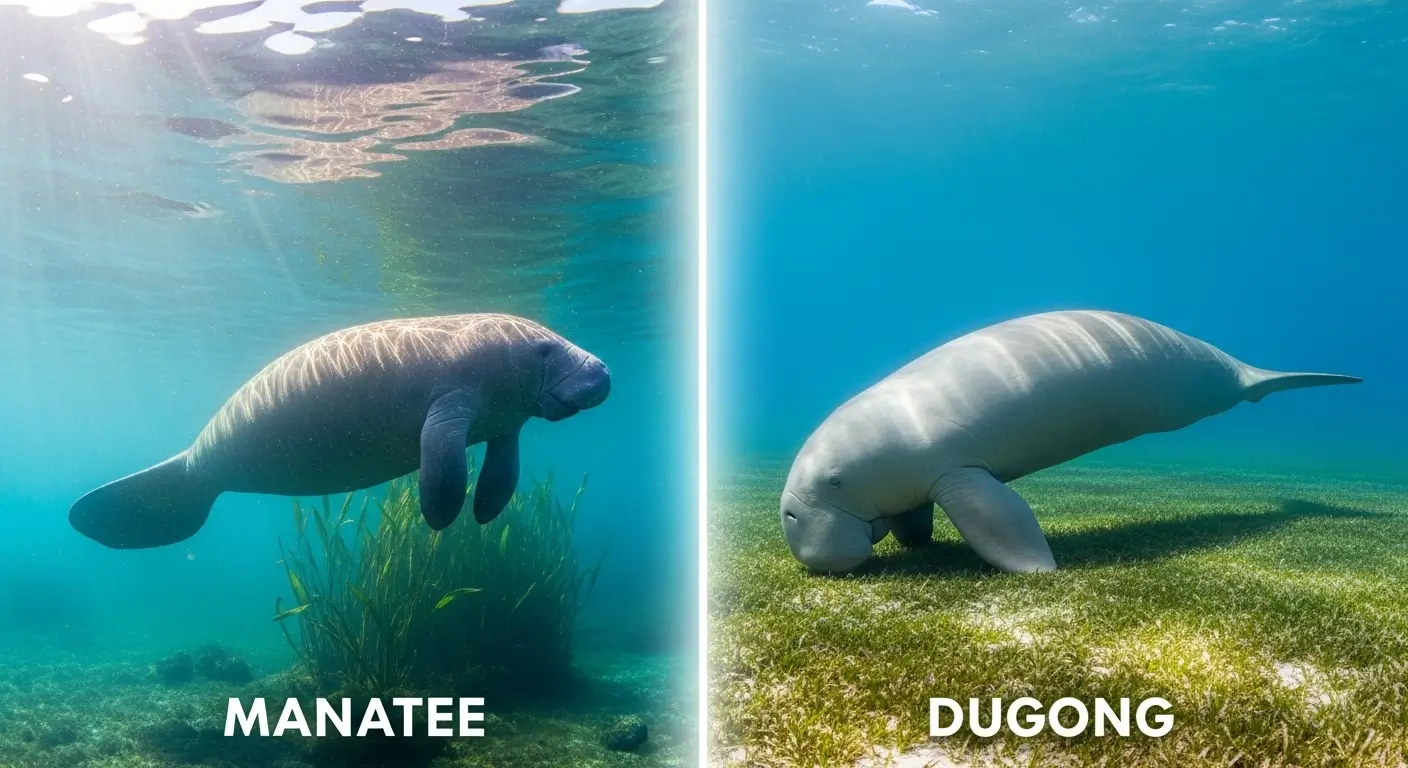
The main difference lies in their physical structure and geographic distribution. Manatees have paddle-shaped tails and live in both freshwater and saltwater environments, while dugongs have fluked tails like dolphins and are found only in marine habitats.
Why Is Their Difference Necessary to Know for Learners and Experts?
Understanding the distinction between these species is crucial in fields such as marine biology, conservation policy, and ecological research. Experts studying sea grass ecosystems need to identify which species is grazing because each affects the environment differently.
For learners, recognizing the difference prevents the spread of misinformation and builds awareness of endangered species. Both animals are indicators of ocean health, so distinguishing between them helps society develop better conservation strategies and educational programs.
Pronunciation
- Manatee
- US: /ˈmæn.ə.ti/
- UK: /ˈmæn.ə.ti/
- Dugong
- US: /ˈduː.ɡɒŋ/
- UK: /ˈdjuː.ɡɒŋ/
Linking Hook
Although they share similarities in appearance and lifestyle, a closer examination reveals striking differences in their anatomy, habitats, and ecological roles let’s explore them in detail.
Difference Between Manatee and Dugong
1. Tail Shape
Manatees have rounded paddle-like tails, whereas dugongs have forked tails resembling dolphins.
Examples:
- The West Indian manatee uses its paddle tail to steer slowly through rivers.
- The Dugong propels itself faster using its fluked tail in ocean waters.
2. Habitat
Manatees live in freshwater rivers and coastal seas; dugongs live strictly in saltwater oceans.
Examples:
- Manatees are often spotted in the Amazon River.
- Dugongs are commonly found in the waters near Great Barrier Reef.
3. Geographic Distribution
Manatees inhabit the Americas and West Africa; dugongs live in the Indo-Pacific region.
Examples:
- The Amazonian manatee lives in South America.
- Dugongs are native to coastal waters of Australia and Southeast Asia.
4. Snout Shape
Manatees have shorter, broader snouts; dugongs have downturned snouts adapted for sea-grass grazing.
Examples:
- Manatees use their flexible snouts to grab floating plants.
- Dugongs dig into sea grass beds with their specialized snouts.
5. Body Size
Manatees are generally bulkier; dugongs are slightly more streamlined.
Examples:
- A manatee may weigh over 1,200 kg.
- Dugongs usually weigh less but appear sleeker in shape.
6. Teeth Replacement
Manatees continuously replace teeth; dugongs have limited tooth replacement.
Examples:
- Scientists observed tooth cycling in manatees similar to elephants.
- Dugongs have tusk-like incisors, especially in males.
7. Diet
Both eat plants, but dugongs rely almost entirely on sea grass, while manatees eat a wider variety of aquatic plants.
Examples:
- Manatees feed on water hyacinth and algae.
- Dugongs mainly graze on sea grass meadows.
8. Behavioral Patterns
Manatees are often solitary but may gather in warm waters; dugongs are more likely to form small herds.
Examples:
- Manatees gather around warm springs in winter.
- Dugongs travel in pairs or small groups during feeding.
9. Conservation Status
Both species are vulnerable, but dugongs face greater threats from habitat loss.
Examples:
- Boat strikes frequently injure manatees in Florida.
- Dugongs are threatened by coastal development and fishing nets.
10. Evolutionary Classification
Both belong to the order Sirenia, but are in different families.
Examples:
- Manatees belong to the family Trichechidae.
- Dugongs belong to Dugongidae.
Nature and Behaviour
Manatee
Manatees are gentle, slow-moving animals often called “sea cows.” They spend most of their time grazing and resting. They are curious and sometimes approach boats or humans.
Dugong
Dugongs are shy and cautious. They prefer deeper waters and avoid human interaction. Their grazing patterns create visible trails in sea grass beds.
Why People Are Confused About Their Use
Their similar body shapes, slow movements, and herbivorous diets make them appear nearly identical to untrained observers. Additionally, both are often referred to collectively as “sea cows,” which adds to the confusion.
Table: Difference and Similarity
| Feature | Manatee | Dugong | Similarity |
| Tail | Paddle-shaped | Forked | Both use tails for propulsion |
| Habitat | Fresh & saltwater | Saltwater only | Both live in warm waters |
| Diet | Aquatic plants | Sea grass | Both herbivores |
| Behavior | Curious | Shy | Slow-moving mammals |
| Conservation | Vulnerable | Vulnerable | Both protected species |
Which Is Better in What Situation?
Manatee
Manatees are better adapted to diverse environments, including rivers, estuaries, and coastal seas. Their ability to survive in freshwater allows them to travel inland and avoid some ocean predators. This makes them more resilient in fluctuating habitats.
Dugong
Dugongs are better suited for open marine ecosystems where sea grass is abundant. Their streamlined bodies and fluked tails allow them to swim efficiently across long ocean distances in search of food.
Metaphors and Similes
- “As gentle as a manatee” – used to describe calm and peaceful personalities.
- “Moving like a dugong through water” – suggests slow but steady progress.
Connotative Meaning
Manatee
- Positive: gentleness, calmness
Example: “He has a manatee-like calmness in stressful situations.”
Dugong
- Neutral: rarity and mystery
Example: “The remote island was as hidden as a dugong in deep waters.”
Idioms or Proverbs
There are no widely recognized idioms directly featuring manatees or dugongs, but creative expressions sometimes appear in environmental writing.
Example: “Protecting oceans is like protecting the manatee slow to show results but worth the patience.”
Works in Literature
- “The Sea Cow and the Mermaid” – Folklore, anonymous, 19th century
- “The Dugong’s Whisper” – Environmental fiction, Margaret Wild, 2003
Movies Featuring These Animals
- The Blue Planet – 2001, UK
- Oceans – 2009, France
Frequently Asked Questions
1. Are manatees and dugongs the same species?
No, they belong to the same order but different families.
2. Which animal is larger?
Manatees are generally larger and heavier.
3. Do both animals eat meat?
No, both are herbivores.
4. Where can you see dugongs in the wild?
Mostly in the Indo-Pacific region, especially near Australia.
5. Why are they called sea cows?
Because they graze on sea grass similarly to cows grazing on land.
How Both Are Useful for Surroundings
Both animals play a crucial role in maintaining healthy sea grass ecosystems. By grazing, they prevent overgrowth and help nutrients circulate in marine habitats, supporting fish and other marine species.
Final Words for Both
Manatees and dugongs represent the peaceful side of marine wildlife. Their slow movements and gentle nature remind humans of the delicate balance of ocean ecosystems and the need for conservation.
Conclusion
In summary, while manatees and dugongs may appear similar at first glance, their differences in tail shape, habitat, behavior, and distribution make them unique species with distinct ecological roles. Understanding the difference between manatee and dugong is essential not only for scientific accuracy but also for conservation awareness.
As human activities increasingly threaten marine ecosystems, recognizing and protecting these gentle herbivores becomes even more important. By learning about them, we contribute to preserving biodiversity and ensuring that future generations can witness these remarkable animals in their natural habitats.

Jordan L. Carter is a contributing language analyst at WordCompares.com, focusing on modern English usage, evolving vocabulary trends, and digital communication language. With over a decade of writing experience, Jordan provides insightful word comparisons that make complex language differences simple for everyday readers.