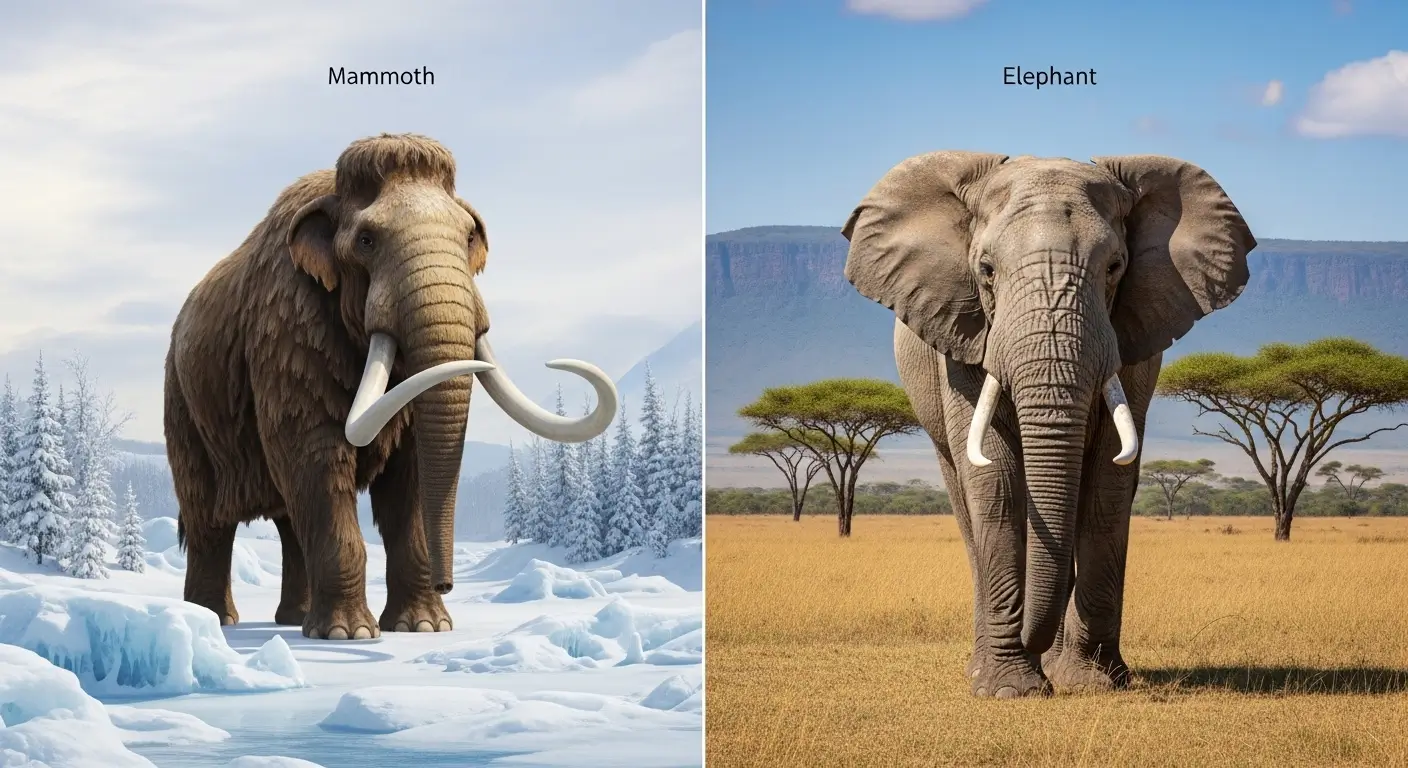
Imagine walking through a snowy prehistoric landscape and encountering a gigantic creature covered in long, shaggy hair. That was the mammoth, a majestic ancestor of the modern elephant. Many people today still confuse the mammoth and elephant due to their similar appearances and immense size. Understanding the difference between mammoth and elephant is crucial for students, researchers, and nature enthusiasts alike.
While elephants roam the forests and savannas of Africa and Asia today, mammoths became extinct thousands of years ago, leaving behind only fossils and frozen remains. Knowing the difference between mammoth and elephant helps us appreciate evolutionary biology, climate adaptation, and animal conservation. In this article, we explore pronunciation, behavior, and fascinating facts to fully grasp the distinction between these two iconic species.
Pronunciation:
- Mammoth – US: /ˈmæm.əθ/, UK: /ˈmæm.əθ/
- Elephant – US: /ˈɛl.ə.fənt/, UK: /ˈel.ɪ.fənt/
Let’s dive deeper to understand the main distinctions and significance of knowing the difference between mammoth and elephant.
Difference Between Mammoth and Elephant
1. Time Period
Mammoth: Lived during the Ice Age, around 4.8 million to 4,000 years ago.
Example 1: Woolly mammoths roamed Siberia.
Example 2: Fossilized mammoths found in Alaska reveal their Ice Age presence.
Elephant: Modern elephants are still alive today, mostly in Africa and Asia.
Example 1: African elephants inhabit savannas in Kenya.
Example 2: Asian elephants are found in Indian forests.
2. Physical Appearance
Mammoth: Covered in thick fur with long curved tusks.
Example 1: Woolly mammoths had long, twisted tusks used for digging through snow.
Example 2: Hair helped mammoths survive freezing climates.
Elephant: Sparse hair, larger ears (African) or smaller ears (Asian), straight tusks.
Example 1: African elephants use ears to regulate body heat.
Example 2: Asian elephants have straighter tusks compared to mammoths.
3. Size
Mammoth: 9–14 feet tall, weighing 6–8 tons.
Elephant: 7–13 feet tall, weighing 5–7 tons.
Example 1: Mammoth skeletons in museums highlight their massive size.
Example 2: African elephants can reach 13 feet at the shoulder.
4. Habitat
Mammoth: Cold regions and tundras.
Example 1: Siberian frozen plains were mammoth habitats.
Example 2: North American mammoths lived in icy steppes.
Elephant: Tropical forests, grasslands, and savannas.
Example 1: Asian elephants inhabit dense Indian forests.
Example 2: African elephants roam savannas in Botswana.
5. Diet
Mammoth: Mainly grasses, shrubs, and plants adapted to cold climates.
Example 1: Ice Age grass was a staple for woolly mammoths.
Example 2: Frozen plant remains in mammoth stomachs confirm their diet.
Elephant: Fruits, leaves, bark, and grasses.
Example 1: Elephants eat mangoes and bananas in the wild.
Example 2: They strip bark from trees to eat.
6. Tusks
Mammoth: Long, spiral-shaped tusks.
Example 1: Used to dig snow for food.
Example 2: Collected by humans for carvings.
Elephant: Straight or slightly curved tusks.
Example 1: African elephants’ tusks are valuable for ivory.
Example 2: Used for defense and digging water holes.
7. Lifespan
Mammoth: Lived 60–80 years.
Example 1: Some frozen mammoths preserved in ice show age around 60.
Example 2: Longevity similar to modern elephants.
Elephant: 60–70 years in the wild.
Example 1: Captive elephants sometimes exceed 70 years.
Example 2: African elephants in the wild average 60–65 years.
8. Extinction
Mammoth: Extinct about 4,000 years ago due to climate and hunting.
Example 1: Human hunting contributed to their extinction.
Example 2: Climate change reduced their cold habitat.
Elephant: Still living but endangered.
Example 1: Poaching for ivory threatens elephant populations.
Example 2: Conservation efforts in Africa aim to protect them.
9. Social Structure
Mammoth: Herd-based, similar to elephants.
Example 1: Fossil evidence shows mammoths moved in groups.
Example 2: Likely had family herds like modern elephants.
Elephant: Strong family bonds in herds led by a matriarch.
Example 1: African elephant herds led by older female elephants.
Example 2: Asian elephants show cooperative care for calves.
10. Evolutionary Relation
Mammoth: Ancestor to modern elephants.
Example 1: DNA studies show mammoths and elephants share a common ancestor.
Example 2: Woolly mammoth closely related to Asian elephants.
Elephant: Descendant species surviving today.
Example 1: Asian elephants are living relatives of mammoths.
Example 2: African elephants share a lineage with extinct mammoths.
Nature and Behaviour
- Mammoth: Adapted to cold climates, calm but wary of predators, migrated in herds.
- Elephant: Intelligent, social, communicates through vocalizations and body language, uses tools, and displays empathy.
Why People Are Confused
Both look similar and have tusks. People often assume any large prehistoric elephant is a mammoth or think modern elephants are unchanged since the Ice Age.
Mammoth vs Elephant: Table of Differences and Similarities
| Feature | Mammoth | Elephant | Similarity |
| Time Period | Ice Age | Present | Large mammals |
| Fur | Thick, long hair | Sparse | Herbivorous |
| Tusks | Long, spiral | Straight | Tusks present |
| Size | Slightly taller | Slightly shorter | Massive size |
| Habitat | Cold tundra | Tropical forests/savanna | Social herds |
| Diet | Grass, shrubs | Fruits, bark, grass | Herbivores |
| Status | Extinct | Endangered | Intelligent |
| Lifespan | 60–80 yrs | 60–70 yrs | Long-lived |
| Social structure | Herd-based | Herd-based | Family-oriented |
| Evolution | Ancestor | Descendant | Shared lineage |
Which Is Better in What Situation?
- Mammoth: Perfect for understanding Ice Age ecosystems, evolutionary biology, and adaptation to cold climates.
- Elephant: Vital for studying living social structures, conservation, and environmental impact. Elephants also enrich tourism and cultural symbolism.
Use in Metaphors and Similes
- Mammoth: “A mammoth task” – huge or difficult task.
- Elephant: “Elephant in the room” – an obvious issue no one addresses.
Connotative Meaning
- Mammoth: Positive (majestic), Neutral (large), e.g., “a mammoth discovery.”
- Elephant: Positive (wise, gentle), Negative (ignored problem), e.g., “an elephant of a mistake.”
Idioms or Proverbs
- “White elephant” – expensive but useless.
- “Memory of an elephant” – excellent memory.
- “Mammoth effort” – very big effort.
Works in Literature
- Mammoth – Jules Verne, Novel, 1869
- The Elephant’s Child – Rudyard Kipling, Children’s story, 1902
Movies
- Ice Age: The Mammoth Adventure – 2002, USA
- Elephant – 2003, USA
Frequently Asked Questions
- Are mammoths and elephants the same?
No, mammoths are extinct relatives of elephants. - Which came first, mammoths or elephants?
Mammoths appeared earlier; elephants are their descendants. - Can elephants survive in cold climates like mammoths?
No, elephants are adapted to tropical and subtropical environments. - Did mammoths have the same behavior as elephants?
Likely similar herd behavior but adapted to Ice Age conditions. - Why are elephants important today?
They maintain forests, grasslands, and biodiversity.
How Both Are Useful for Surroundings
- Mammoths shaped Ice Age ecosystems; their grazing influenced plant distribution.
- Elephants maintain forest and savanna health, disperse seeds, and create water holes used by other animals.
Final Words
Mammoths and elephants symbolize the marvels of nature. Understanding the difference between mammoth and elephant teaches us about extinction, evolution, and conservation. Their legacy enriches our knowledge and reminds us to protect living species.
Conclusion
The difference between mammoth and elephant is more than academic it bridges history, ecology, and culture. Mammoths represent prehistoric resilience in harsh climates, while elephants embody intelligence, social complexity, and conservation urgency today. Recognizing these differences informs scientific research, environmental protection, and cultural symbolism.
From size and tusks to habitat and social structure, each species tells a story of survival, adaptation, and importance. By studying both, learners and experts gain insight into the intricate balance of ecosystems, the consequences of climate change, and the value of protecting living giants.

Alexandra “Alex” Monroe is a senior linguistics contributor at WordCompares.com, where she specializes in comparative word analysis, semantics, and language clarity. With over 15 years of academic and editorial experience, Alex helps readers understand subtle differences between commonly confused words and phrases. Her research-driven yet practical writing style strengthens the educational authority of WordCompares.com.