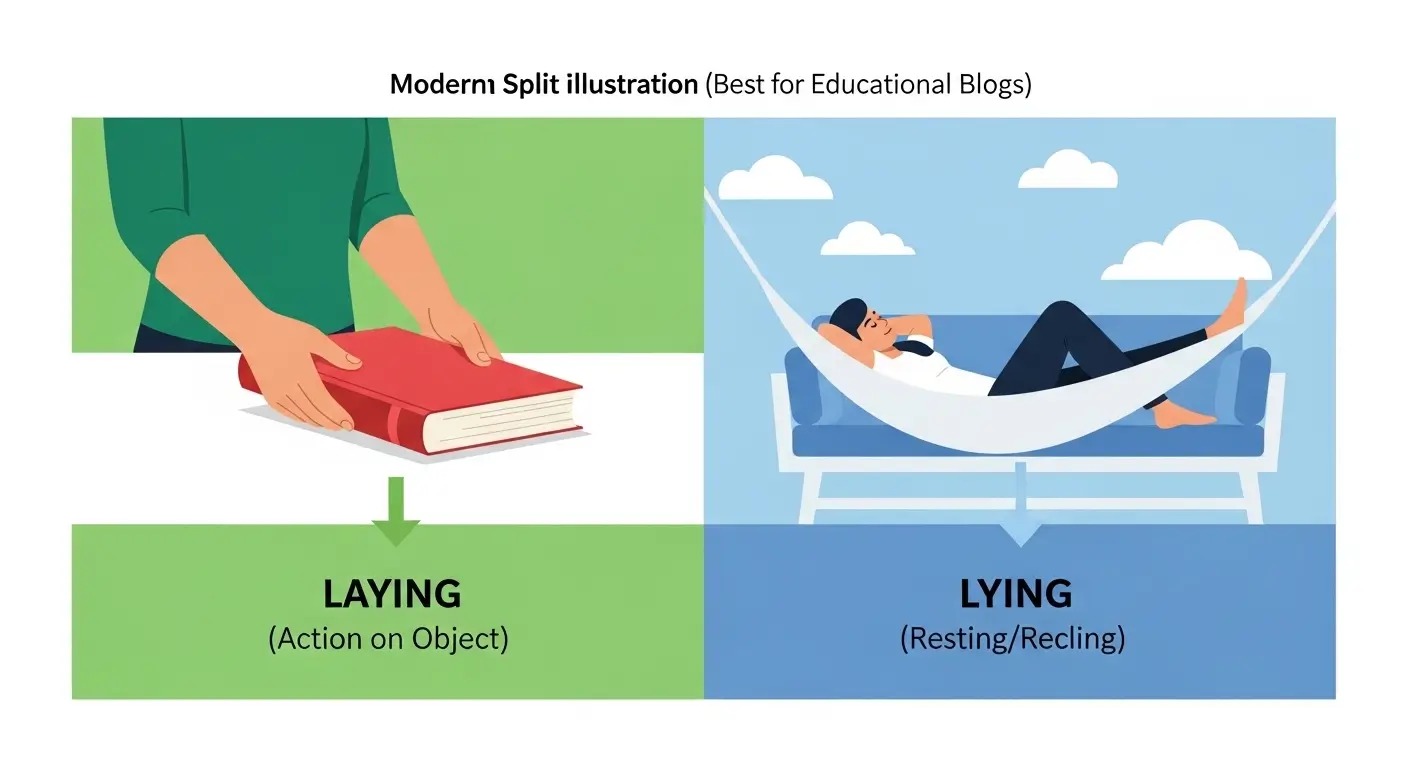
Last weekend, I noticed a sign in a public park that read, “No laying on the grass.” It looked normal at first, but was grammatically incorrect. The correct phrase should have been “No lying on the grass.” This small mistake clearly shows how confusing the difference between “laying” and “lying” can be in everyday life.
Many people even fluent English speakers mix up these two verbs because they look and sound similar. Understanding the difference between laying and lying is important for clear communication, accurate writing, and professional credibility. Whether you are a student, a content writer, or a teacher, mastering the difference between laying and lying helps you avoid embarrassing errors. In simple terms, lying involves placing something somewhere, while lying refers to resting or reclining without an object.
Key Difference Between Laying and Lying
The main difference is that “laying” requires a direct object, while “lying” does not.
- Lay (laying) = to put or place something
- Lie (lying) = to recline or rest
Why This Difference Is Necessary to Know
Understanding the difference between laying and lying is important for both learners and experts because grammar shapes how people perceive intelligence and professionalism. In academic writing, journalism, business communication, and even social media, correct usage builds credibility and clarity. Misusing these words may not stop communication, but it can make writing appear careless or unpolished. In society, language reflects education and attention to detail. Teachers, writers, and professionals are expected to use accurate grammar, making this distinction essential for maintaining standards in communication and education.
Pronunciation (US & UK)
| Word | US Pronunciation | UK Pronunciation |
| Laying | /ˈleɪ.ɪŋ/ | /ˈleɪ.ɪŋ/ |
| Lying | /ˈlaɪ.ɪŋ/ | /ˈlaɪ.ɪŋ/ |
Understanding these basic definitions prepares you for a deeper look at how these verbs behave in different contexts. Let’s explore their differences in detail.
Difference Between Laying and Lying
1. Meaning
- Laying means placing something down.
- She is laying the book on the table.
- He was laying bricks all day.
- Lying means resting or reclining.
- The dog is lying under the tree.
- She was lying on the sofa watching TV.
2. Verb Type
- Laying is a transitive verb (needs an object).
- He is laying the carpet.
- They were laying the foundation.
- Lying is an intransitive verb (no object).
- The cat is lying on the floor.
- I am lying in bed.
3. Past Forms
- Lay (past of lie) vs laid (past of lay) causes confusion.
- Yesterday, she laid the baby in the crib.
- Yesterday, she lay on the beach.
4. Present Continuous
- Laying: She is laying the plates on the table.
- Lying: She is lying in the sun.
5. Use in Instructions
- Laying: Laying tiles requires precision.
- Lying: Lying flat helps reduce back pain.
6. Object Requirement
- Laying always answers “what?”
- He is laying what? → the carpet.
- Lying answers “where?”
- He is lying where? → on the couch.
7. Common Mistakes
- Incorrect: I am laying on the bed.
- Correct: I am lying on the bed.
8. Professional Usage
- Laying is common in construction and cooking.
- The chef is laying herbs on the dish.
- Lying is common in health and daily activities.
- The patient is lying down.
9. Verb Forms
- Lay laid laid
- Lie lay lain
10. Focus of Action
- Laying focuses on an action performed on something.
- Lying focuses on the subject’s position.
Nature and Behaviour of Both
Laying is action-oriented and involves control, intention, and physical placement. It reflects movement and effort.
Lying is state-oriented and describes a condition of rest or position. It reflects stillness and relaxation.
Why People Are Confused About Their Use
People confuse these verbs because:
- Their spellings are similar.
- Their past forms overlap (lay is both present and past).
- Both relate to physical positioning.
- They sound almost identical in fast speech.
Table: Difference and Similarity Between Laying and Lying
| Feature | Laying | Lying | Similarity |
| Verb type | Transitive | Intransitive | Both are verbs |
| Requires object | Yes | No | Both describe position |
| Example | Laying a book | Lying on a bed | Both relate to physical placement |
| Past form | Laid | Lay | Both irregular verbs |
Which Is Better in What Situation?
Laying is appropriate when the subject is actively placing something somewhere. For example, in professional settings like construction, cooking, or parenting, using laying correctly helps convey precise actions. Saying “The workers are laying tiles” clearly indicates that tiles are being placed intentionally.
Lying is better when describing rest, posture, or position. It is commonly used in health, daily life, and storytelling. For instance, “He is lying on the grass” simply describes his position without involving any object. Choosing the correct verb ensures clarity and prevents misunderstanding in both spoken and written communication.
Use in Metaphors and Similes
- Lying like a log means lying very still.
- Laying the groundwork means preparing for future success.
Connotative Meaning
Laying
- Connotation: Neutral to positive
- Example: She is laying the foundation for her career.
Lying
- Connotation: Neutral (but sometimes confused with telling lies)
- Example: He was lying peacefully in the garden.
Idioms and Proverbs
- Lay your cards on the table, be honest.
- He finally laid his cards on the table during the meeting.
- Let sleeping dogs lie
- It’s better not to discuss the old argument; let sleeping dogs lie.
Works in Literature Featuring the Keywords
- “As I Lay Dying” Novel, William Faulkner, 1930
- “The Lion Is Lying in the Sun” Children’s literature theme, various adaptations
Movies Related to the Keywords
- “Lying Eyes” 1996, USA
- “Liar Liar” 1997, USA
Frequently Asked Questions
1. Is it correct to say “I am lying on the bed”?
No, the correct sentence is “I am lying on the bed.”
2. What is the past tense of lie?
The past tense of lie (recline) is lay.
3. Why is this grammar rule difficult?
Because the past tense of one verb looks like the present tense of the other.
4. Do native speakers also confuse these words?
Yes, even native speakers often mix them up in casual speech.
5. How can I remember the difference easily?
Remember: “Lay something down, lie down yourself.”
How Both Are Useful for the Surroundings
These verbs help describe physical actions and positions in everyday life, from giving instructions (lay the tools here) to describing safety or comfort (lie down if you feel dizzy). Accurate usage improves clarity in directions, storytelling, and professional communication.
Final Words for Both
Both laying and lying are essential verbs in English. While one focuses on action and the other on position, together they help describe the world around us with precision.
Conclusion
The difference between laying and lying may seem small, but it plays a major role in grammatical accuracy and effective communication. Because both verbs are irregular and share overlapping forms, confusion is natural. However, remembering that lying needs an object while lying does not can solve most problems instantly.
Whether you are writing an academic essay, a professional email, or a casual message, using these words correctly demonstrates attention to detail and strong language skills. Mastering this distinction not only improves grammar but also builds confidence in both speaking and writing.

Dr. Marcus Reed is a lead editorial author at WordCompares.com and a specialist in communication studies and written clarity. With more than 12 years of university-level teaching experience, he focuses on explaining word distinctions in a clear and structured manner. His work ensures that WordCompares.com maintains accuracy, depth, and reader trust.