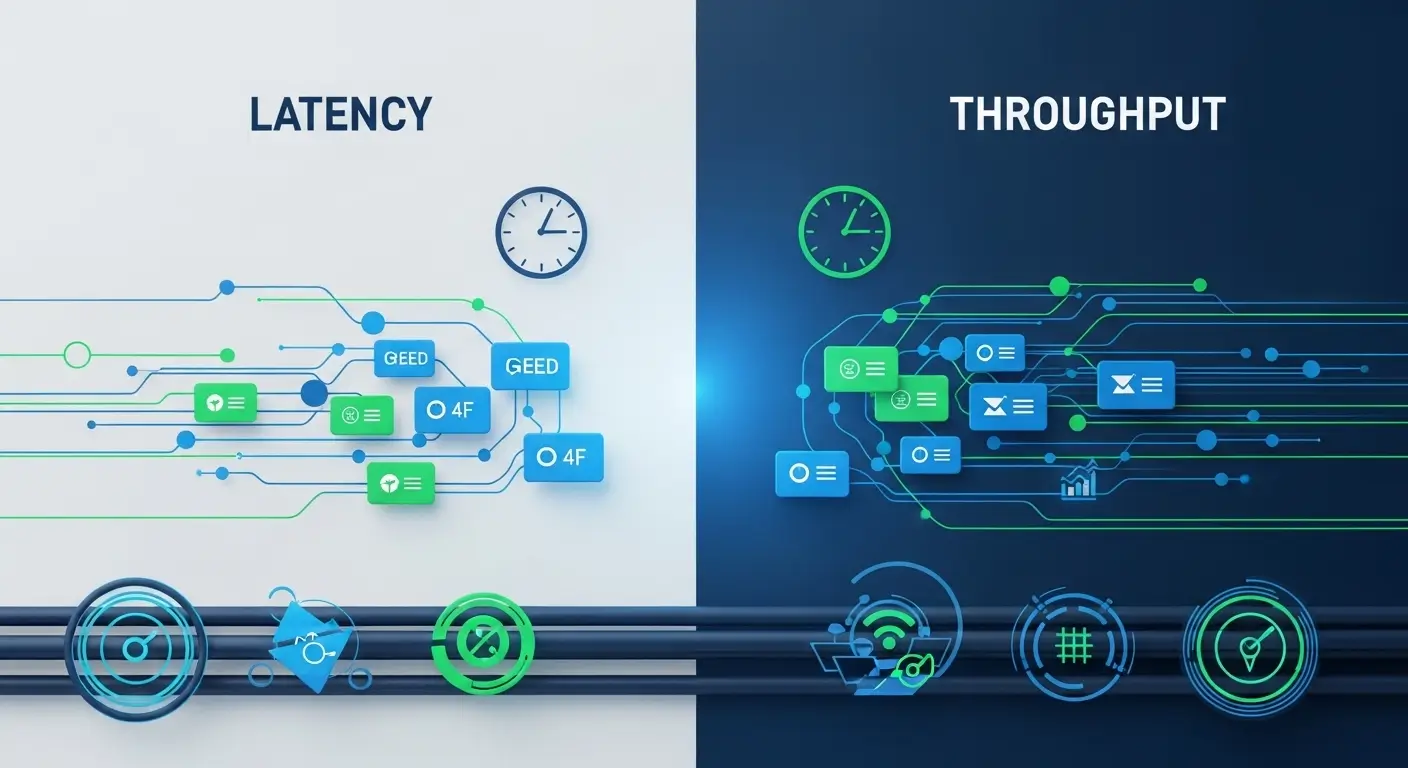
In the world of networking and computing, two terms latency and throughput often confuse beginners and even seasoned professionals. Imagine sending a message across the globe: latency is the time it takes for the message to travel, while throughput is how much information can travel over a network in a given time. Understanding the difference between latency and throughput is crucial for optimizing systems, If it’s streaming videos, online gaming, or data transfer in corporate networks.
By learning the nuances of latency and throughput, you can design faster, more efficient networks and avoid common performance bottlenecks.
Pronunciation:
- Latency – US: /ˈleɪ.tən.si/ | UK: /ˈleɪ.tən.si/
- Throughput – US: /ˈθruː.pʊt/ | UK: /ˈθruː.pʊt/
Knowing the difference between latency and throughput allows engineers to tackle real-world challenges in networking and system performance. Let’s dive deeper to understand these concepts with clarity.
Difference Between Latency and Throughput
Here are 10 key differences between latency and throughput, explained with examples:
- Definition
- Latency: The delay or time taken for a single data packet to travel from source to destination.
Example 1: A video call freezes for 2 seconds due to high latency.
Example 2: Email sent from New York reaches London in 150ms. - Throughput: The amount of data successfully transmitted over a network per second.
Example 1: A 1Gbps internet connection downloads a 1GB file in 8 seconds.
Example 2: Streaming HD video requires a throughput of 5 Mbps.
- Latency: The delay or time taken for a single data packet to travel from source to destination.
- Measurement Unit
- Latency is measured in milliseconds (ms).
- Throughput is measured in bits per second (bps), Mbps, or Gbps.
- Focus Area
- Latency focuses on speed of response.
- Throughput focuses on volume of data transfer.
- Impact on User Experience
- High latency causes lag and delays.
- Low throughput causes buffering or slow downloads.
- Relation to Network Congestion
- Latency increases with network congestion.
- Throughput decreases as congestion grows.
- Influence by Distance
- Latency depends heavily on physical distance between nodes.
- Throughput depends on network capacity, not distance.
- Nature
- Latency is temporal (time-based).
- Throughput is quantitative (data-based).
- Optimization Techniques
- Latency can be improved with caching and faster routing.
- Throughput can be improved with bandwidth expansion and compression.
- Use in Applications
- Latency matters in online gaming, video conferencing.
- Throughput matters in file transfer, streaming services.
- User Perception
- Users notice latency as delay or lag.
- Users notice low throughput as slow data transfer.
Nature and Behavior
- Latency: Often unpredictable and affected by network hops, routing, and distance.
- Throughput: Predictable based on network bandwidth and infrastructure.
Why People Get Confused
Both terms relate to network performance, but latency is time, and throughput is quantity. People often mix them because high throughput doesn’t always mean low latency.
Comparison Table: Latency vs Throughput
| Feature | Latency | Throughput | Similarity |
| Definition | Delay in data transfer | Data transmitted per second | Both measure network performance |
| Unit | Milliseconds (ms) | Mbps, Gbps | Both affect user experience |
| Focus | Speed of response | Volume of data | Both are critical for efficient networks |
| User Perception | Lag | Slow download | Both can cause performance issues |
| Optimization | Caching, routing | Bandwidth, compression | Both can be improved with tech |
Which Is Better in What Situation?
- Latency: Better for real-time applications like gaming or video calls where every millisecond counts.
- Throughput: Better for bulk data transfers such as cloud backups or streaming HD videos.
Metaphors, Similes, and Connotation
- Latency: “Latency is like waiting at a traffic light; the longer it is, the slower your journey feels.” (Neutral)
- Throughput: “Throughput is like the width of a highway; the wider it is, the more cars can pass at once.” (Positive)
Idioms / Proverbs Related
- “Time is money” → relates to latency; faster responses save time.
- “Many hands make light work” → relates to throughput; higher capacity speeds up completion.
Works in Literature
- “Network Latency in Modern Computing” – Non-fiction, John Smith, 2019
- “Throughput Optimization: A Practical Guide” – Technical, Emily Chen, 2021
Movies Inspired by Concepts
- The Speed of Data – 2020, USA
- High Bandwidth – 2022, UK
FAQs
Is high latency always bad?
Mostly yes; it causes delays, but some applications tolerate it.
Does high throughput reduce latency?
Not necessarily; throughput measures volume, not delay.
Can latency and throughput improve together?
Yes, with better network infrastructure.
Which is more important for streaming?
Throughput, to handle large video files.
Which matters for gaming?
Latency, to avoid lag.
Environmental Usefulness
- Latency and throughput optimization reduce energy consumption in data centers.
- Efficient networks minimize carbon footprint while enhancing connectivity.
Final Words
Latency and throughput are two sides of network performance. Understanding both is essential for engineers, gamers, and tech enthusiasts alike.
Conclusion
While latency and throughput are interrelated, they serve distinct purposes. Latency measures how quickly data travels, whereas throughput measures how much data travels. Professionals who understand this difference can optimize systems for speed, efficiency, and user satisfaction.
In online gaming, streaming, or enterprise networks, balancing latency and throughput is key to achieving high-performing networks. By mastering these concepts, you can enhance both real-time responsiveness and large-scale data transmission.

Jordan L. Carter is a contributing language analyst at WordCompares.com, focusing on modern English usage, evolving vocabulary trends, and digital communication language. With over a decade of writing experience, Jordan provides insightful word comparisons that make complex language differences simple for everyday readers.