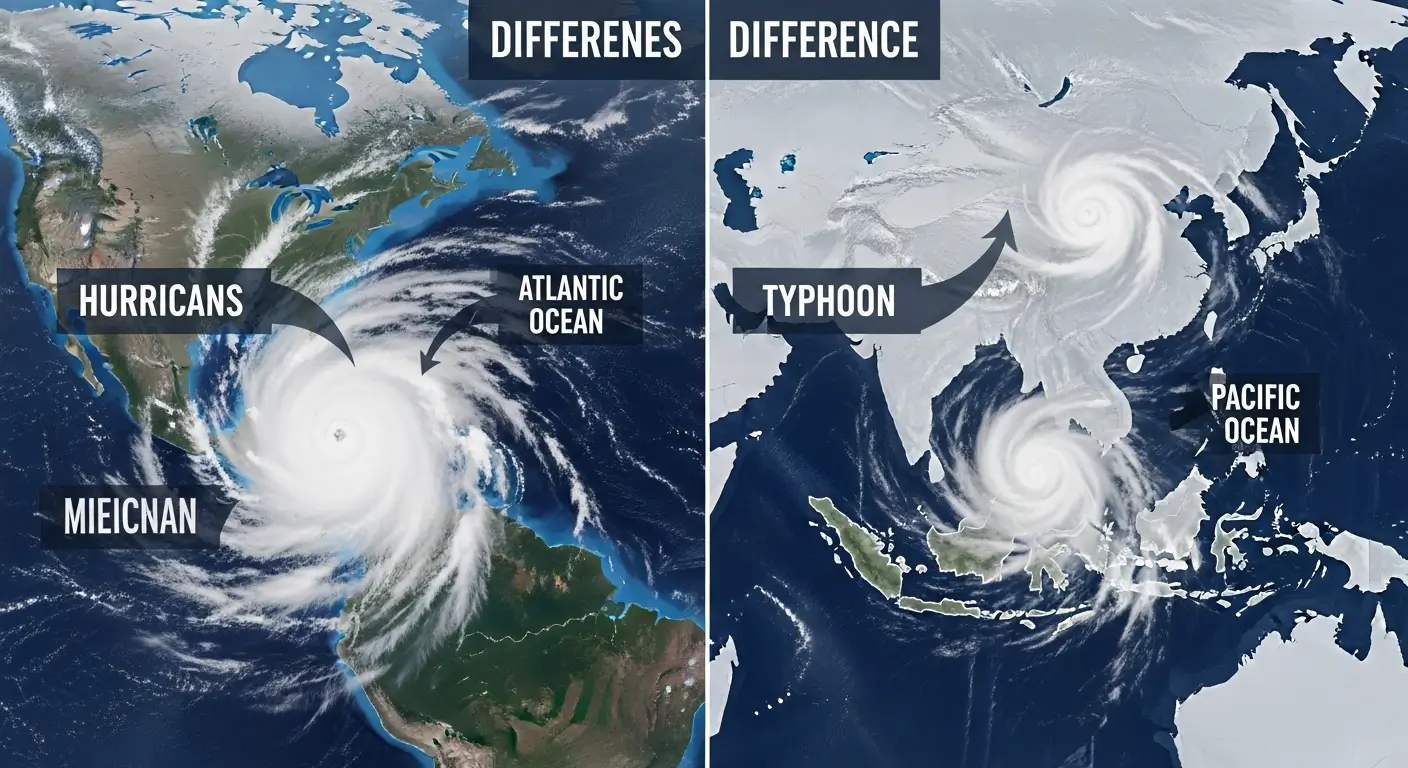
Ever wondered why a massive storm hitting Florida is called a hurricane, while the same storm in Japan is a typhoon? Although they look identical on satellite imagery, the only real difference between hurricanes and typhoons is their location.
Both are powerful tropical cyclones fueled by warm ocean waters, bringing heavy rain and destructive winds. However, their names change depending on which ocean they form in.
In this post, we’ll quickly break down:
- The Geographic Divide: Where hurricanes end and typhoons begin.
- Shared Science: Why they are essentially the same storm.
- Global Impact: How meteorologists track these giants to save lives.
Understanding these terms is essential for travelers and weather enthusiasts to make sense of global news and stay prepared.
Key Difference Between Hurricanes and Typhoons
The main difference between the two storms is their geographic location.
- Hurricanes form in the Atlantic Ocean and the northeastern Pacific Ocean.
- Typhoons form in the northwestern Pacific Ocean, near East and Southeast Asia.
Despite the different names, both storms are scientifically the same type of weather system: tropical cyclones.
Why Is Their Difference Important for Learners and Experts?
Knowing the difference is important for several reasons:
- Weather forecasting: Meteorologists must classify storms correctly to track and predict them.
- Disaster preparation: Countries in different regions prepare for storms based on their typical patterns.
- Education and research: Students studying climate science learn how these storms form and move.
- Public awareness: News and emergency alerts use the correct term depending on the region.
Understanding the difference between hurricanes and typhoons helps societies respond more effectively to severe weather events.
Pronunciation
| Word | US Pronunciation | UK Pronunciation |
| Hurricane | /ˈhɝːɪˌkeɪn/ | /ˈhʌrɪkeɪn/ |
| Typhoon | /taɪˈfuːn/ | /taɪˈfuːn/ |
A Quick Transition to the Main Comparison
Now that we understand the basic meaning of these storms, let’s explore the difference between hurricanes and typhoons in more detail by comparing their features, locations, and impacts.
Difference Between Hurricanes and Typhoons
1. Geographic Location
Hurricanes occur mainly in the Atlantic and Northeast Pacific, while typhoons occur in the Northwest Pacific.
Examples:
- Hurricane Katrina hit the United States in 2005.
- Typhoon Haiyan struck the Philippines in 2013.
2. Naming System
Different regions use different naming authorities for storms.
Examples:
- Atlantic hurricanes are named by the World Meteorological Organization list.
- Typhoon names are contributed by Asian countries.
3. Regions Affected
Hurricanes affect North America, the Caribbean, and parts of Central America.
Typhoons affect East Asia and Southeast Asia.
Examples:
- Hurricanes often hit Florida or Mexico.
- Typhoons frequently impact Japan or the Philippines.
4. Seasonal Timing
Hurricanes typically occur from June to November.
Typhoons can occur throughout the year, though they peak from July to October.
Examples:
- Hurricane season peaks in September.
- Typhoon season often peaks in August.
5. Average Frequency
The Northwest Pacific usually experiences more typhoons than hurricanes annually.
Examples:
- About 10–15 typhoons form yearly.
- The Atlantic averages about 6–10 hurricanes.
6. Storm Strength Classification
Both storms use wind speed categories but may use different scales.
Examples:
- The Saffir–Simpson scale classifies hurricanes from Category 1 to 5.
- Typhoon agencies may classify storms as severe typhoons or super typhoons.
7. Cultural Impact
Storms influence culture differently depending on region.
Examples:
- Hurricanes influence Caribbean disaster planning.
- Typhoons shape infrastructure planning in Japan.
8. Ocean Conditions
Different ocean temperatures and currents influence storm development.
Examples:
- The Gulf of Mexico fuels many hurricanes.
- The Western Pacific’s warm waters strengthen typhoons.
9. Naming Traditions
Hurricane names are alphabetical each year.
Typhoon names come from a rotating list of Asian words.
Examples:
- Hurricane Andrew (1992).
- Typhoon Mangkhut (2018).
10. Media Terminology
News media use different terms depending on region.
Examples:
- American news reports “hurricane warnings.”
- Asian news broadcasts issue “typhoon alerts.”
Nature and Behaviour of Hurricanes
Hurricanes form over warm tropical waters and develop a rotating system with an eye at the center. They bring intense winds, storm surges, and heavy rainfall. Hurricanes usually weaken once they move over land or colder waters.
Nature and Behaviour of Typhoons
Typhoons behave almost identically to hurricanes. They form over warm Pacific waters and rotate in a powerful spiral pattern. Because of very warm ocean temperatures, some typhoons become extremely strong “super typhoons.”
Why Are People Confused About Their Use?
People often confuse hurricanes and typhoons because they are actually the same type of storm. The only major difference is where they occur geographically. News media, regional naming systems, and cultural familiarity also contribute to confusion.
Table: Difference and Similarity
| Feature | Hurricane | Typhoon | Similarity |
| Location | Atlantic & Northeast Pacific | Northwest Pacific | Both form over warm oceans |
| Storm Type | Tropical cyclone | Tropical cyclone | Same meteorological system |
| Regions Affected | Americas & Caribbean | East & Southeast Asia | Cause heavy rain and wind |
| Naming Authority | Atlantic naming list | Asian regional list | Names assigned annually |
| Season | June–Nov | Mostly July–Oct | Seasonal tropical storms |
Which Is Better in What Situation?
In reality, neither hurricanes nor typhoons are “better,” because both are dangerous natural disasters. However, understanding their regional differences helps meteorologists issue more accurate warnings. In hurricane-prone regions like the United States, early hurricane tracking allows communities to prepare for evacuations and strengthen buildings.
In typhoon-prone areas such as Japan and the Philippines, advanced warning systems and strong coastal defenses help reduce damage. Knowledge about typhoons helps governments design infrastructure capable of withstanding powerful winds and heavy rainfall.
Hurricanes and Typhoons in Metaphors and Similes
These words are often used figuratively to describe intense situations.
Examples:
- “His anger hit the room like a hurricane.”
- “The news spread through the office like a typhoon.”
Connotative Meaning
Hurricane
- Negative: chaos, destruction
- “The scandal caused a hurricane of criticism.”
- Neutral: powerful force
- “Her ideas created a hurricane of change.”
Typhoon
- Negative: overwhelming disaster
- “The company faced a typhoon of financial problems.”
- Neutral: intense activity
- “A typhoon of excitement filled the stadium.”
Idioms or Expressions Related to the Words
- “Calm before the storm.”
Example: “The quiet meeting felt like the calm before the storm.” - “Weather the storm.”
Example: “The company managed to weather the storm of economic recession.”
Works in Literature
Hurricane
- Their Eyes Were Watching God — novel by Zora Neale Hurston (1937)
Typhoon
- Typhoon — novella by Joseph Conrad (1902)
Movies About These Storms
Hurricane
- The Hurricane Heist (2018, USA)
Typhoon
- Typhoon (2005, South Korea)
Frequently Asked Questions
1. Are hurricanes and typhoons the same?
Yes, they are the same type of storm called tropical cyclones.
2. Why do they have different names?
The name depends on the ocean region where the storm forms.
3. Which is stronger, a hurricane or a typhoon?
Both can reach similar strengths.
4. Where do typhoons usually occur?
Mostly in the Northwest Pacific near Asia.
5. Can hurricanes become typhoons?
No, but the same storm type is called differently depending on location.
How Both Are Useful for the Environment
Despite their destructive power, these storms play a role in Earth’s climate system. They redistribute heat from tropical oceans to cooler regions and help maintain global temperature balance. Hurricanes and typhoons also bring rainfall that replenishes freshwater supplies in some regions.
Final Words for Both
Hurricanes and typhoons may have different names, but they share the same nature as powerful tropical storms. Understanding their differences helps people prepare, respond, and learn more about the planet’s weather systems.
Conclusion
The difference between hurricanes and typhoons mainly lies in their location rather than their structure. Hurricanes form in the Atlantic and northeastern Pacific, while typhoons occur in the northwestern Pacific near Asia. Both are tropical cyclones that develop over warm oceans and can cause serious damage through strong winds, heavy rainfall, and storm surges.
Learning the difference between hurricanes and typhoons is important for students, researchers, and the general public because it improves awareness of global weather systems and disaster preparedness. By understanding how these storms form and behave, societies can better protect communities and reduce the impact of severe weather events.

Jordan L. Carter is a contributing language analyst at WordCompares.com, focusing on modern English usage, evolving vocabulary trends, and digital communication language. With over a decade of writing experience, Jordan provides insightful word comparisons that make complex language differences simple for everyday readers.