Last winter, my neighbor slipped on an icy road and injured his arm. At the hospital, one doctor said, “It looks fractured,” while another nurse told his family, “Don’t worry, it’s just broken.” This moment clearly shows the confusion surrounding the difference between fractured and broken.
Many people believe these words describe two completely different injuries. However, in reality, they are closely related. Understanding the difference between fractured and broken is important not only for medical clarity but also for everyday communication.
Key Difference Between the Two
The main difference is simple. Fractured is a technical or medical term. In contrast, broken is more general and commonly used in daily conversation.
Why Is Their Difference Important for Learners and Experts?
First, learners improve their vocabulary accuracy when they understand the correct usage. Moreover, professionals such as doctors need precise language to explain injuries clearly.
In addition, society benefits from accurate communication. For instance, the word “fractured” may sound less alarming than “broken,” even though both can describe the same injury. As a result, correct word choice prevents confusion and panic.
Pronunciation
| Word | US Pronunciation | UK Pronunciation |
| Fractured | /ˈfræk.tʃɚd/ | /ˈfræk.tʃəd/ |
| Broken | /ˈbroʊ.kən/ | /ˈbrəʊ.kən/ |
Now that we understand their meaning and pronunciation, let’s explore their detailed differences.
Difference Between Fractured and Broken
Here are ten clear and practical differences:
1. Technical vs General Usage
Fractured sounds technical and professional.
On the other hand, broken sounds simple and general.
Fractured: The doctor confirmed a fractured wrist.
Fractured: The X-ray showed a fractured rib.
Broken: He broke his phone.
Broken: She has a broken arm.
2. Field of Use
Fractured mainly appears in medical contexts.
However, broken appears in everyday situations.
Fractured: The patient suffered a fractured skull.
Fractured: The athlete had a fractured ankle.
Broken: The chair is broken.
Broken: My glasses are broken.
3. Tone
Fractured sounds formal.
In contrast, broken sounds informal.
Fractured: The report mentioned a fractured bone.
Fractured: The diagnosis revealed a fractured collarbone.
Broken: I broke my leg.
Broken: The toy is broken.
4. Emotional Impact
Fractured sounds less dramatic.
Meanwhile, broken often sounds more serious emotionally.
Fractured: She has a fractured finger.
Fractured: It’s only a fractured toe.
Broken: He broke his leg badly.
Broken: My arm is broken!
5. Usage for Objects
Fractured is rarely used for objects.
However, broken is commonly used for objects.
Fractured: The crystal glass fractured under pressure.
Fractured: The mirror fractured at the edge.
Broken: The mirror is broken.
Broken: My laptop is broken.
6. Grammar Role
Fractured works as an adjective or past tense verb.
Broken is the past participle of “break.”
Fractured: His ribs fractured during the fall.
Fractured: The bone fractured on impact.
Broken: She has broken her arm.
Broken: The vase was broken yesterday.
7. Medical Precision
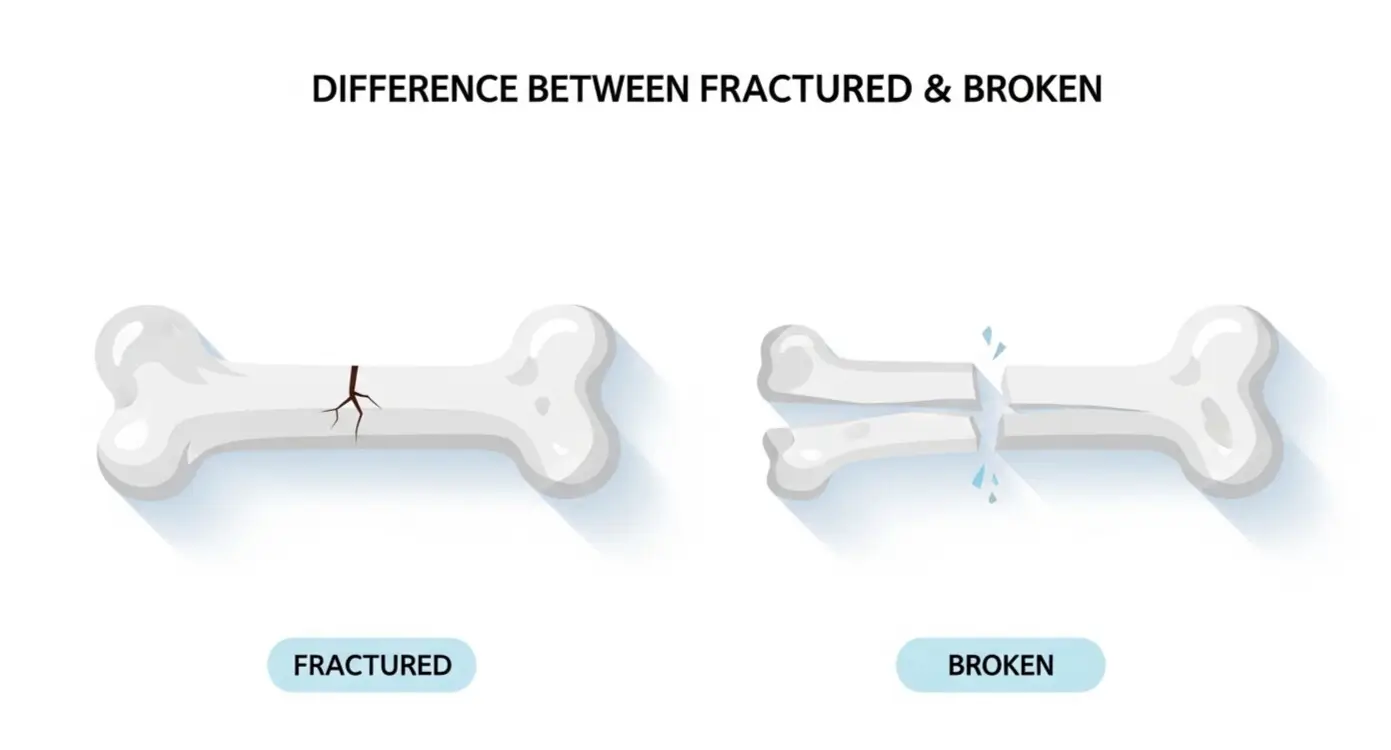
Fractured often suggests a crack in the bone.
However, broken may suggest complete separation.
Fractured: He has a hairline fracture.
Fractured: The scan showed a minor fracture of the wrist.
Broken: His leg is broken in two pieces.
Broken: She suffered a completely broken arm.
8. Metaphorical Use
Fractured suggests division or separation.
On the other hand, broken suggests emotional pain or damage.
Fractured: The country has a fractured political system.
Fractured: Their friendship became fractured over time.
Broken: She has a broken heart.
Broken: He felt broken after the loss.
9. Perceived Severity
Fractured may sound mild.
In contrast, broken sounds are more severe.
Fractured: It’s a small fractured bone.
Fractured: The doctor diagnosed a fractured wrist.
Broken: My leg is badly broken.
Broken: He broke his spine in the accident.
10. Professional Communication
Doctors prefer fractured for accuracy.
However, most people prefer to be broken in conversation.
Fractured: The medical chart states fractured tibia.
Fractured: The scan confirmed fractured ribs.
Broken: He broke his arm playing football.
Broken: My phone screen is broken.
Nature and Behaviour
Fractured feels technical, clinical, and precise. Therefore, professionals often use it in reports and diagnoses.
Broken feels emotional, flexible, and widely used. As a result, it appears in daily speech, storytelling, and emotional expression.
Why Are People Confused?
People get confused because both words describe damage. In medical terms, they often mean the same injury. However, tone and usage create subtle differences. Additionally, media reports and everyday speech mostly use “broken,” while healthcare professionals prefer “fractured.”
Comparison Table
| Feature | Fractured | Broken | Similarity |
| Meaning | Crack or split | Damaged or separated | Both show damage |
| Usage | Medical and formal | General and informal | Used as adjectives |
| Tone | Less dramatic | More emotional | Describe injury |
| Objects | Rare | Common | Describe physical damage |
| Metaphor | Division | Emotional hurt | Used figuratively |
Which Is Better in What Situation?
In medical situations, fractured is the better choice. Doctors use it because it sounds professional and precise. Moreover, it helps maintain calm communication. In reports and scientific writing, fractured ensures clarity and accuracy.
In daily conversation, broken works better. It is simple and easy to understand. For example, if you say, “I broke my arm,” everyone understands immediately. Therefore, broken suits, casual speech, and emotional storytelling.
Metaphors and Similes
- A fractured society
- Broken like shattered glass
- Her trust was broken
- A fractured relationship
Connotative Meaning
Fractured Neutral to slightly negative
Example: The fractured alliance created tension.
Broken Strongly negative
Example: He felt broken inside.
Example: The broken toy made the child cry.
Idioms and Proverbs
Broken heart. She suffered a broken heart after the breakup.
If it ain’t broke, don’t fix it. The system works fine, so do not change it.
Break the ice. He told a joke to break the ice.
Break someone’s spirit. The failure did not break her spirit.
Works in Literature
- Broken April Novel by Ismail Kadare, 1978 (Historical Fiction)
- The Broken Tower Poem by Hart Crane, 1930 (Poetry)
- Fractured Novel by Karin Slaughter, 2008 (Crime Fiction)
Movies
- Broken (2012, United Kingdom)
- Broken (2014, United States)
- Fractured (2019, United States)
Frequently Asked Questions
1. Is fractured worse than broken?
No. In medical terms, both usually mean the same injury.
2. Why do doctors prefer fractured?
Because it sounds more technical and precise.
3. Can broken describe bones?
Yes. People commonly use it in everyday speech.
4. Is fractured only used in medicine?
Mostly, but writers also use it metaphorically.
5. Are fractured and broken interchangeable?
Sometimes yes in a medical context. However, tone and formality differ.
How Both Words Are Useful in Society
Both words help describe physical and emotional damage clearly. Teachers, doctors, writers, and journalists use them to communicate effectively. Therefore, understanding their correct use strengthens language skills and reduces confusion.
Final Words
Fractured represents precision and professionalism.
Broken represents simplicity and emotional depth.
Conclusion
Understanding the difference between fractured and broken improves clarity in medical and everyday communication. Although both words describe damage, fractured sounds technical and formal, while broken feels general and emotional.
Their meanings often overlap; however, context and tone create the real distinction. When you choose the correct word, you communicate more accurately and confidently. Whether you describe a bone injury, an object, or emotions, using the right term ensures your message remains clear and effective.

Dr. Marcus Reed is a lead editorial author at WordCompares.com and a specialist in communication studies and written clarity. With more than 12 years of university-level teaching experience, he focuses on explaining word distinctions in a clear and structured manner. His work ensures that WordCompares.com maintains accuracy, depth, and reader trust.