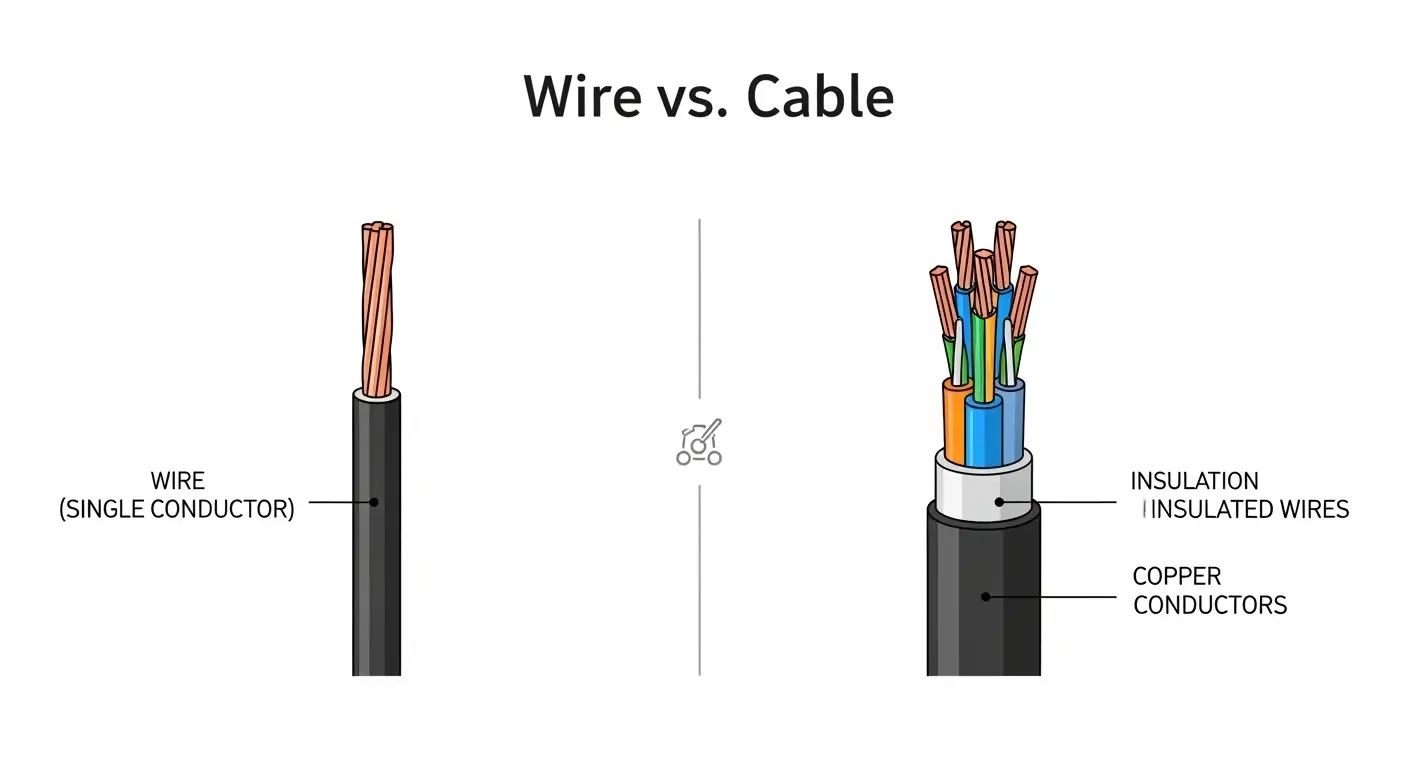
Imagine you are setting up a new television in your home. You open the box and find several thin metal lines and thicker bundled connections. Someone might call them “wires,” while another person says they are “cables.” This everyday situation perfectly explains the difference between cable and wire. Many people use these words interchangeably, but they actually have different meanings in electrical and communication systems.
Understanding the difference between cable and wire helps homeowners, engineers, electricians, and students choose the right material for electrical connections. A wire usually refers to a single conductor, while a cable often contains multiple wires bundled together. Knowing the difference between cable and wire also helps prevent installation mistakes and improves safety in electrical systems. Whether you are installing lighting, networking equipment, or industrial machinery, understanding the difference between cable and wire ensures better performance and reliability.
Pronunciation
Wire
- US: /waɪr/
- UK: /waɪə/
Cable
- US: /ˈkeɪbəl/
- UK: /ˈkeɪbəl/
Linking Hook
Now that we understand the basic idea, let us explore the difference between cable and wire in detail through clear comparisons, examples, and practical uses.
Difference Between Cable and Wire
Below are ten important points that explain the difference between the two.
1. Structure
A wire is a single electrical conductor. It is usually made of copper or aluminum.
A cable contains two or more insulated wires bundled together inside a protective covering.
Examples
Wire:
- Copper wire used for home electrical circuits
- Aluminum wire used in overhead power lines
Cable:
- Coaxial cable used for television connections
- Ethernet cable used for internet networking
2. Composition
A wire normally consists of one conductor with or without insulation.
A cable is made of multiple conductors grouped together and protected by insulation and a sheath.
Examples
Wire:
- Bare grounding wire
- Insulated copper household wire
Cable:
- USB cable for charging devices
- Power cable for appliances
3. Protection
A wire may or may not have insulation and usually has minimal protection.
A cable always includes protective layers that shield the internal wires from damage.
Examples
Wire:
- Bare metal wire used in fences
- Insulated wire in light fixtures
Cable:
- Underground electrical cable
- Fiber optic cable for communication
4. Thickness
A wire is usually thinner and lighter.
A cable is thicker because it includes multiple wires and protective layers.
Examples
Wire:
- Jewelry wire used in crafts
- Thin electrical wire in electronics
Cable:
- Television cable connection
- Heavy-duty power cable
5. Function
A wire mainly conducts electricity or signals.
A cable carries electricity or signals through several wires combined for greater capacity.
Examples
Wire:
- Internal wiring in small devices
- Single conductor for electrical circuits
Cable:
- Internet cable connecting routers
- Elevator power cable
6. Flexibility
A wire can be either solid or flexible.
A cable is generally more flexible because of multiple stranded wires inside.
Examples
Wire:
- Solid copper wire in house walls
- Steel wire used in fencing
Cable:
- Charging cable for smartphones
- Extension power cable
7. Durability
A wire is more exposed and may be easier to damage.
A cable has stronger insulation and protective layers.
Examples
Wire:
- Exposed grounding wire
- Wire used in electronics
Cable:
- Marine cable for ships
- Outdoor electrical cable
8. Application Area
A wire is commonly used in small circuits and simple connections.
A cable is used in complex systems like telecommunications and power distribution.
Examples
Wire:
- Circuit board wiring
- Electric fan wiring
Cable:
- Internet network cable
- Submarine communication cable
9. Installation
A wire is easier to install for simple tasks.
A cable may require special connectors and installation techniques.
Examples
Wire:
- Lamp wiring
- Small electronic device repair
Cable:
- Home internet installation
- Industrial power supply cable
10. Cost
A wire is generally cheaper.
A cable costs more because of its multiple layers and components.
Examples
Wire:
- Basic copper electrical wire
- Craft wire
Cable:
- HDMI cable
- Underground electrical cable
Nature and Behaviour
Wire
- Simple conductor
- Can be solid or stranded
- Used for direct electrical flow
Cable
- Complex structure
- Contains multiple conductors
- Provides protection and higher capacity
Why People Are Confused About Their Use
People often confuse the two because both carry electricity or signals. In everyday language, many people call any electrical connection a “wire.” In reality, many of those connections are cables containing several wires. The similar appearance and overlapping uses make the terms difficult to distinguish.
Table Showing Difference and Similarity
| Feature | Wire | Cable | Similarity |
| Structure | Single conductor | Multiple conductors bundled | Both conduct electricity |
| Thickness | Thin | Thick | Used in electrical systems |
| Protection | Minimal | Strong insulation | Both may have insulation |
| Usage | Small circuits | Power and communication | Carry signals or electricity |
| Cost | Cheaper | More expensive | Used in homes and industry |
Which is Better in What Situation?
Wire
Wire is better for simple electrical tasks and small circuits. It works well in home wiring, electronic devices, and situations where only one conductor is needed. Electricians often use wires inside walls or appliances where multiple layers of protection are unnecessary.
Cable
Cable is better for complex or heavy-duty systems. It is commonly used in communication networks, power transmission, and outdoor installations. Because cables contain several insulated wires and protective layers, they are safer and more reliable for long-distance connections and high electrical loads.
Use in Metaphors and Similes
Wire
- “His nerves were like exposed wires.”
- “The news spread through the office like a live wire.”
Cable
- “The city was tied together by cables of communication.”
- “Their friendship was as strong as a steel cable.”
Connotative Meanings
Wire
- Positive: “live wire” (energetic person)
- Negative: “tripwire situation” (dangerous trap)
- Neutral: electrical conductor
Examples
- “She is a real live wire in the classroom.”
- “The investigation uncovered a financial tripwire.”
Cable
- Positive: strong connection
- Neutral: communication link
Examples
- “Global news travels through satellite cables.”
- “The bridge is supported by strong steel cables.”
Idioms or Expressions
Live wire
Meaning: an energetic or lively person
Example: “Ali is a live wire in every meeting.”
Under the wire
Meaning: at the last possible moment
Example: “The project was finished under the wire.”
Works in Literature
Wire
- The Wire and the Rock — Poetry, Ben Belitt, 1946
Cable
- The Cable — Short story, Guy de Maupassant, 1884
Movies Related to the Keywords
Wire
- The Wire (TV Series, 2002 – USA)
Cable
- The Cable Guy (1996 – USA)
Frequently Asked Questions
1. What is the main difference between cable and wire?
A wire is a single conductor, while a cable contains multiple insulated wires bundled together.
2. Can a cable contain many wires?
Yes, most cables include several wires enclosed in protective insulation.
3. Which is safer: cable or wire?
Cable is usually safer because it has stronger insulation and protection.
4. Are cables used for internet connections?
Yes, Ethernet and fiber-optic cables are widely used for internet communication.
5. Is wire cheaper than cable?
Yes, wires are generally cheaper because they have a simpler structure.
How Both Are Useful for Surroundings
Wires and cables play an essential role in modern life. They power homes, connect communication systems, and support transportation and infrastructure. Without them, electricity distribution, internet connectivity, and industrial machinery would not function properly.
Final Words for Both
Wire represents simplicity and direct electrical conduction, while cable symbolizes strength, protection, and advanced connectivity. Together they form the backbone of modern electrical and communication systems.
Conclusion
Understanding the difference between cable and wire is important for anyone working with electrical systems, technology, or communication networks. While a wire is a single conductor used for simple electrical connections, a cable contains multiple wires bundled together with protective insulation.
Both play vital roles in modern infrastructure. Wires are commonly used in small circuits and appliances, while cables are designed for more complex systems such as internet connections, power transmission, and industrial machinery.
By recognizing their structural and functional differences, users can choose the right option for safety, efficiency, and reliability in everyday electrical applications.

Alexandra “Alex” Monroe is a senior linguistics contributor at WordCompares.com, where she specializes in comparative word analysis, semantics, and language clarity. With over 15 years of academic and editorial experience, Alex helps readers understand subtle differences between commonly confused words and phrases. Her research-driven yet practical writing style strengthens the educational authority of WordCompares.com.