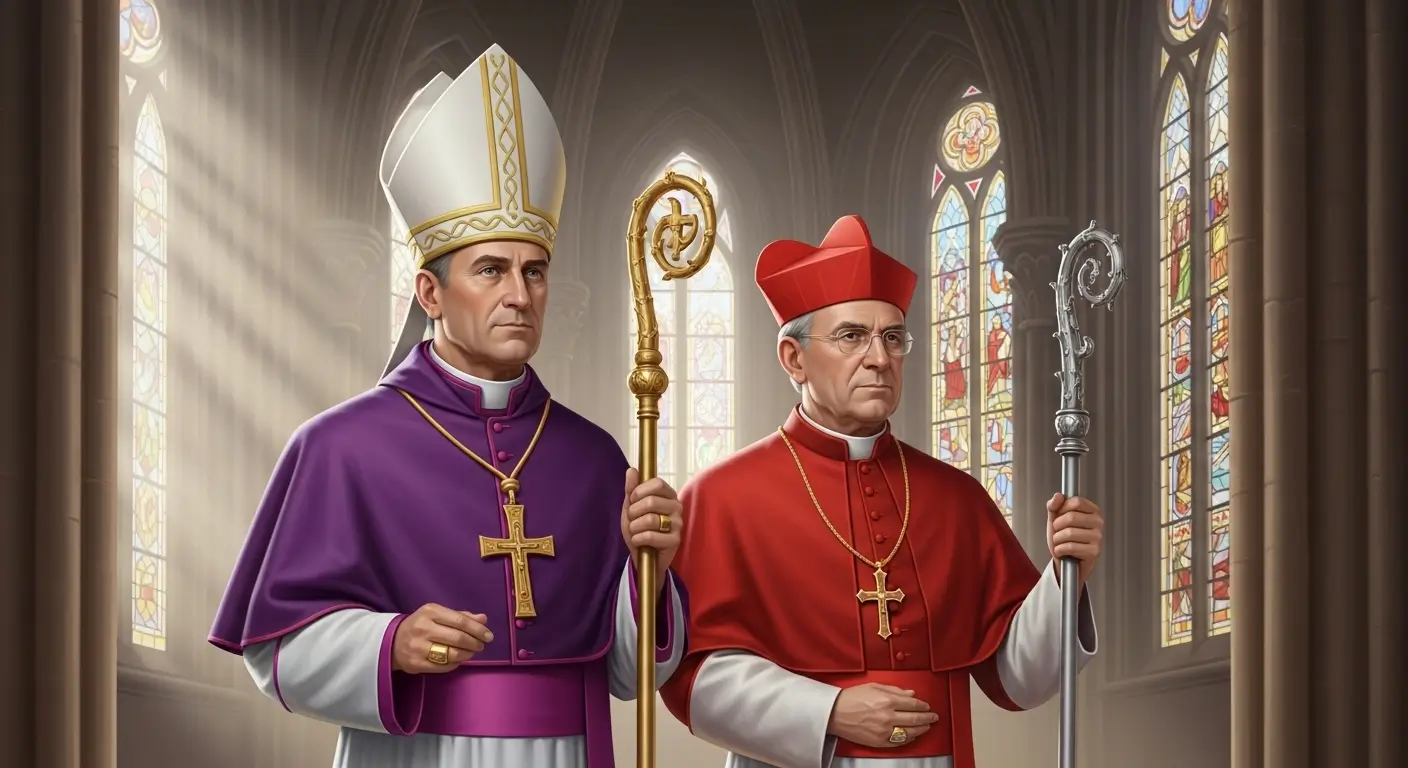
When attending a grand cathedral service or watching a Vatican ceremony, the vibrant robes and titles can often spark confusion. Is the leader a Bishop or a Cardinal? While both hold high-ranking positions, the difference between bishop and cardinal is a matter of both “rank” and “authority” within the global Church.
A Bishop is the spiritual shepherd of a local diocese, overseeing priests and parishioners. A Cardinal, often called a “Prince of the Church,” is a high-ranking official appointed by the Pope to serve as a key advisor and, most importantly, to elect the next Pope.
Understanding these distinctions from their daily duties to the symbolic Purple vs. Scarlet vestments is essential for students, history buffs, and the faithful.
Pronunciation: * Bishop: /ˈbɪʃ.əp/
- Cardinal: /ˈkɑːr.dɪ.nəl/
Let’s dive into the specific details of their authority and how these roles shape the spiritual life of the Church.
Bishop vs. Cardinal: What is the Real Difference?
Understanding the hierarchy of the Catholic Church can be complex. While both are high-ranking officials, the difference between bishop and cardinal lies in their scope of authority and their specific relationship with the Pope. Here are the 10 main differences discussed with examples:
1. Rank in the Church Hierarchy
The fundamental distinction begins with where they stand in the internal structure of the Church.
- Bishop: Oversees a diocese and reports to archbishops or cardinals. For example, a bishop of a local city church manages clergy and ensures all parishes follow canonical rules.
- Cardinal: A senior official who often reports directly to the Pope. Example: Cardinal electors choose the new Pope during a conclave and advise him on global Church matters.
2. The Appointment Process
Both roles are appointed by the Pope, but the path to each position differs.
- Bishop: Appointed for a specific geographic diocese. For instance, Bishop John might be assigned to lead the Diocese of Springfield based on his extensive experience as a priest.
- Cardinal: Usually selected from among existing bishops as a selective honor. For example, Cardinal Smith might be elevated after 15 years of service as a bishop.
3. Core Responsibilities and Duties
Their daily work ranges from local community service to international governance.
- Bishop: Manages local parishes and conducts sacraments like ordaining new priests or supervising financial matters.
- Cardinal: Focuses on Church governance and global policy-making. Example: A cardinal may attend Vatican councils to discuss doctrinal matters or engage in international diplomacy.
4. Scope of Authority
The “reach” of their power is a major difference between bishop and cardinal.
- Bishop: Authority is limited to his specific diocese. For example, Bishop Peter cannot make decisions for parishes outside his own territory.
- Cardinal: Authority extends globally as a senior advisor. They influence policies affecting multiple countries and serve in Vatican congregations with worldwide impact.
5. Voting Rights in Papal Elections
This is perhaps the most famous distinction between the two roles.
- Bishop: Cannot vote in papal elections unless he has been elevated to the rank of cardinal.
- Cardinal: Has the right to vote for a new Pope during a conclave (if under the age of 80).
6. Symbolic Attire and Colors
You can often tell them apart by what they wear during ceremonies.
- Bishop: Characterized by the mitre (tall hat), crosier (staff), and a pectoral cross. Their symbolic color is typically purple.
- Cardinal: Wears distinct red robes, symbolizing a willingness to defend the faith even to the point of shedding blood.
7. Global vs. Local Influence
- Bishop: Primarily focused on regional initiatives, such as local healthcare or education programs in their city.
- Cardinal: Exerts global influence, traveling internationally to mediate Church matters or advise on worldwide policies.
8. Ceremonial Roles
- Bishop: Leads diocese-specific events like confirmations or consecrating new local church buildings.
- Cardinal: Participates in high-level Vatican ceremonies, such as canonizations, and represents the Pope on the global stage.
9. Nature of Behavior and Focus
- Bishop: More community-focused and pastoral; they often listen to parishioners’ concerns personally.
- Cardinal: More strategic and influential, working on Church reform projects across different continents.
10. The Path to the Position
- Bishop: Usually selected from senior priests with advanced theological education.
- Cardinal: Typically selected from distinguished bishops based on merit, loyalty, and contributions to the Church’s global mission.
Table: Bishop vs Cardinal
| Feature | Bishop | Cardinal | Similarity |
| Rank | Local/diocesan | Senior/global | Both are ordained clergy |
| Appointment | By Pope for diocese | By Pope from bishops | Both require papal appointment |
| Responsibilities | Local parishes, sacraments | Church governance, global policies | Both guide Church activities |
| Voting in conclave | No | Yes (if under 80) | Both participate in Church leadership |
| Attire | Mitre, crosier, pectoral cross | Red robes, zucchetto | Both have ceremonial attire |
| Authority | Diocesan | Global advisory | Both have hierarchical authority |
| Influence | Regional | Global | Both impact community life |
| Nature | Pastoral | Strategic | Both serve the Church’s mission |
| Path | Senior priest | Distinguished bishop | Both require experience and devotion |
| Ceremonial Role | Local ceremonies | Vatican/global ceremonies | Both lead religious rituals |
Why People Are Confused
The confusion arises because both are high-ranking church officials, wear ceremonial attire, and perform spiritual duties. People often assume a cardinal is “higher” than a bishop in all respects, not realizing bishops can have substantial local authority.
Which Is Better in What Situation
- Bishop: Ideal for guiding local communities, pastoral care, and regional administration. They are closer to the people and directly influence parish life.
- Cardinal: Best suited for strategic leadership, policy-making, and representing the Church on a global stage. Their decisions impact millions worldwide.
Metaphors and Similes
- Bishop: “As shepherd-like as a bishop,” symbolizes pastoral care.
- Cardinal: “Red as a cardinal,” conveys authority and prominence.
Connotative Meaning
- Bishop: Positive/neutral community leader, wise guide.
- Cardinal: Positive/neutral powerful advisor, global influencer.
Idioms/Proverbs
- “A bishop in his diocese” someone in authority locally.
- “As rare as a cardinal” is exceptional and distinguished.
Works in Literature
- The Cardinal Novel, Henry Morton Robinson, 1950, Historical Fiction
- Bishop’s Gambit Novel, Stefan Petrucha, 2012, Mystery
Movies
- The Cardinal 1963, USA
- The Bishop’s Wife 1947, USA
FAQs
- Can a bishop become a cardinal?
- Yes, many cardinals were previously bishops.
- Do cardinals outrank bishops everywhere?
- Cardinals have higher global authority, but bishops control diocesan matters locally.
- Do bishops vote in papal elections?
- Only if they are appointed as cardinals under age 80.
- Is attire the main difference?
- No, attire is symbolic; authority and responsibilities matter more.
- Which is more influential globally?
- Cardinals have broader global influence than bishops.
How Both Are Useful for Surroundings
Bishops strengthen community bonds through spiritual and social programs. Cardinals influence broader church policies, ensure doctrinal consistency, and guide global humanitarian efforts. Both roles complement each other in maintaining faith and social stability.
Final Words
Bishops and cardinals serve the Catholic Church with distinct yet complementary roles. While bishops nurture communities, cardinals shape global church governance. Understanding both helps appreciate the Church’s structure and influence.
Conclusion
The difference between a bishop and a cardinal lies in their authority, responsibilities, and influence. Bishops focus on local leadership, spiritual care, and community development, while cardinals advise the Pope, govern Church policy, and shape global ecclesiastical decisions.
Confusion often arises due to overlapping ceremonial duties, but recognising their distinctions clarifies the Church hierarchy. Both roles are essential, symbolising pastoral care and strategic leadership, and together, they sustain the Church’s spiritual and social mission. Understanding these roles enhances appreciation for religious structures and their societal impact.
Meta Description:
Discover the difference between bishop and cardinal, their roles, authority, and importance in the Catholic Church hierarchy and society.

Dr. Marcus Reed is a lead editorial author at WordCompares.com and a specialist in communication studies and written clarity. With more than 12 years of university-level teaching experience, he focuses on explaining word distinctions in a clear and structured manner. His work ensures that WordCompares.com maintains accuracy, depth, and reader trust.