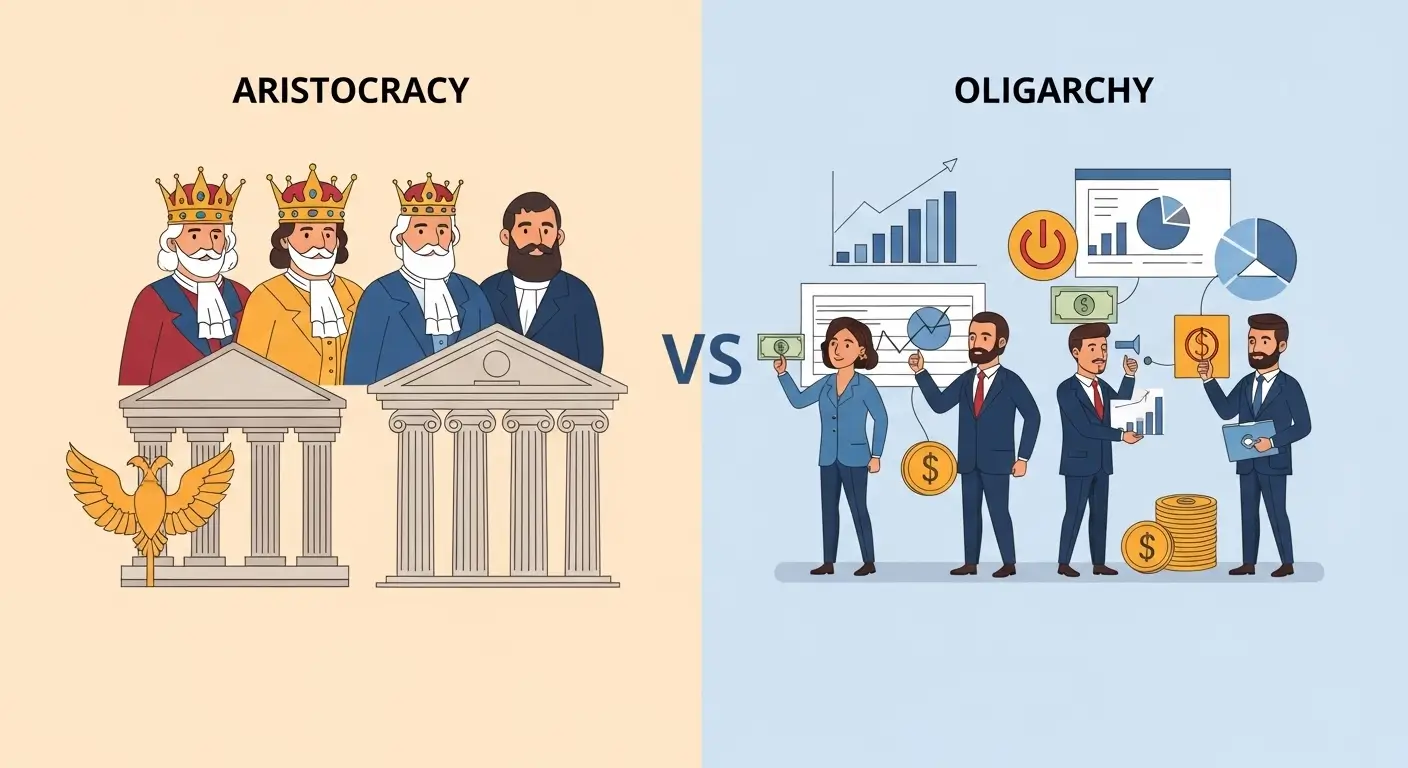
Imagine a town where important decisions are always made by a small group of people. In one situation, the town chooses wise and educated leaders from respected families who are known for their knowledge and leadership. In another situation, a handful of wealthy business owners quietly control the town’s economy and politics because they have the most money and power. Both systems place authority in the hands of a few individuals, yet they work in different ways.
This real-world scenario helps explain the difference between aristocracy and oligarchy. Aristocracy refers to a system where the most noble or qualified individuals govern, while oligarchy refers to a system where power is held by a small group, often based on wealth, influence, or family ties. Understanding the difference between aristocracy and oligarchy is important because these systems shape how power works in societies. When people explore the difference between aristocracy and oligarchy, they gain insight into political structures, leadership models, and social hierarchies that have influenced governments throughout history.
Key Difference Between the Both
The main difference between aristocracy and oligarchy lies in the basis of power.
- Aristocracy is rule by the “best” or most noble individuals who are believed to have superior education, virtue, or heritage.
- Oligarchy is rule by a small group of powerful people who control resources, wealth, or political influence.
While aristocracy emphasizes noble leadership and traditional authority, oligarchy focuses on concentrated power within a limited group.
Why Their Difference Is Important for Learners and Experts
Understanding the difference between aristocracy and oligarchy is important for students, historians, political scientists, and policymakers. These concepts help explain how governments distribute power and how social hierarchies develop in societies.
For learners, studying these systems improves knowledge of political theory and historical governance models. Experts analyze these structures to understand how power influences decision-making, social equality, and economic control. By recognizing the difference between aristocracy and oligarchy, people can better evaluate political systems, identify patterns of elite influence, and understand the balance between leadership quality and concentrated power in modern societies.
Pronunciation
| Word | US Pronunciation | UK Pronunciation |
| Aristocracy | uh-RISS-tok-ruh-see | ar-ih-STOK-ruh-see |
| Oligarchy | OL-uh-gar-kee | OL-ih-gah-kee |
Linking Hook
To fully understand the difference between aristocracy and oligarchy, it is helpful to explore their characteristics, structures, and social effects in detail.
Difference Between Aristocracy and Oligarchy
1. Basis of Power
Aristocracy is based on noble lineage, education, or virtue. Oligarchy is based on wealth, influence, or control of resources.
Examples for aristocracy:
- Noble families governing medieval kingdoms.
- Educated elites chosen for leadership roles.
Examples for oligarchy:
- Wealthy business leaders influencing government policies.
- Small political elites controlling national decisions.
2. Leadership Selection
Aristocratic leaders are usually chosen due to noble birth or merit. Oligarchic leaders gain power through wealth or alliances.
Examples:
Aristocracy
- Noble families inheriting political authority.
- Scholars and philosophers advising rulers.
Oligarchy
- Billionaires funding political campaigns.
- Small corporate groups influencing legislation.
3. Social Structure
Aristocracy creates a hierarchy based on noble status. Oligarchy forms a hierarchy based on economic or political power.
Examples:
Aristocracy
- Nobility ranking above common citizens.
- Titles like duke or lord defining status.
Oligarchy
- Wealthy elites dominating economic sectors.
- Political insiders forming exclusive networks.
4. Historical Presence
Aristocracy existed in many monarchies and ancient societies. Oligarchy appeared in both ancient and modern political systems.
Examples:
Aristocracy
- European noble families ruling regions.
- Traditional elite councils guiding monarchs.
Oligarchy
- Small ruling councils in ancient states.
- Modern systems dominated by wealthy elites.
5. Public Participation
Aristocracy may include limited consultation with society. Oligarchy usually restricts participation to the ruling group.
Examples:
Aristocracy
- Councils advising kings about public issues.
- Noble assemblies discussing policies.
Oligarchy
- Secret meetings among elite leaders.
- Closed decision-making circles.
6. Motivation of Leaders
Aristocrats often claim to rule for honor or duty. Oligarchs usually prioritize maintaining power and wealth.
Examples:
Aristocracy
- Leaders funding education or cultural projects.
- Nobles supporting community traditions.
Oligarchy
- Leaders protecting business monopolies.
- Political elites maintaining economic dominance.
7. Influence on Economy
Aristocracies historically controlled land ownership. Oligarchies often control industries or financial systems.
Examples:
Aristocracy
- Land-owning nobles managing agriculture.
- Estates supporting local economies.
Oligarchy
- Corporate leaders controlling markets.
- Wealthy investors shaping economic policies.
8. Legitimacy of Rule
Aristocracy justifies rule through tradition and heritage. Oligarchy justifies rule through power and control.
Examples:
Aristocracy
- Families claiming authority from ancestors.
- Noble heritage recognized by society.
Oligarchy
- Powerful groups dominating institutions.
- Wealth influencing political legitimacy.
9. Size of Ruling Group
Aristocracy may involve a broader noble class. Oligarchy typically includes a very small number of elites.
Examples:
Aristocracy
- Large noble councils in royal courts.
- Multiple aristocratic families sharing influence.
Oligarchy
- Few individuals controlling political power.
- Small business groups dominating markets.
10. Impact on Society
Aristocracy emphasizes tradition and hierarchy. Oligarchy emphasizes power concentration.
Examples:
Aristocracy
- Cultural heritage shaping social norms.
- Respect for noble traditions.
Oligarchy
- Economic inequality increasing social gaps.
- Elite dominance in politics.
Nature and Behaviour
Aristocracy:
Aristocracy often promotes tradition, honor, and cultural continuity. Aristocratic leaders may present themselves as guardians of heritage and social order.
Oligarchy:
Oligarchy tends to focus on maintaining power and economic influence. Oligarchic leaders may prioritize strategic alliances and control over resources.
Why People Are Confused About Their Use
People confuse these terms because both systems involve rule by a small group rather than the majority. Additionally, in history, aristocratic families sometimes became oligarchic elites by controlling wealth and political influence.
Table: Difference and Similarity
| Feature | Aristocracy | Oligarchy | Similarity |
| Meaning | Rule by the noble or best | Rule by a small powerful group | Both concentrate power |
| Basis of Power | Noble birth or merit | Wealth or influence | Few people govern |
| Social Structure | Nobility hierarchy | Elite power groups | Limited participation |
| Historical Role | Monarchies and noble councils | Economic or political elites | Leadership by minority |
| Impact | Tradition and culture | Economic and political dominance | Influence society |
Which Is Better in What Situation?
Aristocracy:
Aristocracy may function better in societies that value tradition, cultural continuity, and leadership based on education or noble responsibility. In such systems, leaders may be expected to serve the community with honor and long-term responsibility. Historically, aristocracies helped maintain stability in kingdoms and preserved cultural institutions.
Oligarchy:
Oligarchy may appear effective in situations where economic or strategic decisions require coordination among powerful groups. In business-driven societies, influential leaders with resources may make rapid decisions. However, oligarchies often face criticism because concentrated power can reduce fairness and democratic participation.
Metaphors and Similes
Aristocracy in metaphors:
- “The aristocracy of talent.”
- “She belongs to the aristocracy of scholars.”
Oligarchy in metaphors:
- “An oligarchy of corporations controlling the market.”
- “A digital oligarchy dominating social media.”
Connotative Meaning
Aristocracy
- Positive: refined leadership
- Neutral: noble class
- Negative: social privilege
Examples
- Positive: “The university valued an aristocracy of knowledge.”
- Negative: “The old aristocracy resisted social change.”
Oligarchy
- Positive: efficient decision-making (rarely used positively)
- Neutral: small ruling group
- Negative: concentration of power
Examples
- Neutral: “The country was governed by an oligarchy.”
- Negative: “Critics warned about an oligarchy of wealthy elites.”
Idioms or Proverbs (Related Usage)
- “Power tends to concentrate at the top.”
Example: In many industries, leadership becomes an oligarchy where a few companies dominate. - “Blue blood runs deep.”
Example: The aristocracy of the region still valued its historical lineage.
Works in Literature
Aristocracy
- Pride and Prejudice – Romance – Jane Austen – 1813
- War and Peace – Historical novel – Leo Tolstoy – 1869
Oligarchy
- Animal Farm – Political satire – George Orwell – 1945
- The Iron Heel – Dystopian fiction – Jack London – 1908
Movies Related to the Concepts
Aristocracy
- The Favourite – 2018 – United Kingdom
- Downton Abbey – 2019 – United Kingdom
Oligarchy
- Snowpiercer – 2013 – South Korea / USA
- The Hunger Games – 2012 – USA
Frequently Asked Questions
1. What is the main difference between aristocracy and oligarchy?
Aristocracy is rule by noble or highly respected individuals, while oligarchy is rule by a small group with power or wealth.
2. Are aristocracy and oligarchy the same?
No. Both involve minority rule, but their basis of power differs.
3. Can aristocracy turn into oligarchy?
Yes. When noble families gain economic dominance, aristocratic rule may resemble oligarchy.
4. Which system is more common today?
Modern societies sometimes experience oligarchic influence through wealthy elites.
5. Why is understanding their difference important?
It helps people analyze political power and social structures.
How Both Are Useful for Surroundings
These concepts help societies understand how leadership structures work. Recognizing aristocratic and oligarchic tendencies allows citizens, scholars, and policymakers to evaluate governance systems and promote fair distribution of power.
Final Words for the Both
Aristocracy highlights the idea of leadership by the most capable or noble individuals, while oligarchy represents concentrated authority among powerful elites.
Conclusion
The difference between aristocracy and oligarchy lies mainly in the foundation of authority and leadership. Aristocracy traditionally emphasizes noble heritage, education, and responsibility, while oligarchy focuses on power concentrated among a small group with wealth or influence. Both systems have shaped political history and social hierarchies across civilizations.
By studying the difference between aristocracy and oligarchy, learners and experts gain valuable insight into governance models and the role of elite leadership. Understanding these concepts also helps people recognize patterns of power in modern societies and evaluate how leadership structures affect equality, participation, and decision-making.

Jordan L. Carter is a contributing language analyst at WordCompares.com, focusing on modern English usage, evolving vocabulary trends, and digital communication language. With over a decade of writing experience, Jordan provides insightful word comparisons that make complex language differences simple for everyday readers.